

Part 1: The Sound Beneath
“Mr. Caldwell, I don’t think your chair is supposed to do that.”
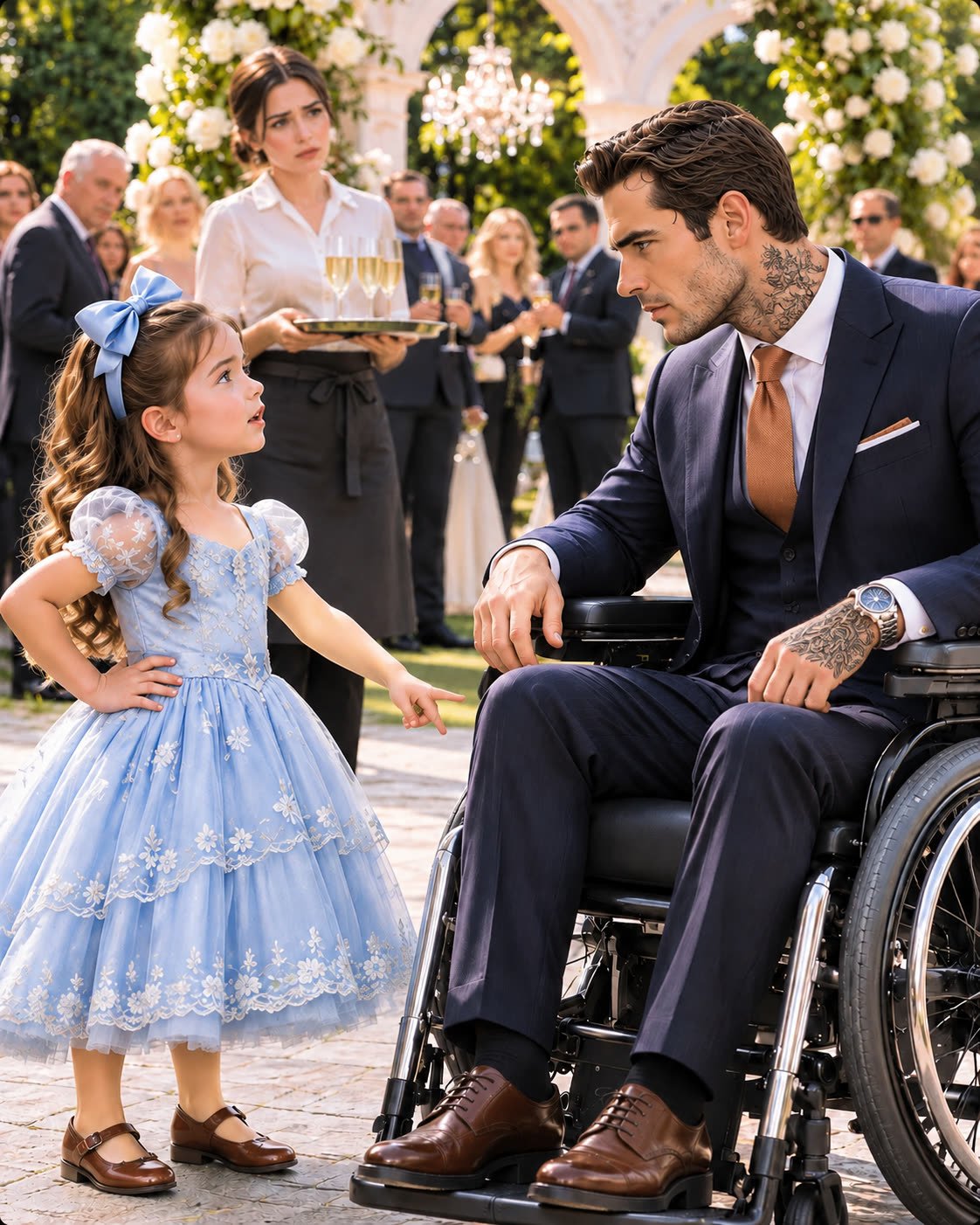
Ethan Caldwell stopped turning toward the photographer. Beside his right wheel stood a girl of about ten, holding a folded paper airplane and studying something beneath his armrest.
“Do what?” he asked.
“Click before your foot moves.”
Around them, the foundation gala continued under white garden arches. A waiter approached with champagne, saw Ethan’s expression, and changed direction.
Ethan had spent four years learning how to end conversations about his body before they began. Usually, one cool look was enough.
“Muscles sometimes move involuntarily,” he said. “That doesn’t mean anything has changed.”
“I know,” the girl said. “Our science teacher explained reflexes when we built a model knee. But I heard the chair first.”
That answer made him look at her properly.
Her chestnut hair was braided, and her green dress had a crooked repair at one pocket. She looked neither frightened of him nor particularly impressed by the cameras, only concerned that he had misunderstood her.
“What’s your name?”
“Lily Mercer. My mom is working here.”
Across the terrace, a woman carrying a silver tray had gone still. Hannah Mercer set the tray on a service table and hurried toward them.
“Lily, the catering room was where we agreed you would stay.”
“The supervisor said I could watch the paper-airplane demonstration.” Lily held up her folded plane. “I was coming back.”
Hannah touched her daughter’s shoulder, then faced Ethan. “I’m sorry for the interruption.”
“Has she been underneath my chair?”
“No,” Lily answered before her mother could. “I haven’t touched it.”
Ethan believed her. He also noticed the two guests who had quietly raised their phones.
“Then let’s not turn this into a performance,” he said.
Daniel Cross appeared at his side almost immediately. After twelve years as Ethan’s chief of staff, Daniel could recognize a problem from the opposite end of a crowded garden.
“Would you like the study?” he asked.
Before Ethan could answer, a guest brushed past the rear wheel. A faint click sounded under the seat, followed by a brief tightening through Ethan’s right thigh.
Lily pointed without moving closer. “That.”
Ethan had felt the sensation hundreds of times. His rehabilitation team had described it as part of the chair’s assisted-stimulation system, something intended to maintain muscle conditioning during long periods of sitting.
He had stopped asking about it years ago.
Now, with a child waiting for him to listen, he wondered why it had happened when nobody had started a therapy session.
“Daniel,” he said, “ask Samuel to join us.”
Dr. Samuel Reeves arrived from beside the fountain, still holding an untouched glass of mineral water. He had been Ethan’s personal physician before the accident and had supervised much of the care afterward.
“Something wrong?” Reeves asked.
“We’re going to find out.”
* * *
Ten minutes later, the study doors were closed and the garden photographer had been firmly redirected elsewhere.
Ethan positioned his chair beside the desk himself. He disliked being pushed without permission, something Daniel knew and the occasional well-meaning stranger never seemed to understand.
Hannah remained near the door. “We can give you our number and leave.”
“You can,” Ethan said. “But first, I’d like Lily to show us what she saw, if you’re comfortable with that.”
Hannah considered him before nodding. “She can point. She isn’t touching medical equipment.”
“Agreed,” Reeves said.
Lily crouched beside the wheel, keeping her hands in her lap. “There’s something under that edge. It moved when the chair clicked.”
Reeves used his phone’s flashlight. Beneath the armrest, behind a lip of black composite, sat a narrow recessed control.
He leaned closer. “Ethan, do you know what this is?”
“I assumed you did.”
The room became quiet.
The chair had been developed by Caldwell Adaptive Technologies, a subsidiary of Ethan’s company. Its pressure management, positioning controls, and portable stimulation equipment had been presented as a coordinated system designed around his needs.
The stimulation reached adhesive electrodes beneath a fitted therapy garment. Ethan knew how to disconnect those leads for bathing and transfers; he had never been told there was another control beneath the armrest.
Reeves did not press it.
“I want the device technician here,” he said. “And I want you transferred before anybody opens the housing.”
“You think it’s unsafe?”
“I think there’s a control I cannot identify, and guessing would be irresponsible.”
Ethan watched the physician call the manor’s medical suite. It was the correct answer, but it frightened him more than an easy reassurance would have.
While they waited, Lily stood and smoothed her skirt. “My mom fixes old appliances sometimes. She says a sound changing is worth checking before something breaks.”
“Your mother is right,” Ethan said.
Hannah’s shoulders loosened slightly.
A transfer team arrived with a standard wheelchair. They explained each step, waited for Ethan’s agreement, and disconnected the stimulation leads before helping him move.
In the unfamiliar chair, Ethan felt awkwardly exposed. Then he realized the low, persistent pulling sensation in his thighs had stopped.
He did not announce it. Not yet.
Daniel photographed the hidden control without touching it and contacted an independent biomedical engineer rather than the subsidiary that had built the chair.
“Why independent?” Reeves asked.
“Because we need an answer nobody here can edit,” Daniel said.
It was an unusually blunt remark from him. Ethan was grateful for it.
* * *
That evening, after the gala guests had left, Hannah and Lily waited in the kitchen while Daniel arranged their ride home.
Hannah had declined an envelope of cash from the household manager. She accepted payment for the extra hours she had remained after her catering shift, with a receipt and no argument.
Ethan joined them carrying a plate of sandwiches on his lap.
“I didn’t know whether you’d eaten,” he said.
“We have,” Hannah answered, just as Lily reached for a sandwich.
Lily paused. “I could eat again.”
For the first time that afternoon, Ethan smiled.
He asked about the paper airplane. Lily explained that its folded nose kept pulling left, and Hannah reminded her that copying a successful design was not cheating if she understood why it worked.
Ethan found himself listening. Nobody mentioned his company’s valuation or told him how inspiring he was for attending his own fundraiser.
When Daniel returned, he carried a tablet instead of car keys.
“The engineer has identified the control,” he said. “It appears to be a manual stimulation cutoff, but the visible switch cover doesn’t match the archived drawings.”
“Meaning?” Ethan asked.
“In the drawings, it’s red and within easy reach.”
Reeves entered behind him. “We’ve also found conflicting controller specifications. We need a proper audit before drawing conclusions.”
“Who designed the original system?”
“Marcus Vale,” Daniel said. “He left shortly after your accident.”
Ethan recognized the name without finding a face to accompany it. His memory of the months surrounding the crash had always been uneven.
“Find him.”
Daniel hesitated. “There’s something you should see first.”
He placed the tablet on the table. The archived personnel order said Marcus Vale had been terminated for unauthorized development work.
At the bottom sat Ethan’s executive authorization.
“I don’t remember approving that.”
“Look at the timestamp,” Daniel said.
October 16, 8:42 p.m.
Ethan’s hand stopped beside his plate.
He knew that date better than his birthday. By 8:42 p.m. on October 16, four years earlier, he had already been unconscious in an emergency department for nearly three hours.
Someone had fired Marcus Vale using Ethan’s name while Ethan lay unable to give an order.
Part 2: The Missing Engineer
The next morning, Ethan asked Daniel to preserve the records before anyone at the company learned why they mattered.
“No accusations,” he said. “No requests that explain what we found. Just preserve everything.”
Daniel contacted outside counsel and arranged a secure copy of the personnel archive. The wheelchair remained disconnected in a locked room, with its condition photographed and each person entering recorded.
For a man accustomed to demanding immediate answers, Ethan found the deliberate pace almost unbearable. He understood why it mattered anyway.
Hannah called at 9 a.m. to ask whether Lily’s school would still receive the science donation he had mentioned at the gala.
Ethan frowned. “Did I mention one?”
“To the demonstration organizer, before all this happened. Lily’s worried they’ll lose it because she interrupted you.”
He looked at the untouched coffee beside him. There had been a fundraiser before there had been a mystery.
“Tell her the donation isn’t conditional on anyone being quiet.”
After a pause, Hannah said, “That’s a useful thing for her to hear.”
He asked whether they would return so the engineer could clarify Lily’s observations. Hannah agreed to one hour, provided Lily could stop whenever she wanted.
“She noticed a noise,” Hannah said. “She didn’t volunteer to become an investigator.”
“I understand.”
Ethan realized, after hanging up, that understanding and behaving accordingly would be two different tests.
The independent engineer arrived with a written examination plan. The hidden control was an emergency cutoff whose red paddle had been replaced with a smaller black cover.
That alteration alone did not prove sabotage. It did mean the chair no longer matched the patient-facing safety drawing.
More troubling were the stored settings. Stimulation had been permitted outside scheduled sessions, with a response pattern the engineer could not reconcile with the approved clinical summary.
“Can it stop someone walking?” Ethan asked.
“Not in the simple way that question suggests,” the engineer said. “It can activate muscles at the wrong time, create discomfort, and work against an attempted movement while connected.”
“And over four years?”
“That is a medical question. But unreliable feedback can certainly make therapy harder.”
Reeves stood beside the window. “We need a fresh neurological assessment, away from the system.”
Ethan met his eyes. “With doctors who don’t report to you.”
The words hurt. Reeves did not pretend otherwise.
“Yes,” he said. “That would be appropriate.”
* * *
Two days later, Ethan arrived at an independent rehabilitation clinic with Daniel and Reeves.
Hannah and Lily came only for the engineer’s follow-up interview in a separate consultation room. Afterward, they were free to leave; when Lily asked to wait, Hannah chose a table near the cafeteria where she could finish a summer reading assignment.
Inside the assessment room, physical therapist Nora Singh moved a stool beside Ethan.
“Before we start,” she said, “what would make today useful to you?”
“An honest answer.”
“I can promise honest observations. Answers may take longer.”
He almost dismissed the distinction. Then he thought of the black switch and said, “All right.”
The examination was tiring and, at times, humiliating in ways Nora seemed to anticipate without making a spectacle of them. She asked permission before repositioning him and explained why a movement mattered.
When he tried lifting his right foot, very little happened.
Ethan stared at it. “There’s your answer.”
“That’s one attempt,” Nora said. “Not an answer.”
Sensors recorded voluntary muscle activation that was weak but repeatable. Other tests suggested the original spinal injury was incomplete, consistent with some old reports but less definite than the language used in later summaries.
A neurologist showed Ethan two passages side by side. One described uncertain recovery potential; the other, written months afterward, treated his limitations as settled.
“What changed between them?” Ethan asked.
“We haven’t found enough evidence to justify the change,” the neurologist said.
It was not a promise that he would walk. They were careful about that, and he was grateful even while part of him wanted someone to promise anyway.
Nora explained how injury, weakness, pain, interrupted practice, and inappropriate stimulation could overlap. Removing one obstacle did not erase the others.
“You may gain useful movement,” she said. “You may still need a wheelchair. Both things can be true.”
Ethan looked away until he could trust his voice.
“Then we work with what’s true.”
Outside the clinic, Lily waited with a paper cup of water she had insisted on carrying herself.
“Did they find out?” she asked.
“They found out they need to find out more.”
She considered that. “That sounds annoying.”
“It is.”
She handed him the water without offering a speech about courage.
* * *
That afternoon, Daniel located a post-office box in Millbrook, Pennsylvania, associated with Marcus Vale’s engineering license.
The license was inactive, not revoked. There were no recent patents, conference appearances, or professional photographs, and the telephone number in the old employee file belonged to somebody else.
Daniel sent a brief letter through a local courier, providing his direct number and asking Marcus to contact Ethan about Project Atlas.
Ethan insisted on going to Millbrook the following day. Counsel advised taking copies rather than original records, and the independent engineer retained the chair.
Hannah initially declined his invitation to join them.
“Lily has already told you everything she knows,” she said.
“I’m not asking her to solve anything. I’d like company that isn’t paid to agree with me.”
“I wouldn’t be very good at that.”
“I’ve noticed.”
Hannah ultimately agreed to a short visit because her sister lived near Millbrook and could collect Lily if the trip became complicated. Ethan covered transportation and her lost shift, with the same written arrangement she had requested before.
On the drive, Lily explained that she wanted to build useful things but had not decided whether bridges were more interesting than prosthetic hands.
“You don’t have to choose at ten,” Ethan said.
“Adults keep asking.”
“Then tell them you’re still collecting evidence.”
From the front seat, Daniel made a small, approving sound.
By evening, they had heard nothing from Marcus. Ethan checked into an accessible hotel and spent an hour reviewing the same termination order without learning anything new.
Hannah found him in the lobby.
“Does reading it again help?” she asked.
“No.”
“Then perhaps stop for tonight.”
He closed the tablet. It was easier to accept the suggestion from someone who did not wrap it in concern about his stamina.
At 11:17 p.m., Daniel knocked on his door.
“He called.”
Marcus’s voice over the speaker was cautious and rough with disuse. “Is Ethan alone?”
“Daniel is here,” Ethan said. “My physician can join if we need him.”
“Not yet.”
Ethan sat straighter. “You know about the chair.”
“I know what we designed. I don’t know what they built after they shut me out.”
“There’s an emergency switch hidden under the armrest.”
A long silence followed.
“It wasn’t hidden in my design,” Marcus said. “You insisted on that yourself.”
Ethan looked at Daniel.
“When?”
“Before your accident. Atlas began as a supervised rehabilitation interface. You came to the lab when the safety review went wrong.”
Fragments surfaced: a conference room, a red indicator, someone speaking too quickly. Ethan could not tell whether they were memories or pictures assembled from Marcus’s words.
“I don’t remember that.”
“Then bring someone you trust tomorrow. I have the drawings and the correspondence.”
Marcus gave an address nine miles outside town.
Before ending the call, he added, “And Ethan? Don’t let anybody tell you the chair was your idea without showing you exactly what you approved.”
* * *
The following morning, Marcus welcomed them into a farmhouse workshop crowded with instruments and labeled storage boxes.
Hannah took Lily to her sister after a brief introduction. Before leaving, Lily asked Marcus whether engineers always kept broken things.
“Only the ones we think we might understand eventually,” he said.
“That’s what Mom says about our toaster.”
When the car had gone, Marcus laid the original safety drawing on his workbench. A red cutoff paddle sat prominently beside the user’s hand.
“I kept copies because the dismissal letter accused me of ignoring safety,” he said. “I wanted the record to survive even if my career didn’t.”
He opened an archived folder containing later files that had reached him through an internal document distribution list before his access was fully revoked.
Daniel checked a software revision’s metadata, then stopped typing.
“What is it?” Ethan asked.
Daniel turned the screen.
The file was dated three weeks after the accident, and its listed author was Dr. Samuel Reeves.
Part 3: Versions of the Truth
For several seconds, Ethan could hear only the workshop computer’s fan.
Samuel Reeves had told him difficult truths for years. He had also been present at birthdays, answered calls before dawn, and once stayed beside Ethan’s hospital bed long after his shift had ended.
None of that changed the name on the screen.
“Open it,” Ethan said.
Marcus did, then compared it with the earlier controller logic. He worked slowly enough that Ethan began gripping the edges of his seat.
“Tell me something.”
“I’d rather tell you something accurate.”
Daniel glanced at Ethan, and Ethan loosened his hands.
Revision 7 contained altered thresholds, revised limits, and comments attributed to Reeves’s clinical account. Some changes appeared protective; others, Marcus said, could make the system respond to the wrong signals.
“Could Samuel have intended to correct a problem?” Daniel asked.
“Yes.” Marcus kept looking at the screen. “The author field isn’t a confession.”
Ethan had wanted certainty badly enough that hearing caution felt almost like obstruction. He recognized the impulse and disliked it.
They called Reeves.
The physician listened without interrupting until Marcus mentioned reversed response thresholds.
“That was not the production build,” Reeves said. “And I did not write executable code. I supplied clinical annotations through a shared project account.”
“Your name is on it,” Ethan said.
“Then my account was used beyond what I understood. That is not a defense of my oversight.”
Marcus leaned toward the phone. “What version went into the chair?”
“Revision 11, according to the certification packet.”
“Do you have it?”
“I have the packet. The source repository was controlled by the research division.”
Ethan closed his eyes.
A physician had trusted a certification. An engineer had trusted a distribution list. He had trusted the physician and the company whose name appeared on the chair.
There were people everywhere in the chain, yet nobody seemed to have held the whole thing.
“Who asked you to adapt Atlas after my accident?” he asked.
“Adrian Locke. He wanted to know whether any part of the suspended project could support rehabilitation.”
Adrian had run Caldwell Dynamics while Ethan recovered. Ethan remembered his deputy at the hospital with a stack of contracts and a promise that the company would survive.
“Did you ask Marcus?”
Reeves looked down on the video screen. “I requested his documentation.”
“And asked him not to contact me,” Ethan said.
“For the first days, yes. You were medically unstable.”
“He stayed shut out for four years.”
“I know.”
It was the first answer Reeves gave without qualification.
* * *
That afternoon, outside investigators collected the wheelchair controller from the manor and delivered a forensic copy of its contents to Marcus.
The original remained sealed with the independent laboratory. Marcus could examine the copied data without risking the only record of what the device had done.
The installed software identified itself as Revision 14.
There was no Revision 14 in the certification packet Reeves supplied.
“Could that label be meaningless?” Daniel asked.
“Certainly,” Marcus said. “So we compare behavior, not labels.”
They traced commands through the copied program and matched them against recorded stimulation events. Marcus made notes; the laboratory’s engineer joined by video and independently checked his interpretation.
By early evening, they agreed on a narrow but serious finding. An adaptive mode could deliver resistance-producing stimulation when it detected attempted voluntary movement, and its use had extended well beyond supervised therapy.
Ethan stared at the event graph. “Every time I tried?”
“Not every time,” the laboratory engineer said. “We won’t make that claim. But often enough to require an explanation.”
The program had originally framed resistance as a training tool. In its installed form, limits had expanded, review prompts had disappeared, and the emergency cutoff had become difficult for the user to locate.
There was no single line of code saying to keep Ethan dependent. There were settings, permissions, and years of records showing that a research function had quietly become part of his daily life.
That distinction did not make him feel safer.
He remembered private attempts in his office: a tightening thigh, a foot that would not lift, the exhaustion of doing the same thing again the next morning.
Eventually, he had stopped attempting movements unless a therapist asked.
“I thought I was learning my limits,” he said.
Nobody rushed to answer.
Marcus finally turned his chair away from the computer. “Some limits came from the injury. Some may have come from the equipment and the care around it. We need to separate them.”
Ethan nodded, though his throat felt too tight to speak.
* * *
The following morning, Hannah returned from her sister’s house with Lily and breakfast they had bought at a bakery.
She saw the untouched food on the workshop table and handed Ethan a paper bag.
“Evidence apparently runs on coffee,” she said. “People don’t.”
He ate because arguing would require more energy than obeying.
Lily stayed at a side bench with permission, sorting loose washers into a tray Marcus gave her. When she grew bored, she studied the photographs pinned above the bench.
“Mr. Caldwell, you said you didn’t really know Mr. Vale.”
Ethan looked up.
She pointed to a photograph showing him and Marcus beside a laboratory prototype. Ethan had an arm thrown around the engineer’s shoulders, and both men were laughing.
“You look like you knew him.”
Marcus took down the photograph.
“The first successful demonstration,” he said. “Six weeks before the crash.”
Ethan studied his own face. “How often was I there?”
“Most Thursdays. Sometimes twice a week.”
Daniel set down his pen.
Ethan had accepted gaps around the accident because everyone had told him that memory loss after trauma could be uneven. But this was nearly a year of regular visits reduced to a name he barely recognized.
“Did I seem forgetful before the crash?”
Marcus hesitated long enough to answer.
“Tell me.”
“Three days before it, you came into the lab and asked who I was.”
Hannah quietly took Lily outside to test her paper airplane. The door closed behind them.
Marcus retrieved a notebook. The entry described Ethan arriving confused, recognizing the equipment but not the engineer, then becoming embarrassed and leaving with his driver.
“You returned the next day and apologized,” Marcus said. “You told me there had been two other episodes.”
“Why wasn’t this in the records I saw?” Ethan asked.
Daniel answered carefully. “We’ve only seen the records people selected for you. We need the originals from every provider.”
Reeves, contacted again, did not deny the episodes.
He described severe sleep deprivation, prescribed medication changes, and Ethan’s participation in an experimental neural-feedback demonstration. None, he emphasized, had been proven to explain the memory problems.
“Did you tell the neurologists after the accident?” Ethan asked.
“In a consultation note.”
“And did anybody tell me?”
Reeves had no answer that satisfied either of them.
Ethan asked for an independent neurologist to review the history. He refused to turn uncertainty into a dramatic diagnosis merely because an explanation would be comforting.
Still, the missing year had become something other than empty space. Other people had lived through it with him, and some had chosen what he was allowed to know.
* * *
That evening, Daniel found remote-maintenance entries buried in the chair’s activity records.
Most were routine status checks. Others changed adaptive settings or downloaded detailed movement data.
The connections came through an internal identifier: Node 17.
“Could somebody operate it from anywhere?” Ethan asked.
“Not without network access,” Daniel said. “We’re tracing the gateway.”
The first answer came from an archived company diagram. Node 17 belonged to a clinical monitoring installation maintained by Caldwell Medical Research, a division dissolved three years earlier.
The second answer arrived from the manor’s network inventory.
Daniel compared the two screens, then checked them again.
“What?” Ethan asked.
“The monitoring installation wasn’t at the company.”
Ethan remembered the recovery suite built in the east wing of his house. Its parallel bars had become a place he avoided, and its server cabinet had become part of the background.
“It’s at home,” he said.
Daniel nodded.
A final log entry showed a local maintenance session initiated less than forty-eight hours earlier. By then, the chair had been disconnected and secured.
Someone had tried to reach the system anyway.
“Who logged in?” Ethan asked.
“The account name is generic,” Daniel said. “But the session originated inside the manor.”
Ethan looked toward the workshop window, suddenly thinking of all the people he had trusted to move through his house without asking.
While he had been searching for answers miles away, someone at home had been checking whether his chair was still listening.
Part 4: The Unlocked Corridor
The following morning, Ethan returned to Caldwell Manor with Daniel, Marcus, and an outside digital-investigation team.
Hannah and Lily stayed with Hannah’s sister. Before leaving Millbrook, Ethan called to tell them there was no reason to come back until they wanted to.
“Thank you,” Hannah said. “She’s been pretending not to worry.”
“So have I.”
It was more honest than he had intended to be.
At the manor, he asked the household manager to gather staff in the dining room.
“Nobody is being accused because they had access to a hallway,” he told them. “We’ve found irregularities in medical equipment, and investigators will ask about maintenance visits.”
He watched several frightened faces relax.
Four years earlier, he might have demanded answers until someone supplied one. He was beginning to understand how easily people with less power could mistake his urgency for an instruction to say whatever ended the meeting.
The recovery suite smelled faintly of disinfectant. A therapist’s old instruction sheet still hung beside the parallel bars.
Ethan looked at the bars without allowing himself to look away.
Marcus examined the server cabinet while the investigators photographed connections. Daniel compared access records with maintenance invoices.
The suite’s electronic door log showed no entry during the recent local session.
“Then either the timestamp is wrong or there’s another way in,” one investigator said.
Ethan pointed toward a narrow panel beside the cabinets. He remembered a maintenance worker using it during the room’s construction.
Behind it ran a utility corridor leading to the old staff hallway. The passage was ordinary, dusty, and entirely absent from the medical-wing access reports.
Nobody had needed to defeat a lock. They had needed to know which door was not being counted.
The investigators found that the server’s most recent session had been initiated from a maintenance terminal in that corridor.
A scheduled technical contractor had been in the building that morning, using a work order generated through an old research-services account. Investigators secured his details for interview rather than confronting him through household staff.
“So he did it?” Ethan asked.
“He performed a visit,” the investigator said. “We don’t yet know what he understood about it.”
Ethan heard his own impatience reflected back at him and let the question go.
* * *
That afternoon, Adrian Locke arrived at the manor carrying a folder of executive-continuity records.
He stopped when he saw Marcus in the library.
“I tried to find you after the division closed,” Adrian said.
Marcus did not stand. “My licensing address worked.”
Adrian accepted that without an argument.
Ethan placed the termination order on the table. “I was unconscious.”
“I know that now,” Adrian said.
“Did you know it when you accepted this?”
Adrian opened his folder. The executive-continuity system had allowed certain decisions to be routed under Ethan’s standing authority during incapacity, but termination of a safety lead required an additional independent approval.
That approval was missing.
“Samuel told me you had ordered Atlas shut down before the crash,” Adrian said. “I treated the personnel order as carrying out that decision.”
“Did you verify it?”
“No.”
Reeves joined by video with his attorney present. Ethan had insisted everyone could bring counsel; he did not want admissions manufactured by fear or confusion.
When shown the authorization trail, Reeves took off his glasses.
“I requested the termination,” he said. “And I submitted it through the continuity process using Ethan’s approval field.”
The admission settled heavily over the room.
“Why?” Ethan asked.
“You had demanded suspension of the project. Marcus wanted access to investigate and preserve the work. I believed an immediate separation would prevent further use.”
“You could have suspended access,” Daniel said.
“Yes.”
“Instead, you made it look like I fired him,” Ethan said.
“Yes.”
Reeves did not claim that good intentions had made it lawful. His attorney interrupted once to clarify that the underlying records still needed verification, and Reeves agreed.
Adrian stared at the table. “You told me the authorization had been completed before the accident.”
“I know what I told you,” Reeves said.
Marcus’s expression barely changed. “And when I sent safety concerns afterward?”
Reeves looked older when he answered. “I treated them as part of a dispute I believed I had already settled.”
For the first time, Ethan understood that the story might not have a single brilliant villain. It might contain people who made one indefensible decision, then spent years protecting it with smaller ones.
That did not make the consequences smaller.
“You’re no longer directing my care,” he told Reeves.
“I understand.”
“The independent team gets everything. Not summaries. Not what you think is relevant.”
Reeves put his glasses back on. “They will.”
* * *
Two days later, the server examination produced an archived rehabilitation folder that had never entered Ethan’s patient portal.
A video inside it showed him seated in his custom chair three years earlier. Beside him stood Dr. Evelyn Shaw, a rehabilitation specialist he dimly remembered.
On-screen, Ethan looked angry and exhausted.
“You changed it again,” his recorded voice said.
Shaw checked a tablet. “The resistance mode is still active outside the supervised window. I’ve asked for it to be disabled.”
“Then disable it.”
“I can disconnect the stimulation now. I can’t rewrite the controller.”
She explained what she was doing and waited for his agreement before disconnecting the leads.
A minute later, recorded Ethan tried lifting his right foot. The movement was small but visible.
Current Ethan leaned toward the screen.
In the recording, he moved it again.
“Why didn’t anyone tell me I could do that?” his younger self asked.
Shaw crouched beside him. “We need to test it properly. This is useful, but it isn’t the same as standing.”
The video ended with her recommending a period of assessment without the custom stimulation system.
Ethan sat very still.
He had no memory of that appointment.
The next morning’s medical note documented a severe migraine, medication-related sedation, and his inability to recall part of the previous day. It recommended neurological review rather than declaring a cause.
A separate administrative form canceled the follow-up session at an outside rehabilitation center.
“Why was it canceled?” he asked.
Daniel enlarged the document. “It says authorization declined.”
“By whom?”
The field named an external administrative contractor, not Ethan’s executive office or his physician.
Ethan asked the investigators to locate Shaw. He did not assume her departure meant guilt, and he did not assume the video made her blameless.
He wanted her account before someone else supplied it for her.
* * *
That evening, Shaw answered a call from her current hospital.
She remembered Ethan immediately. After raising repeated concerns, she had withdrawn from his team and sent a written handover to the program’s clinical office.
She supplied the correspondence she had retained. It showed arguments over research access, unexplained cancellations, and her request for an external review.
“Why didn’t you contact me directly?” Ethan asked.
“I tried through the contact listed in your care plan,” she said. “Then I received a signed instruction restricting communication to the program office.”
Another signature appeared on-screen.
Ethan did not recognize it as his own handwriting.
He asked for a copy and thanked her, though gratitude felt strangely inadequate beside what the records suggested.
Later, Hannah called to ask whether he had eaten anything that did not arrive in a paper cup.
He told her about the canceled appointment, omitting private details but mentioning the contractor’s name.
The silence on the line changed.
“Hannah?”
“Can you say that company name again?”
He did.
She drew a breath.
“I worked for them,” she said. “Before the catering jobs.”
Ethan looked at the cancellation form on his desk.
“Were you ever assigned to this house?”
For a moment, he thought the call had dropped.
Then Hannah said, “Yes. And I think you need to show me exactly what I filed.”
Part 5: What the Records Kept
The next morning, Hannah arrived alone.
Lily was spending the day with her aunt. Hannah had explained that grown-ups needed to finish some difficult work, and Lily had asked only whether noticing the click had made things worse.
“I told her no,” Hannah said as Daniel showed her into the library. “Please make sure I haven’t lied.”
“You haven’t,” Ethan said.
He wanted to ask why she had not mentioned working at the manor. Instead, he offered her a seat and asked whether she wanted an independent lawyer present.
She stared at him. “Do you think I did something?”
“I think a document has your name on it. That isn’t the same thing.”
Hannah accepted the offer. They postponed the interview until the attorney could join by video.
While they waited, she explained that the contractor had sent temporary staff to medical offices, private homes, and insurance-processing centers. Most assignments lasted days.
“I handled forms,” she said. “I wasn’t part of anyone’s care team.”
“Did you know whose house this was?”
“Eventually. I never met you. We used a side entrance, worked in a records room, and were told not to enter the residential wing.”
She had not connected that short assignment with Lily’s discovery because she had never seen the chair or the recovery suite. The gala had been held in a garden she had never entered before.
Ethan believed the explanation, but belief was no longer enough for either of them. Daniel began checking the contractor’s surviving schedules.
When the attorney joined, Hannah examined the cancellation form carefully.
“That’s my login,” she said. “Those are my initials beside ‘entered.’ But I didn’t decide anything.”
Nobody suggested that she had.
She described a stack of appointment changes delivered by a woman who introduced herself as an insurance-review clinician. Hannah had been instructed to transcribe the decisions into the scheduling system.
“Did she sign them?” Daniel asked.
“Some had stamps. Some had handwritten notes. I asked about one because the patient had already been approved.”
“What happened?”
Hannah clasped her hands, then deliberately released them. “She said the review had changed and my job was to enter the result, not interpret it.”
Ethan felt a familiar anger, directed this time at a sentence he could imagine having used himself in a different context.
“Do you remember which appointment?”
“An outside rehabilitation center. There were transport arrangements attached.”
The investigators asked her to describe the woman before showing photographs. Hannah remembered silver glasses, a narrow scar near one eyebrow, and a habit of removing her watch while reviewing paperwork.
She could not remember the woman’s name.
“Don’t try to force it,” the investigator said. “What you know is useful. What you aren’t sure about matters too.”
Hannah nodded, visibly relieved that uncertainty was permitted.
* * *
Over the following ten days, the investigation became less dramatic and more consequential.
The independent laboratory confirmed that Ethan’s chair had been operated under an undocumented adaptive protocol. The research function had remained active after the division responsible for it closed, sustained by automated work orders and a service account nobody had formally retired.
The recent maintenance visitor had followed one of those work orders. His terminal session had attempted a routine synchronization with a chair that was no longer connected.
It was not proof that someone in the house had been watching Ethan’s every move. It was proof that an abandoned research system had continued receiving access it should never have retained.
That distinction mattered.
Other records were less ambiguous. Safety alerts had been downgraded, outside appointments had been canceled, and several patient-facing summaries omitted observed movement that appeared in the raw therapy notes.
Investigators could document what happened before they could establish everyone responsible for making it happen.
The active protocol carried a legacy authorization identifier rather than a clinician’s full name. Tracing it required restoring personnel records from a damaged archive.
Ethan agreed to wait for verification.
He had already acted where certainty was sufficient. The custom chair was withdrawn, the monitoring server disconnected, and all former research participants offered an independent equipment review at company expense.
Reeves reported his own conduct to the appropriate medical authority through counsel. Ethan’s lawyers referred the falsified authorization and disputed signatures for formal investigation.
Adrian stepped away from overseeing the review and supplied his communications without conditions. Whether he had been deceived, negligent, or both was no longer his decision to make.
Marcus received a formal correction to his employment record and an offer of independent consulting work. He accepted the correction immediately and said he would think about the work.
“I’m not coming back to make everyone feel better,” he told Ethan.
“That isn’t why I’m asking.”
“Good. Then you won’t mind waiting.”
Ethan found that he did not.
Hannah’s records matched her account. She had entered decisions supplied by others and had no access to the clinical system beyond the administrative queue.
When Ethan told her, she shut her eyes for a moment.
“I keep thinking I should have asked more questions.”
“You did ask,” he said. “Someone used their authority to stop the conversation.”
He could not undo what her initials had made her fear. He could at least refuse to let the people who designed the process place its responsibility on the person paid to type.
* * *
Three weeks after the gala, Ethan returned to Nora’s clinic in a standard wheelchair chosen with an independent seating specialist.
It fitted him better than the temporary chair and did not collect research data. Its instruction booklet was short enough that he had actually read all of it.
Nora asked what he wanted from the session.
“To know what happens when I try without something arguing back.”
They worked on a supported movement with his leg positioned to reduce the effect of gravity. It was not an impressive sight, and nobody filmed it.
On the fourth attempt, he moved his right foot several inches.
Nora checked the position, rested him, and asked him to repeat it. He did, less far the second time.
Ethan laughed once, then pressed the heel of his hand against his eyes.
“Do we count that?” he asked.
“We count exactly that,” she said. “A voluntary movement you repeated today.”
No prediction followed. No claim that he would abandon his chair by Christmas, no suggestion that he had failed by needing it before.
For once, the size of the achievement did not shrink when described honestly.
Afterward, he called Hannah.
Lily answered with permission and immediately asked whether he had learned anything.
“A few inches,” he said.
She was quiet for a moment. “That sounds like something you can measure.”
“It is.”
“Then write it down.”
He did.
That evening, he also wrote down what he remembered about Atlas without prompting from anyone else. The independent neurologist had explained that recollection could be altered by suggestion, and he wanted his own uncertain fragments preserved as uncertain.
Some gaps might never close. The original crash investigation contained no evidence that the accident had been arranged, and he would not invent a conspiracy to fill the space where memory should have been.
What had happened afterward was serious enough.
* * *
Two days later, Lily and Hannah came to the manor for lunch.
This time, Hannah entered through the front door because she had been invited, not because Ethan believed one entrance conferred more dignity than another. Lily brought a notebook containing a redesigned paper airplane and a carefully labeled drawing of a visible emergency switch.
“Mr. Vale said labels should make sense to the person using the thing,” she explained.
“He’s right.”
Ethan showed her the clinic’s movement chart when she asked, then put it away when she started talking about bridges. He was learning that gratitude did not entitle him to make a child responsible for his recovery.
The foundation had funded her school’s science program along with several others. There had been no public ceremony featuring Lily, at Hannah’s request and Ethan’s agreement.
During lunch, Daniel appeared in the doorway.
Ethan knew his expression.
Hannah noticed it too. “Is it about the woman?”
“We’ve restored part of the personnel archive,” Daniel said. “We need to ask you one more identification question.”
Lily went with the household manager to test her airplane outside, by prior agreement with Hannah. Ethan waited until she was gone before Daniel laid a set of photographs on the table.
Hannah studied them without speaking.
Then she touched one.
“Her. I’m sure.”
Adrian, who had arrived to deliver records, stopped behind Daniel’s chair. “That’s Claire Voss.”
Marcus looked up sharply from the far end of the table.
Adrian explained that Voss had consulted on behavioral adherence and patient feedback during Atlas’s early development. Her research identifier matched the legacy authorization attached to the chair’s adaptive protocol.
It was the first time a verified name had connected the pre-accident project, the later administrative cancellations, and the software that had continued running.
Ethan looked at Hannah. “The woman who gave you the forms?”
“Yes.”
Daniel checked the restored contractor schedule. Hannah’s assignment had occurred fourteen months after Ethan’s accident.
Marcus pushed back from the table.
“That can’t be right.”
“We’ve checked her employment dates,” Daniel said.
“Then check the photograph.”
Hannah did not withdraw her hand. “That is the woman I met.”
Outside, Lily’s paper airplane skimmed past the window and disappeared toward the lawn. For a moment, Ethan heard her laugh through the open terrace door.
He turned back to Marcus.
“What aren’t you telling us?”
Marcus looked at the photograph as though it had changed while they were speaking.
“I knew Claire,” he said. “I attended the memorial.”
Daniel slowly closed the folder.
“What memorial?” Ethan asked.
Marcus met his eyes.
“Claire Voss died four years ago.”
Ethan looked from the photograph to the date beside Hannah’s assignment.
“How long before my accident?”
Marcus shook his head.
“Not before,” he said. “Two weeks after.”
When authority and evidence conflict, what would help you find the courage to ask one more question?
Disclaimer: This story is a work of fiction inspired by real-life themes. Names, characters, places and events are fictionalized, and any resemblance to real persons is purely coincidental. It does not represent any person or organization and does not encourage inappropriate behavior. Images are for illustration purposes only.


