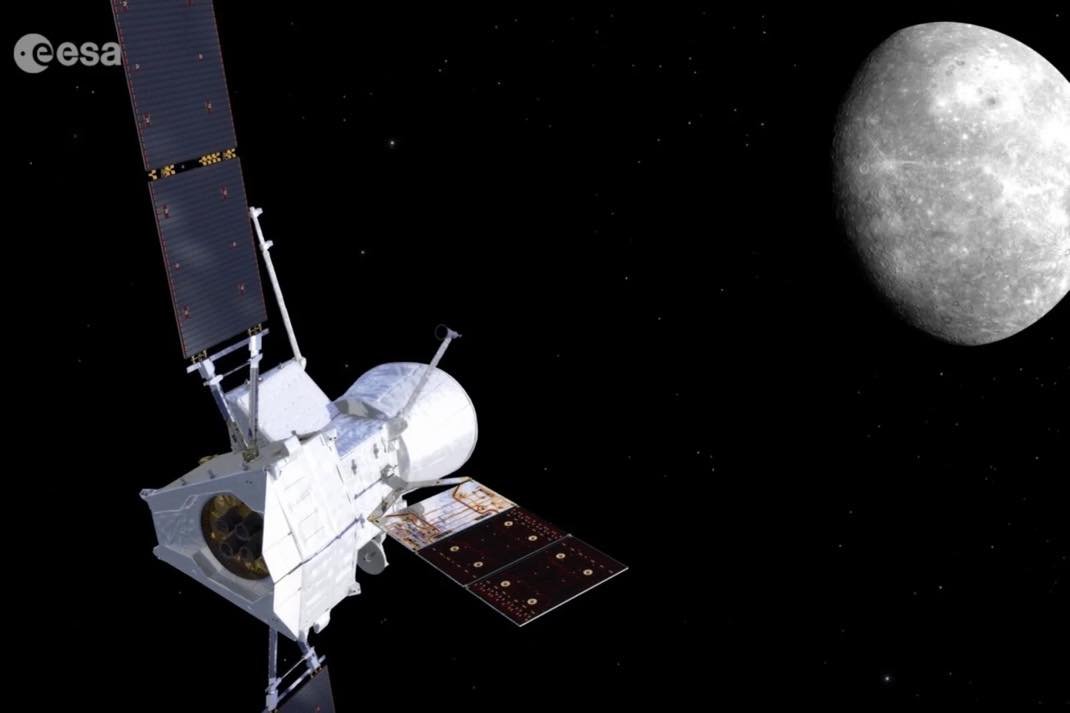
After eight years of interplanetary navigation, the Euro-Japanese mission BepiColombo reached a historic milestone. On November 21, 2026, the two probes successfully entered orbit around Mercury. But this long-awaited arrival was interrupted by a software anomaly that prematurely interrupted the ignition of the thrusters.
A delicate maneuver interrupted by a computer problem
Launched in October 2018, BepiColombo was expected to slow down enough to be captured by Mercury’s gravity. Its four thrusters were activated 635 kilometers from the surface, for an initially planned maneuver of 37 minutes.

However, a failure in the control software interrupted the thrust, limited to 77% of the planned speed variation. The probe then automatically entered safety mode.
After several hours of analysis, engineers from the European Space Agency (ESA) finally confirmed the success of the operation. “We confirm capture in orbit around Mercury! »announced Frank Budnik, chief of flight dynamics.
The machine now operates in a stable orbit for 75 hours, compared to the 58 hours initially planned.
Two scientific probes will soon separate around Mercury
BepiColombo includes two orbiters: the European Mercury Planetary Orbiter (MPO) and Mio, developed by the Japanese agency JAXA. Their separation is still scheduled for December 9 and 10, thanks to an adaptation of the trajectory.
MPO is expected to reach its final orbit in March 2027, before launching scientific observations in April.
The mission will study, in particular, the internal composition of Mercury, its magnetic field and its surface. It will succeed the American MESSENGER probe, whose mission ended in 2015.
This new incident recalls the difficulties encountered by BepiColombo, which had already faced a propulsion failure in 2024. Despite these obstacles, ESA ensures that its scientific calendar remains unchanged, which is quite reassuring for this mission aimed at unraveling the mysteries of the planet closest to the Sun.