

Part 1: The Girl With the Empty Plate
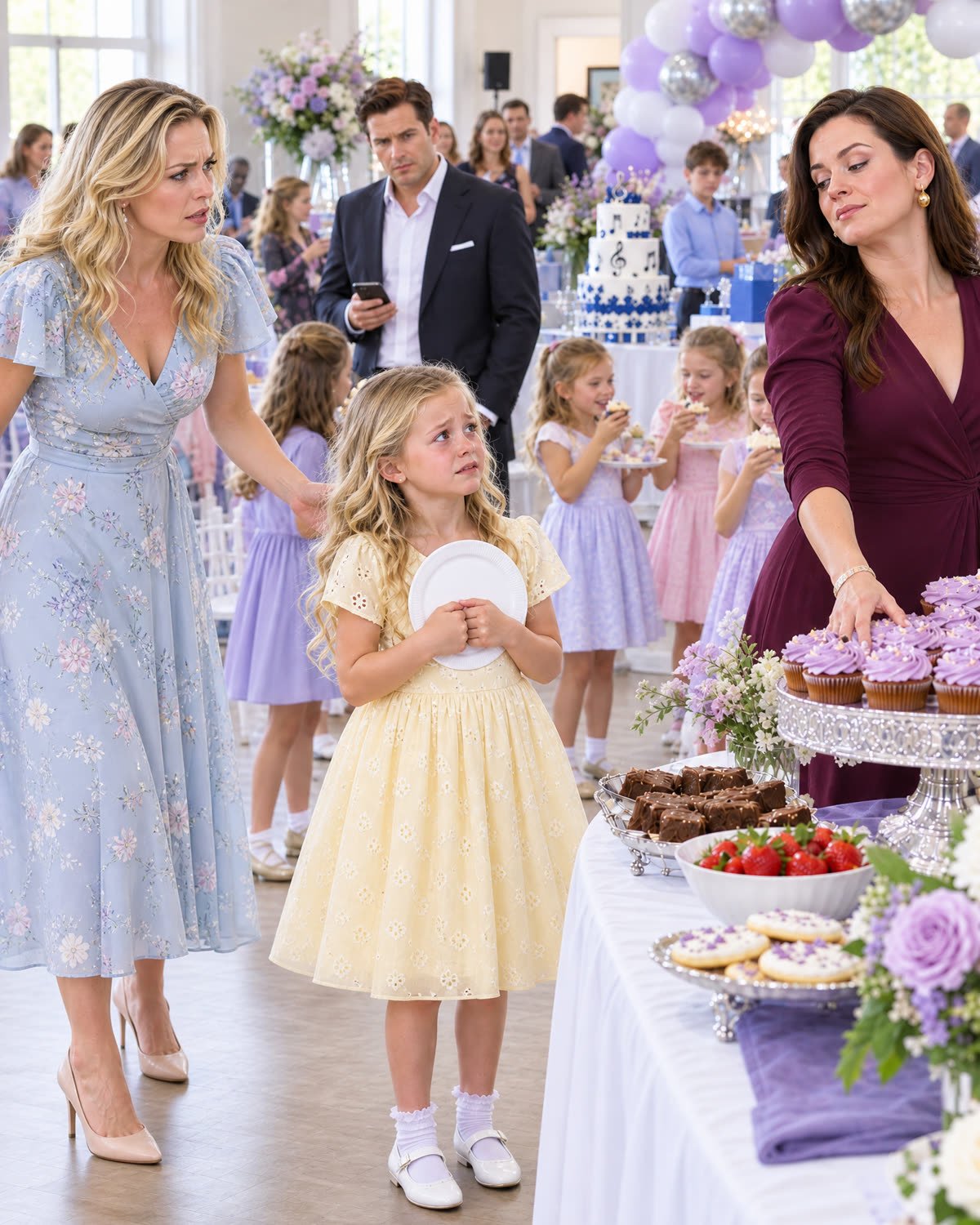
I thought the hardest part of my daughter’s eighth birthday would be getting thirty-two people into one photograph. Then I saw Emma waiting beside the dessert table with an empty plate while her aunt moved the cupcakes away. Across the room stood a second cake I hadn’t ordered—and beside it, my husband was suddenly too busy looking at his phone to meet my eyes.
“You can’t have anything from here. Ask your mom.”
Meredith said it without raising her voice. That was what made me hesitate for half a second. She sounded as though she were explaining an ordinary rule, something everyone understood except the small girl standing in front of her.
Emma looked down at her plate, then toward the children carrying cookies back to their seats.
“But it’s my birthday.”
My sister-in-law rested one hand against the silver cupcake stand.
“Your mother knows what we agreed.”
I left another parent halfway through a sentence and crossed the room.
“What did we agree?”
Meredith’s hand came off the stand. Her smile appeared a moment later, polished and unconvincing.
“Rebecca, please. Not in front of everyone.”
The party had been underway for nearly an hour. There were lavender balloons above the windows, paper stars on the activity tables, and a strawberry cake Emma had chosen from a photograph three weeks earlier. She had written every invitation herself, including a careful message to a classmate who had just moved to Ohio: I hope you can come even if you don’t know everybody yet.
Now she was standing at her own party, trying to understand why everybody else could eat.
“Emma asked for a cupcake,” I said. “Why can’t she have one?”
Meredith glanced over my shoulder. I followed her gaze to Andrew, who stood near the presents with his phone in one hand. He had heard me. I knew because he locked the screen without looking at it.
“Andrew?”
He approached slowly.
“Can we talk somewhere quieter?”
I had heard that sentence before. It usually meant that his sister had made a promise involving our money, or that his mother wanted us to overlook something because Meredith was having a difficult month. Until that afternoon, I had mistaken the request for privacy for an effort to be considerate.
Emma moved close enough for her sleeve to brush my hand.
“It’s okay, Mommy. I can wait until we get home.”
I crouched immediately. The plate had bent slightly beneath her fingers.
“You don’t need to wait until we get home. You haven’t done anything wrong.”
“Aunt Meredith said—”
“We’ll sort out what she said. You can always ask me.”
I stood, intending to pick up a cupcake myself. That was when I saw the other cake.
It stood on a separate table behind Emma’s, taller by an entire tier, with silver musical notes climbing the white frosting. A small sign read, Congratulations, Caleb! Beside it sat a framed photograph of Meredith’s twelve-year-old son holding his violin, a card basket, and several blue gift bags.
Three adults I didn’t recognize were talking with Patricia, my mother-in-law. One held an envelope with Caleb’s name on it. I had assumed they were parents whose faces I hadn’t yet matched to their children.
“What is that?” I asked.
Andrew followed my gaze, although there was no possibility he hadn’t seen the display before.
“Caleb got into the summer academy. Meredith thought we could acknowledge it while everyone was together.”
“Acknowledge it?”
Meredith straightened the edge of the tablecloth.
“They’re cousins. It seemed silly to rent two rooms.”
Nobody had mentioned renting two rooms. Nobody had mentioned a second celebration at all.
Three weeks earlier, Meredith had offered to arrange Emma’s party at a family event center outside Columbus. She knew someone there, she said, and could get a beautiful package without the usual markup. I was buried in residential appraisal reports, working evenings to clear a backlog, and I had been grateful.
Andrew told me the booking would be easier through the customer account he had used for a work gathering. I transferred him $2,500 from the savings I kept for family celebrations and larger purchases. He said he would handle the payment.
I had approved a guest count, colors, a cake flavor, and a total price. I had not approved my daughter becoming an inconvenient extra at an event she believed was hers.
“Who is running the room today?” I asked.
“Rebecca,” Andrew said quietly.
“That isn’t a difficult question.”
An employee nearby introduced me to Caroline Foster, the event coordinator. I explained, as evenly as I could, that my daughter had been refused food and that I needed to see the reservation.
Caroline’s eyes went first to Emma, then to the empty plate.
“Let me check the service notes.”
She opened a tablet at the small staff station beside the doorway. Andrew moved closer. Meredith did too.
Caroline read for a moment, her forehead tightening.
“There is a special instruction attached to the birthday child,” she said.
“What instruction?”
She turned the screen toward us. Under Emma’s name, a note said her mother would provide a separate meal and that staff should not serve her from the catered buffet.
I read it twice. Emma had no food allergies. I had packed no meal.
Beneath the instruction was an acknowledgment bearing Andrew’s name.
“I think our manager should join us,” Caroline said.
For the first time that afternoon, Meredith stopped trying to smile.
Part 2: The Price We Had Already Paid
Caroline looked toward Emma before saying anything more. I was grateful for that small act of attention.
The children were due to begin a craft activity in the adjoining room. At my request, she brought the schedule forward and asked the activity leader to take them through. My friend Nina, whose daughter was in Emma’s class, offered to stay with them.
“Would you like to help choose the crown stickers?” I asked Emma.
She studied my face.
“You’re coming back?”
“In a few minutes. Nina will be right there, and you can come get me whenever you want.”
Only after she followed her friends did I turn back to the tablet.
“Andrew, did you approve that instruction?”
He rubbed the back of his neck.
“Meredith sent an update to the booking. I clicked the acknowledgment. She said it was the final head count and arrangements.”
“Did you read it?”
“Not all of it.”
Meredith exhaled sharply.
“There was confusion about the meal arrangements. It should have been corrected.”
“What confusion?” I asked. “Emma eats ordinary party food. You know that.”
Before she answered, Caroline returned with Daniel Reed, the venue manager. He introduced himself and asked whether we could use the small consultation area just beyond the hall. It had glass doors; I could still see the entrance to the children’s room.
Patricia followed us without being invited. Caleb remained with one of his music friends and the adults near his cake.
Daniel first confirmed that Andrew was the account holder and asked his permission to review the booking with me present. Andrew gave it. The manager pulled up the invoice, the event description, and the changes approved through the account.
Then he read the service note.
“Mr. Whitmore, I need to speak directly with you about this acknowledgment,” he said. “Our staff understood that the parent-provided meal instruction was current. Can you confirm whether there is any actual dietary restriction?”
“There isn’t,” Andrew said.
“Then we’ll remove it immediately.”
Caroline stepped out to tell the catering staff. Daniel made a note in the record before looking back at us.
“The event is listed as a shared family celebration. Was that also approved?”
“Not by me,” I said.
Andrew stared at the table.
Daniel turned the screen. The description named Emma’s eighth birthday and Caleb’s acceptance into a competitive summer music academy. Both occasions appeared in the booking instructions from the beginning.
From the beginning.
I remembered sitting at our kitchen counter while Meredith showed Emma photographs of lavender decorations. She had asked whether Emma wanted stars or butterflies on the cupcakes. Emma had chosen stars because, she said, eight felt like a big enough age to stay up and see them.
Meredith had already been planning something else while my daughter made that choice.
“Families share celebrations all the time,” she said.
“With permission.”
“You would have made it complicated.”
“You didn’t give me a chance to say anything.”
Patricia folded her hands over her purse.
“Caleb has worked very hard, Rebecca. This academy isn’t something every child gets into.”
“I know. I congratulated him when the acceptance came.”
I had also listened to him practice a difficult piece in our living room two Sundays earlier. He had stopped twice, frustrated, and then started again without being asked. His effort was real. It had nothing to do with whether Emma could have a cupcake.
Daniel asked what information I had received about the package. I found Meredith’s message on my phone: room, catered food, custom cake, decorations, craft host, and coordination, all for $2,500.
He studied it carefully.
“This isn’t an estimate issued by our office.”
“What was the venue’s actual charge?”
Meredith shifted in her chair.
“That number doesn’t include everything I arranged.”
“Then we can look at those receipts afterward,” I said.
Daniel opened the paid invoice. It covered a weekday afternoon room rental, light catering for thirty-two guests, standard decorations, a craft host, and the two small celebration cakes supplied through the venue’s bakery partner.
The total, including fees and tax, was $940.
I did the subtraction before anyone spoke.
One thousand five hundred sixty dollars.
For months, Andrew and I had been helping Meredith through a difficult stretch. We had covered a car repair, a late utility payment, and part of Caleb’s school trip. Some of it came from our joint account; some came from money Andrew transferred without telling me until afterward.
I wasn’t angry that she needed help. I was tired of learning about our decisions after they had already been made.
When she asked for Caleb’s academy deposit two weeks before the party, I said we couldn’t make another contribution without reviewing our own commitments. We were rebuilding our emergency savings, and I had already budgeted for Emma’s celebration.
Later, Andrew accused me of making his sister feel as though she had to submit an application to be family.
I told him generosity stopped being a shared decision when one person was forbidden to say no.
Now the missing amount sat between us, exact enough that I no longer needed to guess.
“Where is the other $1,560?” I asked.
Meredith looked at Andrew.
He took his phone out, unlocked it, and set it on the table without opening anything.
“I sent it to Meredith for the academy deposit.”
There it was. Not a billing mistake. Not an expensive cake or an overlooked service charge.
“The morning after I transferred the birthday money?”
He nodded.
“You both knew the real party price before you gave me the quote?”
Andrew’s silence answered first.
Then he said, “Yes.”
I looked from my husband to his sister, and the money was suddenly the simplest part of what they had done.
Part 3: The Instructions Beneath the Instructions
Andrew began explaining too quickly.
The weekday package was cheaper than he had expected. Caleb’s deposit deadline was approaching. Emma would still have a party, so he had convinced himself that no one was actually losing anything.
“You got the celebration you wanted for her,” he said, then stopped when he heard himself.
“Did she?”
He looked through the glass doors toward the activity room.
Meredith leaned forward.
“Rebecca, the money was already set aside for the family. Caleb earned this. I wasn’t going to let him lose his place because we couldn’t find the deposit in time.”
“Then you needed to ask someone who agreed to pay it.”
“I did. I asked my brother.”
“And he used money I gave him for something else. You both let me believe a false price.”
Daniel remained quiet. He wasn’t a referee for our marriage, and I appreciated that he didn’t pretend to be. He simply asked whether I wanted copies of the invoice and approved changes. Andrew authorized the office to email them to both of us.
I gave Daniel my address, then returned to the question nobody had answered.
“Why was Emma singled out?”
Meredith rubbed her thumb over the edge of her bracelet.
“I told you. The note should have been removed.”
“Who was supposed to remove it?”
“The office.”
Daniel checked the change log.
“The separate-meal instruction was submitted yesterday at 7:18 p.m. The account holder acknowledged the revised service sheet at 7:43. There’s no later request to change it.”
Andrew looked sharply at his sister.
“You told me there was an old note left over from an earlier conversation.”
“There was a misunderstanding.”
“You said it had already been fixed.”
Caroline returned and confirmed that the catering team had been told to serve Emma normally. She also brought up an organizer’s email attached to the service note.
“There’s additional wording explaining how staff were supposed to respond,” she told Daniel.
Meredith sat back.
“Those emails were between me and your coordinator.”
“They’re instructions for an event we’re currently serving,” Daniel said. “We need to understand what happened.”
He read silently, then asked Andrew whether he had seen the email. Andrew shook his head.
The note claimed that I had chosen not to include Emma in the catered meal. It told staff to refer Emma to me if she asked for food. It also warned that I might become upset about the arrangements and suggested that Andrew should take me outside to settle any disagreement.
There was no mention of allergies, a medical condition, or a food preference.
My daughter had been told to ask me because Meredith wanted the refusal to belong to me.
Andrew’s phone vibrated against the table. He glanced at it, and something changed in his face.
“What?” I asked.

He hesitated, then slid the phone toward me.
The message was from Meredith, sent while Caroline was finding the email: Take Rebecca outside before they make a whole thing out of the notes. We can handle this ourselves.
I looked up. Meredith’s phone was still in her hand.
“Did you know I was supposed to be taken outside?” I asked Andrew.
He swallowed.
“She said you might be angry about combining the parties. I said I’d talk to you privately if that happened.”
“So you knew there was something I would be angry about.”
“Yes.”
“And you brought me here without telling me.”
He nodded again, smaller this time.
The distinction mattered, although it didn’t excuse him. He had knowingly helped hide the money and the shared celebration. He said he hadn’t knowingly approved punishing Emma. But he had clicked a document about his daughter without reading it, and when I first asked for help, he had tried to move me away rather than find out why she was holding an empty plate.
Daniel closed the internal email and folded his hands.
“Our office should have asked for direct confirmation before applying an unusual restriction to the birthday child. We relied on the organizer’s instruction and the account acknowledgment. That doesn’t change your experience, and I’m sorry.”
I thanked him for saying it plainly.
Through the glass, I saw Emma emerge from the activity room with Nina. My daughter was searching the hallway, turning her head one way and then the other.
I went to her before she needed to call.
“Everything okay?” I asked.
She nodded, then shook her head. Nina quietly stepped back.
“Did I get you in trouble?”
“No. Why would you think that?”
Emma touched the paper crown in her hands.
“Aunt Meredith said you didn’t want me having the party food. She said if I kept asking, you might get upset and we’d all have to leave.”
For a moment, I couldn’t answer without letting my voice do something I didn’t want her to hear.
I knelt beside the hallway bench and waited until she looked at me.
“I wanted you to enjoy the food. I wanted you to enjoy every part of your birthday. What Aunt Meredith told you wasn’t true.”
“Even the purple cupcakes?”
“Especially the purple cupcakes. You picked them.”
Caroline had followed us out. She asked Emma whether she would like one now, and my daughter looked at me before answering.
I nodded, keeping my face steady.
Caroline returned with a cupcake on a fresh plate. Emma held it for a moment, as though another adult might appear with a different rule. Only after I peeled back a corner of the wrapper did she take a bite.
Then she told me her friend had put six stickers on one crown, and for a few seconds she sounded like herself.
I waited until she was back with Nina before returning to the consultation area.
“You told her I would be upset if she asked me for food,” I said.
Meredith pressed her lips together.
“I wanted you to understand something.”
Andrew lifted his head.
I stood beside the empty chair but didn’t sit.
“Then say it to me now.”
Meredith looked directly at me.
“I wanted you to understand that refusing to support family has consequences.”
There was no mistaken instruction left to investigate. She had finally explained exactly why my daughter’s plate had been empty.
Part 4: Who Had to Leave the Room
Nobody rushed to fill the silence.
In the activity room, someone laughed. It was an ordinary, delighted child’s laugh, and hearing it through the wall helped me keep my voice level.
“You wanted consequences for me,” I said. “So you chose Emma.”
Meredith’s eyes flicked toward Patricia.
“I didn’t hurt her. I told her to ask you.”
“You told her that asking would upset me and end her party.”
“You’re making this sound much worse than it was.”
Andrew pushed his chair back.
“It is that bad.”
She turned on him immediately.
“Don’t do this. You knew we were trying to help Caleb.”
“I knew about the money. I knew about sharing the party. I lied to Rebecca about both.”
His voice shook, but he kept going.
“I did not know you were going to make Emma think her mother didn’t want her eating. And when Rebecca asked me what was happening, I should have helped her instead of trying to get her outside.”
For the first time, he wasn’t describing the afternoon as a misunderstanding that had happened around him. He was naming what he had done.
It didn’t make me want to comfort him.
Patricia touched his sleeve.
“Your sister has been under enormous pressure. Surely we can discuss this without tearing the family apart.”
Andrew moved his arm gently away.
“Emma didn’t create that pressure. Neither did Rebecca.”
I looked at Patricia.
“Did you know about the food instruction?”
“No,” she said at once. “I knew we were celebrating Caleb too. Meredith said you’d agreed.”
I believed her about the instruction. The shock on her face when Meredith admitted her purpose had been too immediate to mistake. But believing that didn’t mean I was ready to accept her request to make the problem smaller.
“Then please don’t ask me to overlook it.”
Daniel asked what I wanted for the remainder of the event. There were fifty minutes left in the reservation, and the craft room could be used for cake and singing. Staff could move Emma’s gifts there without disrupting the children.
For the first time since I had crossed the floor, someone was offering a decision that belonged to me.
“Yes,” I said. “Please move her cake.”
Meredith gave a short, disbelieving laugh.
“So now you’re separating the cousins.”
“I’m letting Emma finish her birthday.”
Daniel told Meredith that she could remain only if she stopped interfering with service and respected the other guests. Otherwise, he would need her to leave. He said it quietly, without an audience.
She chose to leave.
Before she went, she looked at Andrew as though he had forgotten a line they had practiced.
“You’re really letting her treat me like this?”
He didn’t answer the question she wanted him to answer.
“The $1,560 needs to come back.”
“It’s already been paid to the academy.”
“Then we’ll discuss a repayment plan. Not here.”
Her expression hardened. She collected her purse and walked toward the main room.
I followed far enough to find Caleb standing beside the music-note cake. He had his jacket folded over one arm. From the way he watched his mother, I knew he understood that something had gone wrong, even if he hadn’t heard the details.
“Caleb,” I said.
He looked at the floor.
“I’m sorry, Aunt Rebecca. I didn’t know it was supposed to be a surprise for you.”
“You haven’t done anything wrong.”
He glanced up.
“I really did get into the academy.”
That nearly undid me.
“I know you did. I heard you practicing. You earned your place, and you should be proud of that.”
His shoulders lowered a little.
I wasn’t going to promise that the adults would work everything out. I didn’t know that. But I could make sure he didn’t leave believing his achievement had caused the trouble.
Meredith called him from the doorway. He said goodbye, then paused to ask whether he could take Emma the card he had brought. I told him I would put it with her gifts.
Inside was a drawing of a birthday cake with eight wildly uneven candles. Beneath it he had written, Next year I will be better at drawing cakes.
I carried it into the activity room myself.
Emma looked up from a table scattered with stickers.
“Are we still doing the candles?”
“We are doing them right now.”
The staff brought in her strawberry cake. Nina gathered the children, and Caroline found the lighter. No one announced that we were rescuing anything. We simply moved chairs, cleared a place, and made room for a birthday.
Andrew stood near the back until I caught his eye.
“You can sing,” I told him. “This is still her birthday.”
He nodded and stayed where Emma could see him without having to stand beside him.
The singing was loud and uneven. One child started too soon, another stretched the final note until everyone laughed. Emma closed her eyes for her wish, her hands clasped beneath her chin.
Then she blew out all eight candles.
I didn’t ask what she had wished for. She deserved to keep something that afternoon entirely her own.
After cake, while the other children packed their crafts, Andrew asked whether he could speak to her. I told him to ask Emma.
She agreed, and he crouched beside her chair.
“Aunt Meredith told you something untrue,” he said. “Mommy wanted you to have the party food. I should have found out what was happening and helped you sooner.”
Emma rolled a tiny ball of paper between her fingers.
“Why didn’t you, Daddy?”
He took a breath.
“I was worried about the adults arguing. I made the wrong choice. That wasn’t your fault, and you don’t have to make me feel better about it.”
She listened without moving closer. He didn’t ask for a hug.
When the last guests left, Andrew asked whether we could go home and talk.
I looked at Emma, who was carefully putting Caleb’s card inside her gift bag.
“Emma and I are staying with my sister tonight,” I said.
He opened his mouth, then closed it.
“Are you coming back tomorrow?”
“I don’t know yet.”
I picked up the cake box and took my daughter’s hand. For once, I was willing to leave an adult uncomfortable rather than ask a child to carry it.
Part 5: The Slice She Chose Herself
My older sister lived twenty minutes away. When I called from the parking lot, she asked only whether Emma needed dinner and which pajamas she liked.
By the time we arrived, there were clean towels in the guest room and a pot of pasta on the stove. She admired Emma’s paper crown, asked about her friends, and didn’t turn the evening into a discussion of what had happened.
Later, after Emma fell asleep, I put the party documents on the kitchen table.
My sister read them without interrupting.
“What do you need tonight?” she asked.
“Not to decide my whole marriage before morning.”
She pushed the papers into a neat stack.
“Then don’t.”
Andrew sent one message that night. He said he was sorry, that he would give us space, and that he would send the bank records in the morning. I replied that practical information was welcome and that I wasn’t ready for a conversation.
He respected that request. It was a small thing, but after an afternoon built on people deciding what I should know, I noticed.
The records arrived before nine. They confirmed the $2,500 transfer from me, the $940 payment to the venue, and the $1,560 sent to Meredith the following morning. There were also messages showing that Andrew had known the actual venue price before he asked me for the money.
I read those more slowly than the statements.
In one, Meredith had written that I would never approve the academy help if they asked again. Andrew had replied that he would handle it.
He had not been tricked into the financial part. Whatever work we did afterward would have to begin there.
When we spoke two days later, I told him so.
“You don’t get to make your sister the explanation for everything.”
“I know,” he said.
“I need you to understand the difference between being sorry that I found out and being sorry that you chose it.”
He looked down at his hands.
“I told myself you’d be pleased with the party and the money wouldn’t matter. I decided my explanation was more important than your answer.”
It was the first explanation he gave that didn’t ask me to agree with it.
Emma and I stayed with my sister for six nights. When we returned home, Andrew stayed in the guest room. We kept her routines steady—school, swimming lessons, reading before bed—and told her only what she needed to know.
The adults were working through a problem. She hadn’t caused it. She didn’t need to fix it.
I also emailed the parents who had attended. I thanked them for coming and briefly explained that a private booking dispute had interrupted the afternoon. I didn’t describe the missing money or invite anyone to take sides. Nina told me later that most of the children remembered the crowns and the cake.
I hoped Emma would eventually remember those things too, without needing to forget what had hurt her.
Daniel sent a written summary of the venue’s review. Staff would no longer accept an unusual restriction involving a child’s meal without clearer confirmation from the responsible parent. He also included a direct apology addressed to us both.
I didn’t ask him to refund a party his staff had worked hard to recover. The venue had received $940, not $2,500. Keeping those facts separate mattered.
The missing money took longer.
Meredith initially called it a family contribution and refused to discuss repayment. Andrew answered her in writing, acknowledging that he had helped misrepresent the expense and stating the exact amount that needed to be returned.
He and I agreed that he was responsible for restoring my savings whether she cooperated or not. He began using money from his personal discretionary account rather than taking anything from our household emergency fund.
After two weeks, Meredith agreed to a repayment schedule. She returned $600 from savings, then the remaining $960 in three monthly payments. As those payments came in, the temporary money Andrew had used was reconciled. There was no extra windfall, just a careful accounting of what had been taken and returned.
Caleb kept his academy place. The adults’ debt remained with the adults.
Andrew also made an appointment with an individual counselor. I didn’t attend his sessions or ask for reports. What I needed was not access to every thought he had, but evidence that he could behave differently when his family wanted something I hadn’t agreed to.
We established a rule for transfers from shared funds: anything beyond ordinary household spending required both of us to know and approve it. Our individual accounts stayed individual. No one would be told that a venue, bank, or relative required a financial arrangement without documentation.
Those rules would not create trust by themselves. They did remove several places where secrecy had been allowed to hide.
Meredith sent me a message three weeks after the party.
I’m sorry Emma got upset. This has gone too far.
I read it, set my phone down, and answered the next morning.
I told her that Emma had been upset because an adult deliberately frightened and excluded her. Until Meredith could acknowledge that without blaming anyone else, there would be no visits. There would be no private messages to Emma and no explanations delivered through Patricia.
She replied that I was being unforgiving.
I didn’t argue.
Patricia later apologized for asking me to overlook the incident. I accepted the apology without promising that everything would immediately feel normal. She began asking before making plans involving Emma, which did more for our relationship than another long conversation would have.
Caleb sent Emma a postcard from the academy that summer. He drew a violin on one side and a lopsided cupcake on the other. She laughed at the drawing and pinned it above her desk.
They were allowed to remain cousins without being asked to repair their mothers’ relationship.
Andrew and I eventually began couples counseling. I agreed to attend because he had kept doing the difficult work after the immediate crisis passed. That was not a promise that our marriage would return to its old shape.
In truth, I no longer wanted the old shape.
I wanted a marriage in which peace didn’t depend on one person swallowing a question. I wanted Emma to see adults disagree honestly, apologize specifically, and accept that an apology didn’t come with a deadline for forgiveness.
About a month after the birthday, she invited two friends over for pizza and a movie. I was cutting slices when she came into the kitchen and stood beside me.
“Do I need to ask before I take one?”
I put down the cutter.
“You can take a slice, sweetheart. This is for all of you.”
She looked toward the living room.
“Even the big one?”
“Even the big one.”
She chose it, balanced it on her plate, and carried it away. I stayed by the counter a little longer than necessary, listening to the movie menu repeat until someone finally pressed play.
The question didn’t disappear forever that night. Healing was less tidy than that. Sometimes she still checked my face before asking for something ordinary, and I answered without making her feel watched.
But there were other moments too.
Months later, after the money had been restored and our household had settled into a more honest rhythm, Emma helped set out snacks for another movie afternoon. Andrew washed grapes at the sink while I found napkins.
She carried the serving plate toward the doorway, then noticed one of her friends hovering at the kitchen entrance.
“Come on,” Emma told her. “You can have some.”
She didn’t look back at either of us for confirmation.
I watched my daughter make room beside her, holding out a plate that was no longer empty.
Disclaimer: This story is a work of fiction inspired by real-life themes. Names, characters, places and events are fictionalized, and any resemblance to real persons is purely coincidental. Images are for illustration purposes only.


