

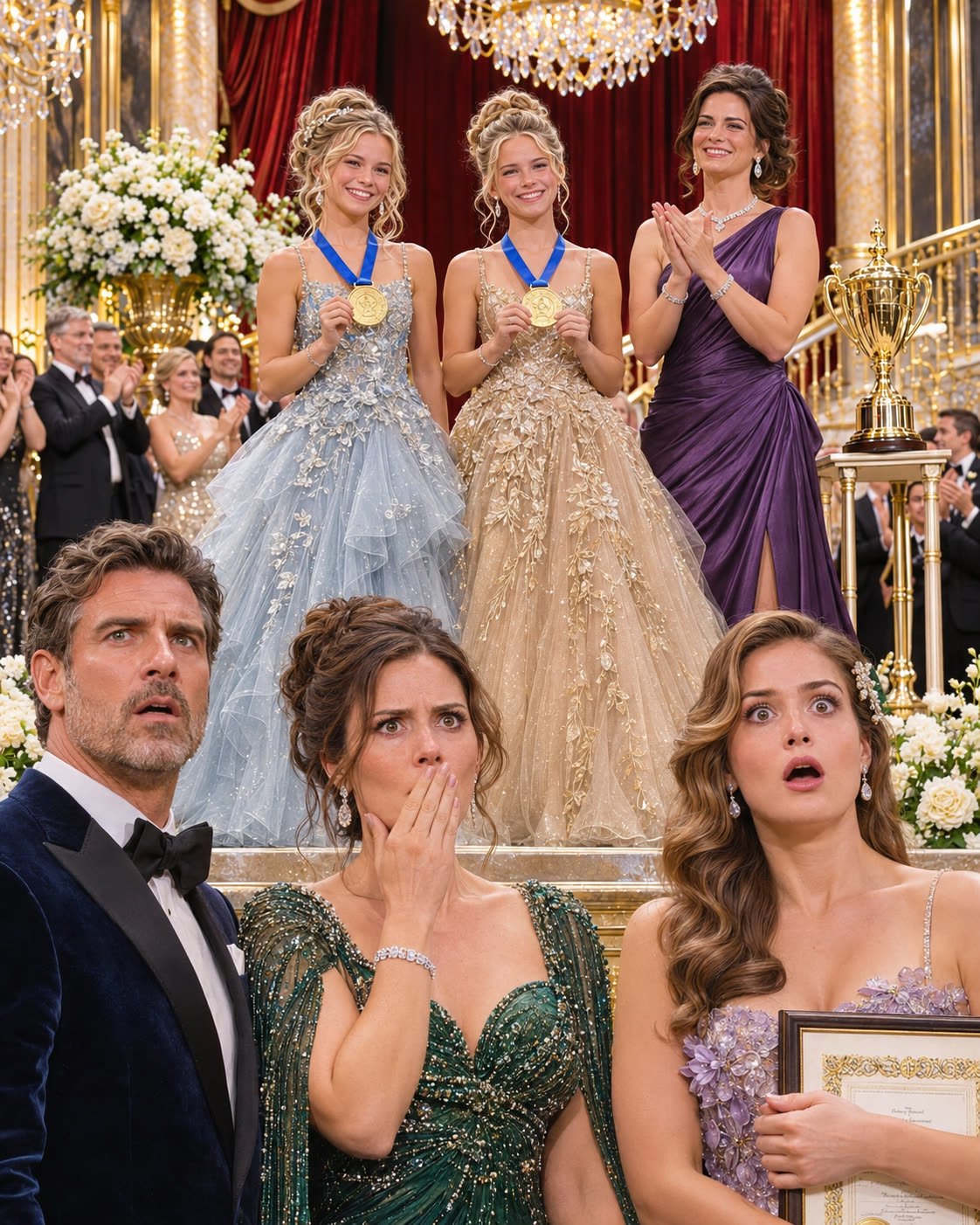
Part 1: The Woman at the Door
“Who gave you permission to come in here?”
Daniel Mercer stepped in front of Elena so abruptly that the paper around her flowers crackled against his sleeve. Behind him, guests were entering the ballroom beneath a banner welcoming the national finalists. Elena had spent the train journey imagining her daughters on that stage. She had not imagined their father guarding the door.
“Move, Daniel.”
His gaze dropped to her visitor badge, then returned to her face. Sixteen years had changed his haircut and added gray to his beard. They had apparently done nothing to soften the expression he used when he wanted someone to feel inconvenient.
“This is a private championship reception.”
“Then the school made a terrible mistake giving me this.”
She lifted the badge without taking it off.
The woman beside him turned. Caroline Mercer wore an ivory pantsuit and the composed smile Elena remembered from a photograph she had once wished she had never seen. A teenage girl stood slightly behind her, holding a framed certificate against her chest.
“Elena,” Caroline said. “What an unexpected place to find you.”
“Not for me.”
Elena tried to pass. Daniel shifted again.
“Our foundation is helping fund this event,” Caroline said. “There are designated areas for guests. You can’t simply wander into the sponsors’ entrance.”
A volunteer stationed beside the doors looked from Caroline to Elena’s badge.
“Competitors’ families use this entrance too, Mrs. Mercer.”
The girl with the certificate lowered her eyes. Elena noticed the white marks her fingers were making along the frame.
“Thank you,” Elena told the volunteer.
Daniel spoke more quietly.
“Whatever you think you’re going to accomplish, this isn’t the place.”
For a moment, Elena was back in a kitchen with a missing suitcase, an empty section of wardrobe, and a note that had managed to end a marriage without once mentioning the child she was carrying.
Then someone inside the ballroom laughed. A teenager called for her mother to hurry because the good seats were filling.
Elena tightened her grip on the flowers.
“You’re right about one thing. This afternoon isn’t about us.”
She walked around him before he could turn her presence into something she needed his permission to justify.
Beth Lawson was waiting beside the family section, one hand resting on two saved seats.
“There you are. Everything all right?”
“An unpleasant surprise.”
Beth followed her glance toward the entrance. She knew enough of Elena’s history not to ask the next question in public.
“The girls are backstage. June has checked the medal table three times. Nora claims she isn’t nervous, which means she’s correcting everybody’s arithmetic.”
Elena laughed, and the sound loosened something in her chest.
Her daughters had traveled from Lancaster with Beth and the school’s other chaperone the previous morning. Elena had worked her Friday clinic shift, caught an early Saturday train through Philadelphia, and arrived with just enough time to change in the station restroom.
The flowers had come from a grocery store near the station. June liked white daisies. Nora insisted flowers were impractical, then kept every dried bouquet anyone had ever given her.
Elena laid them across her knees.
At the front of the ballroom, two chairs waited beside the championship trophy. On either side stood banners naming universities, regional education partners, and the Whitmore Family Foundation.
She had seen the sponsor list in an email weeks earlier. The Whitmore name had registered only as one among many. She had not known Daniel sat on its board, or that Caroline would attend.
She wished she had known—not because she would have stayed home, but because surprises cost energy she wanted to save for her daughters.
Across the aisle, Daniel guided Caroline and the girl toward a reserved table. He looked back once. Elena turned toward the stage.
She had practiced that movement for years: away from questions with no useful answer, toward what needed doing.
There had been permission slips to sign, fevers to sit through, grocery budgets to stretch, and two children who deserved a mother present enough to hear when they said they were fine and meant the opposite.
She had not done it alone. Her father had helped until his death seven years earlier. Beth had opened the science lab after school. A community-college lecturer had answered Nora’s relentless emails about mathematical proofs.
But Daniel had not been among them.
The lights dimmed. The championship director, Dr. Adrian Wells, welcomed the finalists and explained that the results combined written mathematics, laboratory analysis, and a collaborative problem-solving round.
Elena knew the structure by heart. For eight months, versions of those problems had occupied her kitchen table.
She had learned that a quiet room meant concentration, an argument meant progress, and both girls asking whether there was more toast meant they had finally solved something.
At the sponsors’ table, Caroline straightened her daughter’s certificate for a photograph. The girl smiled on command, then let the smile fall when the phone lowered.
“That’s Audrey Mercer,” Beth whispered. “Her school qualified out of Maryland. She did well in the design analysis section.”
Elena nodded. Fifteen, she guessed. Young enough that the arithmetic of Daniel’s departure still had the power to make her stomach tighten.
A school choir finished its short performance. Certificates were presented to the finalists. Audrey crossed the stage, accepted hers, and glanced immediately toward her mother.
Caroline clapped politely. Daniel was checking his phone.
Elena looked away before her expression could betray her.
Then the finalist teams assembled along the side of the stage. Elena spotted June first, standing on her toes to see over another student’s shoulder. Nora caught her sister’s elbow and pulled her back before she collided with a microphone stand.
They found Elena at the same instant.
June’s whole face opened. Nora lifted two fingers in their private signal: found you.
Elena raised the flowers.
The third-place team was announced, followed by the runners-up. Caroline leaned toward Daniel and said something Elena could not hear. Audrey studied the certificate in her lap.
Dr. Wells returned to the microphone.
“Our national champions earned full marks in each scored round. The independent judges have completed their verification.”
June reached for Nora’s hand.
Elena stopped breathing before she knew why.
The screen changed. Her daughters’ names appeared above their school’s name, enormous and unmistakable.
Around her, people rose to applaud. Across the aisle, Daniel turned toward the stage—and went completely still.
Part 2: The Signature He Remembered
For a few seconds, Elena forgot Daniel existed.
Nora and June were climbing the steps together, trying to walk with dignity and failing because June kept laughing. A university judge placed gold medals around their necks. Nora looked down at hers as though checking that nobody had made an administrative error.
Elena stood with everyone else, flowers crushed between her palms.
“They did it,” Beth said.
Elena could only nod.
Then Daniel was beside her row.
“Brooks?” he said. “Those girls—”
His gaze moved from the screen to Elena, then back again.
She had wondered, years ago, how this moment might happen. In her angriest imaginings, she had prepared speeches. Standing there now, she found she had no appetite for any of them.
“Your daughters, Daniel.”
He caught the back of an empty chair.
“Two?”
“Yes. Two.”
Onstage, June tucked a loose strand behind her ear. Daniel made the same gesture, touching hair that was no longer long enough to need moving.
“I didn’t know—”
Elena turned fully toward him.
“I notified you the week they were born. I still have the certified delivery receipt you signed.”
He opened his mouth, then closed it.
“The packet included both birth records,” she continued. “Your attorney acknowledged receiving it. Please don’t make me argue about something you already know.”
His fingers loosened from the chair.
“I remember the envelope.”
It was barely audible, but it was enough.
Caroline had followed him. She stopped close enough to hear.
“What exactly is going on?”
“The girls are Daniel’s,” Elena said.
Caroline looked toward the stage. Her expression did not change quickly enough to resemble surprise.
“You chose a very convenient afternoon to announce that.”
Beth stepped closer to Elena.
“Their school qualified through three rounds,” Elena said. “I came to watch them compete.”
“At an event our foundation supports.”
“At an event hundreds of families are attending.”
Caroline’s voice sharpened.
“I want the results checked.”
Several guests turned. Onstage, a photographer was arranging the winning teams beneath the screen.
“Caroline,” Daniel said.
“No. Two perfect scores from the same household? We’re supposed to accept that without asking questions?”
“The score belongs to their team,” Beth said. “Their individual work and collaborative round were graded under the published rules.”
“And you are?”
“Their faculty adviser. Beth Lawson.”
“Then you should welcome an investigation.”
Elena saw Nora looking toward them. June followed her gaze. Their smiles faltered.
That hurt more than anything Caroline had said.
“Lower your voice,” Elena told her.
“If there’s nothing to hide—”
“My daughters are being photographed. You will not turn their achievement into an accusation because your daughter’s team didn’t place.”
Audrey had come up behind her mother. Color rose along her cheeks.
“They won fairly, Mom.”
Caroline turned.
“You don’t know that.”
“I took the same tests.”
The photographer released the students. Nora and June descended from the stage, moving quickly now. Elena stepped away from Caroline and opened her arms.
June reached her first.
“Did you see the screen?”
“I saw everything.”
Nora pressed into her other side. The bouquet folded awkwardly between them.
“We should have brought a vase,” she said into Elena’s shoulder.
Elena laughed through tears.
“That is what you’re thinking about?”
“The stems are leaking on your dress.”
For one clean moment, they were simply themselves.
Then June looked past her mother.
Daniel stood a few feet away. Elena felt Nora’s arm tighten.
“Mom,” Nora said quietly.
“Not here,” Elena answered. “We’ll talk somewhere quieter.”
Daniel took half a step forward.
“Elena, please. I need—”
“Today belongs to them.”
He stopped.
Caroline was speaking to an event volunteer now, asking for the head judge and using the foundation’s name as though it were a key that ought to fit every lock.
Audrey stood apart, rubbing her thumb against the edge of her certificate.
“Mom, please stop.”
“After everything we arranged for you, you could at least support your own family.”
Elena watched Audrey flinch. She had heard that structure before: a favor transformed into a debt, then presented as love.
Before she could speak, Dr. Wells approached with the event’s safeguarding coordinator and a committee administrator.
“Mrs. Mercer,” he said, “we need to discuss your concerns privately.”
Caroline lifted her chin.
“Finally.”
“Including the correspondence sent from your foundation address before the finals.”
The satisfaction left her face.
Daniel looked between them.
“What correspondence?”
“This isn’t appropriate for the ballroom,” Dr. Wells said. “There are students present.”
Caroline reached for Audrey’s elbow.
“We’re leaving.”
Audrey stepped back.
It was not a dramatic movement. It was a small, unmistakable refusal.
“I saved the messages,” she said.
Caroline’s hand remained suspended.
“Audrey.”
“They were open on the family tablet when you told me to check the schedule. I didn’t go looking.”
“Put your phone away.”
Audrey’s eyes filled, but she did not obey.
“You said their school shouldn’t have been allowed through. You said there had to be a way to stop them before anyone asked questions.”
Dr. Wells kept his voice calm.
“Audrey, you don’t need to explain anything in public.”
Daniel looked at Caroline.
“Why would anyone ask questions?”
Audrey swallowed.
“Because Mom already knew who they were.”
Beside Elena, June’s medal tapped softly against Nora’s.
Audrey looked directly at her father.
“She knew they were your daughters before we ever came here. And she tried to get them disqualified.”
Part 3: What the Messages Proved
Elena’s first instinct was to get the girls out.
Nora had gone very still. June was looking from Audrey to Daniel as though trying to fit together a diagram with several pieces deliberately missing.
“Beth,” Elena said, “would you take them to the lobby?”
“We’re not little kids,” Nora said.
“I know. That’s why I’m asking you, not sending you. You shouldn’t have to stand here while adults argue about your right to be on that stage.”
Nora looked at her sister, then nodded.
“Tell us what happens.”
“I will.”
Dr. Wells offered a conference room off the main corridor. Audrey asked the safeguarding coordinator, Ms. Patel, to stay with her. Caroline objected until Audrey said, with sudden clarity, that she did not want to be alone with her mother just then.
Elena heard Daniel draw in a breath.
Inside, Dr. Wells placed his folder on the table but did not open it immediately.
“First, the championship results are final. Sponsor complaints do not overturn verified scores. The Brooks team’s eligibility was established before the competition.”
“Then there’s nothing to discuss,” Caroline said.
“There is an attempted breach of our sponsorship agreement to discuss.”
Audrey held her phone in both hands.
“I took pictures because I thought I’d misunderstood. Then there were more messages on the same thread.”
Ms. Patel asked whether she wanted to share them. Audrey nodded.
Elena watched Dr. Wells examine the screen without taking the phone away.
The first message contained a regional newspaper photograph of Nora, June, and Beth standing beside their school’s laboratory display. Elena recognized it immediately. June had complained that the photographer caught her blinking.
Below it, Caroline had questioned whether both girls met the residency requirements. A later message suggested outside coaching had invalidated their regional results, although the rules explicitly permitted faculty mentoring.
The committee’s replies were brief and procedural. The team was eligible. No exception had been made. Sponsorship provided no role in selection.
Then Caroline’s final response appeared.
Dr. Wells read it aloud only after Audrey agreed.
“Our foundation’s contribution should carry more weight than a logo on the program. I expect this matter resolved before the finals.”
Caroline folded her arms.
“I was asking for due diligence.”
“You were given due diligence,” Dr. Wells said. “You continued after receiving the answer.”
He opened his folder. The administrator beside him produced copies of the committee’s own records.
Audrey’s photographs had not created the evidence. They had exposed something the organizers had already documented.
“These messages were referred for review when they arrived,” Dr. Wells explained. “Our judging team was kept separate from that process. No scores were changed, and no student was questioned because of your requests.”
Elena let out a breath she had not realized she was holding.
Caroline glanced toward Daniel.
“You understand why I was concerned.”
He did not answer her.
“How did you connect the girls to Elena?”
“Their surname. The photograph. It wasn’t difficult.”
“There are thousands of people named Brooks.”
Caroline’s eyes flicked toward Elena.
“I recognized their mother’s name in the article.”
Elena remembered filling out the newspaper’s permission form, pleased that the reporter wanted to acknowledge the families and teachers behind the students’ work.
Such an ordinary thing. A line she had almost forgotten.
“You knew they existed,” Elena said.
Caroline’s mouth tightened.
“I knew you had children.”
“You knew whose children.”
“Daniel made his wishes very clear back then.”
Silence settled over the table.
Daniel sat down.
Elena had kept the old paperwork in a labeled folder at home, alongside school records and insurance policies. For years she had disliked that folder’s existence. Now she was grateful she had never mistaken wanting peace for needing to destroy proof.
“Your lawyer told me all communication had to go through his office,” she said to Daniel. “I followed that instruction. The court established support. The agency processed it. None of that prevented you from asking whether they were healthy.”
“I know.”
“It didn’t prevent a birthday card.”
He looked at his hands.
“I know.”
“Don’t let this become a story where she kept you away.”
Daniel lifted his head.
“She didn’t. I chose not to come.”
Caroline pushed her chair back.
“How noble of you to discover honesty in front of an audience.”
Elena disliked agreeing with her, but the thought had already crossed her mind.
Daniel seemed to hear it too.
“Saying it doesn’t repair anything.”
Dr. Wells brought the meeting back to the event. The foundation’s remaining promotional activities would be paused while the championship board reviewed the correspondence. Any longer-term action required that review, and Caroline would have an opportunity to respond.
“Our students’ awards are administered through a separate academic endowment,” he added. “Neither a sponsor nor a departing sponsor can withdraw them.”
“My family helped build this event.”
“That does not give your family authority over its students.”
Caroline stood.
“Audrey, get your things.”
Audrey did not move.
“I’d like to stay with Dad.”
Daniel stood too.
“I’ll bring her home. We can speak there.”
Caroline looked at him for a long moment, then left. The door closed without a slam, which somehow made the room feel smaller.
Audrey set her certificate flat on the table.
“I really did study,” she said.
No one interrupted.
“I know I didn’t win. But I worked. I wasn’t pretending.”
Daniel moved closer, stopping before he touched her.
“I believe you.”
“You never asked if I wanted to do this.”
His face changed.
“What did you want?”
Audrey rubbed one eye with her knuckle.
“Architecture. Drawing buildings. Figuring out why a place feels good to be inside. Mom says that isn’t a serious plan unless I get into the best school.”
“It sounds like a plan worth exploring,” Elena said.
Audrey looked at her, startled.
“You’re not angry with me?”
“You didn’t send those messages.”
The girl’s shoulders dropped a fraction.
She asked whether she could congratulate Nora and June. Elena said she could ask them herself.
But when Elena opened the conference-room door, Nora was waiting just beyond it.
She had left June with Beth and come to find her mother.
Her eyes went past Elena to Daniel.
“Did you actually know about us,” she asked, “or are you going to tell us another version?”
Part 4: No More Convenient Answers
Elena stepped into the corridor.
“Let’s get June first.”
Nora shook her head.
“I want him to answer before he has time to practice.”
Daniel remained inside the doorway. He did not ask Elena to help him.
“Yes,” he said. “I knew your mother had given birth to twins.”
Nora’s jaw tightened.
“Then why did you look surprised?”
For once, Elena thought, there was no pleasant way around the question.
Daniel took several seconds.
“Because knowing something on paper and seeing the people you’ve avoided are different. That isn’t an excuse. It’s the truth.”
Nora looked down the corridor toward the lobby.
“June should hear you say that.”
They found her on a bench beside Beth, eating pretzels from a vending-machine bag. Her medal was looped around her backpack strap so it would not knock against her teeth when she leaned forward.
Audrey stopped a few paces away.
“Congratulations,” she said. “Your final solution was amazing.”
June glanced at Nora before answering.
“Thanks.”
“I kept trying to solve it numerically.”
“So did we,” June said. “Then Nora got annoyed and started again from the assumptions.”
“The assumptions were doing most of the lying,” Nora said.
Elena could not tell whether that was deliberate. Daniel seemed uncertain too.
Audrey gave a small, nervous laugh.
“I’m sorry about what my mother said.”
“You didn’t say it,” Nora replied.
It was almost exactly what Elena had told Audrey in the conference room.
Beth offered to take Audrey to get water while Elena and the twins spoke with Daniel. Audrey agreed, after Daniel assured her he would be there when she returned.
Elena chose a quieter cluster of chairs away from the ballroom doors. She sat beside June. Daniel waited until Nora pointed to the chair opposite them.
“Mom told us about you,” June said.
“I understand.”
“Not horrible things. Just true things.”
He nodded.
“She said you left before we were born. She said grown-ups make choices that children don’t cause.”
Elena felt June’s fingers find hers between their seats.
“Your mother was right,” Daniel said.
Nora leaned forward.
“Why didn’t you want us?”
Elena had answered versions of that question for years without possessing the answer. Hearing it directed at the person responsible made her want to reach for Nora and give her room at the same time.
Daniel’s face had gone pale.
“I wanted the life I was building more than I wanted the responsibilities I already had. I told myself staying away would make everything simpler.”
“For you,” Nora said.
“Yes. For me.”
June studied him.
“Did you ever look us up?”
“Not until today.”
That answer cost him something. Elena saw it. It did not come close to what the truth cost June.
Her daughter looked down at their joined hands.
“We used to wonder if you were somewhere far away.”
“I’m sorry.”
“You were just in Maryland.”
Daniel bowed his head.
No one rushed to make the silence kinder.
Finally, June said, “Grandpa came to everything. Even when the school play was terrible.”
Nora’s mouth moved faintly.
“Especially when it was terrible. He liked having opinions afterward.”
Elena smiled despite herself. Her father had once described a production of a children’s musical as an important argument for shorter musicals.
“He died when we were nine,” June told Daniel. “He knew our teachers’ names.”
Daniel looked at Elena, then back at June.
“I should have known them too.”
“But you didn’t,” Nora said.
“No.”
A ballroom door opened. Applause spilled into the corridor, then faded when it closed again.
Daniel rested his hands on his knees.
“I can’t ask you to feel anything for me. But I want to take responsibility for what I’ve avoided.”
Nora’s expression hardened.
“We don’t need rescuing.”
“I’m beginning to understand that.”
“Mom worked for everything we have.”
“I know.”
“No. You know she worked. That’s different.”
Elena squeezed her hand.
“Nora.”
“It is different.”
“You’re right. But you don’t have to defend my whole life in a hotel lobby.”
Nora swallowed and looked away.
Elena waited until her daughter’s shoulders eased before speaking to Daniel.
“There is an existing support order. Our attorneys can review the account, any missed payments, and what needs changing now. You can make additional provision for their education. None of that will buy access to them.”
“I understand.”
“They may want contact. They may not. They may change their minds. You won’t punish them for that, and you won’t send gifts to get around an answer you dislike.”
He nodded.
“And you will not use their names or photographs to explain yourself publicly.”
That made him look up.
“I wouldn’t—”
Elena held his gaze.
“You have spent a long time managing how things look. I need to be clear about this.”
His answer came more slowly.
“You’re right.”
Beth returned with Audrey and three bottles of water. Audrey handed one to June without making a ceremony of it.
The girls began talking cautiously about school. Audrey mentioned a model bridge she had built. June asked whether she had photographs. Within minutes, all three were looking at her phone.
Elena watched their heads bend together. Whatever happened next, she wanted that small beginning protected from adult expectations.
Daniel stood beside her.
“Where do I start?”
She considered telling him that she had once asked herself the same question while holding two newborns and reading a letter from his lawyer.
Instead, she said, “With something you can actually keep.”
He looked toward the girls.
“Could I call next Sunday? Only if they want.”
Nora heard him. She looked at June, and a silent negotiation passed between them.
“Five minutes,” she said. “Mom stays in the room.”
“Of course.”
“Four o’clock.”
Elena checked the time. Their train would not wait for any of this.
They gathered their bags and the damaged flowers. Audrey asked whether they could exchange numbers. June handed over her phone; Nora did too.
At the exit, Daniel said he would call.
Nora stopped with her hand on the door.
“You said you knew about us before,” she told him. “Next Sunday, we’ll find out what knowing means now.”
Part 5: A Place in the Crowd
At four o’clock the following Sunday, Elena put the phone on the kitchen table.
At four-oh-one, it rang.
Nora checked the clock before answering.
“Hello.”
The first conversation lasted four minutes and forty seconds. Daniel asked about their journey home. June described the classmate who had made them a banner with “champions” spelled incorrectly. Nora corrected a detail and otherwise said very little.
When the call ended, neither girl looked transformed.
June opened her homework. Nora asked what was for dinner.
Elena counted that as a reasonable beginning.
The next weeks were less tidy than Daniel’s first promises had sounded. Some calls were awkward. One Sunday, June asked why he had never sent a birthday card, even after knowing there were two children instead of one.
Elena stood at the sink with her back turned, giving them what privacy a small kitchen allowed.
“Because a card would have made me face the next thing I wasn’t doing,” he answered. “I kept choosing not to face it.”
June did not thank him for being honest. She said she had no more questions that day and ended the call.
He did not call back to demand reassurance.
Meanwhile, the championship board completed its review. Elena received a written confirmation that the attempted sponsor interference had not affected eligibility or scoring. The foundation’s sponsorship would not be renewed, and future agreements would include stronger separation between fundraising and competition administration.
The public notice named no students.
Caroline disputed the board’s interpretation through the foundation’s representatives. She did not apologize to Elena or the twins.
Elena stopped expecting her to.
At school, Nora and June were welcomed with handmade signs and an announcement that made June blush and Nora pretend to dislike attention. Their scholarship awards remained secure. A summer program offered them places after reviewing their applications, not merely their medals.
At home, the dishwasher still needed emptying.
“National champions can identify where plates belong,” Elena told them.
“That wasn’t on the syllabus,” June said, taking the plates anyway.
The legal work moved at a different pace. Elena authorized her attorney to obtain the support history and current financial disclosures. Daniel hired separate counsel. Records were requested, figures checked, and old discrepancies reconciled.
The original order had been based on his circumstances years earlier. Elena learned to distinguish what could be enforced under that order from what required a new agreement or prospective modification.
Daniel agreed to pay the documented arrears and related amounts identified through the accounting. The attorneys also negotiated increased ongoing support and additional educational contributions.
There was no triumphant hearing where a judge returned sixteen years to her.
There were documents, careful questions, and a settlement that made the future less precarious.
Before Elena signed, Daniel asked through counsel whether he could include a personal letter. She said he could send it separately. Money and apology did not belong on the same signature line.
His letter arrived a week later.
It did not describe how much he had suffered. It named things he had chosen and things she had been left to carry.
Elena read it once, put it in the records folder, and went to collect June from robotics club.
Daniel and Caroline separated that spring. Their divorce was not finished quickly; their property and business interests made sure of that. Elena learned only what affected arrangements for the girls.
Audrey’s living schedule was settled through her parents’ lawyers and a temporary agreement. She stayed primarily with Caroline and spent regular weekends with Daniel, with her own school commitments considered.
She continued texting Nora and June regardless of which house she was in.
Sometimes they talked about equations. More often, they shared badly drawn cats, complaints about teachers, and Audrey’s sketches of impossible houses.
When Caroline complained that the twins were distracting Audrey, Audrey sent them a message herself.
“You haven’t done anything wrong. I’m sorting things out here.”
Nora showed Elena before replying.
“What do I say?”
“Something true.”
Nora thought for a moment.
Then she typed, “We’re still here.”
Four months after Baltimore, the twins agreed to meet Daniel at a diner in Lancaster. Elena sat in a nearby booth with a book she barely read.
He arrived early. He brought no gifts.
June asked about his work, then challenged his explanation of a development project’s energy systems. Nora asked whether he could name her current mathematics teacher.
He could. He had listened during the calls.
That seemed to surprise her more than anything else.
As they were leaving, she mentioned that her bicycle chain kept slipping.
“I can look,” Daniel said. Then he stopped. “Actually, I don’t know enough to promise I can fix it.”
“There are videos,” Nora said.
The following weekend, Elena watched through the kitchen window while they worked in the driveway. The first adjustment made the problem worse. Daniel admitted it. Nora fetched her laptop.
June came outside, watched for three minutes, and announced that neither of them had loosened the correct bolt.
They spent an hour on a repair a bicycle shop could have completed much faster.
When Daniel left, Nora tested the gears twice before bringing the bicycle inside.
“It works,” she said.
Elena knew better than to turn that into a metaphor aloud.
There were setbacks. In October, Daniel left a voicemail explaining that a business emergency threatened an agreed visit. Nora deleted it halfway through and told Elena she had expected this.
Elena did not defend him.
She sent him one message: “Explain the change directly. Don’t ask them to make it easy for you.”
He rearranged his work and arrived at the original time. Nora remained angry through lunch.
He stayed anyway, without pointing out what coming had cost him.
Later, Elena learned he had started therapy. She was glad, but she did not treat attendance as proof of change. The proof remained smaller and less impressive: calls made, boundaries respected, uncomfortable questions answered without rewriting history.
Audrey began visiting architecture exhibitions with him. Once, she sent Elena a photograph of a museum staircase with six paragraphs explaining why it worked.
Elena replied that she had never thought so much about stairs in her life and would now be inspecting all of them.
Audrey sent back a laughing face.
Nearly a year after the championship, Nora and June entered an engineering showcase in Philadelphia. Audrey came with Daniel, carrying a sketchbook and a bag of snacks large enough for a school trip.
Elena found a seat in the front row. Audrey asked to sit beside her.
Daniel waited at the aisle.
“Is here all right?” he asked, indicating a place several rows back.
Nora, passing on her way to the display area, nodded.
“We can see you from there.”
Their bridge design won its category. June cheered before the announcement was quite finished. Nora put both hands over her face, then immediately asked whether the judges’ comments would be available in writing.
Elena stood applauding. Audrey stood with her.
Daniel remained in his row until June waved him forward.
After photographs, Nora adjusted her backpack and looked at him.
“Our school showcase is next Saturday. Eleven o’clock.”
“Would you like me to come?”
“I’m telling you when it is.”
He smiled carefully.
“Then I’ll be there.”
There was still no easy word for what they were building. Elena did not need one. Her daughters were not required to forget in order to move forward, and she was not required to reopen a door she had closed long ago.
Outside, Audrey pulled Daniel toward a building she wanted to sketch. June linked her arm through Elena’s.
“Do you know what I remember most about Baltimore?”
“The medal?”
June shook her head.
“Finding you before they announced anything.”
Nora came up on Elena’s other side.
“You were holding those ridiculous flowers.”
“You kept them.”
“That’s not the point.”
Elena looked from one daughter to the other.
For years she had counted what she could not give them. They had been counting something else.
Next Saturday, there would be another crowded room, another row of chairs, another moment when her daughters looked up.
And before they searched for anyone else, they would know exactly where to find her.
Disclaimer: This story is a work of fiction inspired by real-life themes. Names, characters, places and events are fictionalized, and any resemblance to real persons is purely coincidental. Images are for illustration purposes only.


