

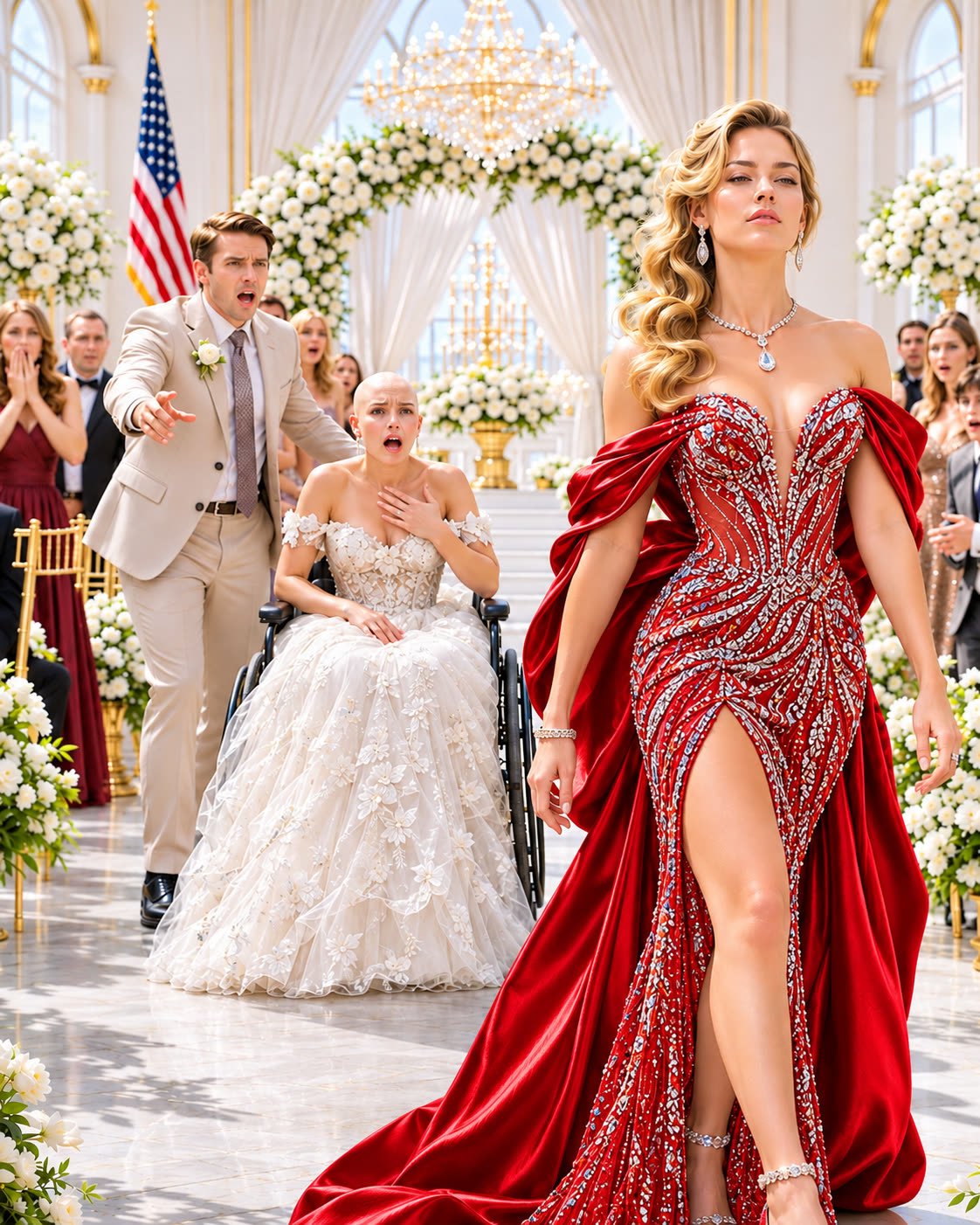
Part 1: The Dress Called Lake Star
“The bride will be Vanessa.”
Alexander said it the way another man might announce a change to the seating chart. One hand held a paper cup of black coffee. His eyes were on my reflection, not on me.
Behind him, the thirty-eighth floor of the Halloran Bridal House hung above the Chicago River in a haze of falling snow. Around me stood three seamstresses, two mirrors taller than doorways, and a gown called The Lake Star. Four thousand hand-sewn pearls covered its bodice. It had cost more than the house my mother grew up in.
Somewhere behind my left shoulder, a seamstress stopped breathing. I heard her pins click against her teeth.
“Say that again,” I said.
“Vanessa Hale.” He sighed, as if I were being slow. “She was diagnosed last week. Stomach cancer, late stage. The doctors are giving her six months. Maybe less.”
Vanessa Hale. His first love. The girl who had left five years ago, in the middle of his war with his cousins over Whitmore Global, to go find herself in San Diego. She had stayed lost until he became chairman, until his face appeared on magazine covers and his defense contracts made the business pages.
In the mirror, his sister Brooke looked up from her phone and smirked. His mother, Evelyn, sat rigid in ivory silk, her silver-blond hair pinned tight enough to hurt. She didn’t look shocked. She looked inconvenienced, like a woman whose car service was running late.
His father, Charles, stood at the window with his hands clasped behind his back. He didn’t turn around.
“What does her diagnosis have to do with our wedding?” I asked.
“It’s her last wish.” Alexander set his cup on the arm of the velvet chair. “To walk down an aisle in a real gown, in front of real people. With me.”
I waited for shame. I gave it a full ten seconds to arrive.
It never did.
“Emily, be reasonable,” Evelyn said. “You are healthy. You have time. That poor girl does not.”
“The Whitmore name cannot be dragged through gossip over a sentimental adjustment,” Charles told the glass.
“A sentimental adjustment,” I repeated.
Brooke shrugged without looking up. “It’s not like he’s dumping you. He’ll marry you later. Quietly. After.” She let the word hang there. “You know.”
After Vanessa died. She said it the way you’d offer someone a hair tie.
“The invitations won’t change,” Alexander went on, warming to the logistics. “Publicly, we’ll say you had a sudden medical issue and need privacy. Vanessa will wear a veil. Most guests won’t realize until the ceremony starts.”
The ceremony was twelve days away. Senators, judges, CEOs, two governors, and old money from Lake Forest had RSVP’d. The Palmer House ballroom had been booked for a year, and the white lilies were being flown in from California. I had chosen every course of the dinner myself, at a kitchen table, over three winters of Sunday nights.
“You’re welcome to attend,” he added, softer now, almost tender. “Behind the scenes. The staff will find you a uniform so nobody bothers you.”
A uniform.
He wanted me in a black apron in the service corridor, holding a tray of champagne flutes, watching him marry another woman. In my dress. Under my flowers. In front of my guests.
I looked at the girl in the mirror. She glittered like something laid out on an altar.
“For three years,” Alexander said, “my family has taken care of you. Your apartment. Your wardrobe. Your reputation. You’ve never wanted for anything. I’m asking you to be gracious, Emily. Don’t turn cruel over one ceremony.”
“A woman’s grace is tested when she’s asked to step aside,” Evelyn said.
I almost laughed. Step aside. That was how families like theirs dressed up humiliation: they called it a courtesy and waited to be thanked.
I thought about the three years. The Sunday dinners where I laughed at jokes about people who sounded like my relatives. The night Evelyn had the flu and I slept in a chair beside her bed, rationing her pills by the hour. The fundraising speeches I wrote and she delivered to standing ovations. The thousand small ways I had made myself easier to keep.
I had believed that was what love cost. I had never once been told the price would go up.
I reached behind me and began to undo the hidden buttons.
The head seamstress, a gray-haired woman named Mrs. Adeyemi, stepped forward. “Miss Hart, please—”
“It’s all right,” I said.
“What are you doing?” Alexander’s voice dropped to the register he used with vendors who missed a deadline.
The buttons gave way one by one. The weight of the gown slid from my shoulders, and I stepped out of it in my plain white slip. The most expensive wedding dress in Chicago settled over the velvet chair like a collapsed swan.
I took my cream wool coat from the hook.
“Send it to Vanessa’s hospital room,” I said. “If she wants my wedding, she can wear my dress.”
“Don’t be dramatic.” He crossed the carpet toward me. “This is temporary. You know your place in my life.”
“No,” I said quietly. “I finally know where it ends.”
The color left his face and came back angrier. “If you walk out of here, the family’s protection ends today.”
Evelyn moved to block the door. “Girls like you don’t last long after insulting families like ours.”
I looked at the woman I had nursed through a fever, whose insulin schedule I knew by heart. Then I smiled, and for the first time in three years it was not the pleasant, folded smile they knew.
“Mrs. Whitmore,” I said, “you have mistaken silence for weakness.”
She stepped aside before she realized she had done it.
Alexander shouted my name as the elevator doors closed. I didn’t turn around.
The snow outside was falling in wide, slow flakes that melted on my coat. I walked eleven blocks to my apartment without feeling the cold. The doorman held the lobby door for me and asked if I wanted a cab, and I said no thank you, and that was the last polite thing I said that week.
I should have known they would not let me leave quietly. The Whitmores were never afraid of losing a woman. They were afraid of losing the story.
Three days later, they tried to bury me without laying a finger on me.
The first message came at 7:42 in the morning, from Jess, a friend from graduate school who had once been my lab partner and now sold software in Denver.
Em, is this true?
Under it was a scanned medical report on the letterhead of Lakeshore Mercy, a private hospital on the Gold Coast. My name sat at the top. My date of birth. My address. A doctor’s signature. A raised seal.
Diagnosis: congenital uterine abnormality. Permanent infertility.
By nine o’clock it was in a private society group chat. By ten, it was on three gossip blogs and a wedding forum with forty thousand members. By noon, women who had air-kissed me at charity galas were posting hearts and prayers and phrases like so sad but deceptive.
By evening, the story had become clean and simple. Poor Alexander Whitmore had discovered, days before the wedding, that his fiancée could never give him a child. Out of kindness, he had tried to spare me public shame. But his family had demanded heirs. And fragile, dying Vanessa Hale was the only innocent person left, offering him one last beautiful memory.
I was the woman who had tried to marry into billions with a defective body and a lie.
I sat at my kitchen island and read every comment. I didn’t cry. I read them the way you read a contract, looking for the clause that would matter later.
I had never been a patient at Lakeshore Mercy. Yet the date of birth was right, and so were the apartment number and the last four digits of a number I had not typed into any form in three years.
Someone had pulled my real file. And there was exactly one place on earth where that file lived, and it was not in Chicago.
I stood up and walked into my study, and my eyes went to the low shelf where three thick engineering textbooks sat, spines uncracked, exactly where I had left them.
Part 2: The Timestamp
At three that afternoon, the doorbell camera chimed.
On the little screen, Alexander stood in the hallway holding three glossy bags from a Michigan Avenue bakery. He looked tired, not sorry. Men like him always confuse the two.
I opened the door but did not step aside.
“Emily.” He lifted the bags like a peace offering. “Lemon tarts. Your favorite.”
“You forged a medical report.”
His hand went still on the paper handles. For a second I saw irritation, before he arranged his face into something wounded.
“It was necessary.”
“Necessary,” I said.
“You don’t understand the pressure I’m under.” He lowered his voice, as if we were the ones with a secret. “Canceling without a reason would have hurt the company. My parents were furious about Vanessa. I needed an explanation people would accept.”
“So you made me infertile.”
He sighed. “Gossip fades. In six months, no one will remember. I’ve bought you a house in Lake Forest, Emily. Three point eight million. It’s already in your name.”
I looked at him.
He took the look for surrender and leaned in. “You won’t be Mrs. Whitmore, not publicly. But I won’t abandon you. When Vanessa is gone, I’ll come see you. I’ll take care of you. Anything you want, within reason.”
I almost admired the architecture of it. He had commandeered my wedding and then wrecked my name, and now he was offering to build me a very beautiful cell.
“Do you know,” I said, “that falsifying medical records is a felony?”
One corner of his mouth lifted. “Don’t be naive. My legal team can bury anything.”
There it was. Not torn. Not noble. Not even cruel, exactly. Just a man utterly certain that money was a kind of weather, and that he lived above it.
“Take the house,” he said. “And leave Chicago before the wedding. Don’t make me be harsher than I want to be.”
I smiled. It was cold and small and entirely steady.
“Remember what you just said, Alexander.”
His eyes narrowed. “Is that a threat?”
“No,” I said. “It’s a timestamp.”
I closed the door in his face. Through the wood I heard him stand there a moment, then the soft chime of the elevator.
I did not cry. After three years, it turned out I had nothing left to cry with.
I went into the study and pulled the three textbooks off the low shelf. Behind them, my thumb found a sensor the size of a coin, and a panel of wall slid back without a sound.
Inside was a steel safe. No jewelry, no love letters, nothing the Whitmores would have thought worth stealing. I entered a thirty-two-character code from memory and the door clicked open.
A matte-black satellite phone lay on top of a small, unmarked alloy computer.
Three years earlier, before I became Alexander Whitmore’s quiet fiancée, I had been Dr. Emily Hart. Lead materials scientist on a classified aerospace-defense program the Pentagon and NASA called Project Liberty Eagle.
At twenty-nine, I had designed the core lattice of a heat-resistant superconductive composite that could change American spaceflight for a generation. Then a lab accident put chemical fumes in my lungs and a fog in my head, and the doctors prescribed a long, silent recovery.
I took leave. I let my name disappear from the journals. Alexander found me in that pale season, tired and grateful for gentleness, and he mistook my restraint for emptiness. His family took my modest background as a lack of ambition. The society women decided I was lucky.
Not one of them asked why a woman with no visible career still carried a federal security clearance.
I turned the satellite phone on, and the screen glowed green in the dim room. The call routed through four layers of encryption before it connected.
It rang three times.
“Dr. Hart?” The voice was old and cracked down the middle.
“Professor Hayes. It’s me.”
I heard a chair scrape hard against a floor. “Emily. My God. Are you safe?”
“I’m safe.”
“Are you well?”
“Yes.”
A pause, heavier. “Then please tell me you’re calling for the reason I’ve prayed you would.”
I looked at the forged report on my desk. Next to it lay the separation agreement Alexander’s lawyers had sent that morning, with its demands for silence and a waiver of every claim.
“My leave is over,” I said. “I want to come back to Liberty Eagle.”
Professor Martin Hayes, former NASA legend and the man who taught me to hold a question open until it answered itself, let out a breath he seemed to have held for three years.
“You have no idea what this means,” he said. “The thermal-shield models stalled the day you left. We have the best minds in the country and not one of them can finish your sentences.”
“I have some trash to take out first. Give me until Friday.”
“I’ll arrange extraction. Andrews can receive you—”
“Chicago first,” I said. “Then Colorado Springs.”
His voice sharpened. “Is someone threatening you?”
I looked out at the lights coming on across the river. Somewhere among them was the tower where Alexander believed he owned the sky.
“Not anymore.”
When the call ended, I signed every document his attorneys had sent. I waived his houses, his cars, his money, his silence payment. I put the credit cards, the keys, the jewelry, and the engagement ring into a courier box and addressed it to Whitmore Global headquarters.
Then I packed one suitcase. Not gowns. Not designer bags. Just my old clothes, the alloy computer, and the woman I had buried alive.
The next morning Evelyn Whitmore arrived with two private guards and let herself in without knocking. Her perfume came through the door before she did.
“I hear you returned the ring,” she said. “How theatrical.”
“I returned everything.”
She looked around my apartment the way you look at a hotel room you intend to complain about. “Do you imagine refusing money makes you noble? My son was generous. A woman in your condition should be grateful that anyone considered marrying her.”
“My condition,” I said.
“Infertile women have limited options, Emily.” Her smile sharpened. “Especially once their reputations are ruined.”
I slid a folder across the counter. Inside was an itemized list of every gift Alexander had ever given me, each one marked returned or still sitting in the Whitmore house, and my signature at the bottom.
“Check it,” I said. “I took nothing from your family.”
Her face flushed from collar to hairline. “You dare speak to me this way?”
“Yes.”
Her eyes widened. For three years she had met only the softened version of me.
“Tell your son something for me,” I said. “He can keep the wedding, the dying sweetheart, the borrowed pity, and the family name he worships. But he doesn’t get my silence forever.”
She laughed, but it came out thin. “And who exactly do you think you are?”
For one second I nearly told her.
“Someone your family should have researched,” I said, “before trying to erase her.”
She left with her guards. I washed my hands for a long time afterward, as if I had touched something.
At dusk, my phone buzzed with a blocked number.
“Emily?” The voice was faint and breathy, rehearsed down to the cough. “It’s Vanessa.”
I said nothing.
“I know you hate me. I start treatment tomorrow and I may not get another chance to talk to you. I want to apologize.” A delicate pause. “And I have something of yours. Something I think you’d want back.”
I closed my eyes. There was only one thing she could mean.
Margaret Whitmore, Alexander’s grandmother, had pressed an antique emerald ring into my palm the winter before she died. She was the only person in that family who ever truly saw me. “Don’t let them convince you that you’re lucky to be tolerated,” she told me.
I had left that ring in the safe at the Whitmore mansion, a safe that only three people could open. One of them was Margaret, and she was dead.
“I’ll come,” I said.
Not for Vanessa. Not for closure. But if Vanessa had that ring, then someone had handed her the family’s last sacred heirloom, and I wanted to know who.
Part 3: The Hospital Charade
The Whitmore Medical Pavilion occupied the upper floors of a private hospital near Northwestern, all cream marble and nurses who spoke in whispers. Vanessa’s suite looked more like a boutique hotel than a sickroom, which seemed right, since nothing in it was meant for healing.
She reclined against white pillows, a pale silk scarf wound around her head, her face powdered a shade too even to be natural. On a mannequin by the window stood my wedding gown. The Lake Star. Its crystals threw tiny rainbows across the ceiling.
Vanessa saw me looking at it and smiled weakly. “Alex wanted me to try it on. He said it looked like it had been made for me.”
“Where’s the ring?” I said.
Her eyes filled on cue. “Emily, I am so, so sorry.”
“There’s no audience here,” I said. “Save your strength.”
For one flicker, her face went flat and hard. Then the softness came back, like a curtain lowered over a stage.
She slid a carved wooden box from under her pillow and opened it. The emerald lay on black velvet, green as deep water.
“Margaret wanted you to have it,” I said.
“Alex says I’m the future Mrs. Whitmore now.” Her voice stayed gentle, but her eyes had a bright, hungry shine. “But I know I haven’t got long. I thought giving it back might help you forgive him.”
I took the box. Her fingers lingered on it a half-second too long before they let go.
“You think you’ve won,” I said.
Her lips parted.
“You’ve taken a man who can drop a woman after three years, forge her medical records, and hand her wedding to his ex. That’s not winning, Vanessa.” I held her gaze. “That’s picking up a loaded gun because it’s shiny.”
Tears slid down her cheeks, quick and beautiful.
As if summoned, the door banged open and Alexander strode in. “Emily, what the hell are you doing?”
He crossed the room and gathered Vanessa into his arms. She folded against his chest and sobbed.
“I only wanted to apologize,” she wept. “She said such terrible things.”
“She’s dying,” Alexander said to me, in a voice made of knives.
I looked at the ring box in my hand, then at the two of them clinging to each other like understudies who had overrehearsed.
“Of course she is,” I said.
“You’re bitter because you lost.”
“No,” I said. “I’m awake because I got out.”
Vanessa pressed her hand over her mouth and cried harder. Alexander pointed at the door. “Get out. You have no place here.”
I set the emerald box on the bedside table, and surprise flickered over his face.
“I came to see if there was anything left in this family worth mourning,” I said. “There isn’t.”
“Emily,” he warned.
I glanced at the gown on its mannequin. “She can keep the dress. She can keep the ring. She can keep your name. I hope you both live long enough to understand each other.”
I walked out. Behind me, Vanessa’s sobbing dropped away to a perfect silence, the instant the door clicked shut.
That night, Alexander’s secretary wired one million dollars into my checking account with a short note.
Mr. Whitmore hopes this will help you leave Chicago before tomorrow’s ceremony. He would like to avoid any emotional disruption at an event with distinguished guests.
I forwarded the full amount, every cent, to a national scholarship fund for girls studying science and engineering. In the donor field, I typed his name. In the comment line, I typed: May this help young women build futures no arrogant man can buy.
I sent the receipt to his secretary and blocked every Whitmore number I had.
At nine, the satellite phone buzzed on the nightstand. A clipped voice came through: a military liaison, reading from a card.
“Dr. Hart, extraction is authorized. A motorcade will be at your residence at 0800. Wheels up from Midway’s restricted terminal at 0900. Destination, Peterson Space Force Base, Colorado Springs. Security classification, highest.”
“I’ll be ready.”
I stood at the window with the lights off. Chicago glowed gold and blue below me. Somewhere in that glow, florists were arranging my lilies, and a chef was plating the courses I had chosen. A quartet was running through the song I had once believed I would walk toward.
Tomorrow at noon, Alexander Whitmore would stand in front of America’s elite and marry his beautiful, dying lie.
And when he thought I had been erased, the country would learn my name.
The morning came bright and brutally cold. I put on a white research uniform, tied my hair into a low knot, and picked up my alloy case. The apartment behind me was spotless and empty. Nothing in it remembered the woman Alexander thought he had made.
At exactly eight, three black armored SUVs rolled into the underground garage. No logos. Federal plates.
Four armed escorts stepped out in silence. Their commander, a broad-shouldered man with close-cropped hair, walked up to me, stopped three feet away, and saluted.
“Dr. Emily Hart. Special Security Unit Eagle, ma’am. Awaiting your instruction.”
For three years, no one had said that name aloud in my presence.
Dr. Emily Hart. Not Alexander’s fiancée. Not the poor girl the Whitmores had graciously lifted up. Not the barren fraud of the gossip blogs.
Me.
I raised my chin. “Let’s go.”
“Yes, ma’am.”
As the motorcade crossed downtown, the giant screens along Michigan Avenue flashed an advertisement for the Whitmore wedding. Alexander and Vanessa smiled from a retouched portrait beneath the words LOVE BEYOND LIFE AND DEATH.
I nearly smiled back. Love had nothing to do with it.
At nine, the plane left the runway. Chicago shrank below the wing into silver lines and winter mist.
At 11:40, Central time, the Palmer House ballroom was full. Senators, governors, CEOs, media owners, and heirs sat in rows of gilded chairs, and every one of them had laughed at me at some dinner. They were dressed in silk and diamonds, here to watch my replacement wear my dress.
Alexander waited under an arch of white lilies, handsome and composed and victorious. Down the aisle came Vanessa, veiled and fragile, leaning on a nurse’s arm, triumph visible in the way she held her head.
The officiant beamed. “Alexander Whitmore, do you take Vanessa Hale—”
Every phone in the ballroom shrieked.
Not one. Not ten. Hundreds, all at once, in a single high wail: a federal emergency tone that cut through the music and left a silence behind it like a held breath.
The officiant stopped mid-word. Guests dug into pockets and purses. Faces changed, first to confusion, then to something closer to fear.
Frowning, Alexander took his assistant’s phone out of her trembling hand. A stark official headline filled the screen.
NATIONAL SCIENCE HERO RETURNS: DR. EMILY HART, LEAD SCIENTIST OF CLASSIFIED LIBERTY EAGLE AEROSPACE PROGRAM, DELIVERS MATERIALS BREAKTHROUGH TO U.S. DEFENSE COMMAND.
Under it was a photograph. Me, stepping off a secure aircraft in Colorado, flanked by generals and NASA officials. White uniform. Alloy case. Head high.
Alive, unbroken, and out of reach.
“Sir,” the assistant whispered.
Alexander did not move. The blood left his face until he looked carved out of salt.
In the front row, a champagne flute slipped from someone’s fingers and shattered on the marble floor, and the sound seemed to crack through the whole ballroom.
Part 4: When the Ballroom Emptied
The panic came in waves.
A retired senator stood first, his face dark red. “Whitmore, what have you done?”
Charles rose unsteadily. “There has been a misunderstanding.”
“Have you?” The senator held up his phone. “You circulated a forged medical record about a protected federal scientist? You let this room laugh at her?”
Evelyn gripped the arm of her chair. “We didn’t know who she was.”
“That’s not a defense, madam.” The senator didn’t raise his voice. “That’s a confession of character.”
Around the family, guests began to move toward the exits, slowly at first, then quickly. No one wanted to be photographed beside the Whitmores. No one wanted to be near a family that had publicly smeared a scientist doing classified work for the nation’s defense.
Phones buzzed. Aides whispered into collars. Publicists went gray.
A defense contractor took Charles aside and said, flatly, “Our joint bid is suspended, effective now.”
A bank chairman murmured, “We’ll need to review our exposure.”
A governor’s chief of staff left without saying goodbye.
In ten minutes, the grandest wedding of the season looked like the aftermath of a flood. White lilies lay crushed under expensive heels. Chairs stood toppled. Champagne soaked the carpet. The string quartet packed their instruments with shaking hands.
At the altar, Vanessa stood alone in my dress. The veil trembled around her face.
“This can’t be real,” she said. “Alex. Tell them it’s fake.”
He kept staring at the phone. His eyes were glued to my photograph.
Three years, I thought, from a thousand miles away, when I would hear about this later. For three years I had eaten breakfast across from him. I’d listened to his complaints and heated soup after his late nights and sat at his family’s table with my mouth closed, because I believed love meant choosing peace over pride.
He had taken my restraint for a lack of substance. Now the whole country was reading what he had thrown away.
Charles sank into a chair. Evelyn pressed a hand to her chest, and for the first time her perfect face folded in on itself. Brooke sat on the carpet in a heap of pink chiffon, scrolling her phone.
“My friends are deleting every photo of us,” she said, in a small, astonished voice.
Alexander finally looked at Vanessa. Something ugly moved behind his eyes. For the first time, he did not see a tragic, dying angel. He saw a woman in another woman’s dress, standing in the wreckage of his name.
“You told me she was nobody,” he said.
“I didn’t know!”
“You said she was some quiet girl.”
“You believed it too!” Vanessa’s voice cracked into something raw.
He laughed, a broken sound. Guests at the doors glanced back. It wasn’t really laughter. It was the sound of a man realizing he had burned down his own house to stay warm beside a painted fire.
By then, I had reached the secure facility in Colorado Springs.
Professor Martin Hayes waited at the entrance to the underground lab. He was seventy-two, white-haired and sharp-eyed, too proud for public tears, and crying anyway.
“Welcome home, Emily.”
I shook his hand. He pulled me into a brief, fierce hug instead.
Past him, the lab hummed with supercomputers and containment chambers and people who hadn’t spent three years wondering whether I was decorative enough to marry. The researchers stood and applauded. A few had gone gray since I left. Others were young faces I didn’t know, who looked at me as if a missing equation had walked back through the door.
I set my alloy case on the central table.
“The final lattice models,” I said. “Thermal tolerance projections. Superconductive stabilization. Molecular-repair simulations.”
The professor’s eyes shone. “You kept working?”
“Every day I could breathe.”
He studied me for a long moment. “And the people who hurt you?”
I looked at the wall monitor, where muted news footage showed the Whitmore ballroom emptying in real time.
“They’ve become irrelevant.”
It wasn’t entirely true yet. Soon it would be.
Within two days, federal investigators had opened inquiries into the forged medical report, unlawful access to private health records, a coordinated online defamation campaign, and possible intimidation of a person connected to classified defense work. Lakeshore Mercy suspended two administrators. Whitmore Global’s stock fell so fast that analysts used the word bloodbath on live television.
On the third day after the ruined wedding, Commander Reed came to my workstation with a sealed folder. His boots were quiet on the lab floor.
“Dr. Hart,” he said. “The investigation turned up something you should hear from me first.”
I pulled off my safety goggles and took the file.
Vanessa Hale did not have cancer.
Not stomach cancer. Not any terminal illness. Her real diagnosis, according to her own records, was mild gastritis.
The oncology report had been purchased from a bribed hospital administrator. Vanessa had come back from San Diego buried under gambling debts and two pending lawsuits. She needed money, status, and protection, and Alexander, with his old wound and his need to be the rescuer, had been easy prey.
But she had not acted alone.
The false infertility report with my name on it had been produced by that same administrator, after messages passing between Vanessa and the office of Alexander Whitmore.
Alexander had wanted a clean public excuse. Vanessa had wanted me ruined. Each of them had signed in a different ink.
“What happens now?” I asked.
Reed straightened. “Vanessa Hale has been taken into custody for fraud, bribery, falsification of medical documents, and conspiracy. The administrator is cooperating. Alexander Whitmore is under investigation for defamation, intimidation, and involvement in distributing falsified records.”
“And Whitmore Global?”
“Audits. Contract freezes. Federal review of every defense-adjacent project. Their partners are running for the exits.”
I closed the folder. There was no joy in it, only a clean, level quiet.
“Proceed by the book,” I said. “No favors. No private revenge. No mercy outside the law, and none above it either.”
“Yes, ma’am.”
That night, while my team ran simulations, Alexander walked out of a federal interview room into a city that no longer bowed when he passed.
He didn’t know that the worst of it was still waiting at home, in a wheelchair, with an oxygen line.
Part 5: The Sky No One Could Take
Harrison Whitmore flew back from his estate in Maine on a private jet and sat in the Lake Forest library with every page of the file spread across his knees.
He was eighty-eight. He had built Whitmore Global from inherited steel money and government contracts, and he loved legacy more than he loved most of his relatives. When he read the last page, he did not shout. He asked for his grandson.
Family lawyers lined the wall. Evelyn wept without sound. Charles looked twenty years older than he had a month before.
Alexander came in unshaven, in the same suit he had worn to the wedding that never happened.
“Grandfather—”
Harrison threw the stack of papers at his chest. It didn’t go far, but it landed hard.
“You stupid, arrogant boy.”
Alexander flinched.
“I gave you a corporation,” the old man said, thin-voiced and lethal. “You handed me a federal scandal.”
“I didn’t know who Emily was.”
“You didn’t need to know she was important,” Harrison said, “to know she was human.”
Nobody in the room spoke.
“Effective immediately, you are removed as chairman and stripped of executive authority. Trust access suspended. Corporate residence revoked. Personal accounts frozen pending legal review.”
Alexander dropped to his knees. “Please.”
“You threw a woman away like furniture,” Harrison said. “Now find out how it feels.”
By sundown, security had walked Alexander out of the house. They took the company car, the cards, the watch, the office, the apartment, and the name that had always opened doors for him.
At the gates, in freezing rain, the man who had once threatened to drive me out of Chicago stood with a thin coat and a phone no one would answer.
He called Vanessa. She picked up from house arrest.
“Alex?” she said sharply. “Did you fix it?”
“I’ve lost everything,” he whispered. “But we still have each other.”
A pause. Then she laughed. It was not weak, and it was not sick, and it was not loving. It was raw and cruel and disgusted.
“You idiot,” she said. “I came back for Whitmore. Not for you.”
He found her days later in a cheap rental outside Joliet, where she was waiting on trial under monitored release. The building smelled of mildew and old cigarettes. Rainwater leaked through a crack in the stairwell ceiling. She opened the door only because she thought he might have money.
Seeing his hollow face, she folded her arms. “You look terrible.”
“I need you.”
“For what? You’re useless now.”
“You said you loved me.”
“You wanted to hear it.”
“You said you were dying.”
“And you wanted to save me. It worked, until you ruined it.”
“I ruined it?” His voice broke. “You forged your diagnosis.”
“You forged hers.”
The words hit him harder than a fist.
Vanessa leaned in, her eyes bright with hatred. “Don’t play noble. You needed Emily humiliated so no one would ask why you’d replaced her. You wanted your tragic romance and your clean name. You’re not a victim, Alex. You’re just stupid.”
Their fight carried through the walls and brought the neighbors, and then the police. By dawn, the tabloids carried both their names again, no longer as lovers beyond death, but as two disgraced opportunists shouting at each other in a hallway.
Vanessa’s release was revoked when investigators found she had tried to move hidden funds through a cousin in Nevada. They led her out in handcuffs, screaming that Alexander had promised to protect her.
He watched from the curb. No driver pulled up. No lawyer rushed to his side. No mother called. For the first time in his life, consequences arrived without a receptionist to announce them.
In Colorado, Project Liberty Eagle entered its hardest stage. For months I worked eighteen-hour days beside Professor Hayes, Commander Reed, and a theoretical physicist named Dr. Nathan Cole.
Nathan had come over from Caltech without the arrogance that usually travels with prodigies. He was tall and quiet and exact, with sandy hair, gold-rimmed glasses, and a habit of leaving coffee beside my keyboard before I knew I needed it.
He never mentioned Alexander. He never turned my pain into conversation.
One night at two in the morning, while we stared at a failed molecular simulation, he said, “People talk about betrayal like it breaks you. I think sometimes it just shows you where you’d been bending too far.”
I looked at him over the rim of my mug. “That sounds personal.”
“It is,” he said. “But tonight it’s also mathematically relevant. Your lattice is bending too far at the stress nodes.”
I laughed for the first time in weeks. By morning, we had fixed the model.
Six months later, the heat-resistant shield passed its first full-scale simulation, and the lab erupted. Professor Hayes wept openly this time, without even pretending to look for a handkerchief.
Whitmore Global kept coming apart. Federal auditors found inflated contracts, political favors, shell vendors, and compliance failures that had nothing to do with me and everything to do with men who believed wealth made them untouchable. Banks called in loans. Partners left. Directors resigned. The company sold its weaker divisions, then its headquarters, then the Lake Forest estate.
Charles and Evelyn moved to a smaller house in Connecticut under a cloud of lawsuits. Brooke married quickly into another family and stopped using the name professionally. Harrison suffered a stroke during the restructuring and withdrew from public life for good.
Alexander wandered. His old friends ignored his calls. No firm would hire him as a consultant. When he gave an interview claiming Vanessa had manipulated him, the public disliked him more for it.
Within a year, he was spotted working under a shortened name, loading event equipment and driving delivery vans, even cleaning offices where men once begged for his attention.
Every fall has its own sound. His was the sound of doors locking.
One winter night he turned up at the outer perimeter of the Colorado facility, thin and unkempt, his shoes split from walking. The cameras recorded him kneeling in the snow at the checkpoint with his hands raised.
“I need to see Dr. Hart!” he shouted. “Tell her Alexander is here. Tell her I’m sorry!”
Commander Reed played the footage for me in the control room.
On the screen, Alexander shivered under the floodlights, his breath white in the air.
“Do you want him detained?” Reed asked.
Alexander pressed his forehead into the snow. “Emily! Please! I was wrong! I’ll do anything. I’ll be nothing. Just let me say it to your face!”
There was a time when the sight of him like that would have torn me in half. That life belonged to someone I no longer was.
“I don’t know that man,” I said.
Reed nodded.
“This is a restricted federal site. Remove him according to protocol. If he returns, hand him to local authorities.”
“Yes, ma’am.”
I went back to the simulation. Outside, security walked Alexander away. Inside, the future waited.
Two years after the wedding that was never mine, Washington prepared a ceremony under a pale November sky. Flags lined Constitution Avenue. Barricades framed the entrance to the National Academy Hall. Crowds waited behind metal rails to see the scientists whose work had become a point of national pride.
I arrived in a black sedan. This time I wore a navy tailored suit, with a small silver eagle pin on the lapel. My hair was swept back and my makeup was minimal. Nothing I wore had been chosen to please a family.
When the car door opened, the crowd called my name.
“Dr. Hart!”
“Liberty Eagle!”
Nathan stepped out of the other side and offered his arm with a small smile. “Ready?”
“For the cameras or the medal?”
“For whatever comes after both.”
I took his arm. We walked beneath the flags, not as a woman clinging to a man’s surname, but as colleagues who had faced impossible equations side by side and trusted each other with the truth.
A reporter called out, “Dr. Hart, what does this honor mean to you?”
I paused. “It means the work mattered. And it means no one should ever mistake quiet dedication for weakness.”
It ran across headlines by evening.
Beyond the barriers, away from the cameras, a man in a sanitation uniform stood holding a plastic bag of empty bottles. Two years had worn him down to the bone. His once-flawless face was weathered, his eyes restless. He had hitchhiked to D.C. after seeing the ceremony announced on a shelter television, and some part of him believed that proximity could buy forgiveness.
Spectators murmured as I approached the doors.
“That’s Dr. Emily Hart.”
“Wasn’t she engaged to that Whitmore guy?”
“The one who dumped her for the fake-cancer woman?”
“Imagine being dumb enough to throw her away.”
Alexander flinched at every word.
Then Nathan leaned close and said something too quiet for the microphones, and I laughed. Not politely. Not carefully. Freely.
Alexander lunged against the rail. “Emily!”
Officers caught him at once.
“Emily, please! Just look at me!”
His voice cut through the applause for one sharp second. I turned.
Our eyes met. The world kept moving. My heart stayed still. The past stayed buried where I had left it.
I saw someone who had once mattered because I had given him meaning. Without that, he was only a stranger with my history attached to his name.
My gaze moved past him to Nathan.
“Shall we?”
“Yes,” Nathan said, gentle and steady.
We walked inside together. Behind us, Alexander slumped against the barricade, sobbing so hard the officers had to lead him away before the evening news cameras noticed.
Inside the hall, the President presented our team with the National Medal for Scientific Achievement. Professor Hayes stood at my side with trembling hands as the audience rose. Nathan squeezed my fingers once when we sat down.
That evening, at the reception, I stood at a window overlooking the capital while the professor came up beside me with two glasses of sparkling cider.
“When you first called,” he said, “I worried revenge would consume you.”
“It didn’t.”
“No.” He smiled. “The work did.”
I watched the lights beyond the glass. “Not the work. The purpose.”
Vanessa was sentenced that spring to ten years in federal prison for fraud, bribery, falsification of medical records, and conspiracy. The hospital administrator took a plea deal and testified. Alexander avoided prison on some counts but was financially ruined, socially toxic, and permanently barred from executive roles in regulated industries.
Whitmore Global was broken up and sold. Its old headquarters became leased office space for companies that neither knew nor cared whose name had once been carved over the door.
I stayed with Liberty Eagle until the first orbital system built from our material launched. On launch night, Nathan and I stood at Cape Canaveral with the Atlantic wind in our coats as the rocket drew another sunrise across the dark.
As the booster cleared the tower, Professor Hayes cried again.
Nathan leaned close. “That’s your wedding march.”
I laughed through tears. Perhaps he was right. Not every woman’s future begins at the end of an aisle. Some of us rise on fire.
Five years after I walked out of that bridal salon, I stood on the observation deck of a mountaintop research station above the San Diego coast, watching a satellite cross the dark.
A wool coat lay around my shoulders, smelling faintly of cedar and coffee. Nathan came out with two mugs of tea.
“You’ll freeze out here,” he said.
“I wanted to watch the orbit.”
“It’s perfect.”
“The satellite, or the night?”
He looked up. “Both. But I meant you.”
I rolled my eyes, though warmth spread through my chest.
The five years had not been smooth or serene. They had been real. I still worked too hard. Nathan still left coffee where I forgot to look. Professor Hayes had retired and called every week to complain that retirement was an inefficient use of his brain. Commander Reed sent a card every December, signed with no message, which somehow said everything.
I had learned that peace is not the absence of pain. Peace is the absence of self-betrayal.
I once believed love meant making myself easier to keep. Softer. Smaller. More convenient. I thought being chosen by a powerful man meant I had been taken somewhere safe.
But a velvet lining doesn’t make a cage any freer.
Alexander had not destroyed me. He had only shown me the price of disappearing.
News of him reached me by accident after that. A former colleague mentioned seeing him outside a Chicago shelter, muttering about being a chairman, a groom, a man betrayed by fate. Someone else said he stood beneath public screens whenever aerospace news played, staring at my face as if it were a punishment he couldn’t stop repeating.
I felt nothing. Not satisfaction. Not sadness. Nothing at all.
That was how I knew I was free.
When Vanessa wrote from prison in her third year, asking for a statement of forgiveness to help with an appeal, I returned the letter unopened. Some doors don’t need to be slammed. They only need to stay shut.
Nathan and I were married the following spring at a small vineyard near Santa Barbara. No senators. No heirs. No ballroom full of people measuring bloodlines and bank accounts.
I wore a simple ivory dress that moved when I did. My mother cried. Professor Hayes gave a toast that began with orbital mechanics and somehow ended in love. Commander Reed stood near the back in a dark suit, habitually scanning the trees.
At dusk, under string lights and old oaks, Nathan and I exchanged vows. He didn’t promise to shield me like something fragile. He promised to stand beside me when the work was hard, to tell me the truth when it counted, and never to ask me to dim myself so he could shine.
That was enough.
Years later, when young women asked how I survived public humiliation and the loss of a life I had almost chosen, I told them the truth. “Your worth was never in the hands of the person who betrayed you. They only helped you forget where you’d put it.”
The last time I saw Margaret Whitmore’s emerald, it sat in a sealed evidence bag during the investigation. When the case closed, it went to the Whitmore creditors and was sold at an anonymous auction. I didn’t bid.
I no longer needed a dead woman’s warning. I had become my own.
On the fifth anniversary of Liberty Eagle’s public success, Nathan and I returned to the station above San Diego. At exactly 9:17 p.m., the satellite we had built crossed overhead, a bright moving point among thousands of stars.
Nathan touched my hand. “Do you ever wonder what would have happened if he hadn’t done it?”
I watched the light slide into shadow.
“Yes,” I said. “I would have married him.”
The truth sat between us, no longer painful, only true.
“I’d have spent years trying to earn kindness from people who had none to give,” I said. “I’d have mistaken endurance for love. I might have forgotten my own name.”
His fingers closed around mine. “And now?”
I looked up at the sky.
“Now I know no one can steal a life from you once you decide to stop handing them the keys.”
Below us, San Diego glittered along the coast. Above us, the universe stretched bright and wide, indifferent to old scandals, ruined weddings, fallen heirs, and women who once cried in rooms no one remembers.
I was not Alexander Whitmore’s abandoned bride. I was not the woman in the forged report. I was not the scandal they invented.
I was Dr. Emily Hart. Scientist. Wife. Daughter. Friend.
A woman who had walked out of a stolen wedding and straight into the sky.
What would you have done in Emily’s place when you stood in front of that mirror, in that dress, with that family watching?
Disclaimer: This story is a work of fiction inspired by real-life themes. Names, characters, places and events are fictionalized, and any resemblance to real persons is purely coincidental. Images are for illustration purposes only.


