

Part 1: The Whisper in the Garden Room
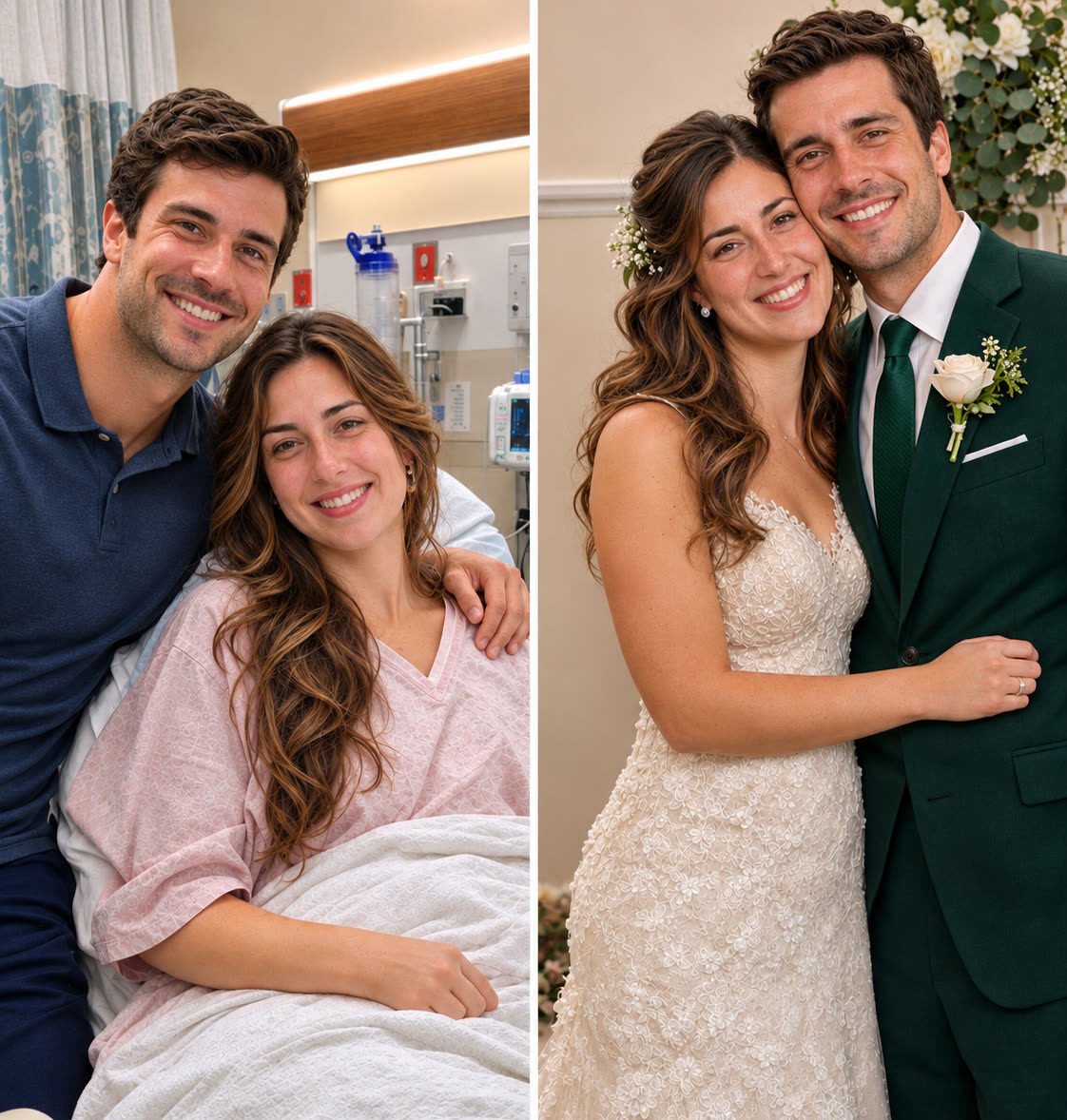
The kidney was barely a month old inside me when Nathan set a silver ring beside my dying fern and told me he was terminally ill. “Marry me.” I said yes, on one condition: no lies. Twelve minutes after the vows, he took my hand, drew me away from our guests, and whispered, “Now I can finally tell you the truth.”
The officiant had barely finished saying “husband and wife” when my new husband’s smile disappeared.
Not faded. Disappeared, like someone had yanked a plug out of the wall.
Nathan took my hand, steered me two steps away from the applause, and put his mouth close to my ear.
“Now I can finally tell you the truth.”
My fingers went cold inside his. Behind us my brother Ben whistled through his teeth, and somebody popped a bottle of prosecco. The garden room behind Kessler’s Tavern in Dayton, Ohio smelled like eucalyptus and spilled bubbly, and I stood in the middle of it unable to feel my own feet.
To understand why a whisper could do that to me, you have to know how I ended up standing there at all.
A year earlier, I was thirty-one years old and sure hospitals were places other people went. I kept the books for a family-owned plumbing supply company, paid a mortgage on a two-bedroom bungalow on Linden Street, and drove a Honda with a check-engine light I had learned to ignore. My body had never given me a reason to think about it.
Then my ankles swelled, my head ached every afternoon, and a nurse practitioner looked at my lab results for a long time before she said the word failure.
Within a month my life was a schedule. Dialysis at the Riverbend center on Tuesdays, Thursdays, and Saturdays, with my chair booked for 5:40 in the morning. A pill organizer the size of a tackle box. A phone full of alarms that went off at dinner, at bedtime, and in the middle of other people’s sentences.
I learned which nurse hummed and which one talked about her dog. I learned that people in waiting rooms never look directly at each other’s fear.
And I learned the thought that comes at the end of every week: maybe this is my life now. Forever.
The transplant team tested my family first. My mother held my hand while the coordinator explained blood types and antibodies, and I smiled the way you smile at a funeral for someone you barely knew. Ben joked that his kidneys were “premium stock, barely used.” Even Dad cracked a grin, though his knuckles were white on the armrest.
Then the results came back, one envelope at a time. Not a single match.
My mother cried in the parking garage so I wouldn’t see. I saw anyway, through the windshield, and pretended I hadn’t.
I went back on the national waiting list, which my doctor described as “long.” Dr. Patel had a way of choosing words that I learned to translate. Long meant years. Years meant maybe not enough of them.
Two months later, he walked into the dialysis center in the middle of my Thursday session with an expression I couldn’t read.
“Claire, we have a volunteer.”
I stared at him over the tubing. “A volunteer for what?”
“A living donor. Someone outside your family. He’s gone through the first round of screening, and he’s a match.”
“Who?”
He checked his notes. “A man named Nathan.”
The name meant nothing to me.
“A stranger wants to give me an organ,” I said slowly. “Why would anyone do that?”
“You can ask him yourself, if you both agree to meet.”
Three days later, I sat in a beige conference room at the hospital, gripping the arms of my chair, when the door swung open and a man walked in carrying two paper cups.
He was in his mid-thirties, with sandy hair that needed a trim and a crooked smile that looked like it had been put on to cover nerves. “Tea or coffee?” he asked.
“Coffee. Strong.”
He handed me the darker cup. I didn’t touch it.
“Why are you doing this?” I asked.
“Hello to you too.” His smile dimmed but didn’t quite go out. “I’m Nathan.”
“I’m serious.”
“I know you are.” He sat across from me. “Mara Ellis told me about you. We worked together a few years back. She mentioned you needed a transplant, and I thought, well, I’ll get tested. I figured the odds were nothing.”
“Lots of people need transplants.”
“Yes.”
“So why me?”
He looked down at his hands. “Because I matched. And after that, walking away would’ve felt like choosing not to help.”
“You don’t know me.”
“Correct.”
That was all he would give me. I decided to take it, because I was tired, and because the alternative was another year of Tuesdays.
Over the following weeks there were more scans, more consent forms, a psychologist who asked Nathan the same question six different ways, and endless chances for him to change his mind. He never did. He showed up to each appointment with the same two paper cups and the same terrible puns.
On the morning of surgery, a nurse found me hiding behind a privacy curtain in pre-op, crying into my gown sleeve. Nathan appeared a moment later, already wearing his own gown and a pair of mismatched hospital socks.
“Hey,” he said quietly. “You’re supposed to be the brave one.”
“You’re the idiot giving away a kidney.”
“One kidney.”
“Still an idiot.”
He pulled the curtain closed behind him and crouched so we were eye level. “Then you owe me something.”
I wiped my face. “What?”
“Use it well.”
The surgery worked. My new kidney woke up almost immediately, like it had been waiting for an invitation, and for the first time in months my skin had color.
Nathan, annoyingly, recovered faster than I did. He shuffled into my room on day two carrying contraband pudding in his gown pocket and sat on my windowsill like a man waiting for a bus.
After we were both discharged, he kept showing up. Sometimes with groceries. Sometimes with a paperback he swore I’d love. Once with a spindly fern in a plastic pot.
“You save my life and now you’re giving me homework?” I asked.
“Correct. Keep it alive.”
“I kill basil.”
“Then this is character development.”
Friendship arrived quietly, and then it sped up, the way it does between two people who have already shared something enormous before learning the ordinary things. I learned he hated cilantro and loved old Cincinnati Reds games on the radio. One evening rain trapped us under the awning outside my building, and neither of us suggested running for it.
The dangerous part was that I started wanting him around even when I didn’t need anything.
Exactly one month after the transplant, there was a knock on my door after dark.
No groceries. No book. No joke. Nathan stood in the hallway with both hands buried in his coat pockets, and the porch light made him look like someone I hadn’t met yet.
“Can I come in?”
I stepped aside. He walked past me, sat at my kitchen table, and stared at the fern for a long time before he said, “My doctors found something.”
Part 2: A Ring Beside a Dying Fern
“It’s still alive,” I said automatically, nodding at the fern.
“Barely.” Nathan tried to smile and couldn’t. “Claire, they found something during my follow-up testing.”
Every muscle in my body tightened. “Because of the donation?”
“No. It’s unrelated. They caught it while they were running extra bloodwork.” He finally looked at me, and his eyes were wet and steady. “It’s cancer.”
I sat down. I don’t remember choosing to.
“What kind?”
He told me, but the name slid right past me. I heard other words instead. Aggressive. Advanced. Terminal. Treatment might buy time, but it would not cure him.
“They don’t know exactly how much time I have,” he said.
I reached across the table, and he took my hand like he’d been waiting all day to hold on to something.
“Nathan, I’m so sorry.”
“I’m not telling you for sympathy.” His thumb traced the ridge of my knuckle. “I don’t want to spend whatever time I have left alone.”
“You won’t.”
He laughed once, without humor. “Careful. I might hold you to that.”
“I mean it.”
“So do I.”
He stood, reached into his coat, and set a small velvet box next to the sad fern. My stomach dropped through the floor.
“Nathan.”
“I know it’s fast.”
“Fast?” My voice cracked in half. “This is insane.”
“Probably.”
“You could be dying.”
“Exactly.” He opened the box. The ring was simple and silver, almost painfully ordinary, the kind of ring a person picks because it asks for nothing. “That’s why I’m not waiting. Marry me.”
I stood so fast the chair scraped, and I paced to the sink with my back to him. Water dripped from the faucet. Somewhere down the street a dog barked at nothing.
“You can’t drop cancer on me and propose in the same breath,” I said.
“I know.”
“Do you?”
“I know I love you.”
I turned around. “Do you want a wife, or are you terrified?”
Nathan flinched, and then he did the thing that scared me more than the ring: he didn’t dodge.
“Both can be true,” he said.
It was the most honest thing anyone had said to me in a year, and that was exactly what made my chest hurt. I looked at the man who had stepped into my life before he even knew my middle name. I thought about the pudding in his gown pocket, the mismatched socks, his hand around mine at the curtain.
I also thought about dialysis chairs, and how little time cares about what is reasonable.
“I need one promise,” I said.
“Anything.”
“No lies. Not small ones, not kind ones, not ones you think are for my own good.”
He held my gaze. “No lies.”
I said yes.
We planned the wedding in three weeks. Small, because Nathan’s treatment wasn’t scheduled to start until after, and because neither of us wanted to count every meal as a last one. We booked the garden room behind Kessler’s Tavern, a glass-walled space with potted eucalyptus and twinkle lights that never quite worked on the left side.
My mother cried while altering the dress, and then cried while insisting she wasn’t crying. Dad kept asking whether Nathan was “sure,” and I kept answering that nobody is sure, which was probably not the comfort he wanted. Ben complained about his tie, his shoes, and the fact that the ceremony conflicted with a Bengals preseason game.
Mara Ellis came early and was in tears before the music even began. “He’s the best person I know,” she told me, clutching my wrists. “Everyone says so.”
I noted that, in the way you note something a second before you understand it.
On the morning of the wedding, I looked at Nathan across the hotel lobby and asked, “Are we doing this because we’re scared?”
He squeezed my fingers. “We’re doing this because we’re scared and because I love you.”
“Okay.”
“Okay.”
The ceremony lasted twelve minutes. I know because Ben timed it on his phone, and when we signed the license he whispered, “Efficient.” Nathan laughed, a real one, and for a moment I believed everything was going to be all right.
Then the officiant said the words, and the guests clapped, and I turned toward my husband expecting relief.
His smile vanished so completely my stomach dropped.
He took my hand, leaned in, and said it. “Now I can finally tell you the truth.”
“What truth?” I whispered.
He glanced at the doors. His jaw worked. “I have a daughter.”
The room seemed to shrink around me, the twinkle lights blurring.
“What?”
“Her name is Sophie. She’s twelve.”
I stared at him. “You have a twelve-year-old daughter, and you waited until after we got married to tell me?”
“I meant to tell you sooner.”
“You promised me no lies.”
“I know.”
“Where is she?”
“With her grandmother, my ex-wife’s mother, Dolores. Sophie stays there during the school week. I have her most weekends and part of every summer. Her mother hasn’t been consistently in her life since the divorce.”
“Does Sophie know about me?”
“Yes.”
That answer hurt worse than the first. “So your daughter knew I existed. And I didn’t know she did.”
He rubbed his face with both hands. “She knows about the transplant. She knows about us. She refused to meet you.”
“Why?”
“Because she thinks I replaced her.”
I laughed, sharp and ugly. “Did you?”
“No.”
“Then why hide her?”
“Every time I brought you up, she got upset. Then the diagnosis happened, and I panicked. I kept telling myself I’d find the right moment. And every day I waited, telling you got harder.”
“So you married me to solve a problem with your child?”
“You married me without knowing the facts,” he said, then winced. “I know. That’s not an excuse. I thought if we were married, maybe Sophie would understand you weren’t temporary.”
I stepped back until my heel hit the base of a eucalyptus pot. “You used our wedding to force an introduction.”
“No. I married you because I love you.”
“And you used our wedding to force an introduction.”
He didn’t answer. That was answer enough.
I walked out through the side door while the guests were still clinking glasses. The September air hit my bare shoulders like a slap. Nathan caught up with me in the gravel parking lot, out of breath.
“Please don’t leave like this.”
I turned around. “Sophie isn’t ready,” he said quickly. “She’ll panic. She’ll shut down. Let me handle it.”
“Stay.”
“What?”
“Stay right here. For once, don’t decide what happens next.”
He stopped as if I’d put a hand on his chest.
I held out my palm. “Give me her grandmother’s address.”
His face tightened. “Claire, you don’t understand how she gets.”
“You’ve made too many decisions for other people, Nathan.”
He looked at me for what felt like a full minute. Then, slowly, he unlocked his phone.
Part 3: The Girl on the Porch Steps
Dolores Whitaker lived twenty minutes away in Kettering, in a pale-yellow ranch house with a ceramic goose on the porch wearing a tiny raincoat.
I drove there in my wedding dress, the seatbelt digging into my ribs, the veil crumpled on the passenger seat like a surrendered flag. At a red light, a man in the next car looked at me, looked at the dress, and mouthed, “You okay?”
I gave him a thumbs up. It was the least convincing lie I told that day, and I’d already been lied to once.
An older woman opened the door before I knocked twice. She wore a gray cardigan and reading glasses on a beaded chain, and she looked at my dress without surprise.
“You must be Claire.”
“Is Sophie here?”
She nodded. “She doesn’t want to talk to you.”
“I figured.”
“Nathan called.”
“Of course he did.”
She almost smiled, and then thought better of it. “You can sit on the steps. I won’t make her come out.”
“I wouldn’t want you to.”
So I sat on the concrete steps in a ten-hundred-dollar dress with the goose looking down at me. A sprinkler ticked in the neighbor’s yard. The sky went from gold to pink.
Ten minutes passed. Then fifteen. I thought about leaving, about how absurd I looked, about my parents standing in a garden room wondering what happened to their daughter. I thought about my kidney, which I had never once asked to be anything but grateful for.
Then the screen door creaked behind me.
“This is weird,” a girl said.
I turned. Sophie stood in the doorway in a gray hoodie and soccer slides, her dark-blond hair yanked into a ponytail. She had Nathan’s gray-blue eyes and the same unimpressed look he wore when I tried to explain why a fern deserved water.
“Probably,” I said.
She crossed her arms. “Did you marry my dad because you felt sorry for him?”
I could have lied. A kind lie would have been easy: of course not, sweetheart, I love him. But I had just walked out of my own wedding because of lies, and I wasn’t going to start a new relationship with another.
“Fear affected the timing,” I said. “We both made decisions fast because we were scared. But no. I didn’t marry him out of pity.”
Sophie studied me for a long moment. She was twelve, but her eyes were older than that.
“Then why did he give you part of himself before he even knew you?”
I opened my mouth. Then I stopped, because I realized her anger wasn’t really pointed at me. It was fear in armor.
“You think he’ll keep giving away pieces of himself,” I said slowly, “until there’s nothing left for you.”
Her face changed, just slightly. A crack in the shell.
“Everybody thinks he’s amazing,” she muttered.
“He is.”
“See?”
“And you have every right to be mad at him.”
She sat down on the step beside me, leaving a careful foot of space. We both watched the sprinkler.
“He fixes everybody’s problems,” she said. “The neighbors. His friends. People from work I’ve never even met. Somebody calls at midnight and he’s already finding his keys. Everybody says he’s so generous.” She picked at a thread on her sleeve. “Nobody asks what it costs us.”
I looked down at the silver ring on my finger. I had loved Nathan’s generosity because I had benefited from it more than anyone alive. Sophie had been paying for it for years.
“That sounds lonely,” I said.
She shrugged, which was a yes.
“He should have told me about you,” I said. “That part is not your fault, and it’s not mine. It’s his.”
“Obviously.”
“And he should stop treating love like it’s something you do alone and announce later.”
Sophie snorted. “Good luck with that.”
“I’m not here to make you like me,” I said. “I just wanted you to know I know you exist. Fully. That you aren’t a secret, and you aren’t a problem to be solved.”
She didn’t answer. But she didn’t go inside, either. We sat there another ten minutes without talking, and it was the first honest silence I’d had all day.
When I stood to leave, she said without looking up, “He doesn’t sleep much. Since the doctors.”
“I’m not surprised.”
“Are you going to be okay?”
I thought about that for a second. It was a better question than anyone had asked me in months. “I don’t know. Are you?”
Sophie almost smiled. “Ask me later.”
I drove back to Kessler’s with the windows down and the sun nearly gone. The party was technically over, but nobody had gone home. My parents stood near the empty tables with their coats still on. Ben had loosened his tie and was sitting on a chair backward, looking uncharacteristically serious. Mara sat with both hands wrapped around an untouched glass of champagne.
Nathan waited by the garden doors, pale as paper.
My mother came toward me first. “Are you all right?”
“No.”
Her eyes moved to Nathan. “What happened?”
Nathan opened his mouth.
“Not you,” I said.
His jaw closed. A plate rattled on a nearby cart, and every face in the room turned to me.
I took a breath, looked straight at my husband, and said what I should have said at the altar.
“Tell them. All of it.”
Part 4: Ask Your Family First
Nathan’s face went the color of the tablecloths.
“Claire—”
“You wanted to decide when everyone learned the truth,” I said. “You don’t get to do that anymore.”
Silence settled over the room like dust. A bulb flickered on the left side of the twinkle lights, then caught.
Nathan looked at my parents, then at Ben, then at Mara, who wouldn’t meet his eyes.
“I have a twelve-year-old daughter,” he said. His voice was rough. “Her name is Sophie. And I married Claire without telling her.”
My mother’s expression went through three stages. Disbelief first, then something close to grief, and finally the cold, quiet anger that I’d only seen twice in my life.
“You let my daughter make a legal promise to you,” she said, “without giving her the truth.”
Nathan looked at the floor. “Yes.”
Nobody rushed to comfort him. Not Mara, who pressed her lips together. Not Ben, who for once had no joke. Dad stepped up beside my mother and folded his arms.
“Why?” he asked.
Nathan’s jaw tightened. For a second I thought he’d reach for a polished answer, the way he reached for coffee orders and fern pots and the right thing to say. He didn’t.
“I told myself I was protecting Sophie,” he said. “Then I told myself I was protecting Claire. Really, I was making sure nobody had the chance to tell me no.”
The words landed in the room with weight. Mara exhaled shakily.
I walked closer. “Our marriage continues only if this stops.”
Nathan met my eyes. “What stops?”
“You deciding what everyone needs, then calling it love.”
He closed his eyes for a second. “Sophie said something like that.”
“Then maybe you should finally listen to her.”
He nodded slowly. Then he turned to my family, one at a time.
“I’m sorry,” he said. “Not because I got caught. Because I took away Claire’s choice. I took away yours, too.”
“Then give it back,” my mother said. She didn’t say it was okay, and she didn’t unfold her arms.
Nathan looked at me, and for once he didn’t guess what I wanted.
“Claire,” he said, “do you want me to leave?”
It was such a small question. It was also the first time he’d asked me one without already knowing the answer he hoped for.
“No,” I said. “But you’re going to learn to ask.”
The months that followed were messy.
Sophie called me Claire, never anything else, and I never asked her to. She slept over twice, then refused to visit for three weeks, and I learned not to chase. Nathan kept his weekends with her even when a neighbor’s flooded basement or a coworker’s broken-down truck tried to swallow them. When one of his appointments conflicted with her recital, he asked Sophie which she wanted him to attend, then listened to the answer even though it cost him a favor and a cranky text.
He stopped deciding what she could handle about his illness and started asking what she wanted to know. Some nights that meant a long conversation at the kitchen counter. Other nights it meant eating cereal in silence while she did homework beside him.
He also stopped managing my pills. One morning he reached for my organizer and I put my hand over it.
“I can handle my own medication schedule,” I said.
“I know.”
“Then practice knowing it.”
He took his hand back. Slowly, like it hurt, but he did.
Treatment was hard. Some scans brought hope, and others brought more questions. His doctors never took back the word terminal, and nothing about Nathan’s future became certain enough for us to relax completely. Some nights I lay awake listening to him breathe, and some nights he did the same for me.
But something else changed. He stopped treating uncertainty like permission to make everyone’s choices for them. The not-knowing, which could have swallowed us, became the thing we sat inside together, out loud, at the table.
That next summer, the three of us had a picnic in the garden room behind Kessler’s, the glass walls propped open to the warm air. The twinkle lights were off and the eucalyptus had survived, which was more than I could say for my first fern. Nathan had since bought me a second one, and it was thriving on my windowsill, almost smug about it.
Sophie handed me a gift bag with tissue paper stuffed in the top. Inside was a chipped, cheap mug with block letters across the side: WORLD’S MOST COMPLICATED STEPMOM.
I laughed so hard I had to put it down.
“Don’t get smug,” Sophie said, pointing at me. “Yours is worse.”
She slid a second mug across the blanket to her dad. His read: ASK YOUR FAMILY FIRST.
Nathan stared at it for a long moment, his thumb brushing the lettering. His eyes were wet, but he was grinning.
“Fair,” he said.
“Very fair,” Sophie said, and stole a strawberry off his plate.
I leaned my head against his shoulder. The breeze moved the eucalyptus leaves, and somewhere in the restaurant a radio played a Reds game, low and crackly. For once, Nathan wasn’t saving anybody. He was just a man sitting with his family.
“Claire,” he said quietly, so only I could hear. “Can I tell you something?”
I lifted my head. “You’re asking.”
“I’m learning.” His mouth twitched. “I’m scared. Most days. And I’m still here.”
I laced my fingers through his. “Now that,” I said, “is a truth I’ll take.”
Have you ever had to choose between forgiving someone quickly and making them earn it?
Disclaimer: This story is a work of fiction inspired by real-life themes. Names, characters, places and events are fictionalized, and any resemblance to real persons is purely coincidental. Images are for illustration purposes only.


