

Part 1: The Empty Refrigerator
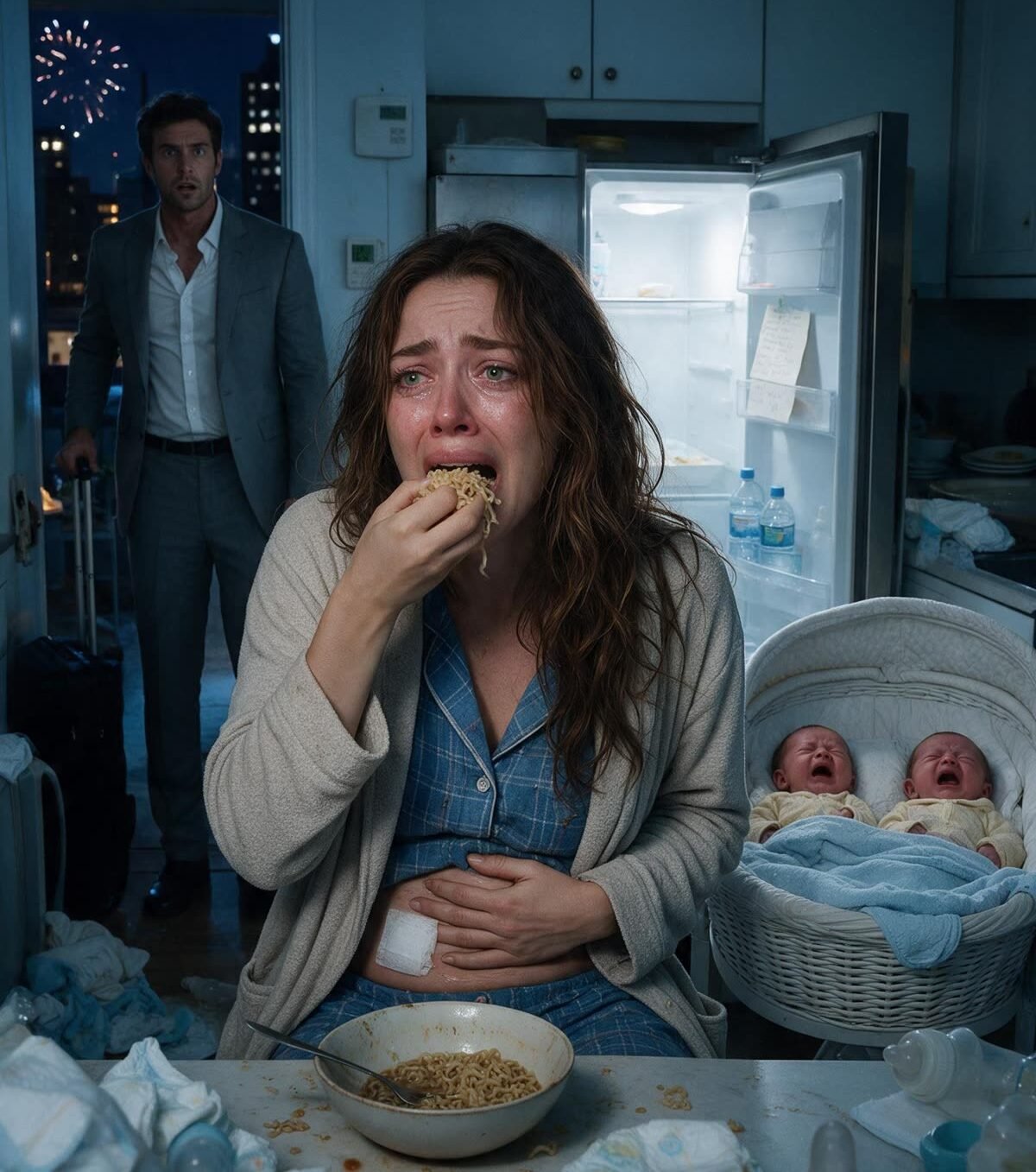
“Where are my wife and sons?” I called into the dark hallway, my key still hanging in the lock. Nobody answered. All I heard was a thin, ragged crying from the kitchen, two small voices that sounded close to worn out.
It was 11:34 p.m. on New Year’s Eve. I was supposed to be in Stuttgart until the sixth of January, signing off on a hydraulic press line for my firm. Instead I had rebooked, paid twenty-three hundred dollars for a last-minute seat, and landed at JFK without telling a single person.
I wanted to surprise my wife. Joanna was eleven days out from an emergency C-section, and I had never held our twin sons, Wyatt and Hudson, for longer than a video call allowed. My suitcase held thermal onesies, a healing balm from a German pharmacy, chocolates for my mother, and a bottle of perfume for my sister Bethany. I still believed everybody in that family deserved a gift.
Our apartment in Park Slope was freezing. The thermostat read fifty-six degrees. There was no music, no streamers, no champagne, not even a plate of leftovers, just a heap of used diapers, a half-empty tub of cheap formula, and a scatter of dirty glasses with lipstick on the rims.
I followed the crying into the kitchen, and my stomach dropped. Joanna sat on a hard plastic folding chair in thin pajamas and a faded cardigan, one hand pressed flat over her incision. A dark spot had seeped through the fabric. Her lips were cracked and her skin was the color of paper.
In front of her sat a chipped bowl of instant ramen, long gone cold, the noodles swollen into a gray clump. She was eating it with her fingers, fast and trembling, as if someone might take it away. Beside her, in a wicker bassinet under a blanket far too thin for December, Wyatt and Hudson were crying with the last of their strength.
“Gavin?” Joanna whispered, trying to stand. “Why are you home? Go rest. I’ll make you something to eat.”
Her knees folded. I caught her before she reached the tile, and she weighed almost nothing.
“Where are my mother, Bethany, and Trevor? Where is the food I paid for?” My voice cracked. “I wired them fourteen thousand dollars to take care of you!”
Joanna’s eyes dropped to the floor. “Miami. Just for a few days. I only wanted some soup, that’s all, so please don’t make a scene. Your mother says a woman after surgery should eat light, to cleanse her system.” I set her gently back in the chair and yanked the refrigerator door open.
The shelves were bare. The smoked salmon, the prime rib, the chicken broth, the fruit, the milk, the vitamins, even the twins’ prescription formula, all of it was gone. Taped inside the door was a note in my mother Margaret’s sharp, slanted handwriting.
We’ve gone to South Beach to ring in the New Year with Bethany, Trevor, Preston and his family. Make do with what’s in the pantry. Don’t go crying to Gavin and playing the victim. He works hard for all of us.
Joanna gripped my sleeve with a hand that shook. “Please don’t confront her. She’ll say I turned you against her.”
I didn’t shout. My anger was too big for noise. I photographed the empty shelves, the cold bowl, the stain on her cardigan, and the note, one clear picture after another.
Then I tucked both boys against my chest beneath my winter coat, wrapped my free arm around Joanna, and walked us out of that kitchen. Her slippers scuffed the hallway floor, and I realized she hadn’t worn real shoes in days.
In the cab to the hospital, fireworks bloomed over the Manhattan skyline across the East River. Joanna shivered against my shoulder, her forehead hot with fever. Somewhere between the Gowanus Expressway and the emergency entrance, I opened my banking app and canceled every authorized card linked to my account, the ones my mother, my sister, and her husband Trevor used every day.
At that hour, they were clinking glasses at a five-star resort in South Beach, sure my paycheck was a bottomless well. My phone buzzed against my ribs at 12:03. It was a text from Trevor: Your cards just died at the bar. Fix it fast, Gavin, or I make a few calls about your firm.
Part 2: The Receipts
Dr. Patel came through the emergency room doors wearing the careful face doctors put on when they’ve decided to be honest.
“Your wife has severe malnutrition, dangerously low blood sugar, an infection in her surgical wound, and early signs of postpartum depression,” she said. “If you had brought her in a few hours later, she could have slipped into a coma.”
“Your sons are warm and being fed. Both were mildly hypothermic and dehydrated. They’ll be fine.”
I didn’t argue. For months I had worked fourteen-hour days in Germany, convinced that wiring money was the same thing as showing up. Sitting under those buzzing hallway lights, I understood that my absence, and my blind trust, had nearly cost me my wife.
At 3:00 a.m. I pulled up my bank statements. The fourteen thousand dollars meant for a night nurse, groceries, and follow-up care had turned into five first-class tickets to Miami, an oceanfront suite, spa packages, lobster dinners, and a VIP table at a New Year’s party.
Then I opened the camera app for our apartment. Three days earlier, the kitchen camera had caught my mother and Bethany loading our refrigerator into heavy coolers. Joanna stood bent over beside them, one hand on her stomach, begging.
“Please, just leave the babies’ formula,” she said on the tape.
“Don’t be dramatic, Joanna,” my mother’s voice answered, crisp and bored. “You have bread and instant soup. All this expensive food will spoil while we’re gone.”
Trevor drifted into the frame with a rolling suitcase, smirking. “And don’t even think about calling Gavin. You’ll stress him out on his trip, and he’ll see what a high-maintenance wife he married.”
I saved every clip and sent them to Spencer Hale, my closest friend since college and my attorney. He replied at 3:09 with one line. Don’t talk to them. Don’t text them. Let me work.
By 10:00 on New Year’s morning, the declined-card alerts started firing in Miami, first at a resort spa, then a brunch spot, and finally at the hotel checkout desk. My phone filled with missed calls and frantic messages. I ignored Trevor’s threat and sent a single text to the family group chat.
Joanna is in the hospital. The money I sent for her recovery was taken. Every account is frozen while my lawyer gathers the evidence.
Two days later they limped back to New York, after Bethany pawned a diamond bracelet just to settle the hotel bill. My mother made a scene in the lobby of our building, announcing to every neighbor that she had raised an ungrateful, heartless son. Trevor stood beside her and told anyone who’d listen that Joanna was faking her illness to turn me against my own blood.
I asked the building manager to switch on the big screen in the residents’ meeting room. In front of the neighbors and relatives who had gathered to watch the show, I played the bank logs, the doctor’s certified diagnosis, and the unedited security footage.
When my mother’s voice filled the room, telling a woman fresh from surgery to live on instant soup, nobody spoke. Mrs. Okafor from 3C, who had knocked on our door all week with no answer, pressed her hand over her mouth. Every person who had come to defend my mother stared at their shoes.
Trevor didn’t back down. That night he posted a long rant on Facebook, claiming Joanna had postpartum psychosis, that she had thrown away perfectly good food in a rage, and that I had thrown an innocent old woman out into the cold. He attached a chopped-up video clip and photos of my mother crying.
By morning, strangers were flooding Joanna’s accounts with vicious comments. She read them from her hospital bed with the twins asleep in the clear bassinet beside her, and she did not fall apart.
“I’m done hiding,” she said, in a voice firmer than any I’d heard from her. “Publish everything.”
With Spencer guiding us, and with Joanna’s signed consent, we released the full unedited video, the itemized statements, and the hospital’s evaluation. Within hours the story flipped. The comments that had attacked her now apologized to her.
Then Spencer called, and his voice had changed. “Gavin, I just got off the phone with the District Attorney’s office. Are you sitting down?”
Trevor had been running a scheme for months, he explained. He had collected tens of thousands of dollars from families across New Jersey and Connecticut by selling them forged sponsorship letters on my firm’s letterhead. He had copied my signature and faked company seals. My text about frozen accounts had made him think I’d found out, and that was why he had launched his smear campaign so fast.
The next morning Spencer set a thick folder on my desk and looked at me gravely.
“The arrest warrant is signed,” he said. “But when they pull him in, something is going to come out that nobody in your family is ready to hear.”

Part 3: The Recording
Trevor was arrested at 6:40 the next morning in a cheap motel off the Belt Parkway near JFK. Officers carried out a duffel bag holding three fake IDs, stamped contracts bearing my firm’s name, a ledger of victims, and a phone full of messages where he bragged about charging ten thousand dollars a head for sponsorship letters that did not exist.
That afternoon Bethany walked into the hospital lobby, dragging her six-year-old son, Owen, by the hand. She wasn’t wearing designer clothes anymore. A gray hoodie hung off her shoulders, and her mascara had run all the way down to her jaw.
“Gavin, please,” she said, dropping into a chair. “Trevor owes money to dangerous people. Men came to my door last night. Mom fainted when the police took him.”
“He committed fraud,” I said. “He can answer to a judge.”
Bethany didn’t argue. She slid onto her knees in front of me and held out her phone with shaking hands. “I found something. Just listen. Please.”
The night before the arrest, Trevor had come home drunk and fallen asleep in his clothes. Bethany had gone through his phone, and she had recorded the end of a call he’d taken in the bathroom with the fan running.
“Once I squeeze enough cash out of Gavin to make these charges go away, I’m selling everything and disappearing to Mexico,” Trevor’s voice sneered through the speaker. “Bethany’s a fool. I married her to get close to her brother’s money. And Margaret? All I had to do was keep whispering that Joanna wanted to take her place as head of the family. The old woman did the dirty work herself.”
A woman’s voice, low and amused, asked why he’d worked so hard to split Joanna from Gavin’s mother.
“Because if Gavin divorced her, Margaret would control the apartment, the family trusts, and every allowance Gavin sends home,” Trevor said. “Put newborn twins in the middle and we could bleed that man dry for eighteen years.”
Bethany wept so hard her shoulders shook as she pulled Owen into her lap. For the first time in her life she saw that she had spent years being cruel to her sister-in-law to protect a man who saw her as a key to my bank account.
Joanna listened from a wheelchair beside me, a hospital blanket over her knees. She had insisted on coming down to hear it with her own ears.
“I’m not asking you to forgive me,” Bethany said to her, barely audible.
“Good,” Joanna answered quietly. “Because I’m not ready to. But I will never let fear run my home again. After today, you decide what kind of mother you’re going to be.”
Bethany handed the audio file to Spencer and agreed to give a full statement to the police. She also gave us access to a private account Trevor managed from his phone. Inside were receipts for paid online trolls, wire transfers to gossip blogs, and a draft of a second smear campaign.
The draft accused me of hurting my own mother. Trevor planned to use old photos of bruises she’d gotten from a fall the year before. He hadn’t cared who got hurt, so long as I paid his debts.
That evening Joanna asked to record a short video from her hospital room. Sitting beside the twins’ bassinet, she held up her medical chart, her patient wristband, and her admission papers. She didn’t insult my mother or Bethany once.
“I stayed silent for years because I didn’t want to break up a family,” she said into the camera. “And I almost left my newborn sons without a mother. No woman should have to starve, or be humiliated, to prove she’s a good daughter-in-law.”
The video was shared tens of thousands of times. Women answered with their own stories, hundreds of them, and Joanna read them late into the night. For the first time she understood that her silence had never kept the peace. It had only protected the people who were hurting her.
A few days later, relatives asked for a gathering at my mother’s apartment. My great-uncle Harold arrived determined to restore order, and he wasted no time.
“Drop the charges against Trevor and spare this family the shame,” he declared. “Family matters stay inside the family. A mother is still a mother, no matter her mistakes.”
Spencer quietly laid five fraud complaints from victimized families on the coffee table. I took out a small speaker and pressed play on Bethany’s recording. Trevor’s arrogant voice filled the living room, mocking my mother, calling Bethany a fool, and explaining how he had used my mother’s insecurity to isolate Joanna and reach my money.
My mother sat frozen on the sofa. For years she had bragged about her successful entrepreneur son-in-law while treating my wife like an unwelcome guest. She had handed her savings, her trust, and her authority to a con man who laughed at her behind her back.
“Did you hear that, Mom?” I said, standing over her. “You starved Joanna because he convinced you she was your enemy. He called you an old woman who did his dirty work.”
Margaret tried to answer. Her lower lip began to tremble in a way I had never seen. She lifted one hand toward her chest, her left side went slack, and she tipped sideways off the couch.
Relatives panicked and grabbed at her arms. Joanna, who had been discharged four days earlier and had insisted on coming so I wouldn’t face the family alone, stepped between them and pushed everyone back.
“Don’t move her!” she shouted. “It could be a stroke. Clear some space and call 911, now!”
And then she knelt on the carpet beside the woman who had left her hungry, and she put two fingers against my mother’s neck.
Part 4: The Woman with the Envelope
Before she had her twins, Joanna taught third grade, and her school had required her to complete advanced first-aid certification every two years. She loosened my mother’s collar, tilted her onto her side to keep her airway clear, and counted the minutes out loud for the paramedics.
The woman my mother had left hungry in a cold kitchen had just saved her life.
At the hospital, the neurologist confirmed a severe ischemic stroke brought on by a hypertensive crisis. Joanna’s quick action had made all the difference, he said. But my mother would live with weakness on her left side and slurred speech.
I stood in that corridor with my hands pressed against a wall, remembering my mother at my high school graduation, proud, upright, unstoppable. I did not know what to feel, so I felt all of it badly.
A few days later, Joanna walked into my mother’s room with the twins’ stroller parked in the hallway. Margaret saw her and began to cry without a sound. She struggled to say something, but all that came out were thick, garbled syllables.
Joanna took her hand. It wasn’t a dramatic embrace, only a quiet, steady hold.
“Focus on getting better, Margaret,” she said gently but firmly. “I don’t wish you any harm. But saving your life doesn’t mean I’ll ever let you run mine again, or have free access to my sons. Compassion does not erase what you did.”
Those quiet words carried more weight than any screaming match could have. My mother nodded once, slowly, and closed her eyes.
Out in the hallway, my aunt Diane cornered us, dabbing her eyes with a tissue. “Joanna, honey, surely the boys will come visit Grandma every week now? She’s all alone with her trouble.”
I opened my mouth to answer for her, the way I had answered for her a hundred times before. Then I closed it. For the first time all afternoon, I let Joanna decide.
“Not yet,” Joanna said calmly. “When I’m ready, and with Gavin beside me. Not before.”
Aunt Diane blinked, and then, to her credit, she stepped aside. It cost Joanna something to say it. I could see it in the way she gripped the stroller handle until her knuckles went pale.
Meanwhile, two board members at my firm asked for an urgent meeting after Trevor’s name appeared next to the company’s in a local news report. I slept three hours a night. I rehearsed explanations in the shower and in the car, afraid that I would lose a career I had spent fifteen years building over a crime I knew nothing about.
Weeks passed. The twins gained weight and learned to smile at the ceiling fan. Joanna’s wound healed, and she started going to therapy on Tuesdays, and she wouldn’t let me drive her there. She wanted to walk in alone.
Then one gray morning, a woman arrived at Spencer’s law office without an appointment. She wore a trench coat, her auburn hair tucked behind her ears, and she carried a folder, a USB drive, and a stack of property deeds for a parcel of land in Sullivan County, upstate New York.
Her name was Brenda, and she was Trevor’s secret girlfriend of two years. The second she said hello, I knew her voice. It was the low, amused one from Bethany’s recording.
Trevor had moved nearly a hundred and fifty thousand dollars of the scammed families’ money into accounts under her name and converted the rest into cryptocurrency. Now he was threatening her from county jail, through collect calls and a cousin, demanding she sell everything to pay for an expensive defense team.
“Why come to us?” Spencer asked, studying her over his glasses. “Why not hire your own lawyer and protect yourself?”
“Because I watched your wife’s video eleven times,” Brenda said, her hands twisting the strap of her bag. “And I realized I’d been part of the same silence she was talking about.”
She slid the USB drive across the desk. Then, just before leaving, she set down a separate sealed envelope and kept her fingers on it a second too long.
“This has nothing to do with the money,” she said quietly. “But it explains why Trevor was so desperate to keep Owen around.”
After the door clicked shut, Spencer slit the envelope open, read the first page, and set it down very slowly.
“Gavin,” he said, “you need to be the one to tell Bethany.”
Part 5: Twelve Years and One Year Later
Inside the envelope was a certified DNA report and a stack of old custody filings. Six-year-old Owen was not Trevor’s son, and he was not Bethany’s either. He was the son of Trevor’s late older brother and sister-in-law, who had died together in a car accident when Owen was a few weeks old.
Trevor had taken temporary guardianship of the orphaned baby. Then he met Bethany and invented a story that Owen was his biological child, abandoned by an ex-girlfriend. He knew my mother longed for a grandson to carry on her name, and he used a motherless infant as the key that unlocked my family’s sympathy and wallet.
I told Bethany at a quiet café near the hospital. She read the report three times before she let out a sound that turned every head in the room. She had spent six years raising that boy, enduring Trevor’s coldness, defending him, believing she was bonding with her husband’s child.
“So none of it was real?” she whispered.
“Your marriage was a lie,” I said gently. “But the love you gave Owen wasn’t. He’s innocent in all of this.”
Through the window we could see Owen at a corner table in his red jacket, coloring a dinosaur green and purple, completely unaware of the adult wreckage around him. Bethany wiped her eyes and pulled him into a fierce, careful hug.
“I’m not leaving him,” she said into his hair. “He already lost his real parents, and now he’s losing the man he thought was his dad. I’m going to be the mother he deserves.”
I did not forgive Bethany overnight, and neither did Joanna. But Bethany began making amends through her actions. She filed for divorce and surrendered any claim to Trevor’s assets. She took a job at a logistics company and cooperated fully with the DA’s office to help return stolen money to the victims.
She moved into the ground-floor apartment I rented for her and our mother, and she took over our mother’s daily care. She raised Owen under legal guardianship, and she never once used him as a reason to ask me for money.
Three months later, Trevor’s trial began. The courtroom was packed with families who had taken out second mortgages or emptied retirement accounts to buy his fake sponsorship letters. A woman in the front row clutched a church bulletin like a lifeline.
Trevor walked in wearing an orange jumpsuit, thin and gray-faced, the slick confidence he used to wear like armor completely gone. The handwriting analysis, the text messages, Brenda’s testimony, Bethany’s recording, and the forensic audit left no door open. His smear campaign against Joanna was entered as an aggravating factor.
The judge sentenced him to twelve years in state prison and ordered full restitution. As the officers led him away, he twisted around and mouthed at me, over and over, Think of the family, Gavin. Sign the waiver.
“The family died for you the night you left my wife on a kitchen chair while you spent her recovery money in Miami,” I said, so softly that nobody but Spencer heard me.
Seized assets and liquidations returned a large portion of the stolen savings. It could not erase what those families had been through, but it was something, and the woman with the church bulletin cried into her hands when the judge read the number.
I also sat in front of my firm’s executive board with the whole case laid out. For weeks I had feared losing my partnership. But the internal audit confirmed that my signature had been copied from private family documents I’d emailed to my mother years earlier.
It was a different kind of pain, knowing my own family’s trust had been used as a tool against strangers. The chairman shook my hand and told me I could stay. I told him I would stay, but in New York.
A year later, I spent New Year’s Eve at home in Brooklyn. I had turned down a permanent promotion in Germany and accepted a lower-paying regional director job based in the city.
I used to think that sacrificing my presence for a larger paycheck was the highest proof of love. Now I knew that a husband and father cannot delegate his family’s care, least of all to people who never respected his boundaries.
That afternoon we visited my mother in the small apartment I rented. She was still in a wheelchair. When she saw Joanna walk in, she shakily held out a box of bakery cookies and managed one soft, slurred, humble “thank you.”
Joanna took the box with grace and reminded Bethany about the physical therapy schedule. There was no movie-style embrace and no pretending that everything was forgotten. I paid my mother’s medical bills because that was my duty as her son, but no credit card carried her name, and she did not have a key to our door.
Bethany could call us in a real emergency, but she no longer had a say in how we raised our sons. Forgiveness, we had learned, doesn’t mean handing someone the same knife they once used on you.
Our apartment smelled of rosemary, warm bread, and apple cider. Wyatt and Hudson, one year old now and wobbling across the rug after a plush ball, shrieked with joy whenever one of them fell. Joanna had her strength back, and something steadier than before. She managed her own accounts, held a part-time remote consulting job, and no longer asked permission to say no.
At midnight we toasted with sparkling cider. Fireworks burst in color across the cold sky outside the living room window, and the twins clapped their chubby hands, one in my arms and one in hers.
“To a family where nobody has to bleed to be heard,” Joanna said, lifting her glass to mine.
I pulled her close and kissed her. I thought of the cold bowl of ramen, the bare refrigerator, and the note that had tried to demand obedience through isolation. For years I had confused family loyalty with endurance, and success with sending checks from thousands of miles away.
I learned the hard way that blood makes you related, but only mutual respect makes you a family.
Since that night I have kept one simple rule: anyone who hurts my wife or my children loses the right to hide behind the titles of mother, sister, or brother-in-law. You can help someone without handing them the keys to your peace. You can forgive without forgetting. And you can honor the family you came from without letting it destroy the family you built.
The next evening I came home from the office, unlocked the door, and stepped into a warm hallway with the radio playing low.
“Where are my wife and sons?” I called, grinning, my key still in the lock.
Two small pairs of feet came thundering down the hall, and Joanna’s laughter followed them, bright and unafraid.
Would you have forgiven Margaret and Bethany, or kept the door closed the way Joanna did?
Disclaimer: This story is a work of fiction inspired by real-life themes. Names, characters, places and events are fictionalized, and any resemblance to real persons is purely coincidental. Images are for illustration purposes only.


