

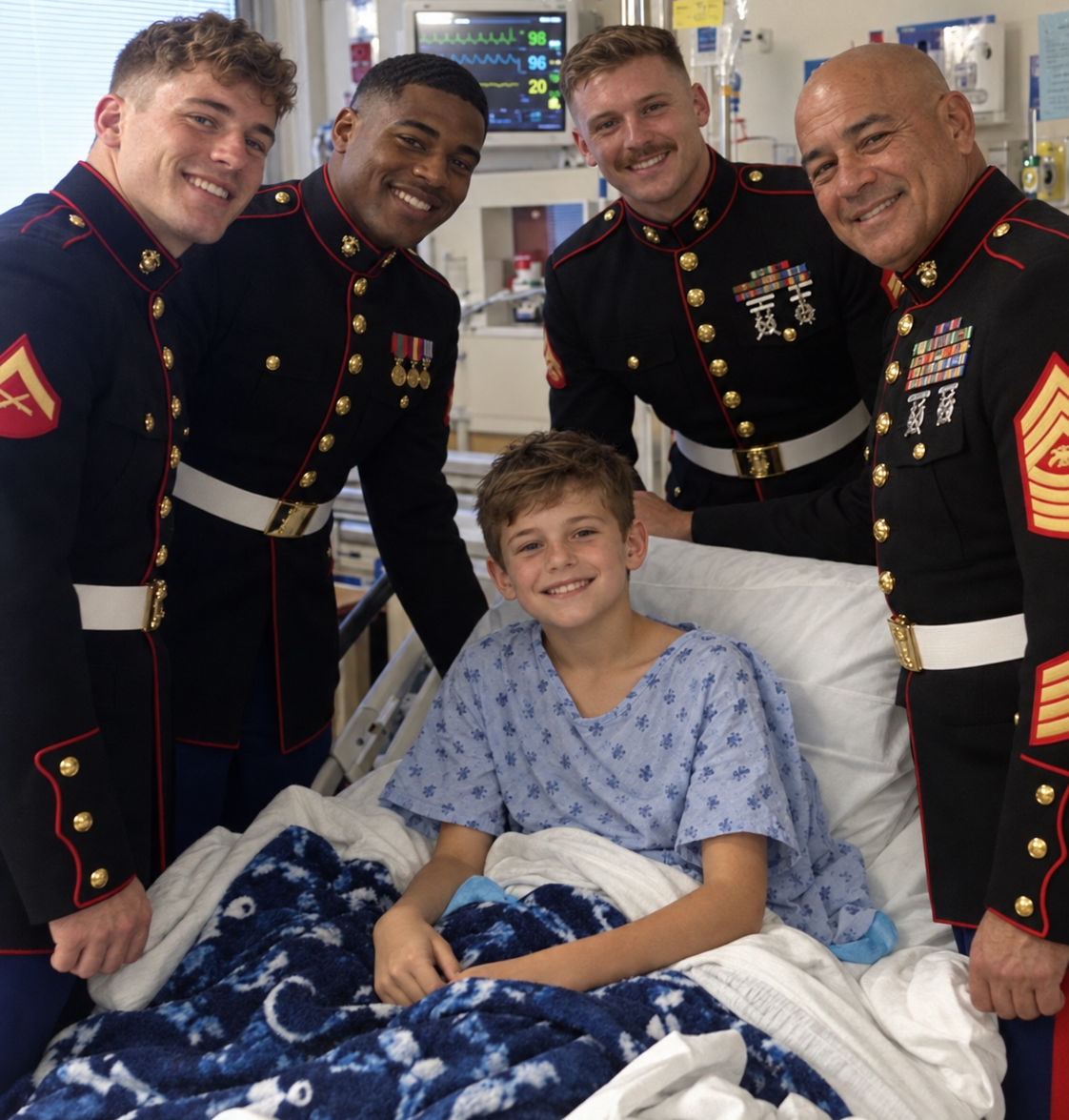
My son survived 7 hours of heart surgery, and then 4 Marines in dress blues appeared at his hospital room, saying they’d served with his late father. They brought a box of memories. But the youngest one was hiding something in his jacket, and when I saw what it was, I made a decision that nearly destroyed my son’s trust in me.
Part 1: The Men in Dress Blues
I thought I already knew what fear felt like.
I’d felt it the day two officers knocked on my door to tell me my husband wasn’t coming home. I’d felt it every time a cardiologist lowered his voice and said, “Let’s step into the hallway.”
But nothing prepared me for the seven hours I spent in a plastic waiting room chair while surgeons held my nine-year-old son’s heart in their hands.
When they finally let me see him, Caleb was propped against the pillows, his face the color of old paper. Wires ran from his chest to a monitor that beeped steadily beside the bed. And resting over his hospital gown, rising and falling with every shallow breath, were his father’s dog tags.
He hadn’t taken them off since he was four.
His eyes cracked open. “Mom. You’re doing the face.”
“What face?”
“The worried one.”
“I’m allowed,” I said, smoothing his hair. “It’s basically in my job description.”
He managed a weak smile. Then his fingers found the tags and rubbed the metal, the way he always did when he was scared and didn’t want me to know.
Nathan died overseas when Caleb was barely walking. Our son never heard his father’s voice outside of one grainy video, never felt his arms, never got to ask him a single question. Everything Caleb knew about his dad came from photographs, from my stories, and from those two thin pieces of metal on a chain.
But that was enough for him to build an entire dream.
For years, he marched around the living room with a broom over his shoulder. He saluted the flag at baseball games before anyone else stood up. He told every teacher, every dentist, every stranger in the grocery line the same thing.
“I’m going to be a Marine. Like my dad.”
Then his heart got worse. And one day, he just stopped saying it.
A few weeks before the surgery, I heard a thud from his bedroom. I found him on the floor beside his bed, arms shaking, face red, trying to do a push-up.
He couldn’t do even one.
I lifted him back onto the mattress, and he wouldn’t look at me.
“Mom,” he whispered, “would Dad be disappointed if I never get to wear the uniform?”
“Your dad loved you,” I told him. “Not a uniform.”
He nodded. But I could see it in his eyes. He didn’t believe me.
Now, in that hospital bed, he turned the tags over in his fingers.
“Do you think Dad would be proud I made it through surgery?”
“Baby, your dad was proud of you long before this.”
“Even though I’m kind of a mess?”
“He was a mess too,” I said. “Ask anybody who knew him.”
I had no idea how soon someone would take me up on that.
A soft knock. A nurse leaned into the doorway, smiling in a way I hadn’t seen the staff smile in a long time.
“Caleb, are you feeling up to some visitors?”
He glanced at me before answering. I understood why. For two years, almost every person who walked into his room came with a clipboard, a needle, or news neither of us wanted to hear.
“Depends,” he said. “Are they bringing another needle?”
The nurse laughed. “Not this time.”
“Then… maybe.”
“Visitors?” I asked. “Who?”
She didn’t answer. She just stepped aside.
Four men stood in the corridor.
They wore Marine Corps dress blues. White gloves. Brass buttons gleaming under the fluorescent lights. They stood so straight and so still that the whole hallway seemed to go quiet around them.
Caleb’s mouth fell open.
“Mom,” he breathed. “Those are Marines.”
The oldest of them, gray at the temples, stepped forward and removed his cover.
“Ma’am. I’m Sergeant Harris. We served with Nathan.”
My hand clamped onto the bed rail. For a second, the room tilted.
“You knew my husband?”
“Yes, ma’am. Every one of us.” His voice was low and steady. “We’ve brought something he wanted his son to have.”
After Nathan died, I’d run. I moved Caleb closer to my parents, changed my number, let the Christmas cards from his unit go unanswered until they stopped coming. It hurt too much to look at anyone who’d been there when I wasn’t.
Harris explained that a veterans’ support contact had heard about Caleb’s hospitalization and tracked us down.
“I wish we’d found you sooner,” he said quietly. “I’m sorry we didn’t.”
But Caleb wasn’t listening to any of that. He was staring at those uniforms like they were made of light.
“Did you really know my dad?”
“We really did, son,” Harris said. “May we come in?”
I looked at my boy. At the color slowly creeping back into his cheeks.
“Please,” I said.
They filed in and gathered around his bed, and Harris set a worn wooden box on the tray table.
“Your father asked us to keep these safe for you,” he said.
Caleb lifted the lid with trembling hands. Inside were photographs, a faded unit patch, a sealed letter, and a handful of small keepsakes I’d never seen.
He pulled out a picture and gasped.
“That’s Dad. He’s laughing.”
“He did that a lot,” the youngest Marine said, grinning. “Mostly at his own jokes. Which were terrible.”
Caleb laughed so hard the monitor jumped.
And for a while, I truly believed this was the best thing that could ever have happened to my son.
I was wrong.
Because the fourth Marine hadn’t laughed. He hadn’t said a word. He just kept staring at the box like something was missing from it.
And when Caleb looked up and asked, “Did my dad ever say anything else about me?” that Marine’s hand went to the inside of his jacket.
Then he turned and walked out of the room without a word.
Part 2: What Was in His Jacket
Caleb watched the door swing shut.
“Did I say something wrong?”
“No,” Harris said. Too quickly.
The other two Marines exchanged a look. The kind of look grown men share when they know something a child doesn’t.
“He talked about spending time with you,” Harris added. “All the time.”
It wasn’t an answer. Even Caleb knew it wasn’t an answer. He stopped turning over the photographs and just held them in his lap, his eyes drifting back to the empty doorway.
Whatever that young Marine had carried out of the room had suddenly become more important than everything they’d carried in.
“Keep looking through the pictures, sweetheart,” I said, standing. “I’ll be right back.”
I found him at the end of the corridor, by a window that looked out over the parking garage. His shoulders were rigid. His name tag read D. REYES.
“What happened in there?” I asked.
He didn’t turn around at first. When he did, his eyes were red.
“I’m Daniel, ma’am. And we left something out of the box.”
He reached into his jacket and pulled out a folded sheet of paper, soft at the creases from being opened and closed too many times.
He handed it to me.
At the top, in handwriting I would have known anywhere, in the slanted, hurried letters of the man I’d married, was one word.
Caleb.
My knees almost buckled.
Below it was a list.
Go fishing.
Go camping.
Teach him to ride a bike.
See the ocean.
Baseball game. Hot dogs. The works.
That was all. Five lines. Five ordinary things a father expects to do with his boy someday. Things most kids take for granted. Things Nathan had written down because he couldn’t wait to come home and do them.
But Nathan never came home.
And Caleb had just come out of a surgery that left him too weak to sit up on his own.
“He wrote it on deployment,” Daniel said. “Every night, he talked about coming home and making up for lost time. Before his last mission, he gave it to us. Said to keep it with the other things for Caleb, just in case.”
I couldn’t stop staring at my husband’s handwriting.
“Then why,” I said, my voice breaking, “didn’t you give it to him?”
Daniel looked down at his gloves.
“We fought about it. When we heard how sick he was, some of the guys thought it would destroy him. Seeing everything his dad wanted to do with him. Everything he might never get the chance to do.” He swallowed hard. “I said he had a right to know. That it was his. But I lost the vote.”
I read the list again.
Go camping. Caleb couldn’t walk to the bathroom without help.
Teach him to ride a bike. His doctors had banned anything that raised his heart rate.
See the ocean. We had no idea if he’d ever leave this hospital.
How could I hand my son a future written by a dead man, a future that might never come?
“What do you want me to do?” I whispered.
“He’s your son, ma’am,” Daniel said. “But Nathan wrote that for him. Not for us. Not for you.”
I folded the paper along its tired creases.
And I made a decision I would come to regret.
“Not yet,” I said. “Please. Not yet.”
Daniel didn’t reach for it. He just looked at me for a long moment.
“And if he asks you directly?”
I glanced back down the hall toward Caleb’s room. Through the closed door, I could hear him laughing at something the other Marines had said. A real laugh. The first one in months.
“Then I’ll tell him,” I said.
And I meant it. I just hadn’t decided when.
Daniel hesitated. Then he nodded once.
“Keep it safe.”
When I went back in, the Marines were saying their goodbyes so Caleb could rest. Each of them shook his hand like he was a grown man. Caleb didn’t stop smiling until long after they’d gone.
“Mom,” he said as I tucked the blanket around him, “did Dad really talk about what we’d do together?”
The paper was burning a hole in my purse.
“All the time, baby.”
For two days, Caleb barely let go of that box.
He studied every photograph. He held the patch against his chest. He read his father’s letter so many times the paper went soft.
On the second night, he asked me to read one passage aloud.
“I like hearing Dad’s words in your voice,” he said.
So I read it. My husband telling our son to be brave, to be kind, to take care of his mom. My voice cracked twice. When I finished, Caleb was smiling with his eyes closed.
I almost told him then. The words were right there on my tongue.
Instead, I asked if he wanted another pillow.
That night, after he fell asleep, I sat in the dark and unfolded the list again. I read it over and over, searching for one line, just one, that the doctors might approve. Something I could hand him along with a plan. Something that wouldn’t feel like a door slamming shut.
I told myself I was protecting him.
I told myself I’d show him once I had a way to make it hurt less.
That was easier than admitting the truth. I was lying to my son.
At midnight, I called Daniel.
“Could you help him try something from the list?” I asked. “Only if his doctors say it’s safe.”
“Of course,” he said. “Anything.”
He came to the hospital the next afternoon. We stood in the corridor just outside Caleb’s door, speaking in low voices about medical clearance, about which items might be possible, about how to break it to him gently.
I thought the door was closed all the way.
It wasn’t.
When we walked back into the room, Caleb was sitting upright in bed. Wide awake. Staring straight at me.
“What list,” he said, “are you talking about?”
Part 3: “I Want Daniel. Not You.”
I froze in the doorway.
Behind me, I heard Daniel stop breathing.
“Mom.” Caleb’s voice was very quiet. “Did Dad leave something else?”
There was no way out. There was no lie left that wouldn’t make it worse.
“Yes,” I said. “A list. Of things he wanted to do with you.”
“Can I see it?”
I pulled the paper from my purse and put it in his hands. He unfolded it slowly. Then he traced his father’s handwriting with one finger, line by line, the way you’d touch something you were afraid might disappear.
Go fishing. Go camping. Teach him to ride a bike.
His lips moved silently over each word.
Then he looked up.
“How long have you had this?”
I could have said recently. I could have said I was going to tell you. Both would have been half-true.
“Since the Marines came.”
His face crumpled.
“You hid it.” His eyes filled and spilled over. “You decided I couldn’t handle it.”
“Baby, I didn’t want to hurt you…”
“Mom, I know I’m sick!” His voice cracked straight down the middle. “I hear the doctors. I hear you crying in the bathroom when you think I’m asleep. How does hiding something Dad wrote make any of that better?”
“I thought I was protecting you.”
“From what?” he shouted, and the monitor beside him began to beep faster. “From Dad?”
I had no answer.
Because he was right. I had taken the last words his father ever wrote to him and locked them away, because I was the one who couldn’t bear to look at them.
“The Marines were worried too,” I said, my voice barely holding. “But I agreed with them. And that was wrong. I was wrong.”
“They barely know me.” He was sobbing now. “You know. You know how much I wanted anything about him. Anything at all.”
“I’m so sorry, Caleb.”
He wiped his face with the back of his hand, careful of the IV. Then he turned away from me, toward the young man standing frozen in the doorway.
“Daniel. Did my dad really want to take me fishing?”
“He did,” Daniel said softly. “He talked about it constantly. Drove us all crazy.”
“Would you take me?”
Daniel’s throat worked. “I’d be honored. If your doctors say it’s safe.”
“I’ll come too,” I said quickly.
“No.”
The word hit me like a slap.
Caleb clutched the list against his chest. “I want Daniel. Not you.”
I reached for his hand.
He pulled it under the blanket.
Daniel looked out the window, trying to give us a privacy that didn’t exist in that tiny room.
I stood there with my empty hand hanging in the air. Two years. Two years of appointments and procedures and sleepless nights in plastic chairs. Two years of holding his hand through every needle, every scan, every bad report. And now he was choosing a stranger he’d met twice.
I wanted to say all of that. I wanted to remind him who had been there.
But none of it erased what I’d hidden.
“Okay,” I whispered.
“I want to go as soon as possible,” Caleb said.
“We have to ask your doctors first.”
He let out a bitter little laugh I’d never heard from him before.
“See? Another excuse.”
That was when Daniel stepped forward and crouched beside the bed, putting himself at eye level with my son.
“Hey. Listen to me. Your dad trusted me to look out for you. That means I’m not taking you anywhere that isn’t safe.” He paused. “But here’s the deal. You ask the doctors. Yourself. And we’ll all listen to what you have to say.”
Caleb studied him through wet eyelashes.
“I get to talk?”
“First,” Daniel said.
The consultation was the next morning.
Caleb sat up as straight as his stitches would allow, the list folded in his lap. He asked every question himself, in a careful, serious voice that made him sound years older than nine.
Could he go fishing? Just for an hour?
The cardiologist was kind. But the answer was no.
His heart was still healing. He needed constant monitoring. No outdoor trips. Not yet.
“What if I sit the whole time?” Caleb asked. “I won’t even stand up.”
“I’m sorry, buddy. It’s not safe right now.”
He swallowed. Tried once more.
“What if it’s really close to the hospital? Like, really close?”
The doctor shook his head gently.
Caleb looked down. Then he folded the list along its worn crease, so slowly and so carefully that I knew he was fighting with everything he had not to cry in front of all of us.
I almost promised him we’d go when he got better.
But I couldn’t. I didn’t know if better was coming. I’d already broken his trust once. I wasn’t going to do it again with a promise I couldn’t keep.
“What can he do?” I asked instead.
“Short activities. Seated. When he feels strong enough,” the doctor said.
Daniel leaned toward Caleb.
“I’ve got your dad’s old tackle box. Kept it all these years. What if I bring it in and show you a few things?”
Caleb’s chin trembled. “I still want to go fishing for real.”
“I know,” Daniel said. “And we’re not crossing it off. Deal?”
A long pause.
“Deal. Bring it.”
Three days later, there was a knock at the door.
Daniel stood there with a battered green tackle box tucked under one arm.
But he wasn’t alone.
Behind him, in full dress blues, stood Sergeant Harris. And behind Harris, the other two Marines.
Caleb’s eyes went wide. “All four of you?”
“All four,” Harris said. He stepped inside, pulled a chair to the bedside, and sat down heavily.
His face was grave.
“Caleb, we owe you an explanation. There’s something your father made us promise before his last mission. Something we should have told you the first day.”
Part 4: The Knot
The room went very still.
Caleb’s hand drifted to his dog tags.
“Before Nathan shipped out on that last mission,” Harris began, “he sat us down. All four of us. He said if he didn’t make it home, we had to make sure you got his things.” He paused. “And then he made us promise something else.”
“What?” Caleb whispered.
“That if you ever wanted us in your life, we’d show up. We’d help you learn the things he wouldn’t be there to teach you.”
Caleb looked from one uniform to the next. His lower lip trembled.
“Then why didn’t you tell me before?”
It was Daniel who answered.
“Because we were scared, buddy. Scared the list would hurt you more than it helped. I argued that you should see it. Then I handed it to your mom and let her make the call so I wouldn’t have to.” He shook his head. “That was cowardly. I was wrong too.”
Caleb glanced at me. He didn’t say anything. But for the first time in four days, he didn’t look away either.
Harris laid his hand on the folded list. “We can’t promise you’ll get to do every single thing on here, son. Nobody can promise that. But we can promise we’ll listen to you. Every time.”
Caleb rubbed his father’s tags.
“Did Dad ask you because he thought I couldn’t do stuff by myself?”
“No,” Daniel said firmly. “He wrote that list long before you ever got sick. He wanted to teach you himself. That’s all he ever wanted.”
“Well, I can’t even do a push-up anymore.” Caleb’s voice cracked. “I wanted to be a Marine like him. Now I can’t be anything.”
Nobody spoke.
Daniel unlatched the tackle box. But he didn’t take anything out. He just rested his hands on the lid.
“Let me tell you something about your dad,” he said. “When I first joined the unit, I was the worst recruit they’d ever seen. There was this one training exercise I kept failing. Over and over. Everybody else finished and went to chow. I was so humiliated I told your dad to just leave me and go.”
Caleb leaned forward. “What did he do?”
“He sat down in the dirt next to me. Asked me to show him exactly where I was getting stuck.” Daniel smiled faintly. “I begged him to just do it for me. He wouldn’t. He stayed right there until I could do it myself.”
One of the other Marines snorted. “Nathan missed dinner that night. Complained about it for a week.”
“He did,” Daniel said, and his voice went rough. “Next morning, he told me, ‘Someday, somebody’s going to need your help. And then it’s your turn to stay.’”
Caleb stared at the tackle box.
Daniel cleared his throat. “So. You want to learn a knot?”
Caleb nodded. Then, quietly: “Can everybody stay?”
“Of course we can,” Harris said.
Daniel pulled out a length of clean fishing line. Harris held one end steady while Daniel showed Caleb how to loop the other, slow, step by step.
Caleb tried. The line slipped right through his fingers.
“That looked way easier when you did it,” he muttered.
“It looked easy when your dad showed me, too,” Daniel said.
For a second, relief flickered across Caleb’s face. Then he set his jaw, the exact way Nathan used to, and bent over the line again.
“Again.”
He tried twice more. His fingers trembled. His breathing went thin and shallow.
I was halfway out of my chair before I knew it.
Daniel saw me. But he didn’t take the line away.
“Let’s rest a minute,” he said.
“I want to finish.”
“We will. After a break.”
Caleb let the line drop into his lap, frustrated, eyes shining. The Marines stayed. They told stories about Nathan, about the time he got lost on a night march, about the care packages he shared with every guy in the barracks, until Caleb’s breathing slowed again.
Then he picked the line back up.
“Show me where I went wrong.”
Daniel pointed to the loop.
Caleb threaded it through. Pulled.
The knot held.
“I did it!” His whole face lit up. “I did it!”
Harris leaned in and examined it with exaggerated seriousness. “Looks Marine-grade to me.”
Caleb beamed. Then his eyes fell to the dog tags on his chest, and the light dimmed a little.
“But I still can’t be a Marine.”
Daniel didn’t argue. He didn’t lie to make him feel better.
“I know,” he said simply.
The room went quiet.
And then Caleb turned his head and looked at me. Really looked at me, for the first time since the day he found out.
“Mom. Do you know how to do this?”
“Not even a little,” I admitted.
“Want me to teach you?”
My throat closed. I could only nod.
I sat down on the edge of his bed. He handed me a second piece of line and showed me the first loop, the way Daniel had shown him.
I tangled it instantly.
“Mom! The other way!”
“Which way?”
“The way that’s not that way!”
He laughed. He actually laughed. And I laughed too, through the tears I couldn’t stop.
I tried again. He pointed to my mistake and waited. He didn’t take it from me. He didn’t do it for me. He just waited, patient as anything.
This time, my knot held.
Across the bed, Daniel had gone completely still.
“What?” Caleb asked him.
Daniel was staring at the line in my hands.
“That’s what your dad did for me,” he said, his voice barely there. “He didn’t take over when I got it wrong. He stayed. He stayed until I could show somebody else.”
Caleb looked from Daniel to me. Slowly, understanding spread across his face.
“So now it’s my turn to stay?”
Daniel nodded, blinking hard. “Looks that way, buddy.”
Caleb lowered his eyes to his father’s list.
I reached out and touched the edge of the paper, gently.
“I’m sorry I hid this from you,” I said. “I was so scared of what it might mean that I made the choice for you. That wasn’t mine to make. I won’t ever do that again.”
“I’m still mad at you,” he said.
“You’re allowed to be.”
He nodded slowly. He didn’t take my hand. But he didn’t pull his away either.
The Marines began gathering their things so he could rest. Harris promised they’d call before they visited next time, and that there would be a next time. Lots of them.
Just before they reached the door, Caleb spoke up.
“Mom? Can I have a pen?”
I handed him one.
He smoothed the list across his knees. Then, slowly, his small hand shaking from the effort, he wrote something beneath his father’s five unfinished dreams.
He held it out to me.
Below Nathan’s slanted, hurried handwriting, in my son’s careful pencil-thin letters, was a sixth line:
Teach Mom how to fish.
I couldn’t breathe.
Then Caleb picked up the fishing line and held it out to me.
“You still need practice,” he said.
I took it.
And my son pointed to the first loop, and waited, while I tried again.
[This story is a work of fiction inspired by real events. Names, places, and details have been changed, and any resemblance to real people is coincidental.]


