

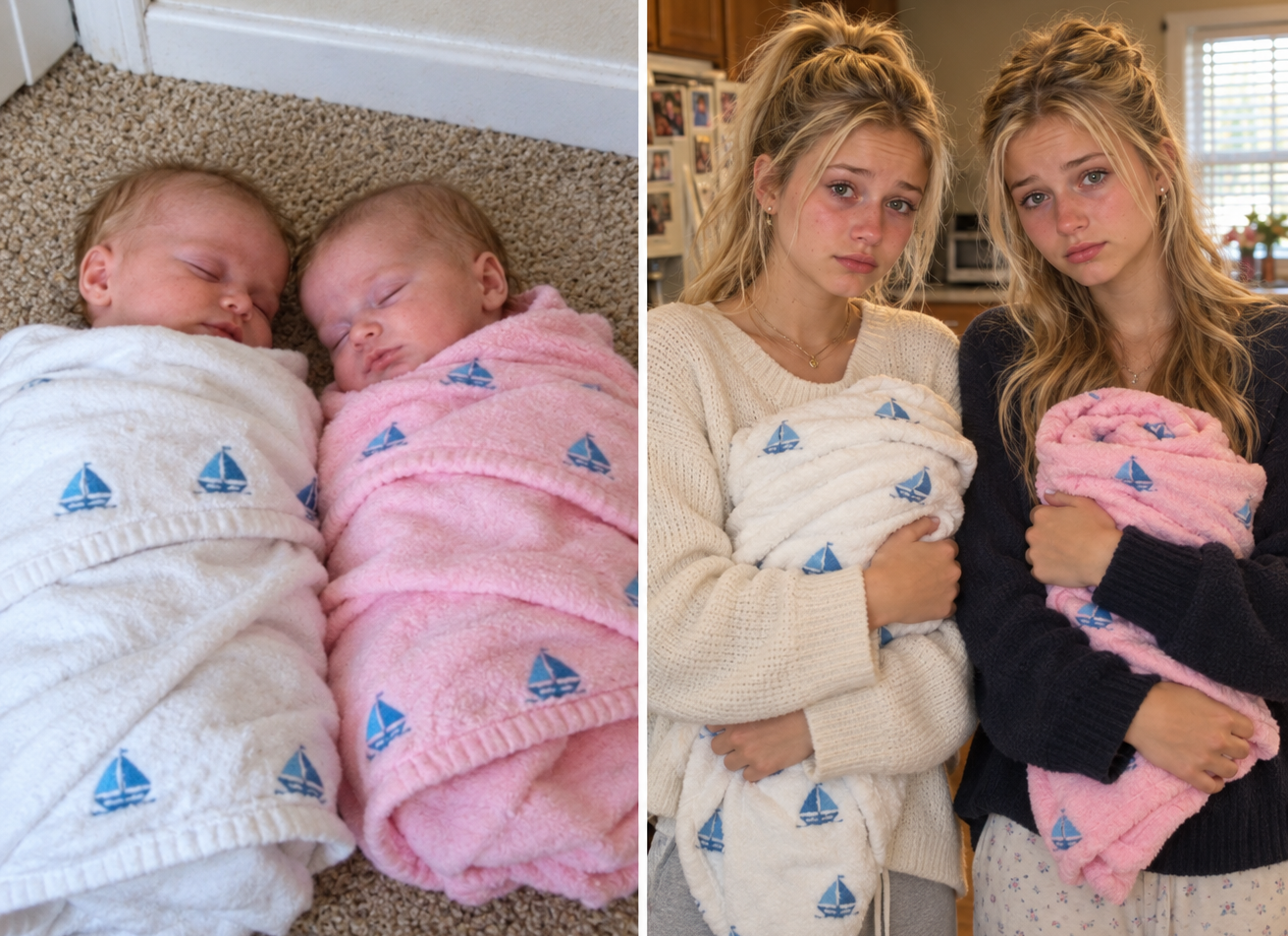
I never took my daughters back to the beach where I found them. I never said the name of the baby I lost before them. I thought silence was how I protected them. For three years they lied to me about where they were going and I was sure I knew why. I was wrong about all of that.
Part 1: The Scream Behind the Curtain
The night my daughters turned eighteen, they carried two faded beach towels down the stairs and placed them on the kitchen table as evidence in a trial.
“Dad,” Ivy said, taking my hand. “Please don’t hate us for what you’re about to see.”
I knew those towels better than my own scars. One white, one pink, both stitched with tiny blue sailboats along the hem. Eighteen years earlier, I found my daughters wrapped in these clothes on the floor of a locker room on a beach, three states from home, during the worst month of my life.
To understand why my hands were shaking before I even touched them, you need to know how I ended up on this beach.
Eighteen years ago, I buried my fiancée, Laura. She was thirty-six weeks pregnant. A blood clot that no one saw coming took her away in her sleep and our daughter went with her.
We had already named the baby Lily. We painted the nursery a pale yellow because Laura said babies deserve the sun before they can even see it. For weeks, she teased me about the corner by the window, where my roller had left an uneven mark.
“Every time she looks at that wall,” Laura said, “she’ll know her father tried.”
After the funeral, I stopped answering my phone. I stopped shaving. I stopped eating unless someone put a plate directly in front of me. Most of the time I would sit on the floor of the nursery and stare at the empty crib. Some nights I painted that crooked corner, as if doing it right could undo everything else.
Three weeks later, my best friend, Grant, came in with a spare key that I had forgotten.
He stood in front of the nursery door and observed everything. The blinds closed. The untouched casserole dishes piled on the counter. The paint tray drying on the floor.
“No,” he said.
“No what?”
“No to that. Pack a bag.”
“I’m not going anywhere.”
“Then I’ll pack it.”
“Grant, go.”
“You haven’t opened a curtain in three weeks, Owen.”
“It’s none of your business.”
“No,” he said. “But you are.”
“I didn’t ask to be saved.”
“Fine. I’m not asking permission.”
I hated him for that. I got in the truck anyway.
He drove nine hours to a quiet part of the coast where his family rented a cottage when we were kids. It was the end of September. The tourists were gone, the snack stand was closed, and the beach was empty except for seagulls and a row of weathered wooden changing rooms with faded canvas curtains.
We walked all afternoon without much. Grant didn’t push. He just stayed close to me, like he was afraid I was going to step in the water and keep going. Maybe he was right to be.
By sunset, I had had enough.
“I’m done,” I said. “Take me home.”
“Owen…”
“Take me home, Grant.”
I was already turning toward the parking lot when I heard it.
A thin and irregular cry. So small that at first I thought it was a seagull.
Then a second one, just above.
Grant stopped walking. “Did you hear that?”
I was already moving.
The noise was coming from the locker rooms. I drew the first curtain. Empty. Just sand and a broken plastic hanger. The second was the same.
I removed the third.
Two newborn babies lay on the sand, huddled side by side against the wooden wall. One was wrapped in a white beach towel, the other in a pink towel. Their faces were red and wrinkled, their little fists pushing the air. Someone had carefully folded these towels around them, the same way you would wrap something you can’t bear to let go of but can’t bring yourself to keep.
There was no bag. No bottle. No comments. No one on the beach in either direction.
For a second I couldn’t move. Three weeks earlier, I stood next to a coffin containing my daughter. Now there were two little girls in front of me, close enough to touch, and no one in the world was coming to pick them up.
Then my body moved before my grief could stop it.
“Grant! Call 911. Now!”
I knelt in the sand. The wind blowing from the water had become cold, and when I touched the baby’s cheek in the pink towel, it felt like glass.
“They’re freezing,” I said. “Tell them they’re freezing.”
I took off my jacket and draped it over them both, too afraid to pick them up, too afraid to hurt them. The baby in the white towel screamed until his face turned purple.
GOODI thought. Shout. Keep screaming.
Behind me, Grant was shouting our location into his phone, already running towards the road to signal whoever got there first.
I looked at the baby in pink.
She had cried a moment ago. Now she wasn’t.
His mouth was still open, but no sound came out. His eyes were half closed. And in the last orange light of the day, his lips took on a color I had only seen once before, three weeks ago, in a hospital room I would never stop seeing.
“No,” I whispered. “No, no, no. Not you too.”


