

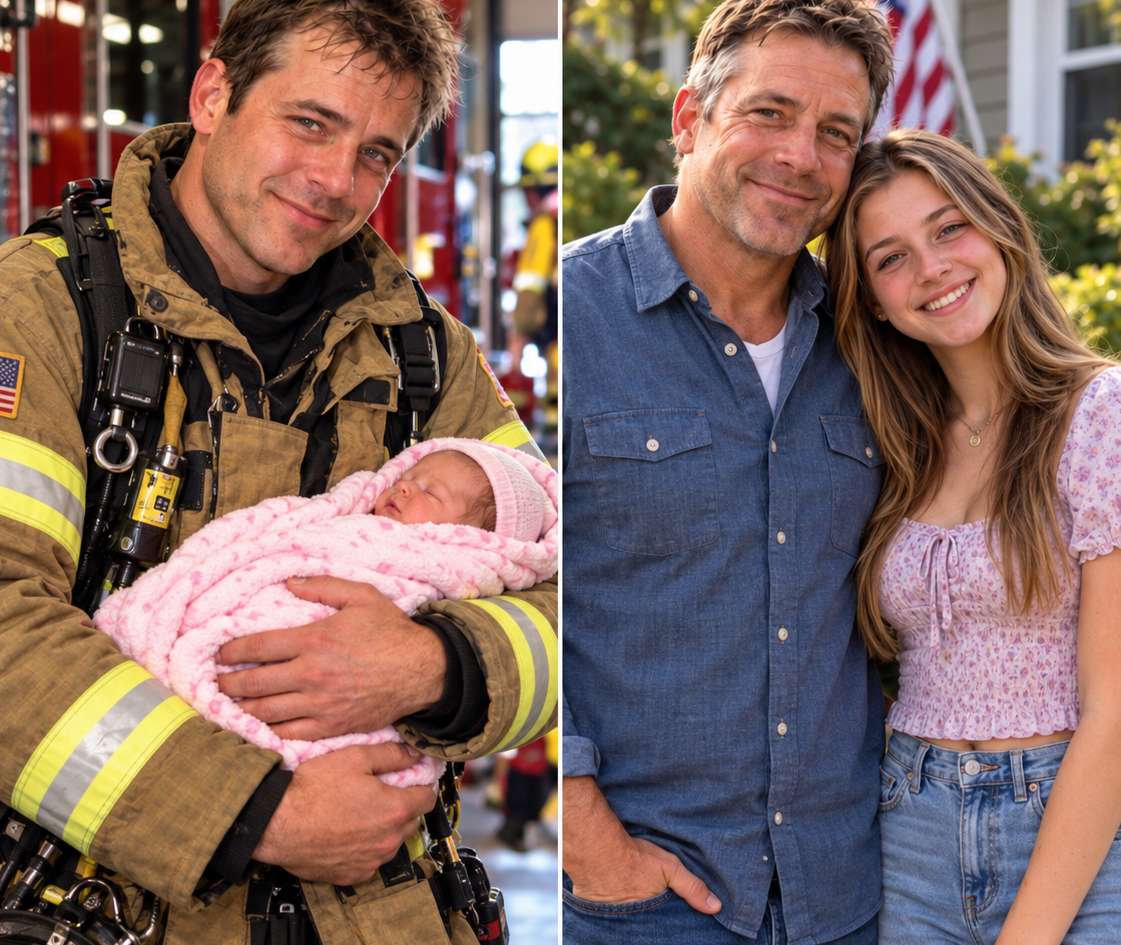
For seventeen years, the only thing my daughter and I knew about the night she was abandoned was a thin pink blanket and a cold concrete step. We made peace with not knowing. Then, on an ordinary Tuesday in March, a woman in a worn coat stood in my kitchen and told us the truth about her mother. Twenty minutes later, a woman in a designer coat walked in behind her and offered my daughter half a million dollars to sign it all away. She had three weeks before Hope turned eighteen. She didn’t plan on us finding the dying man upstairs.
Part One: The Cry Outside the Station Door
Seventeen years ago, I was halfway through an overnight shift at Station 9 when I heard it.
It was close to three in the morning. The rest of the crew was asleep in the bunk room, and I was sitting at the kitchen table with a cup of coffee that had gone cold an hour earlier, filling out a report on a dumpster fire nobody would ever read. The building was so quiet I could hear the clock over the sink.
Then, under the hum of the refrigerator, there was a sound.
Thin. Ragged. It rose and broke off, then rose again.
At first I thought it was a cat. We got strays sometimes, drawn by the warmth from the bay doors. But the longer I listened, the more wrong it sounded. No cat cries like that. No cat runs out of breath like that.
I set down my pen and went to the side door.
The cold hit me first. It was one of those February nights when the air feels sharp enough to cut your lungs. Then I looked down.
On the concrete step, tucked against the wall where the wind couldn’t quite reach, was a bundle wrapped in a pink blanket. The blanket was cheap and thin, the kind you’d find in a bin at a discount store. It couldn’t have kept out a stiff breeze, let alone a February night.
Inside it was a baby.
She was hours old. I’d seen enough newborns on calls to know. Her skin was still red and creased, her hair damp and dark, her face scrunched in pure fury at the world she’d just been handed.
I knelt down and picked her up. She weighed almost nothing.
And then she did something I have never been able to explain to anyone who wasn’t there. She stopped crying, worked one tiny hand free of the blanket, and wrapped it around my finger.
She held on like she’d decided something.
I’ve pulled people out of burning buildings. I’ve carried kids down ladders and held pressure on wounds in the back of an ambulance. I had never in my life felt as responsible for anyone as I did standing in that doorway, holding a stranger’s child against my chest to keep her warm.
Part Two: The Name I Gave Her
I woke the crew, and we did everything by the book. We checked her over, called it in, and I rode with her to the hospital, holding her the whole way because I couldn’t bring myself to hand her off.
The nurses took her from me in the emergency room, and I stood in the hallway in my turnout pants feeling like someone had taken something out of my hands that I hadn’t known I was carrying.
The police opened a case. They checked the cameras on the street, but the one that faced our side door had been broken for months, and nobody had gotten around to fixing it. They asked around the neighborhood. They put out a notice. Nobody came forward.
I told myself my part was finished. I’d found her, I’d gotten her help, and now the system would take it from there.
Then I found myself driving back to the hospital two days later. Just to check on her, I said.
Then again the next week.
The nurses started recognizing me. One of them, an older woman who’d been working the maternity floor longer than I’d been alive, started calling me “Firehouse” and letting me hold the baby during my visits. When I fed her a bottle for the first time, I spilled formula all over my shirt, and the nurse laughed so hard she had to sit down.
Weeks passed. Nobody claimed her. She went to a temporary foster placement, and I kept visiting. I filled out paperwork I didn’t fully understand. I sat through a home study. I bought a crib and put it together wrong twice.
I was thirty-four years old, single, and worked twenty-four-hour shifts. Every sensible person in my life told me I was out of my mind.
But every time I thought about her disappearing into a file somewhere, growing up without ever knowing that someone had found her and cared what happened to her, it hurt worse than any burn I’d ever taken.
So I adopted her.
I named her Hope, because that’s exactly what she’d brought into my life on the coldest night of the year.
Part Three: The Story She Always Knew
I never kept the truth from her.
From the time she was old enough to ask where babies come from, Hope knew her own story. The firehouse. The pink blanket. The finger she wouldn’t let go of. I told it to her like a bedtime story when she was little, and she’d make me tell the part about the finger over and over until she fell asleep.
When she got older, the questions got harder.
“Why did she leave me?”
“I don’t know, sweetheart.”
“Do you think she was sad?”
“I think anyone who leaves a baby somewhere warm and safe is thinking about that baby.”
“But you don’t know.”
“No,” I’d say. “I don’t know.”
I never pretended otherwise. I never invented a tragic backstory to make it easier, and I never let her believe her mother hadn’t cared. The truth was simple and frustrating: we didn’t know anything.
And to her credit, she never pushed. Some years she seemed to forget about it entirely. Other years, usually around her birthday, she’d go quiet and spend a lot of time in her room, and I learned to leave a plate of pancakes outside her door and wait.
Hope grew up loud, funny, and stubborn. She learned to ride a bike in the firehouse parking lot with half my crew cheering her on. She called every firefighter at Station 9 “Uncle” until she was twelve and decided she was too old for it. She argued with her teachers, adopted every injured bird in the neighborhood, and at fifteen announced she was going to be a paramedic, “because somebody in this family has to be the smart one.”
She was my whole world.
And for seventeen years, the question of why she’d been left on that step just sat quietly between us, like a door neither of us needed to open.
Until a Tuesday evening in March.

Part Four: The Woman in the Thin Coat
I was standing at the stove, burning an onion and feeling perfectly fine about it, when the front door opened.
Hope came in first.
At seventeen, my daughter didn’t so much enter a room as arrive in it, like a weather event. Backpack thrown on the floor, shoes kicked off somewhere I’d trip over later, a running commentary about her day before the door had even shut.
That night, she was silent.
Her jaw was set in a way I recognized, because it’s the exact way mine sets when I’m trying very hard not to react to something.
A woman followed her inside. Mid-forties, maybe. She wore a thin coat that had seen too many winters, and her hands were twisted together in front of her like she was wringing out a towel.
I turned off the burner without thinking about it. Call it instinct. Twenty years on the job teaches you to recognize the moment right before something goes sideways.
Hope crossed the kitchen and took my hand. She hadn’t held my hand like that since she was about nine.
“Dad,” she said. “She knows why I was left there.”
My heart did something I didn’t love.
“I’m Rachel,” the woman said quickly, as if she’d been rehearsing it in the car. “I’m your daughter’s aunt. Her mother was my little sister.”
The word was landed in the room like a dropped plate.
“Was?” I said.
“She died years ago.” Rachel swallowed hard. “I’m so sorry. I should have found you sooner. I didn’t know where the baby ended up. I didn’t even know what name she’d been given.”
I looked at Hope. She wasn’t crying. She was just holding on to me.
“Let her talk, Dad,” she said quietly.
So I pulled out a chair for Rachel, and I let her talk.
Part Five: What Happened to Her Sister
“My sister fell in love with a man named Richard,” Rachel began. “He was rich. Old-money rich. Charming, generous, the kind of man who remembers your coffee order after meeting you once.” She paused. “He was also married.”
Hope’s grip tightened.
“She got pregnant. She was terrified, but Richard swore he’d take care of them both. He said he’d leave his wife. He said they’d figure it out together.”
“At first,” I said.
Rachel gave a bitter little nod. “At first.”
“Then his parents found out. They had money, and they had friends in all the right offices. Within a couple of months, my sister lost her job. No reason given. Then her landlord suddenly needed the apartment back for a relative. Every door she knocked on closed before she could get her hand on it.”
She looked down at the table.
“Richard kept telling her he’d make sure the baby was taken care of. He kept saying, ‘Just hold on, I’m handling it.’ But after the birth, everything fell apart. She was exhausted, broke, staying on a friend’s couch. And then, one day, the baby was just gone.”
Rachel finally looked up at Hope.
“When I asked her where you were, she only said you were somewhere safe. She wouldn’t tell me anything else. She seemed so certain. So for all these years, I believed she’d left you somewhere herself, because she had nowhere else to go and she couldn’t bear to tell me.”
She took a shaky breath.
“Now, I’m not so sure that’s what happened.”
“What does that mean?” I asked.
“A few weeks ago, someone came looking for me. She started asking what I knew about my sister’s baby. I didn’t know anything useful, so she left. But it shook something loose in me. I started digging. Old hospital records. My sister’s old letters. A friend of hers who still remembered that winter.” She glanced at Hope. “Eventually, it led me to an article about a newborn found at a fire station. The dates matched. And then I found Hope.”
“Why now?” I asked. “Who came looking for you?”
Rachel took a breath.
“Victoria. Richard’s wife.”
The refrigerator hummed behind me. Nobody said anything for a long moment.
“Richard is dying,” Rachel continued. “Cancer. And Victoria told me his estate mentions the daughter he had before their marriage. She wanted to know where that child was.”
“Hope,” I said automatically. “Her name is Hope. What does Victoria want with her?”
“I don’t know. But something about that woman gave me chills. The way she asked questions, like she was already ten steps ahead.” Rachel shook her head. “I don’t think you should let her anywhere near your daughter.”
“Those are rather unkind words.”
Part Six: The Woman in the Doorway
We all turned toward the unfamiliar voice.
A woman stood in my kitchen doorway. Perfectly styled silver-blonde hair. A camel coat that probably cost more than my truck. Leather gloves she was pulling off one finger at a time, as if she’d been invited over for tea.
Rachel’s face went white.
“Victoria,” she breathed. “But how…”
Victoria’s eyes moved past her and settled on Hope, studying her the way you’d study a painting at an auction.
“You led me straight to her,” she said to Rachel. “I hope nobody minds that I let myself in. The door wasn’t locked.”
I stepped between her and my daughter before I even knew I was moving.
“You followed Rachel here?”
Rachel stood up so fast her chair scraped the floor. “You had no right.”
“Neither did you,” Victoria said calmly, “considering you don’t know the whole story.”
Rachel stared at her. “I know exactly what your husband’s family did to my sister.”
“You know part of it.” Victoria turned to Hope, and her voice changed, just slightly. “Your mother didn’t leave you at that firehouse.”
Nobody moved.
Rachel frowned. “What are you talking about?”
“Richard took the baby,” Victoria said. “He told his mistress he’d arranged somewhere safe for the child while she got back on her feet. A few weeks, a few months at most. Then he drove the baby across town in the middle of the night and left her on the step of a fire station.”
“No,” Rachel said immediately. “She told me the baby was safe. She said she’d made sure of it.”
“Because that’s what Richard told her.”
The kitchen went so quiet I could hear the clock over the sink. The same kind of quiet as the night I first found her.
Hope let go of my hand.
“My mother didn’t leave me?”
Victoria’s expression shifted. I couldn’t tell if it was pity or discomfort. Maybe she couldn’t either.
“Not there,” she said. “No.”
Hope stared at the floor.
For seventeen years, we had wondered what kind of desperate circumstances would drive a mother to leave her newborn alone in the cold. We had built a careful kind of peace around that question.
Now we had a completely different one.
Part Seven: Half a Million Dollars
“I want to talk to Richard,” Hope said.
“No.” Victoria’s answer came instantly. “He’s extremely ill. Dragging him through something he did seventeen years ago, to a child he didn’t care about, won’t change a thing.”
Hope flinched like she’d been slapped.
Then, slowly, she frowned.
“But he put me in his will,” she said. “And you came looking for me. If he didn’t care about me, why would either of those things happen?”
Victoria was quiet for a moment. Then she opened her handbag and removed a cream-colored folder.
“Because there’s a practical matter that needs to be resolved.”
She set the folder on my kitchen counter, right next to the burned onion.
“Richard’s estate contains provisions concerning his biological daughter. I’m prepared to offer you five hundred thousand dollars, today, in exchange for signing an agreement that settles any rights or claims you may have under those provisions or against his estate.”
I actually laughed. Once. I couldn’t help it.
“She’s seventeen.”
“For three more weeks,” Victoria said.
There it was. A clock ticking out loud in my kitchen.
I understood then exactly why she’d come tonight, and not a month from now. She wanted this settled while Hope was still a kid. While she could still be rushed, dazzled by a number, and talked into something she didn’t understand.
I looked at the folder but didn’t touch it.
“How much did Richard actually leave her?”
“The estate is complicated.”
Hope stepped toward her. “Does Richard know you’re offering me this?”
Victoria hesitated. Only for a heartbeat, but I’d spent two decades reading people in the worst moments of their lives. I saw it.
“Richard wants his affairs settled without a fight.”
Another non-answer. Hope looked at the folder, then back at Victoria.
“I want to see him.”
“I’ve told you that you can’t.” Victoria’s voice had gone icy.
I picked up the folder and held it out to her. “She’s not signing anything tonight.”
Victoria looked down at it and didn’t take it.
“Keep it. Sign it when you’re ready.” She turned to Hope, and for the first time, I heard something hard and cold underneath the polish. “And take my advice, dear. Don’t involve yourself in a family you know nothing about.”
She pulled her gloves back on and walked out.
For a few seconds, none of us spoke. I could hear her heels on the porch steps, then a car door, then an engine.
Hope turned to Rachel.
“Do you know where he lives?”
Rachel nodded.
I reached for my keys.

Part Eight: The House Behind the Gate
Richard’s house was forty minutes away, in a part of the county where the houses sit so far back from the road you can’t see them. Stone pillars marked the driveway, and an iron gate blocked the way in.
Rachel leaned out the passenger window and gave her name through the intercom. There was a long pause. Then, to my surprise, the gate swung open.
I wasn’t sure whether that was a good sign.
It wasn’t. When we reached the front door, Victoria opened it herself.
“Well,” she said coolly, “I suppose I should be grateful you didn’t climb over the wall like criminals.”
“I want five minutes,” Hope said. “That’s all.”
“No.”
“Does he know I’m here?”
Victoria didn’t answer.
“Then tell him,” Hope said. Her voice shook, but she didn’t back down. “If he says he doesn’t want to see me, I’ll leave. I promise. I’ll never come back.”
“He’s resting. You are not going upstairs.”
I stepped forward. “Then go upstairs and tell him she’s here. Let him decide.”
Victoria looked at me like she’d been waiting all evening for me to make things difficult.
“Get off my property,” she said, “or I’ll have security escort you off it.”
Beside me, Hope went completely still. I knew that stillness. It was the same one she’d had at six years old, when a kid at school told her that her real mom must not have wanted her. She didn’t cry then either. She just turned to stone and waited until she got home.
“Come on, kiddo,” I said quietly.
We turned and started walking back down the long drive. Rachel had her arms wrapped around herself. Hope stared straight ahead.
We were halfway to the car when someone shouted behind us.
“Rachel! Wait!”
Part Nine: The Man Who Had Been Waiting
We turned around.
A gray-haired man in shirtsleeves was hurrying toward us across the lawn from the side of the house. No coat, despite the cold. He was out of breath by the time he reached us.
Rachel stared at him. “Do I know you?”
“No,” he said, still panting. “But I know your name. I’ve known it for years.”
Then he looked at Hope, and his face softened completely.
“So you’re her sister’s daughter,” he murmured. “You must be. You have Richard’s eyes.”
Rachel nodded slowly.
“My name is Martin. I’ve worked for Richard for more than twenty years. Driver, assistant, whatever he’s needed.” He glanced back toward the house, toward the lit windows on the second floor. “He’s been trying to find that child for as long as I’ve known him.”
Hope stared at him. “Victoria said he didn’t want to see me.”
Martin’s mouth tightened into a thin line.
“She didn’t ask him.”
That was all Hope needed to hear.
“Will you?”
Martin looked at her for a long moment. Then he nodded.
“Come with me. Quietly.”
He led us around the side of the house, through a service entrance, past a kitchen where a pot of soup was simmering for someone who probably couldn’t eat it. We climbed a narrow back staircase, the kind built for staff a hundred years ago. At the top, he stopped outside a closed bedroom door.
“Wait here.”
He slipped inside. We stood in the hallway in silence. I could hear the soft, steady hiss of an oxygen machine through the door.
A minute later, Martin came back out. His eyes were wet.
“He wants to see her.”
Hope looked up at me.
“I’m right here,” I said. “I’m not going anywhere.”
She took my hand anyway. I didn’t mind one bit.
Part Ten: The Man in the Bed
The room was dim, lit by a single lamp. Richard was propped up against a mountain of pillows, an oxygen line running under his nose. He was thin in the way only serious illness makes people thin. Whatever charm Rachel had described, it had long since burned away.
When he saw Hope, his whole face folded in on itself.
“Is it really you?” he whispered.
Hope stood at the foot of the bed. She didn’t go any closer.
“Did you take me from my mother?”
Richard closed his eyes.
“Yes.”
Behind us, Rachel made a small, broken sound.
“Did she know?” Hope asked. “Did she know you were going to leave me at the firehouse?”
“No.”
Hope’s chin began to tremble. Of everything we’d heard that night, that single word seemed to hit her the hardest. Her mother hadn’t given up on her. Her mother had been lied to.
“Then why did you do it?”
“Because I was a coward,” Richard said.
Nobody rescued him from the silence that followed. Not me, not Rachel, not Martin. We just let it sit there, heavy and long, until he was forced to fill it himself.
He turned his head toward Rachel.
“My parents gave me a choice. End it, give up the baby, or they’d cut me off completely. And they swore they’d make sure your sister had nothing. No job, no home, no future. They’d already started.” His breath rattled. “I told myself I was protecting her. I told her I was taking the baby somewhere safe for a little while. That I’d come back with an address once I had things arranged.”
His voice cracked down the middle.
“I drove to the fire station at two in the morning. I put the baby on the step. I knocked on the door, and then I ran back to the car and waited across the street until I saw someone come out and pick her up.”
I felt something cold slide down my spine. Seventeen years, and I’d never known anyone had been watching.
“Then I lied,” Richard went on. “I told your sister the family caring for the baby wouldn’t let me disclose where she was. I told her it was better that way. By the time I found the courage to try to undo it, she’d moved, changed her number, disappeared. I couldn’t find her. And I couldn’t find the baby.”
Rachel’s eyes overflowed.
“She died thinking she’d lost her daughter because she trusted you.”
“I know,” Richard said. “I know.”
Part Eleven: The Trust Fund
Hope wiped her cheek with the heel of her hand, quick and angry.
“Did you ever look for me?”
“Yes.” It was Martin who answered, from his place by the door. “He did.”
Richard glanced at him gratefully, then turned back to Hope.
“For years,” he said. “I hired investigators. I called hospitals and adoption agencies. But I had almost nothing to go on. Adoption records are sealed. I didn’t know what name you’d been given, or where you went after the hospital. Every lead dried up. But I never stopped looking.”
Hope was quiet for a long time. Then she pulled Victoria’s cream-colored folder out from under her arm. She’d brought it with her. I hadn’t even noticed.
“What did you leave me?”
Richard frowned. “What?”
“Your wife came to our house tonight. She offered me five hundred thousand dollars if I signed away whatever you left me.”
Richard’s face changed completely.
“She did what?”
I took the folder from Hope and set it on the bed. Richard opened it with shaking hands. He didn’t get past the first page.
“I never authorized this,” he said hoarsely. “I’ve never seen this.”
Hope folded her arms. “Then what did you leave me?”
Richard sank back against the pillows.
“I started a trust for you eleven years ago,” he said. “The day my father died, and I was finally out from under my parents’ control. I couldn’t find you, but I knew you were out there somewhere. So I started putting money aside. I’ve funded it every year since. And my will adds considerably more.”
Even Rachel looked stunned.
Hope stared at him. “How much?”
Richard told her.
I’m not going to write that number here. I’ll only say that Victoria’s half-million-dollar offer suddenly looked like a bad joke.
“So five hundred thousand wasn’t a settlement,” I said. “It was a clearance sale.”
“Dad,” Hope muttered.
“Sorry.”

Part Twelve: “Your Legitimate Heirs”
The bedroom door flew open so hard it bounced off the wall.
Victoria stood in the doorway. Her eyes went first to Hope, then to the open folder on Richard’s bed, and finally to Martin.
“What have you done?”
Martin didn’t flinch. “Richard asked to see her.”
“You had no right to bring these people into my home.”
“Victoria,” Richard said.
She ignored him. “This visit is over. All of you, out.”
“Victoria.“
Something in his voice, weak as it was, finally made her look at him.
He lifted the settlement papers with a trembling hand.
“Did you do this?”
Her face tightened. “I was trying to protect this family.”
“By offering her a fraction of what I set aside for her? Behind my back? While I’m lying here?”
“Our children have spent their whole lives believing they knew what their future looked like,” she snapped. “And then, out of nowhere, this girl appears and—”
“She didn’t appear out of nowhere,” Richard said. “I lost her. There’s a difference.”
Victoria stared at him. “And our children? Your legitimate heirs?”
The word hung in the air like smoke.
Richard’s breathing had gone shallow, and the oxygen machine hissed louder, but his voice stayed steady.
“Our children will be more than fine. They’ve had everything their whole lives. Leave her alone, Victoria. Don’t punish her for what I did.”
The room went still.
Victoria looked at Hope. For a moment, I was sure she’d start another argument.
Instead, she picked up the folder, closed it, and pressed it flat against her side.
“Fine,” she said. “But don’t expect this family to become something it isn’t.”
Hope looked straight at her.
“I didn’t come here looking for a family. Especially not one where I’m not welcome.” She glanced at me. “I already have one. I came for the truth.”
“Well,” Victoria said, “now that you have your precious truth, please stay out of our lives.”
She turned and left. We listened to her footsteps fade down the hallway.
Richard closed his eyes for a long moment.
“I’m sorry,” he said finally. “For all of it. I have no right to ask you to forgive me.”
“No,” Hope said. “You don’t.”
He nodded, as if that was exactly the answer he’d expected and deserved.
Hope looked at him for one more moment. Then she turned to me.
“Can we go home?”
Part Thirteen: The Choice That Was Hers
Out in the hallway, she leaned against the wall and let out a long, shaky breath. I stood next to her and didn’t say anything. Sometimes the best thing a parent can do is just be the wall you’re leaning against.
After a while, she looked up at me.
“Dad. What would you do about the money?”
“I’m not going to tell you.”
She frowned. “Seriously? Now you decide to stop having opinions?”
“Seventeen years ago,” I said, “somebody made the biggest decision of your life without asking you. You didn’t get a vote. I’m not going to make this one for you too.”
She looked down at her socks. She’d come all this way without real shoes, just the slip-ons she’d kicked off in our kitchen.
“I’m not signing Victoria’s papers,” she said.
“Good.”
Her head snapped up.
I raised both hands. “That one I’m allowed to have an opinion about. Rachel was right. That woman gives me the creeps, too.”
For the first time all night, a tiny smile tugged at the corner of her mouth.
“I’m eighteen in three weeks,” she said. “I’ll wait. Then I’ll find a lawyer who doesn’t work for any of them, and I’ll have them go through everything with me. Every page. After that, I’ll decide.”
I looked at my daughter, this kid I’d found on a concrete step, and I felt prouder than I’d ever felt in my life.
“Sounds reasonable to me.”
The bedroom door opened, and Rachel stepped out. Her eyes were red and swollen. Hope looked at her for a long moment.
“Do you have pictures of my mom?”
Rachel pressed her hand to her mouth and nodded.
“So many,” she said. “Do you want to see them?”
“Please,” Hope whispered.
That night, the three of us sat at my kitchen table until almost two in the morning, going through a shoebox of photographs Rachel had brought from her car. A girl with Hope’s crooked smile, laughing on a beach. A girl with Hope’s stubborn chin, blowing out birthday candles. A girl who, Rachel told us, used to sing off-key on purpose just to annoy everyone.
Her name was Lily.
Hope fell asleep at the table with one of the photos still in her hand.
Part Fourteen: What Came After
Three weeks later, Hope turned eighteen.
She hired an independent attorney, a no-nonsense woman recommended by one of my old captains, and they went through everything together, line by line. The attorney confirmed that Richard had told the truth. The trust was real. It had been funded every year for eleven years, exactly as he’d said.
Hope accepted what Richard had set aside for her. She was very clear that it wasn’t forgiveness, and to his credit, neither was he. Some of the money is already set aside for paramedic school. Some of it, she told me, is going to a fund for the fire station. They’re finally fixing that broken camera on the side door.
Richard died a few months later, in early summer.
Hope went to the funeral. She sat in the very back row, by herself, and left before the reception. Victoria didn’t look at her once. Martin did. He came over afterward, hugged her, and told her Richard had kept her baby picture, the one from an old newspaper clipping, in his nightstand drawer until the day he died.
How Hope feels about Richard is complicated. Maybe it always will be. But she doesn’t call him Dad.
She calls me that.
Rachel stayed in our lives. She comes over for dinner every Sunday now, and she’s slowly filling in seventeen years of stories about the sister she lost. Hope has a framed photo of Lily on her nightstand. Sometimes I catch her talking to it.
For seventeen years, my daughter wondered why the woman who gave birth to her had left her on a cold step outside a firehouse.
Now she knows the truth.
Her mother never left her at all.
Sometimes, on quiet night shifts, I still think about that February night. The thin pink blanket. The sharp air. The cry that didn’t sound like a cat.
And that tiny hand, wrapping itself around my finger like she’d already made up her mind about me.
She changed my life. She gave me a reason to come home.
I named her Hope. Seventeen years later, I can tell you I picked the right name.
What That Night Taught Me
The truth doesn’t always arrive when we’re ready for it, and it rarely looks the way we imagined. But it has a way of setting people free, even when it hurts.
Family isn’t decided by blood, money, or a name on a will. It’s decided by who shows up at three in the morning, who stays, and who keeps showing up for seventeen years.
People who rush you to sign something, especially while you’re still young and grieving, are rarely protecting you. A fair offer can wait for you to understand it.
Love doesn’t mean making choices for the people you care about. Sometimes it means stepping back, standing close, and trusting them to make the right one on their own.
An apology can be honest and still not earn forgiveness. Both of those things can be true at the same time.
And the people we lose, like Lily, deserve to have their stories told correctly. Sometimes the greatest thing we can give someone who’s gone is the truth about how much they loved.
Note: This story is a work of fiction inspired by real events. Names, characters, and details have been altered. Any resemblance is coincidental. The author and publisher disclaim accuracy, liability, and responsibility for interpretations or reliance. All images are for illustration purposes only.


