

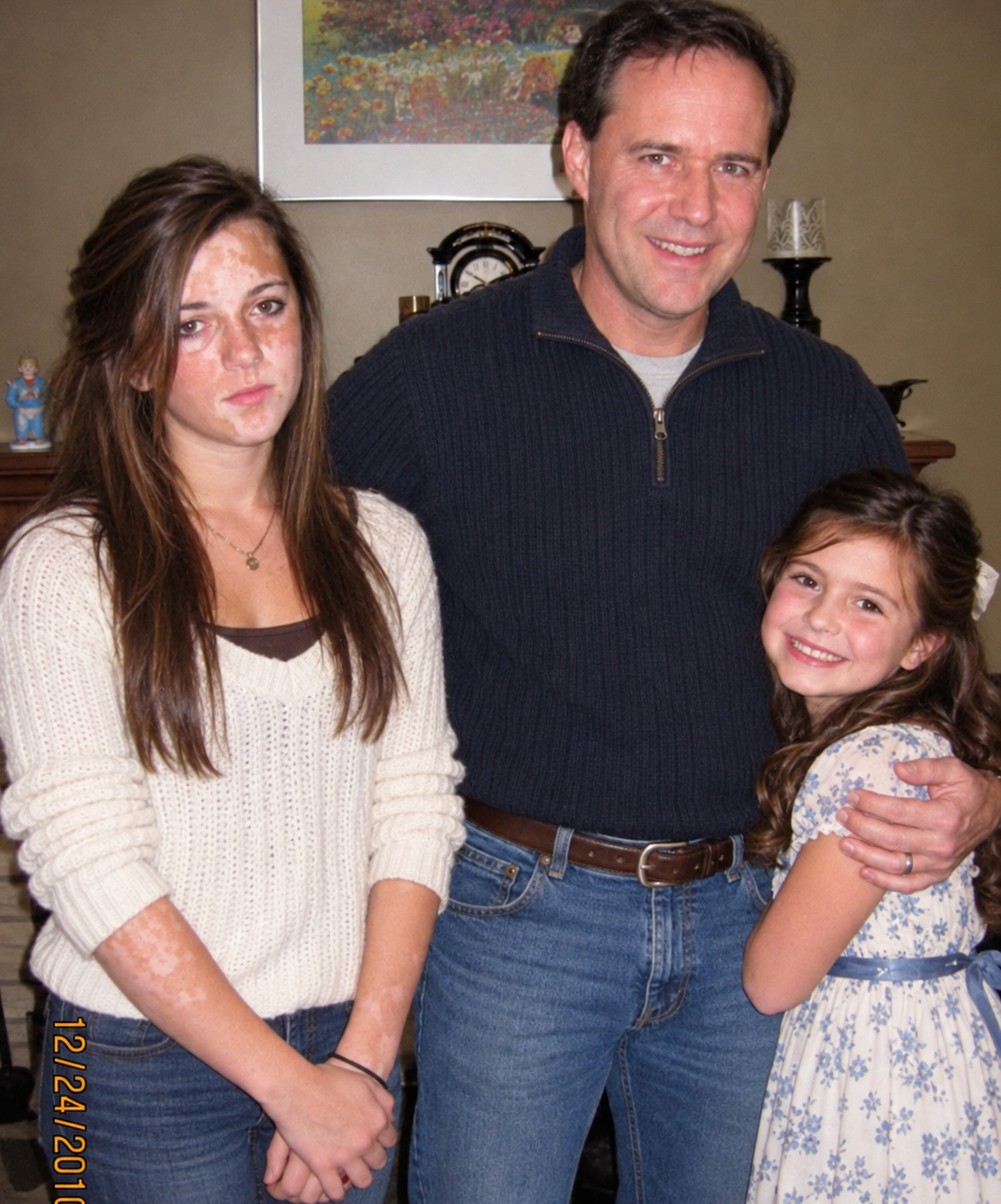
I spent my whole life believing my father was ashamed of my face. The box he brought me proved he had wanted me there all along – and that the truth was so much harder to forgive.
Part One: The Box
I was sixteen the night I wore my mother’s blue dress, and my father looked at my face and took my sister instead.
Twenty-two years later, on my thirty-eighth birthday, he stood in my dining room holding a cardboard box in both trembling hands.
I hadn’t seen him in person in almost two years. The cancer had gotten there first. His coat hung off his shoulders like it belonged to a bigger man, and there were deep lines carved around his mouth that hadn’t existed the last time we’d spoken face to face.
Behind him, my younger sister Lily stood with one hand pressed over her mouth. She had driven him here. She hadn’t warned me.
In the next room, my husband and kids had gone suddenly, suspiciously quiet. The birthday cake sat on the table between us, candles still unlit.
Dad pushed the box toward me.
“Before I pass away,” he said, “you need to know why I treated you the way I did.” His voice broke on the last word. “Please. Open it.”
I lifted the lid.
The first thing I saw was a plastic name badge, the kind with a metal clip on the back. The lettering had faded, but I could still read it.
EMMA – GUEST OF JOHNNY
In the corner was the logo of an old downtown hotel.
And just like that, my birthday disappeared. The cake, the voices in the kitchen, the streamers my daughter had taped crookedly across the doorway – all of it fell away.
All I could see was that blue dress.
Part Two: The Night I Stayed Home
It had been my mother’s. She’d worn it to their fifteenth anniversary dinner, and after she died, it hung untouched in the back of her closet for two years.
The night of Dad’s company banquet, I put it on.
He had promised both of us – me and Lily – that we could come. I had spent an hour in front of the bathroom mirror with Mom’s old foundation, dabbing and blending, trying to cover the pale patches that had spread across my cheek and around my mouth. Vitiligo. I’d had it since I was eleven.
No matter how much I used, the patch beside my lips still showed through.
I came down the stairs smoothing the skirt with both hands. Dad was by the front door, adjusting his tie.
He turned.
He didn’t look at the dress.
He looked at my face.
His eyes stopped on that pale patch beside my mouth, and something in his expression closed like a door.
“Plans changed, Emma,” he said. “I can only take one of you.”
Lily went.
I stood in the hallway in my dead mother’s dress and listened to the car pull out of the driveway. Then I went into the kitchen and scrubbed counters that were already clean until my hands were raw.
That was the first night. It wasn’t the last.
Now, twenty-two years later, I held the badge up between us.
“You had a badge for me.”
“Yes.”
“You told me there was only one guest ticket.”
“I know.”
I set it on the table very carefully, as if it might break, and reached into the box again.
An invitation to a company dinner the following spring. Two guest names typed neatly across the bottom. Lily. Emma.
Beneath it, an RSVP card for his cousin’s wedding. Three names in his handwriting. Johnny. Lily. Emma.
“You said the car was full,” I whispered.
Dad lowered himself slowly into the chair beside my birthday table.
“I lied.”
There were more. A Christmas party. A retirement dinner. Another banquet, and another. Every single event I remembered being left behind for – every night I’d spent alone in that house telling myself I didn’t care – had my name on it somewhere.
For twenty years, I had believed my father never wanted me there.
That wasn’t true.
And somehow, the truth felt worse.
“You planned to take me.”
“Every time.”
“And then you changed your mind.”
“Yes.”
“Why?”
He rubbed his thumb along the edge of the box, back and forth, back and forth.
He didn’t answer.
“Dad.” My voice came out sharper than I meant it to. “You showed up at my house on my birthday, crying, and told me I needed to know the truth before you die. So tell me.”
His voice was barely more than a rasp.
“It started before your mother died.”
I turned to Lily. “Did you know about this?”
“No.” She answered so fast, so stricken, that I believed her instantly.
Dad glanced toward the kitchen, where someone was whispering just loudly enough to prove they were listening. Then he looked back at me.
“There’s somewhere I need to take you.”
I almost laughed. “Of course there is.”
“Emma—”
“No. You don’t get to turn this into one of your mysterious lessons.”
“It’s not a lesson.” He pushed himself carefully to his feet, one hand braced on the table. “It’s where I first failed you.”
That stopped me cold.

Part Three: The Hotel
Twenty minutes later, Lily was driving us downtown.
Dad sat in the passenger seat. I sat behind him, the old badge pressed so hard into my palm that the clip left a mark. Nobody spoke.
When Lily turned onto the avenue, I recognized the building before anyone said a word.
The hotel.
It had been renovated since I’d last seen it, but the wide stone steps were the same. So were the tall front windows, glowing gold in the late afternoon light.
“I’ve been here before,” I said slowly.
Dad nodded. “You were twelve.”
Something stirred at the edge of my memory. Mom fastening her earrings in the hallway. Dad grumbling about parking. Lily, too young to come, sulking with the babysitter. And me, standing in front of Mom’s bathroom mirror, turning my face from side to side.
We walked inside. Dad stopped near the entrance to the ballroom and stood there for a long moment, breathing hard.
“This used to be where my company held its client dinners,” he said. “Your mother came with me that year. So did you.”
I crossed my arms. “And?”
He glanced at my face.
Then he looked away.
It was such a small movement. But it was so familiar that for one ugly second, I was sixteen again, standing at the bottom of the stairs.
“Dad.”
He nodded, like he’d been expecting that tone.
“There was a man at our table. Someone I worked with. You’d just started getting new patches around your eyes and on your hands.”
I remembered that. I also remembered begging Mom for the heavy concealer I’d seen in a magazine, and Mom refusing.
“It’s skin,” she’d told me, cupping my chin. “It doesn’t need permission to look like skin.”
“During dinner,” Dad said, “the man leaned over and asked if what you had was contagious.”
My fingers tightened around the badge.
I remembered him. Not his face – I’d never been able to hold onto his face. But his watch. Big and gold, catching the chandelier light every time he lifted his fork.
“What did you say?”
“I told him it was vitiligo.”
“And?”
Dad went quiet.
“You changed the subject,” I said.
He looked at me, and I knew I was right.
I couldn’t remember the exact words. But I remembered the feeling. That small, awful pause. The man’s embarrassed little chuckle. Dad’s voice, too bright, asking him about some project at work. And Mom’s hand finding mine under the tablecloth and squeezing so hard it hurt.
I had spent twenty-six years forgetting the details and keeping the humiliation.
“You changed the subject,” I repeated.
“Yes.”
“Did you tell him he was being rude?”
“No.”
“Did you tell him not to talk about your daughter like she wasn’t sitting right there?”
“No.”
“Did you say anything?”
Dad shook his head. “No.”
Lily stared at him. “Dad…”
“I know.”
“No,” I said. “You don’t get to say that yet.”
He nodded once. Then he walked slowly to a bench beside the ballroom doors and sat down like his legs couldn’t hold him anymore.
Part Four: What Mom Said
“Your mother tore into me when we got home,” Dad said.
That sounded like Mom. I could almost hear her.
“She asked me why I’d cared more about making a client comfortable than about protecting my own daughter.”
My throat burned. “What did you tell her?”
“That I didn’t want to make a scene.”
Of course. Dad had always hated scenes. Mom used to joke that he’d rather quietly carry a burning chair out of the room than ask who set it on fire.
“She said, ‘She should never have to leave a room because someone else doesn’t know how to behave.’” Dad’s voice cracked. “And then she said, ‘Next time, you stand beside your daughter.’“
The badge in my hand suddenly felt like it weighed ten pounds.
“A few months later, she got sick.”
For a moment, the years seemed to fall off his face. He looked exactly like the man who used to stand beside Mom’s hospital bed, nodding at every word the doctors said as if he understood any of it.
“After she died,” he said, “I kept coming back to that night. Here.”
“Why?”
“Because I’d failed you. And she was gone, and I couldn’t tell her I was sorry.”
“So you decided to keep failing me?”
“Emma,” Lily whispered.
I didn’t look at her.
Dad didn’t defend himself. He just said, very quietly, “That’s about right.”
I hadn’t expected that. I’d come braced for excuses.
He rubbed both hands slowly over his knees.
“The banquet when you were sixteen – I put your name on the list. I meant to take you. I wanted to take you. I thought, this is it. This is my chance to do it right.”
“The badge.”
“Yes.” He swallowed. “Then, two days before, I overheard two people at work talking about a woman with vitiligo they’d seen at a restaurant.”
My spine straightened. “What did they say?”
“It doesn’t matter.”
“It mattered enough to leave me at home.”
Dad closed his eyes. “You’re right. They were making jokes.” He took a shaky breath. “And I remember thinking – what happens if I bring Emma and someone says something? What if they stare? What if someone asks another question, right in front of her?”
“And what if you froze again,” I said.
He looked at me.
And there it was, finally, right there in his face.
Not disgust. Not embarrassment.
Fear.
But not only fear for me.
My father was afraid of himself.
“I told myself I was protecting you,” he said.
“From what?”
“From people who made me afraid I’d fail you again.” He paused, and then, quieter: “I was protecting myself, too. I couldn’t stand the thought of sitting at that table and becoming that man again. So I made sure I never had to find out.”

Part Five: Beautiful
I walked away from him. I needed the distance.
For twenty years, I had pictured Dad walking into all those glittering rooms proud to have Lily on his arm – and relieved not to have me.
The truth was stranger than that. Crueler, somehow.
He had written my name down. He had imagined me beside him. And then, every time, fear had arrived – and he had removed the one person whose presence would have forced him to find out whether he could finally be brave.
Me.
I turned back around.
“So Mom told you to stand beside me,” I said, “and your solution was to stop taking me anywhere at all?”
He didn’t answer.
Lily had sat down on the bench beside him. She looked almost as furious as I felt.
I pointed at her. “Why Lily?”
Dad answered immediately, like he’d been waiting years to be asked.
“Nobody made comments about Lily.”
“So I was the problem you removed.”
“No.”
“That’s what you did, Dad.”
A long silence. Then: “Yes.”
Lily suddenly stood up.
“Did you tell me Emma didn’t want to come?”
Dad shut his eyes. “Lily…”
“Did you?”
“Sometimes.”
She turned to me, and her eyes were wet.
“When I was little, I asked why you never came. Every time. He said you hated those parties.”
“And you believed him?”
“I was nine, Emma.”
That shut me up.
Lily wiped her palms against her skirt. “And then when I got older and asked you myself, you’d say you didn’t care.”
“I got tired of caring.”
“I know that now.” She looked down. “Do you remember the desserts?”
Of course I did.
Slices of cake folded into napkins. Cookies in tiny plastic bags. Once, an entire chocolate mousse cup that had leaked all over the inside of her purse.
I had hated those gifts. They’d felt like crumbs brought home from rooms I wasn’t allowed to enter.
“I thought you pitied me,” I said.
Lily stared at me. “What?“
“The desserts.”
“No. Emma, no—” She looked horrified. “Dad said you didn’t like the parties. I just thought… you’d still like dessert.”
I thought of that ridiculous mousse cup dripping through the lining of her purse, and nine-year-old Lily carrying it home anyway, so carefully, for me.
Something in my chest cracked.
Lily almost smiled. Then she turned back to Dad.
“You know what else you used to say? ‘This is my beautiful girl.’ Every time you introduced me to anyone.”
His face crumpled. “I meant it.”
“I know, Dad.” Her voice shook. “But after a while, beautiful stopped sounding like a compliment. It started sounding like the reason I got to go – and Emma didn’t.”
Nobody spoke.
My sister had carried her own version of that word for twenty years. I’d never once thought to ask.
Part Six: The Blue Dress
I looked down at the badge again. The hotel logo. My name. Guest of Johnny.
And the last piece slid into place.
Mom’s blue dress. Dad at the door. His eyes moving over me. Plans changed.
My stomach turned over.
I held up the badge.
“This was that night. Wasn’t it?”
Dad nodded.
“The blue dress.”
“Yes.”
“The dress Mom wore to your anniversary dinner.”
“Yes.”
I stepped closer. “You already had my badge in your pocket.”
“Yes.”
“You already knew exactly what Mom told you to do.”
He didn’t look away this time. “Yes.”
“Then why did you take Lily?”
He was quiet for so long I thought he wouldn’t answer.
“Because you came down those stairs looking so much like your mother,” he said, “that for one second, I could hear her voice. Stand beside your daughter.“
His voice broke, but he kept going.
“And I realized God had given me another chance. The one I’d been praying for.”
I waited.
He looked down at the floor.
“And I panicked.”
I didn’t feel forgiveness. Nothing close to it.
But I felt something I’d never had before.
Clarity.
For twenty-two years, I had imagined my father looking at my skin and deciding I wasn’t pretty enough to be seen with him.
The truth was that he’d looked at me and seen, perfectly clearly, exactly what he needed to do.
And he had chosen fear instead.
Again. And again. And again.
I took his hand, turned it palm up, and placed the badge in it.
“You were so afraid that somebody else might make me feel ugly,” I said, “that you became the one who did.”
He stared down at the badge. His shoulders began to shake.
“I loved you,” he said. “And I behaved like I was ashamed of you.”
I didn’t answer.
“You didn’t misunderstand what I did, Emma. You understood that perfectly. I just let you misunderstand why. Because the truth made me a coward, and I couldn’t stand for you to know it.”
That mattered. It didn’t fix anything. But it mattered.
“Why keep all of this?” I asked, nodding at the box in Lily’s arms.
“At first, because I hated myself every time I came home without you.” His eyes drifted to the box. “Later, throwing it away felt too much like pretending it had never happened. And you deserved for it to have happened. You deserved for someone to remember.”
He didn’t ask me to forgive him.
That helped more than I ever would have expected.

Part Seven: Come Stand in It
When we got back to my house, Lily went inside ahead of us. Dad stopped on the porch.
He looked past me at the birthday streamers, the lights in the window, the shadows of my family moving around inside.
“Do you want me to come in?” he asked.
For twenty years, he had decided which daughter stayed home.
This time, the door was mine.
“For cake,” I said.
He let out a breath that sounded like it had been trapped in him for decades. “Okay.”
Later, after the candles had been lit and blown out, my daughter shouted, “Birthday picture! Everybody!”
Everyone crowded together near the table.
Dad stayed back by the wall, half in the shadow of the doorway, exactly where he’d always put me.
I looked at him.
“Dad,” I said. “If you’re going to be in it, come stand in it.”
He hesitated. Then he crossed the room slowly and stood beside me. He lifted his arm to put it around my shoulders – then stopped, hovering, uncertain.
“Is this okay?”
I nodded.
His arm settled around me, thin and trembling and warm.
The camera flashed.
When we looked at the picture, Lily was laughing, Dad’s eyes were closed, there was a smear of frosting on my sleeve – and every pale patch on my face showed clearly, under the full, bright light.
Dad squinted at the screen. “Take another one.”
I looked at the photo for a long moment.
At my father, finally standing beside me.
At my face, not hidden, not covered, not left at home.
“No,” I said, and handed the phone back to my daughter.
“Keep this one.”
Note: This story is a work of fiction inspired by real events. Names, characters, and details have been altered. Any resemblance is coincidental. The author and publisher disclaim accuracy, liability, and responsibility for interpretations or reliance. All images are for illustration purposes only.


