

Part 1: The Song She Chose
The first thing Chloe asked when I picked her up from school was whether people in wheelchairs were allowed to be bad at dancing.
“Of course,” I said.
She considered that while I secured her chair for the ride home.
“Good. Because Mason says everybody has to practice, but Avery says if I do it, the grown-ups will clap even if I mess up.”
My hand stopped on the buckle. Eighteen months earlier, my daughter had survived the collision that cost her both legs; now, at eight, she was asking for something I had not realized she needed permission to want.
Not applause. The right to try something without everyone deciding the attempt was enough.
“Would you like me to tell them to save their clapping until the end?” I asked.
“You can tell yourself first.”
She was smiling when she said it. That helped, because she was right.
Two days earlier, her teacher, Ms. Ramirez, had asked me to stay after pickup. The class was preparing a dance for the fall festival, and several children wanted Chloe to participate.
“Only if she wants to,” Ms. Ramirez said. “They’ve been talking about changing the formations.”
My first questions were about the floor, the space between the children, and whether anyone intended to push her chair. I had six questions before I asked what song they had chosen.
Ms. Ramirez answered patiently. Then she turned her notebook toward me.
The page held an untidy drawing of dots and arrows. Someone had drawn a small square with two large circles beside it.
“Mason suggested wheelchair turns,” she said. “Avery asked why they couldn’t change the dance instead of asking Chloe to keep up with the old one.”
I looked at that square for longer than I needed to.
“Have you asked her?”
“I wanted to speak with you first. But I’d like the decision to be hers.”
There was nothing unreasonable in that sentence. Still, I felt the familiar tightening beneath my ribs.
Before the accident, Chloe had danced everywhere. She danced while brushing her teeth, while waiting for toast, and once in the grocery store with a bag of frozen peas held above her head because she thought it looked like a crown.
She had taken a beginner class since she was five. She was not unusually talented; she liked the music, the other children, and the serious business of choosing a recital costume.
After the accident, her dance bag stayed behind her bedroom door until I moved it into a closet.
I told myself I was making room for medical supplies. That was true, but it was not the whole truth.
The collision happened on a Tuesday afternoon when Chloe was six and a half. A driver went through a red light and struck the passenger side of our car.
I remember the sound, then the strange stillness after it. I remember asking a stranger whether my daughter was breathing and hating how long it took him to answer.
She survived. Surgeons could not save either leg, and the amputations were at different levels, one above the knee and one below.
The months that followed belonged to appointments, healing, rehabilitation, and a hundred unfamiliar practical tasks. Chloe learned transfers and pressure relief; I learned that helping without asking could make an already difficult morning worse.
There were things neither of us learned neatly.
A few weeks after she came home, she asked me to take down her bedroom mirror.
“I don’t want it there,” she said.
I asked whether she wanted it moved. She shook her head without looking at me.
I took it down. Then I cried in the hallway, quietly enough that she would not feel obliged to comfort me.
For a while, music disappeared too. I stopped playing it while cooking because Chloe would leave the room, and eventually the silence became ordinary.
School returned in stages. There were meetings, a bathroom access plan, adjustments to her desk, and practice getting through doors without someone lunging forward to help.
Her classmates learned faster than some adults. They asked direct questions, accepted direct answers, and returned to arguing about whose turn it was to use the good markers.
Chloe liked that.
But when children danced at recess, she watched from the edge. Sometimes she clapped along, and sometimes she suddenly needed to inspect something in her backpack.
So when she asked whether she could be bad at dancing, I tried not to turn the answer into a speech.
“You can be good, bad, or somewhere in the middle,” I said. “And you can change your mind.”
“Not after we print the programs,” she said gravely.
That evening, she asked me to move the kitchen chairs.
“How far?”
“Far enough that I don’t take out the recycling.”
She tried a turn, stopped too sharply, and frowned. On the second attempt, her hand slipped against the push rim.
I took a step toward her.
“Mom.”
I stopped.
She tried again. This time she completed the turn, raised both hands, and nearly forgot to slow herself before the cabinet.
We both laughed. The sound startled me.
Over the next six weeks, the class built a routine rather than simply finding Chloe a place in one. Some movements were seated, others standing; children traveled in pairs, crossed through open lanes, and mirrored one another’s arms.
Chloe vetoed being pushed into the center at the beginning.
“I can get there,” she told Ms. Ramirez.
She also changed a turn that made her dizzy and suggested a slower movement before the final formation. When Mason lost count, she was merciless.
“It’s eight beats, not whenever you feel ready.”
At home, music returned in short, increasingly confident bursts. Some afternoons she practiced; some afternoons she said her shoulders were tired and watched cartoons.
I tried to treat both choices as ordinary.
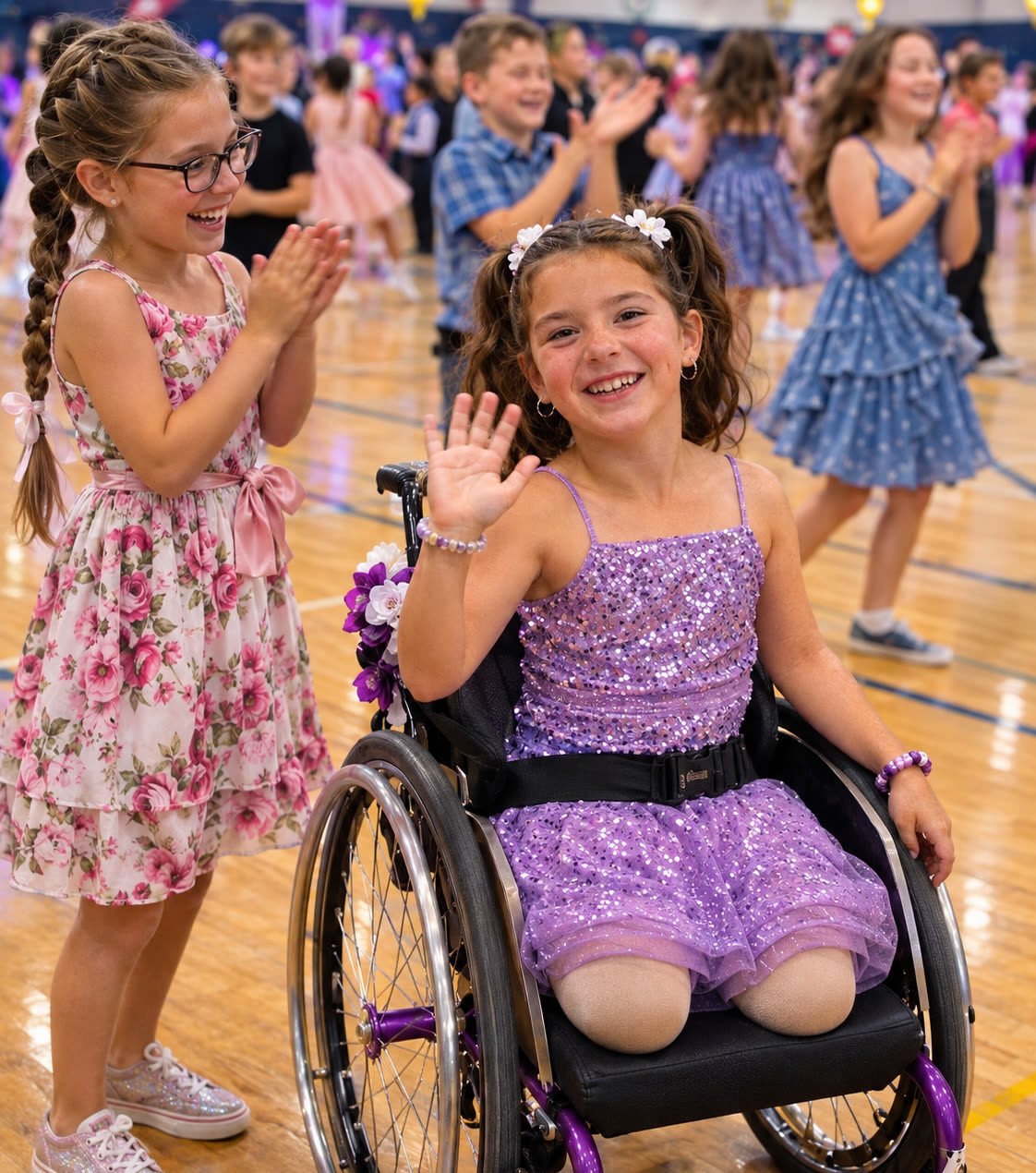
She chose a sparkling purple dress and flower clips for her hair. Instead of fastening anything near her wheels, we tied two silver ribbon bows high on the back of the chair, where they could not catch.
On the festival morning, she sat outside her bedroom while I checked the hem of her dress.
“Can you put it back?” she asked.
“Put what back?”
She looked toward the closet where I had stored the mirror.
I hung it lower than before so she could see herself comfortably from her chair. Then I stepped away.
Chloe adjusted a flower clip. She smoothed the skirt across her lap and studied the reflection with a concentration I recognized from dance practice.
“I look fancy,” she said.
“You do.”
She caught my expression in the glass.
“Remember the clapping rule.”
I promised I would.
An hour later, I stood in the school gym with my phone charged, my daughter’s water bottle under my arm, and no idea that before her song ended, I would be begging a stranger to let go of me.
Part 2: The Sound Above Them
That afternoon, the gym looked more elaborate than it had during the rehearsal I had attended.
There were folding chairs for families, a painted autumn backdrop, and portable lights on tall stands near the performance area. A speaker cart waited beside the wall, and taped cables crossed places children had been told not to walk.
I noticed the tape because I had become a person who noticed floors.
Ms. Ramirez met Chloe at the entrance and crouched so they could hear each other over the crowd.
“Any last changes?” she asked.
“Mason needs to remember the second line.”
“Mason is standing right here,” he said.
“Then it saves time.”
He grinned and offered her a fist bump.
I watched them go, resisting the urge to follow Chloe all the way to her starting position. She knew the route; she had practiced it.
Near the side wall, a man in a navy facilities polo was moving an empty equipment case. I had seen him fixing a door closer earlier that month but did not know his name.
He paused when several children ran past him.
“Walking near the cables, please,” he said.
They slowed down for perhaps four steps.
I found a seat on the aisle. When Chloe caught my eye, I raised a hand instead of calling out.
She gave me a tiny nod, businesslike now.
The first class sang. Another performed a short play in which a cardboard tree fell over for reasons unrelated to the script. Everyone laughed, including the child wearing it.
Then Ms. Ramirez led Chloe’s class into position.
I stood at the aisle to record without blocking the parents behind me.
The music began.
Chloe rolled forward beside Avery, both of them lifting one arm on the fourth beat. Mason and his partner crossed behind them, almost early, then corrected themselves.
My daughter’s face changed.
I had seen her happy since the accident. I had seen her absorbed in games, furious at homework, delighted by jokes that made no sense to anyone else.
But I had not seen this particular expression: the pleasure of knowing what came next and being exactly where she wanted to be.
She turned cleanly. Her skirt glittered beneath the lights.
I kept my promise and did not clap.
Halfway through, she missed a hand movement because Avery whispered something. They both laughed, recovered, and went on.
It was wonderfully imperfect.
Then the music stopped.
Not at the end of a phrase. In the middle of one.
Several children kept moving for another beat. Chloe looked toward Ms. Ramirez.
A harsh scraping sound came from my left.
The man in the navy polo looked up before I did.
One of the lighting stands was leaning into the performance area.
At first, I could not understand what I was seeing. The crossbar seemed to be moving independently of its base, too slowly to belong to an emergency.
Then a teacher shouted.
“Move away! Toward the wall!”
Children scattered from the open side of the formation. Chloe reached for her rims, but two classmates were crossing in front of her, and she checked her movement rather than hit them.
I dropped my phone onto an empty chair and ran.
An arm caught me around the waist and pulled me backward.
“Not there!” the man said.
I fought him.
“That’s my daughter!”
He released me almost immediately. I stumbled against the end of a chair row as he ran the few steps into the performance area.
Chloe had begun to turn. There was no longer enough time.
The man reached across her lap. I saw his hand at her positioning belt, then at her shoulder and waist.
What happened next looked like an attack.
He pulled her hard sideways out of the chair, turning as they fell. Her hand struck the floor, and he folded himself over her.
I screamed.
The crossbar hit the wheelchair.
There was a crash, the sharp break of a light cover, and a wave of shouting so loud that I could not hear my own voice.
For a moment, all I could see was his back and the purple fabric beneath him.
Then he lifted his head.
“She’s here,” he said. “She’s here.”
I reached them on my knees.
Chloe was crying, trying to look around him.
“Mommy?”
“I’m here.”
He moved aside carefully. I gathered her against me without thinking, then loosened my hold because I was afraid of hurting something I could not see.
“Where does it hurt?”
“My elbow.”
“Your head?”
She shook her head.
“Your neck? Your back?”
“Mom, my elbow.”
The repetition steadied me more than any reassurance could have.
A teacher knelt nearby and told us not to move farther until the paramedics arrived. Ms. Ramirez was directing children away from fragments on the floor while another staff member checked names against her class list.
Someone had already called 911.
The facilities employee sat back, pressing his uninjured hand over his forearm. There was blood on his sleeve, but he kept looking at Chloe.
“Did you hit your head?” he asked her.
“No.”
He nodded once, then looked toward the damaged chair.
I looked too.
One wheel was bent inward. The armrest had broken, and the crossbar lay across the place where Chloe’s upper body had been.
My stomach turned over.
The paramedics assessed her, then him. A child on the far side of the group had a small cut from a piece of broken light cover; other children were shaken but accounted for.
Nobody asked the class to finish. Nobody announced that the show must go on.
The festival ended.
At the emergency department, Chloe answered the same questions several times and grew irritated when I answered one for her.
“It’s my elbow,” she reminded me.
The examination found bruising and a superficial scrape, with no signs of a serious injury. We received instructions about symptoms that would require another assessment.
Only after the clinician left did Chloe ask about her wheelchair.
“Can they fix it?”
“We’ll find out.”
“Don’t let someone throw it away.”
“I won’t.”
She picked at the edge of the blanket.
“My hands know that one.”
That was when I understood that replacing a wheelchair was not like borrowing another folding chair from the cafeteria.
Ms. Ramirez arrived carrying Chloe’s backpack and the flower clip someone had found on the gym floor. She asked permission before sitting beside the bed.
“I’m sorry,” she said.
Chloe took the clip.
“Did everybody get out?”
“Everybody is accounted for. Everyone’s families have been contacted.”
“Did Mason cry?”
Ms. Ramirez glanced at me.
“A lot of people cried.”
“Tell him I did too.”
Later, while my sister stayed with Chloe, I found the facilities employee in the hallway with a fresh bandage on his arm.
“Marcus Reed,” he said when I asked his name.
I had rehearsed a thank-you on the way down the corridor. Instead, the first thing I said was that he could have hurt her.
His face tightened.
“I know.”
“You knocked her onto the floor.”
“I did.”
He did not defend himself or tell me I should be grateful. That made the next words harder.
“But you saw something I didn’t.”
“The stand was coming down. You were running under the end of the bar.”
I sat beside him.
“And Chloe?”
“She was turning, but there wasn’t room. I couldn’t get the whole chair clear in time.”
He rubbed his thumb against the edge of his bandage.
“There wasn’t a good way to do it. There was the way I had.”
I finally thanked him. He accepted it quietly.
Before we left, the principal came to collect my account of the incident. She told me the equipment would remain untouched except where necessary to make the area safe.
“We need to establish exactly what happened,” she said.
I thought of the taped cables, the crowded chairs, and the stand leaning where children had been dancing.
For the first time since the crash, I wondered whether what had happened was something someone should have seen coming.

Part 3: What Safety Owed Her
The next morning, Chloe wanted cereal in the blue bowl and a precise account of what had happened to her chair.
I could provide the cereal.
The chair was harder.
The district had arranged a loaner through a medical equipment provider, but it needed adjustments. Its seat felt different, its push rims were unfamiliar, and Chloe announced that turning it was like steering a shopping cart with opinions.
The provider scheduled a fitting adjustment. I wrote down everything she said rather than telling her she would get used to it.
By noon, three parents had sent messages asking whether we were all right. One sent a short video that began just before Marcus reached Chloe.
I watched it once.
Without the stand visible at the top of the frame, it showed a man rushing a child, reaching for her belt, and pulling her onto the floor.
I put the phone facedown.
Then I asked the parent not to share it.
She called immediately.
“I wasn’t going to. I thought you might need it for the review.”
I thanked her and forwarded the original file to the district contact, explaining what the recording did and did not show.
It unsettled me that I had been standing there and had misunderstood the same seconds.
That afternoon, I called Marcus through the school office and asked whether he was comfortable speaking with me.
“I need to apologize,” I said when he called back.
“You were frightened.”
“I was. And I accused you before I understood.”
He was quiet for a moment.
“I’d rather you ask than keep wondering.”
I asked about the belt.
“I saw the buckle,” he said. “I released it. I knew I couldn’t pull her against it.”
He explained that he had intended to support her as they went down but had lost his footing. He had not performed some perfectly calculated rescue; he had recognized an immediate danger and made the fastest choice he could.
“I wish I’d noticed the stand sooner,” he said.
“Were you responsible for setting it up?”
“No. But I was there.”
I recognized that kind of sentence. I had spent eighteen months finding new ways to say it about the intersection.
“So was I,” I said.
Neither of us had an answer to that.
Two days after the festival, Chloe lay on the couch with a cushion beneath her elbow and watched a rehearsal video on my phone.
She stopped it before the final formation.
“We didn’t finish.”
“No.”
“Can we do it again?”
I had known the question might come. Knowing did not make my answer ready.
I pictured the crossbar across her empty seat. I heard the light cover breaking.
“Not right now,” I said.
“I didn’t mean in the living room.”
I almost smiled.
“I need to know what went wrong first.”
She studied me.
“And then?”
I could have said we would see. It would have been an easy way to postpone telling the truth.
“And then we talk about what would make another performance safe enough.”
“Safe enough for you or safe enough for me?”
She was not being clever. She genuinely wanted to know who would decide.
“For everyone,” I said. “But I get a say because I’m your mother.”
“I get a say because it’s my dance.”
“You do.”
A week after the festival, the principal invited families to a meeting about the initial findings. The equipment supplier and district safety staff were still completing their review, so she separated what had been confirmed from what remained uncertain.
I appreciated that more than a confident promise would have helped.
Photographs and several recordings established that one stabilizing leg on the lighting stand had been moved inward after setup to make space for an additional row of chairs. A power lead had also been rerouted tightly around the base.
During the dance, a speaker cart was moved near the wall. Its wheel caught the lead, disconnecting the music equipment and putting tension on the already unstable stand.
The scraping Marcus heard was the base shifting.
The principal did not describe it as bad luck.
“The original placement was changed without a new safety check,” she said. “We also failed to maintain adequate separation between temporary equipment and the children’s activity area.”
A parent asked who had folded the leg.
The principal said the personnel review was ongoing and individual employment matters would remain private, but the district would report the procedural changes and address responsibility through its established process.
Someone behind me made an impatient sound.
I understood the desire for a name. A name would have given the anger somewhere small enough to put it.
But the photographs showed more than one person’s mistake. The seating plan had changed; equipment had been moved; nobody had been assigned to approve the final arrangement before children entered.
I raised my hand.
“Who had authority to stop the performance if the setup changed?”
The district safety officer paused.
“That responsibility was not clearly designated. It will be.”
“And who checks that the changes actually happen?”
This time she answered with a name, a role, and a date for written follow-up.
I put all three in my notebook.
The school offered families access to its counselor. Ms. Ramirez planned a classroom conversation where children could ask questions without being made to watch recordings of the accident.
The damaged wheelchair had been assessed by a qualified repair provider. The district confirmed in writing that it would cover the loaner, the necessary repair work, and the equipment-related expenses we had documented.
The repair estimate was still pending. Nobody handed us a check in the meeting or pretended everything could be restored by Friday.
Afterward, Ms. Ramirez caught up with me near the exit.
“They’re asking about the dance,” she said.
“Chloe too.”
She pressed her folder against her chest.
“I want to support them. I also don’t want to ask frightened children to prove they aren’t frightened.”
“Then it can’t be compulsory.”
“Agreed.”
We stood there for a moment, two adults who had spent six weeks arranging arrows on a page and now knew how little paper could guarantee.
“No special lights,” I said.
“No portable stands. No backdrop.”
“A clear floor plan. Nothing moved after it’s checked.”
“And a rehearsal where they can stop whenever they need to.”
I nodded, but I had not said yes.
That evening, I found Chloe trying to recreate the final formation with pencils on the kitchen table.
She moved one pencil between two rows, then frowned.
“This chair turns differently.”
“The provider is coming again tomorrow.”
“I know. I might need to change the turn anyway.”
I sat across from her.
“Ms. Ramirez says some children might not want to perform again.”
“That’s okay.”
“The dance might look different.”
She gave me a look of mild disbelief.
“Mom. We already know how to change a dance.”
I looked at the pencils, then at the bruise fading along her elbow.
I had spent the week deciding what conditions would permit me to say yes. Now I had to face the possibility that even after those conditions were met, I might still want to say no.
Part 4: The Space Between Lines
The following Monday, I asked the school counselor for an appointment of my own.
Not because I believed one conversation would remove eighteen months of fear. I wanted help recognizing when that fear was making decisions I was calling practical.
We talked about the difference between a specific concern and an impossible demand.
A specific concern could be checked: equipment placement, clear exits, a suitable chair, an adult authorized to stop an event.
An impossible demand sounded like safety too: promise me nothing frightening will ever happen to my child again.
I left with no such promise.
That afternoon, I sat beside Chloe while she worked on a spelling worksheet.
“If the safety review is finished and the plan is followed, you can do the dance again,” I said.
Her pencil stopped.
“Really?”
“Really. You can also stop if you change your mind, even on the day.”
“What if you change your mind?”
I took a breath.
“If I see a real problem, I’ll say so. But being scared won’t be the same as finding a problem.”
She looked back at the worksheet.
“You can hold Aunt Beth’s hand.”
“I might.”
“She won’t mind.”
The second performance took place two weeks after the first.
Between them came a new floor plan, a written safety check, and a rehearsal with no audience. Families were told participation was optional, and children could join only the movements they wanted.
One child chose to help Ms. Ramirez start the music instead of dancing. Another stood beside her for the first rehearsal before joining the group.
Nobody called either choice a failure.
The regular gym lights stayed on. A single speaker sat securely against the wall, with its cable kept outside the activity and audience routes.
There were no freestanding lights, no autumn backdrop, and no extra seating squeezed into the performance area.
When I arrived for rehearsal, the room looked almost disappointingly plain.
I had never liked a room more.
Marcus was there with the district safety officer, checking the final arrangement. His arm was healing, though he still had a dressing over part of it.
Chloe rolled toward him before I could decide whether an introduction was necessary.
“You’re Marcus.”
“That’s me.”
“Mom said you got stitches.”
“A few.”
She looked at his arm, then down at her own elbow.
“You pushed me.”
He crouched a comfortable distance away.
“I pulled you out of the chair. I’m sorry it hurt.”
“It did.”
“I know.”
She picked at a loose thread on the loaner chair’s cushion cover.
“Could you have just pushed my chair?”
He did not glance at me for the answer.
“I didn’t think I could get you far enough away before the light came down.”
Chloe considered that.
“Next time, say something.”
His face changed, not quite a smile.
“I’ll try. I hope there isn’t a next time.”
“Me too.”
Then she held out her hand for a high five, and he met it gently.
I was grateful he had answered the question she actually asked. He had not told her to be brave or suggested that being saved meant she should not mind what had happened.
She went back to the class.
The first rehearsal stopped halfway through when a ball bounced loudly in the corridor. Two children flinched, and Chloe grabbed her rims.
Ms. Ramirez stopped the music.
“That was a ball outside,” she said. “Do we need a break?”
They did.
After water and several minutes of unrelated conversation, they tried again. This time they reached the end.
Chloe’s turn in the loaner chair was wider than it had been before. She and Avery adjusted their spacing, and Mason moved his starting point half a step.
It took four attempts to get the crossing right.
Watching them solve that ordinary problem helped me more than a speech about resilience would have.
On performance day, the audience was limited to class families and staff so the seating plan would stay as approved. Even so, the room felt full.
Beth sat beside me. I handed her my phone.
“You film.”
“You don’t want to?”
“I want to watch.”
Before the children began, the principal thanked the families and briefly explained that the school’s safety changes would apply to future events, not only this one.
She did not turn Marcus into the center of the afternoon. At his request, she thanked the staff who had responded without asking him to stand.
He waited near the back wall.
Chloe spotted him and waved.
Then Ms. Ramirez asked the class whether they were ready.
Mason gave two thumbs up. Avery adjusted her glasses. Chloe placed her hands on her rims.
The music started.
For the first several seconds, I watched everything except my daughter.
I watched the speaker. The doors. The people near the walls. Every small noise arrived inside me as a warning.
Beth put her free hand beside mine on the chair between us. She did not grab me.
I took it.
On the floor, Chloe completed her first turn.
I nearly missed it.
So I made myself look at her.
She was counting under her breath. Avery was smiling too early because she knew the next movement was the one they had changed.
Mason crossed at exactly the right time.
The dance unfolded without becoming perfect. A sleeve caught briefly on another child’s hand; someone went left instead of right and corrected course.
Chloe laughed once, then concentrated so fiercely that the tip of her tongue appeared between her teeth.
I knew that expression too.
Near the end, the children formed two open lines. This time the lane was generous, its spacing built into every rehearsal.
Chloe rolled between them while their hands marked the beat.
She was not being delivered to a special place. She was traveling through a formation they had made together.
At the center, she stopped, lifted both arms, and held still.
The class held with her.
The song ended exactly where it was supposed to.
For a heartbeat, nobody moved.
Then the applause began.
I clapped so hard my palms stung. Around me, parents stood, but Chloe was looking at her classmates rather than at us.
Mason said something I could not hear. She threw back her head and laughed.
That was the moment my shoulders finally dropped.
Afterward, she rolled toward us, flushed and thirsty.
“You waited,” she told me.
“Until the end.”
“Good job.”
Beth made a small choking sound beside me.
Chloe found Marcus near the door.
“We finished,” she said.
“I saw.”
She held out her arms, and this time he asked her directly.
“Would you like a hug?”
“That’s why I’m doing this.”
He laughed and leaned down carefully.
She said something close to his ear. When he straightened, he rubbed one hand across his face.
In the car, I asked what she had told him.
“Thank you for getting me out.”
“That was a good thing to say.”
She looked out the window.
“I also told him not to let anyone put those lights back.”
The investigation continued after the applause was over.
The district issued a written summary, revised its rules for temporary equipment, and required a designated staff member to approve event layouts and any later changes. Personnel matters stayed private, but families received the promised follow-up about completed training and inspections.
I kept copies. Gratitude did not make documentation unnecessary.
The repair provider completed Chloe’s wheelchair two weeks after the second performance. The frame was cleared for use after damaged components were replaced, and the fit was checked before she brought it home.
The district paid the documented equipment costs directly. We submitted the remaining medical expenses through the district’s claims process and received updates rather than instant assurances.
Chloe was interested in exactly one thing when her chair came back.
She pushed down the hallway, turned neatly before the linen closet, and grinned.
“There you are.”
Life did not divide cleanly into before the dance and after it.
Some nights she wanted to talk about the falling stand. Sometimes a sudden crash made both of us jump.
She continued rehabilitation and explored prosthetic options with her clinical team as she grew. There were days she wanted to practice and days she preferred the speed and comfort of her wheelchair.
We tried not to make either choice a verdict on her future.
Months later, she joined an adaptive dance class. She liked the music but disliked an instructor who called nearly every ordinary movement inspiring.
“I asked whether my turn was too wide,” she told me after one lesson. “She said I was amazing.”
“Did she answer your question?”
“No.”
We spoke with the instructor. When the pattern continued, we found another class.
Her new teacher watched her turn twice and said she was starting it too late.
Chloe came home delighted.
By the next fall festival, Marcus had become someone she greeted by name rather than the man from the accident. He still worked at the school, and she still asked whether the equipment had been checked.
He answered seriously every time.
She was allowed to want reassurance without having the rest of her afternoon turned into a lesson about courage.
Chloe is ten now. She still loves music, still corrects Mason’s counting, and still has days when something she misses catches her by surprise.
So do I.
I no longer tell myself that protecting her means keeping every possible hurt outside the door. I check what can be checked, ask the difficult questions, and try not to make her carry the fear I have not finished learning to manage.
The mirror is still in her bedroom, at a height that works for her.
One afternoon, months after the festival, I passed the open door and heard a song we used to play while making dinner.
Chloe was facing the mirror in her wheelchair. She moved one arm slowly across her body, tried the movement again, then changed the angle of her hand.
There was no costume and no audience. She was practicing because she wanted the movement to look a certain way.
She saw me in the reflection.
“Mom. You’re staring.”
“Sorry.”
She turned her chair slightly.
“Come dance.”
The old answer slipped out before I could stop it.
“I can’t dance.”
Her eyebrows rose.
“You can be bad at it.”
I stepped into the room.
She gave me instructions, most of which I failed to follow. When I turned the wrong way, she laughed and started the song again.
In the mirror, there was room for both of us.
How do we protect the people we love without taking away their right to try?
Disclaimer: This story is a work of fiction inspired by real-life themes. Names, characters, places and events are fictionalized, and any resemblance to real persons is purely coincidental. It does not represent any person or organization and does not encourage inappropriate behavior. Images are for illustration purposes only.


