

Part 1: The Morning Invoice
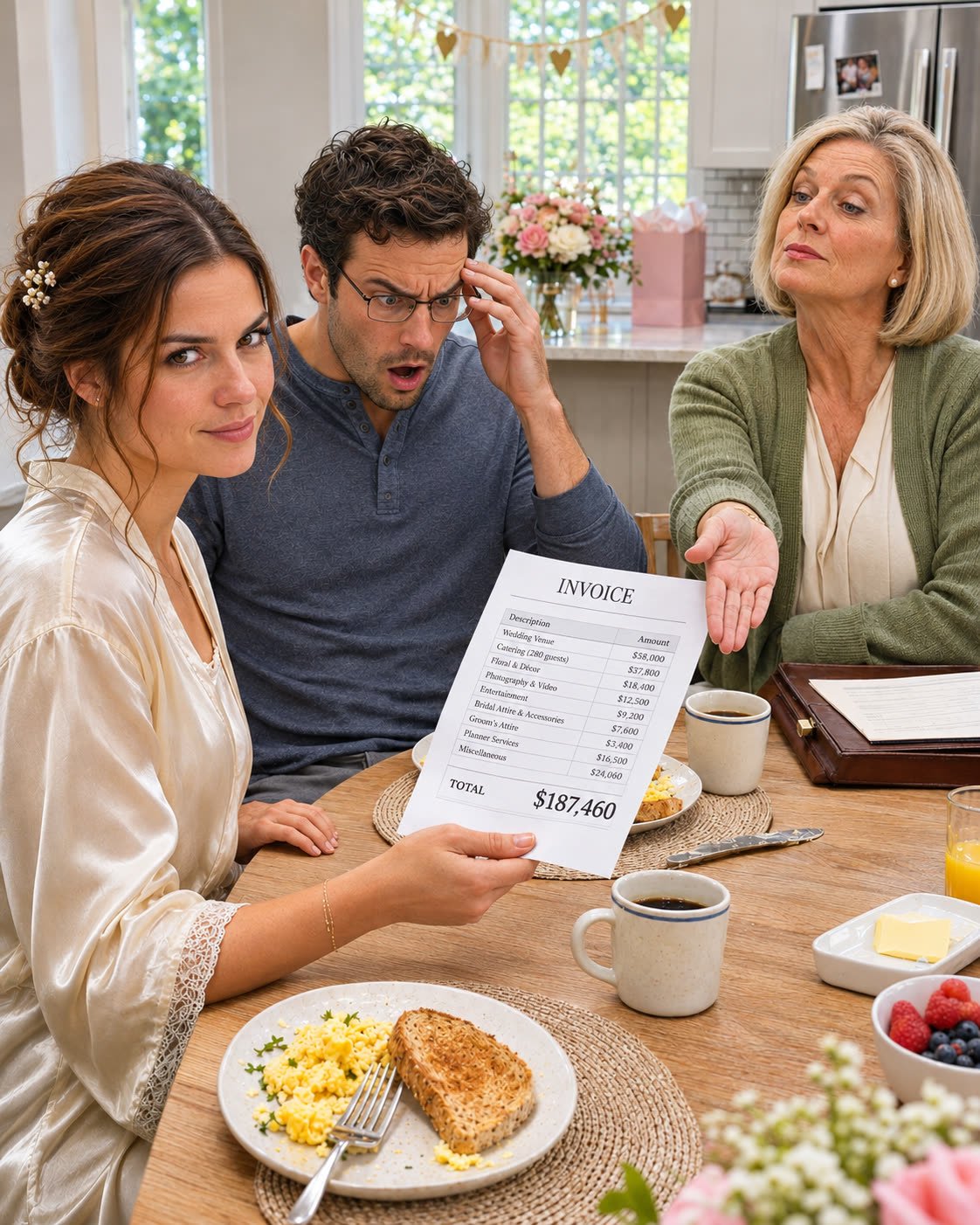
The first bill I received as a married woman wasn’t from our florist, our photographer, or the hotel where we would spend our honeymoon. It came from my husband’s mother, who laid a folder beside my breakfast plate and said, “I made a list.”
I still had a few stubborn hairpins left over from the wedding, and Andrew was buttering toast with the solemn concentration of a man who had slept five hours. Neither of us immediately understood that our marriage had apparently come with an acquisition fee.
“A list of what?” I asked.
Diane settled into the chair opposite me. “What it cost to raise Andrew.”
My husband stopped moving his knife.
The previous afternoon, we had promised to love each other through sickness and health. Nobody had mentioned reimbursing his mother for swimming lessons.
I was twenty-nine and worked in purchasing for a manufacturing company. My days involved checking invoices, spotting duplicate charges, and asking people to explain why a delivery fee had somehow doubled between a quotation and a final bill.
Andrew, thirty-one, worked in IT and possessed the patience required to explain the same computer problem six times without making anyone feel foolish. We had been together four years, which was long enough for me to know both his kindness and his mother’s habit of attaching a price tag to it.
Whenever someone complimented him, Diane supplied the cost of producing him.
“Those manners didn’t happen by themselves,” she would say.
Or, “People forget what a mother gives up.”
I had never argued with that second statement. Raising a child required work, money, and sacrifices that rarely came with applause.
But Andrew hadn’t forgotten. He fixed her leaking faucets, assembled her furniture, handled the mysterious warnings on her laptop, and took her to dinner often enough that her favorite restaurant knew his order.
Somehow, appreciation never seemed to satisfy her for very long.
At our wedding reception, Diane had hugged me tightly and whispered, “Andrew is the perfect husband. You owe me for raising him so well.”
I’d laughed because I thought she wanted me to.
“Should I write you a check?” I’d asked.
Her smile had stayed in place a little too long.
Now, on Sunday morning, she opened her folder.
Several relatives were still in town, and Andrew and I weren’t leaving for our honeymoon until Tuesday. When she had called to ask whether she could stop by, I’d assumed she wanted to return something left at the reception.
Instead, she slid a printed spreadsheet toward me.
School clothes. Medical bills. Sports equipment. Birthday parties. College expenses.
At the bottom, in bold type, was $187,460.
I looked up, waiting for the punch line.
Diane folded her hands. “I raised my son for you. Now, you owe me for everything I spent on him.”
Andrew set his knife down so carefully that I knew he was angry.
“Mom, this is insane.”
“Don’t speak to me like that. I’ve put years into this family.”
“That doesn’t make my wife responsible for your expenses.”
She turned toward me instead. “You understand finances, Delaney. You know that nothing comes free.”
There were several possible answers to that, most of which would have ended breakfast immediately. I chose to look at the spreadsheet.
She had included his first pair of shoes.
Not a symbolic entry, either. There was a date, an amount, and a category labeled developmental necessities.
I looked at the next line. His high school graduation dinner had made the list, too.
“Did you calculate interest?” I asked.
“No. I’m being reasonable.”
Andrew pushed his chair back. “You need to take this home.”
Diane’s mouth tightened. “I’m not asking for everything today. We could arrange installments.”
There it was: I had married Andrew on Saturday and acquired a financing agreement on Sunday.
I put a hand over his before he could say anything else. It wasn’t a signal to surrender; it was a request for a moment.
“All right,” I said. “I’ll pay every cent.”
Andrew turned toward me so quickly his glasses slipped.
Diane’s expression softened into triumph. “I knew you’d understand.”
“Every cent that a review establishes I actually owe,” I added. “I’ll need to verify the charges and where the money came from first.”
“Of course.” She waved a hand at the folder. “It’s all there.”
I had heard suppliers say that exact thing immediately before I discovered they had billed us twice for the same shipment.
“Then leave this with me.”
Diane stood, pleased with herself. At the doorway, she suggested that monthly payments would demonstrate good faith.
Andrew answered before I could. “We haven’t agreed to any payments.”
She gave him a wounded look, then told me we would discuss it once I had finished.
The moment her car disappeared down the street, Andrew turned back.
“Please tell me you didn’t just agree to give my mother almost two hundred thousand dollars.”
“I agreed to review an invoice.”
“You said you’d pay.”
“Anything I actually owe. At the moment, that appears to be nothing.”
He sat down again, but he wasn’t smiling.
“I’m sorry,” he said. “I should have stopped her sooner.”
“You told her no immediately.”
“Not just today. All those little comments before the wedding—I kept telling myself she was joking.”
I understood that. I had been doing the same thing.
We sat quietly for a moment, with cold eggs between us and his childhood itemized on our table.
Then Andrew pulled the spreadsheet closer.
“Wait a minute.”
His finger stopped beside the entry for his first car. Diane had listed $10,000.
“What?” I asked.
“Mom didn’t buy my car. Grandpa Walter did.”
I reached for a pen.
“Are you certain?”
“He took me to the dealership. Mom paid some of the insurance afterward, but Grandpa bought the car.”
I circled the line.
Andrew scanned farther down. “And this tuition number isn’t right. My grandparents covered part of college.”
That changed the shape of the morning. This wasn’t only an unreasonable demand; some of the sacrifices Diane was billing me for belonged to other people.
I took out my phone.
“Who are you calling?” Andrew asked.
“Your uncle Russell. Before I challenge a bill, I like to speak with someone who remembers the original order.”
Russell answered on the fourth ring, sounding as though he was clearing breakfast dishes.
I explained what Diane had brought us. The dishes stopped clattering.
“She actually put this in writing?” he asked.
“Every dollar.”
“And the car is on there?”
“Yes.”
There was a silence, followed by a quiet breath that wasn’t quite a laugh.
“Bring the paperwork over,” he said. “There are a few things you and Andrew need to see.”
Part 2: What the Records Kept
At 11 a.m. that Sunday, Andrew and I arrived at Russell and Colleen’s house with Diane’s invoice, my notebook, and a rule we had agreed on during the drive.
We would challenge what she had done without turning her into entertainment for people who had nothing to do with it.
“I want this to stop,” Andrew had said. “But I don’t want a hundred relatives laughing at her in a group chat.”
“Neither do I.”
He had glanced at the folder on my lap. “I do reserve the right to laugh at developmental necessities.”
“That seems fair.”
Colleen opened the door before we knocked.
“Let me see this masterpiece,” she said.
She read the first page standing up. By the second, she had sat down.
“Birthday parties?” she asked. “She charged you for his birthday parties?”
“Apparently, childhood entertainment wasn’t included in the standard motherhood package.”
Russell brought his reading glasses from the kitchen. He was Diane’s younger brother, and his face moved from amusement to irritation as he read.
“I thought she might be making a bad joke,” he said. “Did she make it clear that she was serious?”
“She offered installments,” Andrew said.
That settled it.
Colleen tapped an entry halfway down the page. “I bought that baseball equipment. It was his Christmas present.”
Andrew leaned forward. “The blue bag?”
“With your name stitched on it. You dragged it everywhere until the zipper broke.”
Russell pointed to the line underneath. “And I drove him to most of those practices because Diane’s shift didn’t end in time.”
I opened my notebook. “How often?”
“Twice a week during the season. More if there was a weekend game.”
“We’re not calculating a real debt,” I said. “I want to understand who contributed what.”
Russell’s expression changed. “Good. Because I never thought she owed me for driving my nephew.”
“Exactly,” Andrew said.
Colleen went upstairs and returned with an old photo album. She wasn’t searching for evidence so much as checking her own memory, but each page supplied something Diane’s spreadsheet had left out.
There was Andrew holding the baseball bag beside a Christmas tree. There was Russell standing behind a team of children, one of whom appeared to be wearing his jersey backward.
“That was a fashion choice,” Andrew said.
“It was a Tuesday,” Colleen said. “You dressed yourself.”
For several minutes, we laughed about things that hadn’t been funny to Andrew when he was eight. Then Colleen turned a page and grew quiet.
The photograph showed Diane asleep in a lawn chair after a family picnic, with a much smaller Andrew tucked against her.
“She did work hard,” Colleen said.
“I know,” Andrew answered.
He said it without hesitation, and I loved him for that. His mother’s behavior that morning hadn’t erased the years she had cared for him.
“But this isn’t a fair way to ask me to remember it,” he added.
Russell closed the invoice folder.
“No,” he said. “It isn’t.”
That was when I explained my idea.
If Diane believed every act of family care created a collectible debt, we would show her what that system looked like when everyone used it. Not with real demands, but with clearly imaginary invoices from people who had helped raise Andrew.
Russell’s grin returned.
“Transportation,” he said immediately.
“Babysitting,” Colleen added.
Andrew considered it. “No ambush from strangers. Nobody posts anything online. And when we’ve made the point, we stop.”
“Agreed,” I said.
Russell asked whether he could contact a few people privately. Andrew gave him permission to share the relevant pages with the participating relatives, not the entire family chat.
We chose people who knew Diane well enough to challenge her and cared enough not to enjoy hurting her.
Our next stop was Walter’s house, ten minutes away.
At seventy-eight, Andrew’s grandfather had an excellent memory and a filing system that would have made my accounting department emotional. Russell had called ahead, so Walter was waiting at the door.
“Come in,” he said. “Apparently, I’ve been running a charity without realizing it.”
Andrew hugged him before handing over the folder.
Walter read without speaking. When he reached the car entry, he removed his glasses.
“Ten thousand?”
“That’s what she wrote,” Andrew said.
Walter walked to his study and returned with a thin envelope. Inside were copies of the purchase documents for an $8,000 used car.
“I kept these because we had trouble getting the title mailed,” he said. “Not because I expected repayment.”
“I know, Grandpa.”
There was no triumph in Andrew’s voice. The discovery hurt him.
Walter found records of several tuition payments as well. Together, they accounted for half the amount Diane had listed under college.
Some of her smaller entries were estimates, impossible to verify after so many years. We marked those unverified rather than pretending uncertainty proved dishonesty.
The car and tuition were different. We had documents.
“Perhaps she remembers all the worry as money she paid,” Walter said eventually.
“Then she needs to separate them,” Andrew replied.
His grandfather nodded. “Yes, she does.”
While Walter made copies, Andrew stepped into the hallway to answer a call from his mother. I could hear only his side.
“We’re looking at the list, Mom.”
A pause.
“Because you asked my wife for money.”
Another pause, longer this time.
“No. Delaney isn’t turning me against you. I’m telling you what I think.”
When he returned, his jaw was tight.
“She says we should have kept this between the two of you.”
“Did she ask you to say that?”
“Yes.” He sat beside me. “I told her there isn’t a version of this where you stand alone and I stay out of it.”
Walter placed the copies on the table between us.
“Your grandmother would have liked her,” he told Andrew, nodding toward me.
I swallowed unexpectedly hard.
Before we left, Walter asked whether he could attend the evening discussion. He didn’t want a pretend invoice; he wanted to ask his daughter a real question.
“Of course,” Andrew said.
Outside, I checked my phone. Russell had sent a photograph of his draft transportation bill, with a large note at the top identifying it as a demonstration, not a payment request.
Russell: Greg remembers the soccer years. Marcus remembers the driving lessons. Both are available.
Andrew looked over my shoulder and gave a reluctant laugh.
Then my phone rang.
Diane’s name filled the screen, and beneath it came another message from Russell.
Russell: She just asked whether I’m keeping records too. I told her that depends on whether she still wants everyone to start.

Part 3: An Evening of Accounts
By 3 p.m., Diane had called me four times.
I hadn’t ignored her to make her nervous. Andrew and I had spent the previous hour checking Walter’s records and deciding what we would say, and I wasn’t willing to have three overlapping arguments before we had finished.
We were standing in an office supply store when she called again. Andrew held two inexpensive folders while I compared packs of play money.
“Are we really buying this?” he asked.
“I refuse to introduce genuine currency into this business model.”
He added a small receipt book to the basket.
I answered the phone.
“Hello, Diane.”
“Have you been talking to Russell?”
“Yes. I had questions about the expenses.”
“He asked whether I included transportation.”
“Did you?”
“That isn’t the point.”
I looked at Andrew, who had stopped smiling.
“Then what is the point?” I asked.
“This was supposed to be between us.”
“You billed me for Andrew’s childhood. Some of the people who helped with that childhood remember the expenses differently.”
She was quiet long enough for a shopping cart to rattle past us.
“You’re making me sound dishonest.”
“I’m checking the information you gave me.”
“I don’t appreciate being investigated.”
I lowered my voice. “Then imagine how I felt being invoiced.”
She ended the call.
Andrew took the basket from my hand.
“We can stop the demonstration,” he said. “Tell her no, put the folder away, and leave for our honeymoon.”
For a moment, that sounded wonderful.
But I thought about birthdays and holidays still ahead of us, about favors presented later as obligations, about a child someday hearing that love was an investment that needed to perform.
“Would she hear the no?” I asked.
He considered that honestly.
“Not yet.”
“Then we keep it small. And you lead the serious conversation afterward.”
“Absolutely.”
Back at Russell’s house, we prepared the folders. Every pretend invoice carried a clear statement that no payment was expected.
Russell’s transportation total was $8,400, based on a deliberately exaggerated family-driver rate. Colleen’s $19,000 babysitting claim included evenings when she had insisted Diane go out and enjoy herself.
“Which is why this is imaginary,” she said, underlining the note. “I liked having him here.”
Greg, Andrew’s former soccer coach and Russell’s longtime golf partner, phoned to ask whether he could include a charge for repeatedly explaining which goal belonged to Andrew’s team.
Andrew leaned toward the speaker. “I was six.”
“That didn’t make the instructions less repetitive,” Greg said.
Marcus sent a driving-lesson invoice with a $250 emotional-exhaustion supplement for parallel parking.
“That one might stand up under review,” I said.
Andrew gave me a betrayed look.
Beneath the jokes, I assembled a separate folder containing only factual corrections: Walter’s car documents, the tuition records, and notes distinguishing gifts from expenses Diane had actually paid.
I also made a page of services Andrew regularly provided his mother. We assigned no serious market value; the point was simply that care had continued in both directions.
Lawn maintenance. Computer repairs. Furniture assembly. Emergency rides.
At the bottom, Andrew added an afternoon spent canceling a subscription his mother had been certain she never purchased.
“Three hours,” he said.
“You remember that precisely?”
“I remember missing lunch.”
At 4:30 p.m., Andrew called Diane and asked whether we could all come by at six to settle the matter. He named everyone who would attend.
She apparently believed the gathering would help her defend herself, because she agreed.
Nobody would be waiting unexpectedly in her living room. That mattered to both of us.
We went home to change and leave our wedding gifts somewhere less precarious than the hallway. The entire day had passed without us opening a single card.
Andrew picked up one envelope, then set it down.
“This wasn’t how I wanted our first day to go.”
I leaned against him. “We still have tonight.”
“After a family audit.”
“Every marriage needs hobbies.”
He laughed, but when he kissed my forehead, he held me a little longer than usual.
At 5:55 p.m., my phone rang again.
“Forget the money,” Diane said before I could greet her. “I don’t want a cent.”
Her voice had lost its certainty.
“Are you withdrawing the bill?” I asked.
“Yes. Whatever you want to call it. Just undo what you did.”
I sat on the edge of the bed.
“What do you want undone?”
“Russell has sent me his transportation total. Colleen says she found her old calendar. Now Marcus wants to know whether driving instruction counts as professional development.”
I pressed my lips together.
“Nobody expects you to pay those bills, Diane.”
“Then why are they bringing them?”
“To explain why I shouldn’t have received one.”
In the background, her doorbell rang.
A familiar voice carried faintly through the phone. “We’re a few minutes early. Is Andrew bringing his wife? We’ve got quite a few expenses to discuss.”
Russell, of course.
“They’re here already,” Diane whispered.
“We’ll be there shortly.”
“Delaney, please. I’ll tear up the bill.”
“That’s your decision. But Andrew still needs to speak with you.”
She hung up.
I put the phone down, and Andrew sat beside me.
“We don’t have to keep pushing once she understands,” he said.
“I know.”
He picked up the folder containing Walter’s records. “I’m not sure she does yet.”
We arrived fifteen minutes later. Russell, Colleen, Walter, Greg, and Marcus were sitting in Diane’s living room with the strained good manners of people who had been offered coffee during an unexpected inspection.
Diane stood as soon as she saw me.
“Delaney, tell them it’s over.”
I glanced at Andrew. He nodded.
“Nobody is collecting anything,” I said. “Let’s make that clear before we start.”
Then Russell lifted his demonstration invoice, and Diane stared at the total.
“This is ridiculous,” she said.
“I agree,” Andrew answered.
She turned toward him in relief.
Then he added, “That’s what we need you to understand about yours.”
Part 4: The Balance Between Us
For a moment, nobody moved.
Then Colleen patted the empty cushion beside her, and Diane sat down instead of retreating into the kitchen. It was a small choice, but it was the first useful one she had made all day.
Russell cleared his throat.
“My invoice covers years of transportation, including emergency retrieval after one particularly muddy practice.”
“You volunteered,” Diane said.
“Correct.” He placed the page on the coffee table. “Remember that word.”
Colleen presented her babysitting total.
“Nineteen thousand dollars?” Diane asked.
“Imaginary dollars,” Colleen said. “For evenings I was happy to spend with my nephew.”
Greg leaned forward with his coaching invoice.
“Mine includes repeated instruction on the location of the opposing goal.”
“I was six,” Andrew said again.
“We’ve documented your objection.”
Even Walter smiled at that.
Marcus handed me his driving-lesson bill. I read the parallel-parking supplement and nodded gravely.
“Necessary business expense. Approved.”
I counted out play money and passed it to him.
For the first time that evening, Diane looked less frightened than offended.
“You’re all being absolutely ridiculous.”
Russell folded his hands. “I gave up Saturday mornings.”
“You’re his uncle.”
“And?”
“Family members are supposed to help each other.”
The room became quiet.
I didn’t turn her words into a victory speech. I just let them remain where she had put them.
Andrew leaned forward, his elbows on his knees.
“That’s all we’re saying, Mom.”
Her gaze moved from his face to the pretend money in Marcus’s hand. Slowly, the joke stopped being something everyone else was doing to her and became something she could see.
Walter waited until she looked at him.
Then he placed his documents beside the play money.
“Now, Diane, about that car.”
Her shoulders stiffened. “Dad.”
“I paid $8,000. You charged Delaney $10,000.”
“I paid insurance. Registration. There were other costs.”
“Then those are other costs. They aren’t the purchase price.”
She opened her mouth, then closed it.
Walter placed the tuition records on top.
“Your mother and I also covered half the college amount you listed.”
“You wanted to help.”
“Yes.” His voice stayed gentle. “Those were gifts.”
“I know that.”
“Then you understand why I’m confused about seeing them on a bill addressed to your son’s wife.”
Diane looked down at her hands.
There was nothing funny about that part, and nobody tried to make it funny. Walter wasn’t asking for credit; he was asking her not to turn his generosity into somebody else’s obligation.
I opened our final folder.
“There are things on your list you really did pay for,” I said. “Nobody is denying that. But paying them didn’t create a debt for me.”
Andrew put our page of his contributions on the table.
“And I haven’t stopped being your son because I got married.”
She read the list of repairs, rides, errands, and household jobs. Her eyes stopped near the bottom.
“That subscription didn’t take three hours,” she said. “It was two and a half.”
I lifted my pen.
“Excellent. We’re negotiating.”
Colleen laughed first. Andrew followed, and then even Diane released a short, unwilling breath that almost became a laugh.
It loosened something without excusing anything.
Diane reached for her original invoice.
“I’m withdrawing it.”
“All $187,460?” I asked.
“Every cent.”
She tore the paper in half, then into smaller pieces. The sound was surprisingly ordinary after all the trouble those pages had caused.
Russell lifted his own invoice.
“Wonderful. Now, about those Saturday mornings—”
“Russell,” Colleen said.
He grinned and tore his page too.
Everyone laughed, including Diane, although she wiped her eyes afterward and kept looking at the scraps in her lap.
Once the folders were closed, Andrew asked her to join us in the backyard. The others stayed inside, giving us privacy without making a ceremony of it.
Outside, Diane stood beside the patio table.
“I suppose I took it too far,” she said.
Andrew shook his head.
“It wasn’t only the amount.”
She looked at him.
“You talked about me like something you made and transferred to Delaney,” he said. “I’m grateful for what you did for me. But being grateful doesn’t mean I belong to you, and getting married doesn’t mean somebody purchased me.”
Diane’s face tightened.
“I never thought of it that way.”
“That’s how you described it.”
She didn’t argue.
I rested my hands on the back of a chair.
“I wanted a good relationship with you,” I said. “I still do. But I won’t accept financial demands or tests of loyalty because I married Andrew.”
Diane looked toward the kitchen window, where the silhouettes of her family moved behind the glass.
“Everyone kept telling me how happy I must be,” she said. “And I was. I am.”
She paused.
“But yesterday, watching you leave together, I kept thinking that all the years when I was the person he needed most were finished.”
Andrew’s expression softened, but he didn’t step around what she had done.
“You could have told me you were having a hard time.”
“I didn’t want to sound selfish.”
She glanced at me, and a little painful honesty entered her voice.
“So I found a much worse way to sound.”
“Yes,” I said quietly. “You did.”
For several seconds, she watched a leaf skitter along the edge of the patio.
Then she said, “I wanted you to understand what I’d given him. But I think I also wanted you to feel you couldn’t simply come into his life and have what I’d worked for.”
It was the first explanation she had offered that wasn’t disguised as a justification.
“He isn’t something either of us gets to have at the other’s expense,” I said.
Diane nodded.
“I’m sorry, Delaney. For the bill, and for treating you like you’d taken something from me.”
She turned to Andrew.
“And I’m sorry I made you spend your first day married proving you were still a good son.”
He stepped forward and hugged her.
I didn’t suddenly forget the morning. An apology couldn’t make that happen, and I didn’t think she expected it to.
But when she looked at me afterward, she asked, “May I?” instead of assuming, and I let her hug me too.
Before we left, I gathered the pretend invoices into one folder and wrote a final line on a clean sheet.
BALANCE: $0.00.
Under it, we added a plain statement that no repayment was owed for raising Andrew and no part of his childhood expenses would be transferred to me.
Diane signed first. Andrew signed beside her.
Walter insisted on witnessing it.
“Not because you need a contract to be family,” he said, adding his name. “Because sometimes it helps to remember what you agreed.”
Diane folded her copy carefully instead of tearing it up.
Two days later, at the airport on Tuesday morning, Andrew and I finally sat down with nothing to do but wait for our honeymoon flight.
We had spent Monday opening wedding cards, returning borrowed decorations, and declining any conversation that involved reimbursement.
Diane had called once to apologize again, without adding an explanation or asking us to reassure her. It was a small beginning, but a better one.
Just before boarding, Andrew’s phone buzzed.
His mother had sent a photograph of a tiny pair of shoes, carefully preserved in a box.
Diane: Have a wonderful trip. These are officially paid off.
I laughed and leaned against Andrew’s shoulder.
I had married into a family that remembered who needed rides, who preferred chocolate cake, and who still couldn’t parallel park under pressure. Most of them had managed that for years without keeping score.
Now Diane had a chance to remember how.
“For the record,” I told my husband, “I never paid a cent for you.”
“Excellent value,” he said.
His phone buzzed again.
Marcus: No charge for the driving lessons. But if you’re renting a car on your honeymoon, call me before attempting anything ambitious.
Andrew slowly turned his screen toward me.
Behind him, our boarding group was called, and I suddenly remembered whose name was on the rental-car reservation.
How would you set a firm boundary with someone you love without closing the door on a better relationship?
Disclaimer: This story is a work of fiction inspired by real-life themes. Names, characters, places and events are fictionalized, and any resemblance to real persons is purely coincidental. It does not represent any person or organization and does not encourage inappropriate behavior. Images are for illustration purposes only.


