

Part 1: The Red Word on the Screen
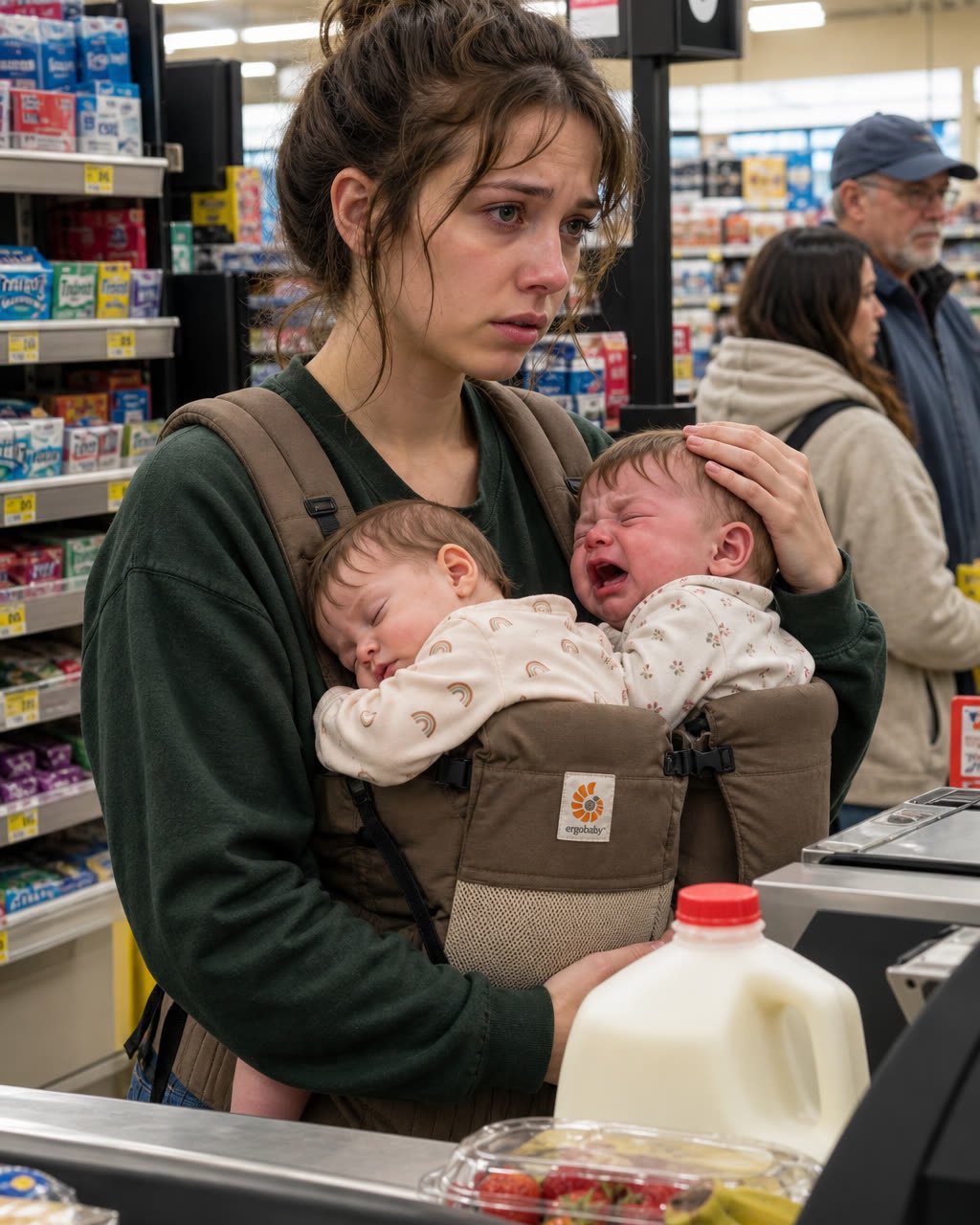
The card reader made its flat little two-note sound, and the word came up in red block letters: DECLINED.
The young woman in front of me laughed under her breath, the kind of laugh people use to cover a stumble. “Sorry. It does that sometimes. Can I try again?”
“Sure, go ahead,” I said.
She pulled the card out, wiped the chip on the hem of her sweatshirt as if dust were the problem, and pushed it back in. Her hand was shaking enough that it took two tries to seat it.
Two notes. Red letters. DECLINED.
Behind her, a man in a camouflage ball cap let out a sigh so long and loud it sounded rehearsed. Farther back, past the gum rack, someone said, “Oh, come on,” to nobody in particular.
Strapped to her chest in a black double carrier were two babies. One was asleep with his cheek squashed against her collarbone. The other was screaming, his face the color of a ripe plum, fists punching the air.
She bounced him without seeming to notice she was doing it. Then she looked at me, and her chin did something small and unsteady.
“I’m sorry,” she said, barely above the noise. “Could you take the diapers off?”
I looked at the screen. With the diapers, she was short $8.42. Eight dollars and forty-two cents, on a Friday night, with a line backing into the cereal aisle.
I didn’t know yet that those eight dollars were going to carry something back to my family that we had stopped looking for twenty-two years earlier. At that moment, all I knew was that my own checking account had sixty-one dollars in it, and I had counted that number twice before breakfast.
So let me back up to breakfast.
My name is Rachel Hale. I’m thirty-four, I run register three at Hollis Market in Millbrook, and in a town of about four thousand people, that makes me something between a bartender and a priest.
That Friday started at 6:00 a.m. with my phone buzzing on the nightstand and me staring at the brown water stain above my bed. It’s shaped a little like a rabbit with one ear folded down. I’d been meaning to get someone up on that roof for two years, which in my house means I’d been meaning to have an extra four hundred dollars for two years.
Downstairs, the kettle started its climb toward a whistle. The radio was on low, some old Alan Jackson song, and a kitchen chair scraped across the linoleum.
Yes, I still live with my mother. At twenty-four I’d have mumbled that. At thirty-four I don’t bother, because after Dad died it stopped being a living arrangement and became a partnership, two people holding up one roof.
I buttoned my green work shirt, the one with HOLLIS MARKET stitched in white over the pocket, and went down.
Mom was at the table in her quilted robe, coffee in one hand, the electric bill flattened under the other, and a yellow pencil parked behind her ear. The pencil meant arithmetic. Arithmetic in our kitchen never meant good news.
“Morning, Rae.”
“How bad?”
She slid her glasses up into her gray hair. “Worse than September. Nobody even runs the air in October.”
I leaned over her shoulder and read the number. She was right, and I felt my jaw tighten the way it does when the world sends a bill it didn’t earn.
“I’ll pick up another shift.”
“You’re already on six days.”
“So I’ll make it seven.”
“Rachel Anne.” She only middle-names me when she means it. “You’ll run yourself into the ground.”
“Dad did seven days all the time,” I said, and it came out sharper than I meant, like I was scoring a point.
She went quiet. Bringing up my father does that to her. It’s not a sad quiet exactly, more like she’s heard a voice from another room and is waiting to see if it speaks again.
“Your father,” she said finally, “was the most mule-headed man God ever put behind a steering wheel. He didn’t know what a day off was for.”
“I know.”
“And you got every ounce of it.”
“I know that too.” I felt bad about my tone, so I put my hand on her shoulder. She reached up and covered it, and her fingers were cold the way they always are before the coffee kicks in.
“Go,” she said. “Take a banana. You live on crackers.”
I took the banana. I did not eat the banana. It rode shotgun all day, going spotted and then brown, like a little timer counting down my good intentions.
The car is a 2009 Honda Civic with a crack running across the windshield and a check-engine light I’ve learned to see as decoration. That morning, when I turned the key, it made a grinding noise I’d never heard before, like a coffee grinder full of gravel.
“Please,” I told the dashboard. “Thursday, maybe. Not today.”
It caught on the third try. I patted the wheel like a horse.
On the drive in, I did what I always do, which is math. The electric bill, Mom’s blood pressure prescriptions, and the car insurance due on the fifteenth. Whatever that grinding was going to cost. Payday on Thursday, sixty-one dollars until then.
Millbrook has one stoplight, two churches, a hardware store, and Patty’s Diner, where the Tuesday meatloaf hasn’t changed since I was in diapers. And it has Hollis Market, where I’ve worked for six years.
You learn a town from a register. You notice when a woman stops buying the good ice cream, when a man switches from name-brand coffee to the store brand, when a bottle of wine shows up every Friday and then, one week, quietly doesn’t. Nobody tells you anything, and you know it anyway.
Lori was already clocked in when I came through the employee door at 6:56. She’s sixty-three, she’s been at Hollis since before I was born, and she considers herself Millbrook’s evening edition.
“Honey, you look like something the cat dragged in and then dragged back out,” she said, handing me a coffee.
“Thank you, Lori. Always a pleasure.”
“Truck’s late and we’re short a stocker. Mike’s in a mood.”
Mike Delgado, our manager, is always in a mood. He’s a big man with a salt-and-pepper beard and drugstore readers he shoves up on his forehead and then hunts for. He barks. He also once drove forty-five minutes through a snowstorm to bring a cashier the insulin she’d left in the break room fridge.
“Hale. Three,” he said as I passed, which from Mike is a full paragraph.
I counted my drawer, wiped down the belt, and checked the paper roll. Then I did what I do every morning before the first customer.
Taped to the side of my scanner, under a strip of packing tape gone yellow at the edges, is a photograph of my dad. He’s leaning against his big blue Peterbilt with his arms crossed, ball cap pushed back, grinning like somebody just told him the best joke of his life.
He’s wearing his brown canvas work jacket, and on his left wrist is a silver watch with a dark face and a brown leather strap. Mom bought it for their tenth anniversary. She skipped lunches for most of a year to afford it, and it was the only nice thing he ever let anyone give him.
He died when I was twelve. Black ice on Route 9, a March night, coming home a day early because he missed us.
When I was little and whined that something wasn’t fair, he’d crouch down until we were eye to eye and say it the same way every time: “Rae-bug, you can’t make the whole world right. But you can make the next ten minutes better for somebody.”
I touched the corner of the photo. “Morning, Dad.” Then the doors whooshed open, and Friday started.
The day went the way Fridays go. Mrs. Kowalski with cat food and prune juice. The Jensen boys with energy drinks and jerky. Emma Tate’s mom with sprinkles, candles, and a phone photo of a homemade unicorn cake that leaned like a tower in Italy.
“It’s perfect,” I told her.
“It’s a disaster.”
“It’s a perfect disaster. She’ll love it.”
By two I’d eaten a sleeve of saltines. By four my feet hurt. By six the after-work rush had turned every line into a slow, sighing snake.
At 6:40, a woman I didn’t know walked in, and in Millbrook you notice a face you don’t know.
She was maybe mid-thirties, with long braids pulled back in a plain black elastic. She wore an oversized gray hoodie and jeans worn almost white at the knees, and across her chest was that black double carrier with the two babies inside.
Twins, five or six months old, I guessed. One was out cold, mouth open, a hand fisted in the cotton of her hoodie. The other was crying like he’d been personally betrayed.
“I know, baby, I know,” she murmured, swaying down the aisle. “Mama’s almost done.”
She didn’t take a cart. She carried three things in her arms, and while she waited behind four people in my line, I watched her look at those three things, then at her phone, then at the three things again. Her lips moved. She was adding.
I knew that face. I’d worn it at the kitchen table that morning.
Right behind her stood Dale Pruitt, who runs the repair garage out by the county line. Dale isn’t mean. He’s a man whose patience comes in a very small size, and he had a twelve-pack under one arm, a frozen pizza in his hand, and a jaw that tightened every time the baby wailed.
When she reached me, she set the three things on the belt. A gallon of whole milk. A canister of formula. A pack of size-two diapers, store brand, the cheapest we carry.
“Twins?” I asked, scanning.
She smiled, tired. “The loud one’s Noah. The sleepy one’s Eli.”
“Hi, Noah. Rough day, buddy?” Noah answered with a shriek that made the bagger at register two flinch.
“He’s hungry, he’s wet, and he’s mad at me about both,” she said. “He’s got his daddy’s lungs.”
Something shut behind her eyes when she said daddy, like a door pulled closed. I didn’t ask.
Which brings me back to 6:52 p.m., the red word on the screen, and a woman asking me to take the diapers off.
She’d opened her wallet on the counter by then. A library card, a folded piece of paper, a few quarters and dimes. She counted the coins with one finger while she bounced Noah with the rest of her body, and then she stopped counting, because there was nothing more to count.
Without the diapers, she could cover the milk and the formula. With them, she was eight forty-two short. People spend that on a latte and a muffin without blinking.
But I knew what eight dollars means at the bottom of a month. I’d watched a man put back a loaf of bread. And I remembered being eleven, watching my mother quietly lift a package of chicken thighs out of our cart and set it by the gum because the total had come up too high.
This woman was choosing between fed and dry. With both babies strapped to her body. In front of a line of strangers.
I thought about my sixty-one dollars. The electric bill. The grinding noise. For one honest second, I thought about saying, “Sure, I’ll void those,” and letting that be that.
Then my knuckle grazed the corner of Dad’s photo.
I pulled my own debit card out of my back pocket. “Keep the diapers,” I said. “I’ve got the rest.”
Her head came up fast. “No. No, you don’t have to do that.”
I’d already tapped. The reader chirped. APPROVED, in friendly green.
Her eyes filled so fast it looked like it hurt. She pressed her knuckles against her mouth. “I don’t know when I could pay you back.”
“You don’t. Go home and take care of these guys.” I tucked the diapers into her bag myself.
Behind her, Dale opened his mouth. Then he saw her face, closed it, and suddenly found the magazine rack very interesting.
She took the receipt but didn’t move. Then her gaze slid off me, down and to the right, to the side of my scanner.
To my father.
The color left her face in one long drain, the way a sink empties. Her hand stopped moving on Noah’s back. She looked like someone who had just watched a person walk in from a place people don’t come back from.
“Ma’am?” I said. “Are you okay?”
She looked at the photo. Then at me, searching my face for something. Then at the photo again.
“Is that—” she whispered.
Part 2: The Watch That Wasn’t in the Bag
Before she could finish, Noah let loose a scream that rattled the gum rack, and Eli, jolted awake, joined him on the high note.
“Today, lady,” someone called from back by the cereal. Dale shifted his twelve-pack to his other arm.
Whatever she’d been about to ask folded itself back up. She shook her head hard, like clearing water from her ears. “I’m sorry. Thank you. Thank you so much.”
She gathered the bag and turned for the doors. Halfway there, she turned around again.
“You don’t understand what you just did,” she said, her voice wobbling. “Today, of all days.”
“It’s only a few dollars,” I said.
“No.” She said it firmly, the way a teacher corrects a wrong answer. “It’s not just a few dollars.”
The automatic doors slid open for her. Right before they closed, she looked back one last time, and it wasn’t at me. It was past me, at the side of my scanner.
Then she was gone into the dark of the parking lot.
Dale stepped up and set his beer and pizza on the belt without a word. “Thirty-one sixteen,” I told him. He paid in cash, and when I counted his change into his palm, he didn’t close his hand right away.
“That was decent of you,” he muttered.
“She needed it.”
“Yeah.” He looked toward the doors. “Yeah, she did.”
He stopped just inside the exit and stood there a second, staring at the lot. Then he shook his head at something only he could see and walked out.
The rest of the shift ran together. A college kid with a Delaware license that said twenty-six and a face that said nineteen. A jar of dill pickles that exploded in aisle four and made the front end smell like a deli. Coupons, small talk, and the ache in my arches climbing up into my calves.
But under all of it, like a song you can’t stop humming, was her face going white.
At closing, Mike came over to count my drawer. He snapped a rubber band around a stack of tens and didn’t look up.
“Lori says you bought a customer’s groceries.”
“Diapers. Eight bucks.”
“You know cashiers aren’t supposed to do that. Corporate calls it a liability.”
“I know.”
He counted the fives, then the ones, then set the stack down. “Go home, Hale. You look like a ghost.”
The banana on my passenger seat had gone fully black. I dropped it in the lot’s trash can and apologized to it, which tells you how tired I was.
At home, the kitchen light was on. Mom always waits up, no matter how many times I tell her not to. She was at the table with a cup of chamomile and the newspaper crossword, pencil back behind her ear.
“Potato soup on the stove,” she said without looking up.
I ladled a bowl and sat across from her, and after three spoonfuls I realized I hadn’t eaten anything real since the saltines. She watched me over her readers.
“Something happened.”
“How do you always know that?”
“I changed your diapers, Rachel. I know everything. Spill.”
So I told her. The twins, Noah and Eli. The red word on the screen, twice. The sigh from the man in the camo cap. The eight forty-two.
I didn’t mention the sixty-one dollars. I didn’t have to. My mother has run the numbers in that kitchen for twenty-two years, and she knew what eight dollars meant in a week like this one.
When I finished, she set down her pencil. Her smile had something sad folded inside it.
“Your father did that kind of thing constantly.”
“I know, Mom.”
“No, honey. You know he was generous. I mean constantly.” She leaned back in her chair. “We’d be sweating the mortgage, and he’d call from a truck stop in Ohio to tell me he’d filled some stranger’s tank because the poor guy was stuck.”
She shook her head. “One December he gave his winter coat to a hitchhiker outside Pittsburgh. A kid, maybe nineteen. Your father came home with his lips blue.”
“I never heard that one.”
“Because I was too mad to repeat it. I told him, Tom, you cannot save every stray in America.” She looked at me over her mug. “You know what he said?”
I did. “You can’t make the whole world right. But you can make the next ten minutes better for somebody.”
Her eyes went shiny. “He said that to you, too?”
“About a thousand times.”
“That stubborn, stubborn man.” She picked her pencil back up and stared at the crossword without seeing it. “I miss him, Rae.”
“Me too.”
I went up around midnight, but sleep wouldn’t come. I lay there looking at the rabbit-shaped stain and replaying the moment her eyes landed on that photo.
It hadn’t been curiosity. Curiosity tilts its head. What I’d seen was recognition, the full-body kind, like hearing your own name shouted across a crowded room.
But that didn’t add up. Dad had been gone twenty-two years. She looked a couple of years older than me, which meant she’d have been a young teenager when he died. And she wasn’t from Millbrook, or I’d have known her.
I told myself she was exhausted. People see faces in clouds when they’re that tired. I told myself that three or four times.
Somewhere after one, my mind slid where it always slides on bad nights. The phone ringing at 2:10 a.m. My mother saying “yes,” and then “yes,” and then nothing at all. The silence after, which was the loudest thing I’d ever heard.
The funeral, with truckers who’d driven in from four states and stood along the back wall of the church in their good flannel shirts, hats in their hands.
And the bag.
A week after the accident, a state trooper brought Dad’s things to our door in a clear plastic bag. His wallet. His wedding ring. His keys on the Peterbilt fob. A half-eaten pack of sunflower seeds. A crumpled receipt from some diner.
The watch was not in the bag.
Mom called everyone. The state police, twice. The hospital. The tow yard in Carver. She even called Hanley’s, the jeweler on Main Street, which I didn’t understand at the time and never thought to ask about.
Nobody had it. The theory we settled on was that it had been flung from the cab when the truck went over, and that it was out there somewhere under the snow on Route 9.
That April, when the thaw came, Mom drove us out to the spot. We walked the ditch for three hours in rubber boots, turning over wet leaves with our bare hands. We found a hubcap, a beer can, and a cracked robin’s egg. We never found the watch.
She stopped talking about it after that. But sometimes I’d catch her rubbing her own wrist with her thumb, right where a watch would sit.
Lying there that night, something small surfaced that I’d never let myself look at. That last winter, the one before the ice, I couldn’t actually remember seeing the watch on his wrist. I’d been twelve. I hadn’t been looking. It was probably nothing.
I fell asleep picturing it ticking under wet leaves, keeping time for no one.
I was four minutes late the next morning. I’d barely gotten through the employee door when Lori came toward me at something close to a jog.
Lori does not jog. In six years I’d never seen her move faster than a determined stroll, and my stomach dropped to my shoes.
“Mike wants you in his office,” she said. “Right now. I’m covering three.”
“Am I in trouble?”
She hesitated a beat too long. Then she squeezed my arm. “Just go, sweetheart.”
The walk to the back felt a mile long. Somebody had complained about the diapers. Corporate had flagged the transaction. My drawer had come up short. They were cutting hours and needed an excuse.
I could not lose this job. Not with Mom’s prescriptions, not with the electric bill pinned to the fridge, not with a car one bad morning away from the scrapyard.
My palms were damp when I knocked.
“Come in. Shut the door.”
Mike sat behind his desk with his hands folded on top of a plain white envelope. His readers were up on his forehead. He didn’t look angry. He looked like a man who’d been up too late thinking about something he couldn’t put down.
“Sit, Hale.”
I stayed standing and started talking fast. “Mike, if this is about last night, I know it’s against policy. But she had two babies on her and she was trying to put back the diapers, and I used my own card, I didn’t touch the drawer, so I thought—”
“Hale.”
“—it technically wouldn’t count as a store transaction, and—”
“Rachel.”
I stopped. In six years, Mike Delgado had never once called me Rachel.
He took a breath and tapped the envelope. “She came back last night, after you left.” He looked up at me. “And she asked me if your father’s name was Tom.”
Part 3: An Envelope Underlined Twice
For a second I honestly thought I’d misheard him, the way you mishear a song lyric.
“She what?”
“A few minutes after ten. I was dragging the sidewalk sign in, and here she comes across the lot with those two babies strapped on. On foot, in the dark.”
He rubbed the bridge of his nose. “First she wanted your full name. I told her I don’t hand out employee information. She said she understood. Then she asked, real careful, if the cashier at register three had a father named Tom. A trucker. Blue rig.”
My hand found the back of the chair.
“I’ve listened to you say good morning to that picture for six years,” Mike said quietly. “And Lori’s told me about Tom Hale more times than I can count. So I told her yes. She sat down on the bench by the carts and cried, Rachel. Not a little. Like something broke open.”
He pulled his readers off his forehead and folded them, which is what Mike does when he doesn’t know what to do with his hands.
“Then she asked if your mom’s name was June.”
The office tilted. There’s no other way to say it. The floor stayed put, and everything else slid an inch to the left.
“How would she know my mother’s name?”
“I asked. She said it was all in here.” He slid the envelope across the desk. “She wrote it on my clipboard, sitting on that bench, with one baby asleep and the other chewing on her braid. Made me promise you’d get it first thing.”
On the front, in neat blue capitals, it said: FOR RACHEL, THE CASHIER AT REGISTER THREE. PLEASE.
The word please was underlined twice. The second line had been pressed so hard it nearly tore the paper.
I picked it up, and the first thing I noticed was the weight. Envelopes aren’t supposed to be heavy. This one sagged in the middle like it was carrying a stone.
I sat down then. My knees made the decision for me.
On top inside was a small zip-top sandwich bag with coins and a few folded bills. A sticky note was pressed to the plastic, the handwriting smaller and hurried: $8.42. I told you I’d pay you back. I just didn’t think it would be this soon.
Under that were two sheets of lined paper torn from a spiral notebook, fringe still on the edge. Blue ink, front and back, packed close.
And under the pages, filling the bottom of the envelope, was something wrapped in a white baby washcloth. The terry kind, with a little yellow duck stitched in one corner, folded over and over the way you’d swaddle something you were afraid to drop.
I lifted it out. It was solid and cool through the cloth. I unfolded one corner, then another.
Then I stopped breathing.
A silver wristwatch. Dark face. Brown leather strap, cracked at the holes where it had bent for years around somebody’s wrist. And across the glass, a fine diagonal scratch running over the number four.
I knew that scratch the way you know a scar on your own knee.
When I was six, seven, eight, I used to climb into Dad’s lap in his recliner while he told me about the places he’d driven. The salt flats. A bridge in Louisiana so long you lost sight of land. Mountains in Colorado that made his ears pop. And while he talked, I’d trace that scratch with my fingertip, back and forth, like it was a road on a map.
“Where’d the scratch come from?” I asked him once.
“Tailgate in Amarillo,” he said. “Tried to fight me. I won.”
My hands didn’t feel like mine when I turned the watch over.
The engraving was there. Worn shallow in places, but there, in small looping script, the kind Hanley’s used to charge for by the letter.
TOM. COME HOME TO US. LOVE ALWAYS, JUNE.
I’d read those words a hundred times as a kid. I hadn’t realized I still knew them by heart until I caught myself mouthing them in Mike Delgado’s office.
Then I noticed a sound, so small I’d missed it under the hum of the little office fridge.
It was ticking.
Twenty-two years. Twenty-two years of my mother rubbing her empty wrist. A whole April afternoon in a ditch with our hands in the cold leaves. And all that time, it had been somewhere, being wound.
“Mike,” I said, and my voice came out thin. “This is my dad’s watch.”
He came around the desk and crouched beside my chair, which for a man his size is an undertaking. “I know, kid. She showed me the back last night.”
“We looked everywhere. The police. The hospital. Mom and I walked Route 9.” I couldn’t stop the words. “It was supposed to be in the snow. It was supposed to be gone.”
“I know.”
“How does a stranger walk into Hollis Market with my father’s watch?”
He nodded at the two pages in my lap. “I think that’s going to tell you.”
He stood, filled a paper cup at the water cooler, and set it by my elbow. “Take whatever time you need. Nobody’s coming in here.” After he shut the door, I heard him in the hallway telling someone, in his regular bark, to leave the office alone or answer to him.
I didn’t open the letter right away.
I sat with the watch in my palm and let something rise in me that I’d been pressing down since I was a girl, because suddenly it had nowhere else to go.
When Dad was alive, I was going to be a veterinarian. Not wanted to be. Was going to be. I kept a notebook of every animal I’d ever bandaged, including a sparrow, two frogs, and a neighbor’s beagle that didn’t actually need bandaging. Dad called me Doc whenever he phoned home from the road.
After the funeral, money got tight in a way it never really loosened from. I stopped saying veterinarian at fourteen. By eighteen I was running a register at the old Dollar Barn, and by twenty I’d stopped even thinking the word, because thinking it hurt.
And here’s the part I’d never told anyone, not even Mom. Some part of me had been angry at him. For driving home early. For the ice. For leaving us a stack of bills and a pencil behind her ear.
I’d loved him with my whole chest and been furious with him with the same chest, for twenty-two years. I think I’d taped his picture to my register partly so I’d never have to look that second feeling in the eye.
Sitting there with his watch ticking against my palm, it felt like he’d caught me at it.
I took a sip of water. My hand shook enough to slosh it onto my jeans.
Then I unfolded the first page.
Dear Rachel,
My name is Maya Brooks. I’m thirty-six years old. And when I was fourteen, your father saved my life.
Part 4: Twenty-Two Years in Blue Ink
I read that line twice before my eyes would move on.
Twenty-two years ago this past January, I was living in a foster placement in eastern Kentucky. I won’t go into all of it. It wasn’t a safe house, and I knew that if I stayed, I’d stop being myself. One night I left with a backpack, eleven dollars, and no plan except away.
I walked until I hit a truck stop off the interstate. It was snowing sideways, and I couldn’t feel my toes. I went into the diner because it was warm and sat in the back booth pretending to read the menu. When the waitress came, I ordered hot water, because hot water was free.
Then a trucker came over. Ball cap pushed back, the biggest grin I’d ever seen on a grown man. He said his name was Tom.
I was scared of him. I was scared of everybody. He must have seen that, because he slid into the other side of the booth and kept both hands flat on the table where I could see them. Then he said I’d been glaring at that menu so long it must have said something about my mother.
I laughed. I hadn’t laughed in a long time.
Before I could argue, he ordered pancakes, eggs, bacon, and a hot chocolate with whipped cream. He didn’t ask where I came from or why I was alone. He just talked, so I wouldn’t have to.
He talked about his wife, June. He said she was the smartest person he’d ever met and he’d spent fourteen years trying to figure out why she married him. He said she did the bills with a pencil behind her ear and it scared him to death.
I laughed once, a wet sound, alone in Mike’s office.
He talked about his daughter, Rachel. He called her Rae-bug. He said she was twelve and going to be a veterinarian, and that she’d once bandaged a beagle that wasn’t even hurt. He said she had a laugh like a hiccup, a little catch at the top. He showed me a school picture from his wallet. You were missing a front tooth.
I put the page down on my knee. The beagle. He’d told a stranger about the beagle.
I’d always thought that dream died quietly in our kitchen sometime around my fourteenth birthday. It had never occurred to me that he’d carried it around in his wallet and shown it off in diners.
When I finished eating, he asked if I had anywhere safe to go. I told him about my aunt Denise in Macon, Georgia, my mother’s sister. I hadn’t seen her since I was nine. I didn’t know if she’d even want me.
He said, Well, let’s find out.
He drove me to the bus station in Lexington and made me wait in his cab with the heater running while he went inside to the pay phone. He was in there almost an hour. He called a youth hotline, they called someone else, and somehow he got my aunt on the line. She said yes. She said, Put that baby on a bus.
He came back with a ticket to Macon. But there was an overnight layover in Atlanta, and he was worried about me sitting in a station with nothing. He opened his wallet, and there was four dollars and some change in it. He looked at it like it had personally let him down.
So he took off his watch.
I said no. I said it a lot of times. He put it in my hand, closed my fingers over it, and told me that if anything went wrong, anything at all, I should sell it and get myself the rest of the way.
I turned it over and saw the engraving. I said, Your wife gave you this. You can’t.
He laughed. He said, June’s going to lecture me for an hour. And then she’ll understand. That’s how we work.
Before I got on the bus, I asked him why. Why would he do all that for a girl he didn’t even know?
He crouched down so we were eye to eye. And he said the thing I’ve repeated to myself almost every day since.
“You can’t fix the whole world, kiddo. But you can make the next ten minutes better for somebody. Tonight somebody’s doing that for you. Someday you’ll get your turn to do it for somebody else.”
I pressed my hand over my mouth. Not something like what he used to tell me. The same words, crouched down the same way, in a Kentucky bus station, to a girl I’d never met.
Macon was where my life started over. Aunt Denise was waiting at the station in her church hat at six in the morning. She raised me. She made me finish high school. I became a certified nursing assistant at twenty, and I’ve worked with elderly patients ever since.
I never had to sell the watch. I wound it every morning. On bad days I held it to my ear and listened, and I’d remember that a stranger once decided my life was worth his only nice thing.
I tried to find him for years. I wrote to the truck stop. When I got older, I searched online. But all I had was Tom, a wife named June, a daughter named Rachel, and a blue truck. Do you know how many Toms drive blue trucks?
Then this year, everything came apart. My husband left in July, when the boys were three months old. He took the car and most of our account, and I haven’t heard from him since. I took a job at Willow Creek Nursing Home here in Millbrook because they were hiring and the rent on Pike Street was something I could almost afford. I start Monday. My first check is two weeks out.
Yesterday the bank hit me with overdraft fees I didn’t see coming. That morning I sat on my kitchen floor with your father’s watch in my hand, and for the first time in twenty-two years, I seriously thought about selling it. He’d told me to, if I needed to. And I needed to. The boys were down to four diapers.
I couldn’t do it. I’d always believed I’d find him someday and hand it back.
Then I walked into your store. My card got declined, the man behind me sighed, Noah wouldn’t stop crying, and I wanted the floor to open up. And you paid for the diapers like it was nothing. Like it was the most normal thing in the world.
Then I saw the picture taped to your register. The grin. The cap. The blue truck. The watch on his wrist, the same one sitting in my diaper bag at that exact moment.
I came back after closing because I had to know. Your manager told me your father was Tom Hale. He told me Tom died when you were twelve.
Rachel, I’m so sorry. I didn’t know. All these years I pictured him still out there driving, buying pancakes for runaways, making waitresses laugh.
I’m giving the watch back. Please give it to your mother. Please tell June her husband did find his way home. It just took twenty-two years and a scared girl from Kentucky to get him there.
And please tell her it did exactly what he wanted it to do. It got me somewhere safe.
The $8.42 is in the bag. I know you said not to. Twenty-two years ago your father helped me when I had nobody. Yesterday you did the same for my sons. Thank you for both.
With my whole heart, Maya Brooks. The yellow house on Pike Street.
P.S. He said you laugh like a hiccup. I hope you still do.
I read it three times. I kept seeing her on her kitchen floor that morning, four diapers left in the house, deciding not to sell it. Then strapping both boys on and walking to the store with whatever she had left.
Mike knocked softly and put his head in. “You okay, Hale?”
“Yeah,” I said. It was not a convincing yeah.
He looked at my face. “Go home.”
“We’re short a stocker.”
“We’ve been short a stocker since 2019. Your mother needs to see that before you do one more thing today.”
I held the watch out, back side up. He pulled his readers down onto his nose for once and read the engraving. Then he handed it back, cleared his throat hard, and became very interested in a stain on his own ceiling.
“Go home, Rachel.”
Lori was scanning a cart at three when I came up front. She took one look at me. “Sweetheart?”
“Tonight,” I said. “I’ll tell you everything tonight. Promise.”
I stopped at the scanner and laid two fingers on the corner of the photograph, the yellowed tape, his grin. “Hi, Dad,” I whispered. “You finally made it home.”
I don’t remember the drive. I remember the Honda starting on the first try, which felt like a sign, and that I wouldn’t have cared if it hadn’t.
Mom was at the sink in her yellow rubber gloves when I came in the back door. She turned with a plate in her hand. “Rae? It’s not even ten. Are you sick?”
Then she saw my face, and the plate went down on the drainboard. “Rachel. What happened?”
“Nothing bad. I swear, Mom, nothing bad. Will you sit down?”
She peeled off the gloves and sat, and the fear on her face made me feel awful for the ten seconds it took to get the envelope open.
“The woman with the twins,” I said. “She came back to the store last night after I left.”
I set the washcloth bundle on the table between us and folded back the corners.
The watch lay in a stripe of morning sun from the window over the sink. Ticking.
My mother went completely still. Not frozen, exactly. Still the way a deer goes still, every part of her listening.
She reached out and touched the cracked strap first, with just one fingertip. Then she picked it up, turned it over, and read the words she’d paid Mr. Hanley to carve there when she was thirty-eight years old.
She pressed it against her mouth and made a sound I hadn’t heard from her even at the funeral. Low and raw, like something giving way that had been holding for twenty-two years.
I came around the table and got my arms around her. She hung onto my sleeve with her free hand, and we stayed like that until the coffee maker clicked itself off.
“Where?” she finally said into my shoulder. “Where on earth?”
“There’s a letter. Can I read it to you?”
I read her all of it. The diner. The hot water. The pancakes. The pay phone in Lexington. The four dollars in his wallet.
When I got to the part where he said June would lecture him for an hour, she laughed out loud through all of it. “That ridiculous, impossible man.”
“Were you mad? When he told you?”
She set the watch down very gently.
“He never told me.”
I stared at her.
“He came home that January without it. I noticed right away. He said it was in the glovebox because the band was rubbing. A week later I asked again, and he said he’d dropped it at Hanley’s for a new strap.” She touched the cracked leather. “After the accident I called Hanley’s. They’d never seen it. I thought he’d lost it and was too ashamed to say, because he knew what I’d given up to buy it.”
Her voice broke and then came back. “So I decided it was on the road. For twenty-two years, I’ve had it lying out on Route 9 in my head.”
“He gave it to a kid who needed it,” I said.
She traced the engraving with her thumb. Come home to us. “Of course he did,” she said. “Of course that’s what he did.”
Then she sat back, and I could see her deciding something.
I had a dozen sentences ready. We should send a card. We should give her some space. We should think this through first. I’d been answering for my mother for twenty-two years, at bank counters and pharmacy windows and on the phone with the electric company, and the words were already in my mouth.
For the first time all morning, I didn’t say any of them. I waited.
“Where does she live?” Mom asked.
“The yellow house on Pike Street.”
She stood, took her purse off the hook by the door, and buckled Dad’s watch onto her wrist. It slid nearly down to her knuckles. She pushed it back up and held it there against her chest.
“Get your keys.”
“Mom, she has two babies and starts a new job Monday. Maybe she doesn’t want people showing up.”
“Then she can tell me so herself, and I’ll listen.” She was already at the door. “Keys, Rachel.”
She made me stop at Hollis first. She pushed the cart herself and filled it like she was stocking a bomb shelter. Two packs of diapers, formula, wipes, milk, eggs, bread, a whole chicken, potatoes, carrots, apples, oatmeal, coffee, and a box of the good cookies.
“Mom,” I whispered at the dairy case. “We can’t afford this.”
“We can afford today,” she said. “Next week can introduce itself when it gets here.”
Lori rang us up with her eyebrows somewhere near her hairline. Halfway through, Mike walked up and stood at the end of the belt with his arms crossed.
“Thirty percent off,” he said.
Lori looked at him. “Since when do we do that?”
“Since this morning. Ring it.”
Pike Street sits at the far end of town, where the sidewalks give out. The yellow house had paint peeling off the clapboards in long curls and a porch that leaned a few degrees toward the road. Two tiny blue socks were drying over the railing, and beside the steps sat a coffee can full of orange marigolds.
There was no car in the driveway. Of course there wasn’t.
Mom stopped at the bottom of the steps with her hand wrapped around her wrist. She stood there long enough that I almost asked if she wanted to go home. Then she climbed.
I knocked. A baby started up inside, and footsteps came toward the door.
It opened four inches on the chain. Maya was in the same gray hoodie, braids loose down her back this time. She saw me first, and her face did something hopeful and scared at the same time.
Then her eyes moved past me to my mother. Then down, to the silver on Mom’s wrist.
Her hand flew to her mouth.
“June?”
Part 5: The Yellow House on Pike Street
My mother nodded. I don’t think she trusted her voice.
The door closed. The chain rattled loose. Then it swung all the way open, and for a long moment the three of us just stood there: Maya with Eli on her hip, me with grocery bags cutting into my fingers, Mom on the top step with her hand around her own wrist.
Then Mom stepped in and put her arms around her, baby and all, the way you’d hold someone you’d been waiting for at an airport.
“He would have been so proud of you,” Mom said into her braids. “He’d have been over the moon to see you grown and safe.”
Maya’s shoulders were shaking. “I’m sorry I kept it so long.”
“Don’t you dare apologize.” Mom pulled back and held her by both arms. “You kept it safe. You kept it running. And you brought it back. That’s three things more than anybody else managed.”
From inside, Noah let out an outraged wail at being left out of whatever was happening.
Maya wiped her face on her sleeve. “Sorry. He hates being on his own.”
“Then let’s go fix that,” Mom said, and walked in like she owned the place.
The house was small and nearly bare. A sagging plaid couch. A card table with two folding chairs. A playpen wedged in the corner. In the kitchen, one saucepan sat on the stove beside an open sleeve of crackers.
But it was clean, scrubbed clean. Bottles stood washed and lined up on a dish towel like soldiers. On the fridge hung a dollar-store calendar with Monday circled in red marker, and in the square beside it Maya had written FIRST DAY! with the exclamation point traced over three times.
Mom went straight to the playpen. “May I?”
“Please.”
She lifted Noah, who objected on principle for about five seconds. Then she tucked him against her shoulder and started the slow bounce-and-pat I remembered from being sick as a kid, and his crying wound down into hiccups. He grabbed a fistful of her gray hair and stared at her like she’d hung the moon.
“Well, hello, handsome,” she told him. “You’re going to be trouble.”
I made four trips from the car. On the fourth, Maya caught my arm in the doorway.
“Rachel, I can’t take all this. You’ve already done more than enough.”
“This was all Mom. Trust me, arguing with her is a waste of a good afternoon.”
“I heard that,” Mom called from the living room.
Maya laughed, and then her eyes filled again. “I’ll pay you back when the checks start.”
I set the bags down, reached into my jacket, and took out the little sandwich bag of coins. The eight dollars and forty-two cents. I put it in her palm and folded her fingers over it, the way she’d described my father folding hers.
“You already gave us something nobody could buy,” I said. “You brought my dad back into our house.”
She looked at the bag for a long time. Then she nodded and slid it into her pocket.
We stayed all afternoon. Mom made chicken soup in Maya’s one saucepan, with potatoes and carrots and far too much black pepper, which is how Dad liked it and how nobody else ever has. Maya owned exactly two bowls, so we ate out of coffee mugs around the card table.
And Maya told us everything she remembered. How Dad said the diner coffee tasted like it had been brewed in a tire. How he said meeting June at the VFW dance was the luckiest night of his life, even though he stepped on her feet four times.
“Five,” Mom said. “It was five, and he knew it.”
“He said Rachel once brought a possum into the bathroom.”
I nearly dropped my mug. “I forgot about the possum!”
“I did not,” said my mother, covering her eyes.
“He said June screamed so loud the neighbors came over.”
“I didn’t scream. I raised a concern.”
“Mom, you were standing on the toilet lid!”
And we lost it, all three of us, the real kind of laughing where your ribs ache and you have to set your mug down. Somewhere in the middle of it, I heard it come out of me, that silly little catch at the top. The hiccup.
Maya stopped laughing. She looked at me with so much tenderness that I had to look at the table.
“There it is,” she whispered. “Your laugh.”
It was getting dark when we stood to leave. Mom wrote our number on the back of a Hollis receipt and stuck it to the fridge under a magnet, right next to FIRST DAY!
At the door, she looked down at the watch hanging loose on her wrist. Then at Maya.
“Do you want to keep it?” she asked. “You’ve had it longer than I did.”
I had a whole speech in me about what that watch meant to us. But it wasn’t my watch, and it wasn’t my question, so I kept my mouth shut.
Maya shook her head. “It belongs with you.”
“You’re sure?”
“I don’t need it the way I used to.” She glanced at me, then back at Mom. “I’ve got people now.”
On the drive home, Mom kept her right hand cupped over her left wrist. As we neared the Route 9 turnoff, she asked me to pull over.
I eased onto the gravel shoulder. She rolled down her window, the cold came in, and the only sound in the car was the ticking.
“I hated this road for twenty-two years,” she said. “I thought a piece of him was lying out there in that ditch.”
She watched the dark fields for a while.
“But it wasn’t out here. It was in Georgia. In bus stations and nursing homes and a little yellow house. He was still out there doing things, Rae. Even after.”
She rolled the window up. “Take me home, honey.”
I didn’t tell anybody at work at first. It felt too private, like a letter you keep in a drawer. But Millbrook is Millbrook, and Lori is the evening edition, and by the following Wednesday half the town knew about Maya, the twins, and Tom Hale’s watch.
Then the town did what small towns do when they decide to. Pastor Greene showed up on Pike Street with two hand-me-down cribs in the bed of his pickup. Patty from the diner started dropping off a hot dinner every Tuesday, swearing she’d accidentally made too much meatloaf.
The director at Willow Creek arranged an advance on Maya’s first check. And Mrs. Odell, ninety-one and a resident on Maya’s hall, knitted two tiny sweaters, one blue and one green.
The Friday after, Dale Pruitt came through my line with a loaf of bread and a jar of peanut butter. He paid, and then he didn’t leave.
“The woman with the twins,” he said. “Maya.”
“That’s her.”
“I heard about the watch.” He glanced at Dad’s picture. “I knew your dad. When I was a kid, he brought that blue truck into my old man’s garage. Paid me a whole dollar once to do his windshield. I thought I was a millionaire.”
Then his face changed. “I acted like a jerk that night.”
I waited.
“I’d found out that morning I had to let two of my guys go. Business is bad. I was taking it out on a grocery line, and she was standing there trying to buy diapers.” He swallowed. “That’s no excuse. I know that.”
He reached into his jacket and set an envelope on the counter. “Can you get this to her? Don’t say it’s from me.”
“Dale, you just told me money’s tight.”
He shrugged one shoulder. “Your dad told me once you can’t fix everything. But you can make the next ten minutes a little better.” He saw my face. “Somebody stole my bike when I was ten. I was bawling outside the shop. He spent an hour driving me around looking for it.”
“Did you find it?”
“Nope.” He almost smiled. “Never forgot he looked, though.”
He waited a second, like he was hoping I’d tell him we were square. I didn’t. It wasn’t my sigh he had to answer for.
“I’ll give it to her,” I said. “What she does with it is up to her.”
He nodded like that was fair, and left.
That night, Maya opened it at her card table. Three twenty-dollar bills and a note in blocky capitals: SORRY FOR SIGHING. GOOD LUCK WITH THE BOYS.
She read it twice. Then she taped it to the fridge beside the calendar and said, “He can come say it to my face sometime.”
Life didn’t turn into a greeting card. Maya’s furnace quit in January. Eli got an ear infection in February that kept her up four nights straight. Her husband never called. Some weeks she came over to our kitchen gray with exhaustion.
But she came over. That was the difference. Mom started going to Pike Street every Wednesday and Saturday, first to watch the boys so Maya could sleep, then to teach her our pot roast, then just because. Somewhere in there it stopped being help and became family. The boys call her Nana June.
Mom wears Dad’s watch every day. She had the jeweler punch two new holes in the old strap so it would fit her wrist. He offered to replace the band, and she said no. He offered to buff out the scratch over the four, and she told him, “Those are Tom’s. Leave them.”
Dale fixed whatever was grinding in my Honda and wouldn’t take a dime. And one night in January, after Mom went to bed, I sat at the kitchen table and enrolled in an online veterinary assistant program. Two evenings a week. Eighteen months, at my pace.
When I told Mom, she went to the hall closet and came back with a shoebox. Out of it she pulled a photo of me at twelve, gap-toothed, holding a very offended orange cat, and stuck it on the fridge. “Your father would’ve taken you out for pancakes,” she said.
Under register three now sits a washed-out pickle jar with a strip of masking tape across the front. It says FOR THE NEXT TEN MINUTES.
I put in what I can, when I can. Lori puts in more than she admits. Mike pretends he’s never seen it. When somebody comes up short, I make up the difference, hand them their receipt, and tell them they’re all set. No speeches.
Once, someone left an envelope in it with sixty dollars inside and FOR WHOEVER NEEDS IT on the front in blocky capitals. I’ve never said a word to Dale about it.
A few weeks ago, Maya came through my line with the boys in a secondhand double stroller, both of them wearing Mrs. Odell’s sweaters. Milk. Formula. Size-four diapers. A box of marshmallow cookies.
She tapped her card. Two notes. The screen lit up green: APPROVED.
“Look at that,” she said.
“Look at that,” I said.
Then she took a little sandwich bag of coins out of her purse and dropped it into the jar. It landed with a soft clink.
“Eight forty-two,” she said. “Every month, as long as I can.”
“You don’t have to do that.”
“I know.” She smiled. “That’s why I want to.”
She pushed the stroller toward the doors. Noah was hollering at a balloon tied to the gum machine. Eli was already asleep.
I touched the corner of Dad’s picture. “I think you’d like her,” I whispered.
I got home late that night. The kitchen light was on. Mom had fallen asleep at the table, cheek beside an unfinished crossword, readers still on, chamomile gone cold at her elbow.
Her left wrist lay on the table. The scratched glass. The cracked strap with two new holes. The steady little tick.
Twenty-two years ago, my father took that watch off in a bus station and pressed it into the hand of a frightened fourteen-year-old. It went to Atlanta and Macon and through every hard morning of her life, and it came home because of eight dollars and forty-two cents on a Friday night.
I sat down across from her and laid my hand over hers. Over the watch. Over all those years.
Her fingers, the ones that are always cold in the morning, were warm.
And listening to that ticking, I finally understood what he’d been crouching down to tell me all along. You can’t make the whole world right. But ten minutes, handed from one person to the next, can last a whole lot longer than any of us do.
Has a stranger’s small kindness ever found its way back to you years later, in a way you never saw coming?
Disclaimer: This story is a work of fiction inspired by real-life themes. Names, characters, places and events are fictionalized, and any resemblance to real persons is purely coincidental. Images are for illustration purposes only.


