

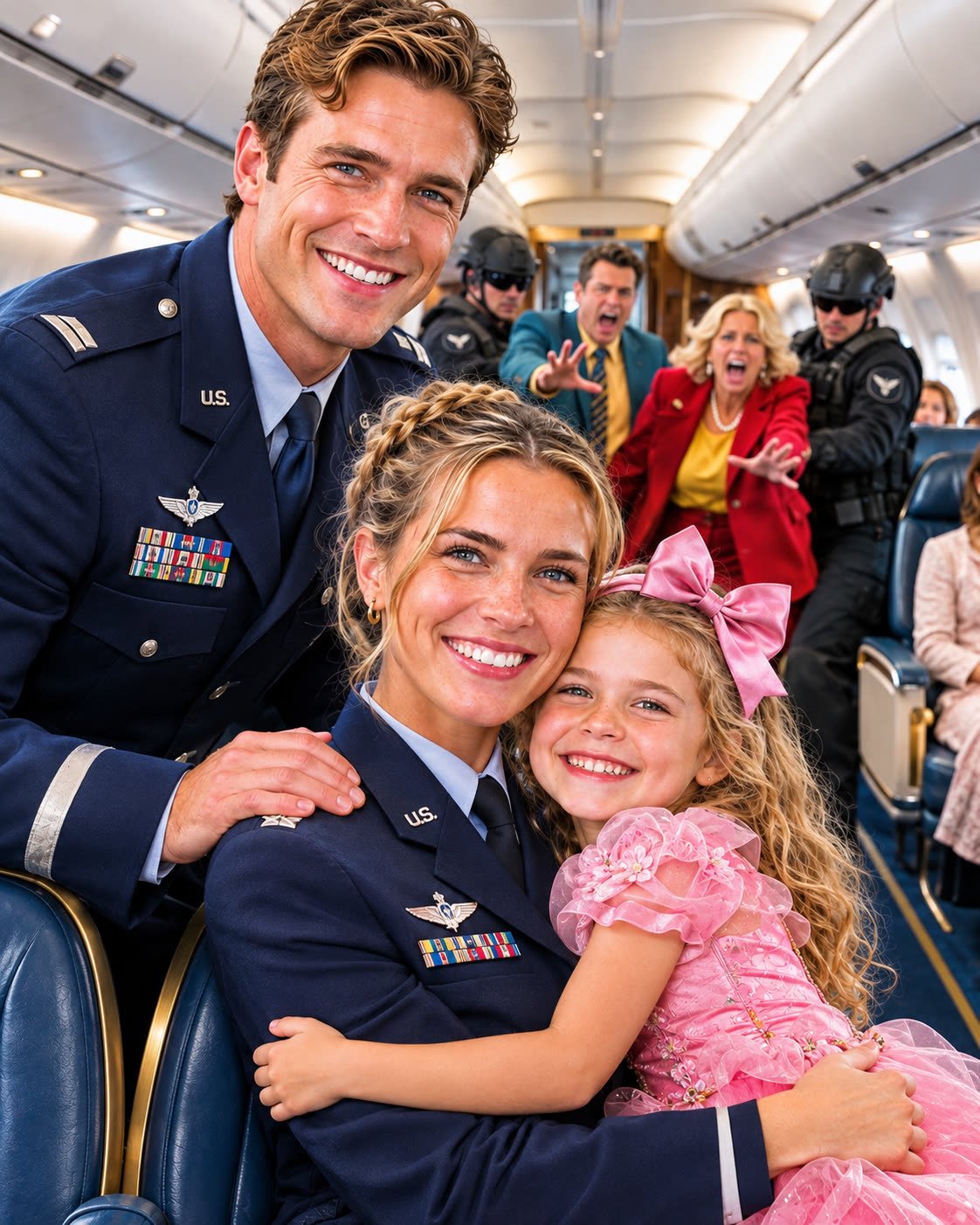
Part 1: Across the Aisle
“Excuse me. Are you sure you’re in the right cabin? Economy is farther back.”
I recognized my former husband’s voice before I lifted my eyes from the conference agenda. More than six years had passed since Owen Mercer left me eight months pregnant, but he still knew how to disguise an insult as a helpful correction.
He stood across the aisle in the business-class cabin of a flight from San Diego to Baltimore, studying the seat number above my head. His gaze traveled to the leather document case at my feet, then to the uniform jacket folded carefully over my lap.
Beside him, Sabrina Vale adjusted the strap of her carry-on. She was the woman he had left me for, and the small smile she gave me suggested that she remembered our history as something she had won.
“This is my seat,” I said.
Owen checked his boarding pass again, although there was nothing confusing about the numbers. “Well. Things have apparently improved.”
I closed the agenda without answering. There had been a time when I would have explained the ticket, the trip, and every dollar I had spent, hoping a sufficiently reasonable answer might persuade him to treat me kindly.
I no longer confused an explanation with a defense.
“Owen, let her settle in,” Sabrina said, but she was still smiling as she took the window seat across from me.
My phone vibrated against my knee. Ethan had sent a photograph from the terminal bookstore: our daughter holding a book about ocean animals, her smile missing one small front tooth.
Ethan: The expedition has secured reading material. Boarding now.
I was typing a reply when Owen leaned into the aisle again.
“Are you traveling for work?” he asked. “Or did somebody finally decide to spoil you?”
“Work,” I said.
His eyes lingered on the dark green sleeve of my jacket. Before he could ask another question, a familiar voice rose above the shuffle of boarding passengers.
“Mom, they had the octopus book!”
Maisie came toward me with her yellow sketchbook tucked beneath one arm and her new purchase clutched against her chest. Ethan followed a few steps behind, carrying both of their bags and reminding her to leave room for the passenger ahead.
She stopped beside my seat and opened the book to a page she had marked with her finger. “Did you know they can taste things with their arms?”
“Then we should be grateful you don’t have eight hands at dinner,” I said.
She laughed and leaned into me. I kissed the top of her head, grateful for the interruption and the ordinary warmth of her small body against mine.
“Daddy said we can read it after takeoff.”
Across the aisle, Owen went still.
Ethan noticed him, then looked at me. I gave the smallest shake of my head, asking him not to let this stranger turn our departure into a scene.
“Everything all right?” he asked.
“Yes. We’re just finding our places.”
Our tickets were on the same reservation, but a late aircraft change had separated our seats. Ethan and Maisie were together two rows ahead, and a flight attendant had promised to see whether anyone wanted to exchange seats once boarding was complete.
He squeezed my shoulder before helping Maisie forward. She waved her book at me once more, entirely unaware that the man watching her had once argued that buying a crib was an unnecessary expense.
Owen sat down slowly.
“How old is she?”
I met his eyes. “Six.”
He looked toward her again. “Nora—”
“Her name is Maisie.”
Sabrina stopped arranging the things in her handbag. For the first time, her expression held something other than amusement.
“Is she yours?” Owen asked, and I heard him recognize the foolishness of the question before he finished it.
“She’s my daughter. You knew I was having a baby when you left.”
A flight attendant paused between us with a tray of water. I accepted a glass, giving us both a reason to be quiet until she moved on.
Owen lowered his voice. “And that man?”
“My husband. Ethan Ellis.”
“She called him Daddy.”
“Yes,” I said. “She does.”
He pressed his lips together as if I had deliberately arranged the encounter to embarrass him. I watched him struggle with the unfamiliar experience of discovering that my life had continued without his permission.
When I slipped my arms into my service jacket, his attention sharpened. He studied the paired silver bars on the shoulder straps, then the nameplate above my pocket.
“You’re an officer?”
“A captain.”
He glanced at my conference folder. The cover identified the Atlantic Defense Logistics Forum and the hotel in Arlington where it would be held.
Something changed in his face. The surprise remained, but calculation moved in beside it, and that was the expression I remembered most clearly from the last year of our marriage.
Before he could speak again, the flight attendant returned. A passenger farther forward had offered to take my aisle seat so that the three of us could sit together.
I thanked her and stood. Owen’s hand lifted as though he meant to stop me, then settled on his armrest instead.
“We should talk,” he said.
“Not in front of Maisie.”
“I’m serious, Nora.”
“So am I.”
Ethan took my document case when I reached our new row. Maisie immediately began explaining the seating arrangement to her stuffed rabbit, which apparently needed reassurance about where everyone belonged.
I fastened my belt and let myself breathe. Ethan waited until Maisie was absorbed in the safety card before leaning closer.
“Owen?” he asked.
I nodded.
His jaw tightened, but he did not look back. “Tell me what you need.”
That question still had the power to steady me. Owen had always asked what I could do to make things easier for him; Ethan asked what would help.
“For now, just a normal flight.”
He opened the ocean book across his lap. “Then I believe we have an appointment with an octopus.”
For almost an hour, we managed it. Maisie read slowly, sounding out the longer words, while I reviewed the unclassified presentation I would give about repairing gaps in supply delivery.
The trip mattered to me. My command had chosen me to explain a pilot program our team had developed, and I had spent weeks making sure the junior Marines who did the work received proper credit.
Ethan and Maisie had come along because the forum ended before a long weekend. We had paid for their tickets and planned two days of museums afterward, a small vacation fitted around my official obligations.
I wanted that to remain the story of the week.
When I stepped into the aisle later to stretch my legs, Owen rose almost immediately. He followed me toward the rear galley, stopping a respectful distance away only when a flight attendant glanced up.
“I had no idea you were Captain Ellis,” he said.
“Now you do.”
“The forum website still lists your presentation under your professional biography. I looked at it before this trip.”
A small uneasiness moved through me. “Why?”
“My firm is pursuing the logistics compliance support contract being discussed there. Mercer & Vale. We provide legal and regulatory services to federal contractors.”
I knew the procurement he meant, although I was not on the selection board. Several vendors would be presenting their capabilities during the industry sessions, separate from the government briefings.
“Then you should know we can’t discuss an active acquisition.”
“I’m not asking for confidential information.” He smiled, trying on warmth. “I’m saying it’s remarkable that the person who could help me happens to be my daughter’s mother.”
“I can’t help you get a contract.”
“A favorable technical assessment. A recommendation that people take our proposal seriously. Nobody needs to call it anything more than that.”
I looked at him until his smile faded.
“You’ve misunderstood my job.”
“And perhaps you’ve misunderstood my position.” His gaze flicked toward the cabin. “I have a daughter I’ve never met. Courts tend to believe fathers deserve opportunities.”
For a moment, the noise of the aircraft seemed to recede. I could see Maisie’s shoes beneath the seat ahead, swinging gently while Ethan read to her.
“If you want to discuss a lawful way to contact her, you can do it through an attorney,” I said.
“Or we can make this simple.” Owen lowered his voice. “Help my firm, Nora, and I won’t have to find out how a custody fight looks on an officer’s record.”
I had thought he was staring at Maisie because he recognized his child. Standing in that narrow aisle, I understood that he had recognized leverage.
Part 2: What I Built
Six years earlier, I had stood in the kitchen of our rented house outside Oceanside and tried to calculate whether my final paycheck would cover rent, utilities, and the deposit for a crib. The defense subcontractor where I worked as a scheduling coordinator had eliminated my department, and my pregnancy made every unanswered job application feel urgent.
Owen was an associate at a growing law firm then. He had once talked about building a life together, but lately he spoke as if the life we shared were an expensive mistake for which I alone was responsible.
When I showed him a secondhand crib I had found, he asked why I couldn’t borrow one. When I mentioned a prenatal appointment, he said his calendar was not available for every minor inconvenience.
I kept explaining that the layoff was temporary. I had a degree, experience, and a plan to return to work after the baby was born.
He kept talking about Sabrina.
She understood ambition. She stayed late without complaining. She had ideas about opening a firm that would serve companies doing business with the government.
Eventually, I asked the question that had been sitting between us for weeks.
“Are you having an affair with her?”
He laughed once, without humor. “Not everything revolves around your insecurities.”
Three weeks later, he placed a large envelope on the kitchen table. The divorce petition inside had my name spelled correctly, which struck me afterward as the only careful thing he had done for me in months.
“I’m finished, Nora,” he said. “I can’t keep carrying someone who expects me to solve her life.”
I rested a hand against my stomach. “I’m eight months pregnant with your daughter.”
“You’ve made your choices.”
At the time, I thought he meant losing my job or asking too many questions about Sabrina. I did not understand the peculiar certainty in his voice, and he refused to explain it.
He packed that evening. After he left, I sat on the kitchen floor because I could no longer make my knees hold me.
Aunt June found me there an hour later. I had called her intending to say I was fine, but she had heard enough in my breathing to get in her car.
She did not tell me to be strong. She set a glass of water beside me and asked where I kept the folder with my medical paperwork.
“We’ll do the next thing,” she said. “Then we’ll do the thing after that.”
She became the person who drove me to appointments, argued with an insurance representative when I was too tired to understand the problem, and sat beside my hospital bed when Maisie arrived. Owen did not answer the message June sent him announcing the birth.
Holding my daughter, I discovered that terror and love could occupy exactly the same space. I had never needed to become reliable so badly, and I had never felt less certain that I knew how.
The divorce took months rather than an afternoon. A family-law attorney helped me obtain sole physical and legal custody, with any future contact by Owen subject to a court-approved arrangement.
He was served, represented, and informed. He did not request parenting time, and although support was ordered, the payments were inconsistent and then stopped.
I kept the records. At first, that felt petty; later, I understood that facts were a form of shelter.
For a while, Maisie and I lived with June in Vista. I worked temporary scheduling jobs, took evening assignments when June could watch her, and tried to imagine a career that would not disappear every time a company lost a contract.
The Marine Corps was not an escape I discovered overnight. I had considered an officer program during college and set the idea aside when Owen said military life would interfere with his plans.
This time, I attended an information session without asking him.
The officer selection staff did not promise an easy solution. There were medical screenings, physical standards, selection boards, and questions about whether I had a dependable arrangement for my child during training and deployments.
June came to one meeting with me. She had already spoken with my attorney about the documents needed to care for Maisie, and she arrived carrying a calendar covered in notes.
“I’m not volunteering for a weekend,” she told the staff member. “We understand what she’s applying to do.”
I submitted the required dependency paperwork, built a family care plan, and waited through a selection cycle. While I waited, I ran before dawn, worked during the day, and studied after Maisie fell asleep.
There were nights when she cried through a video call because she wanted me home. There were mornings during training when I wondered whether pursuing stability had required me to make the person I loved most feel abandoned.
June never dismissed those fears. She reminded me that Maisie was safe, loved, and allowed to miss me—and that keeping a promise sometimes meant enduring a season neither of us liked.
I earned my commission shortly after Maisie’s first birthday. Years of training, assignments, evaluations, and steady work followed before the promotion that placed captain’s bars on my uniform.
Nothing happened as quickly as people assumed when they heard the shortened version. There were childcare emergencies, a failed inspection I had to help correct, and a promotion board package I assembled while Maisie recovered from an ear infection.
There were also Marines who taught me without making me ashamed of what I did not know. I learned to ask clear questions, own mistakes early, and never promise a shipment I could not deliver.
I met Ethan at a community volunteer event when Maisie was two. He had left the Corps and worked as a facilities engineer, and he spent most of that first afternoon helping a group of children build wooden birdhouses.
Maisie informed him that her birdhouse required two doors.
Instead of telling her birds did not need a front and back entrance, he asked her to show him the plan.
Our friendship became dinner invitations, then shared errands, then a relationship I was careful not to rush. I watched how he behaved when Maisie was tired, when plans changed, and when nobody was there to praise him for being kind.
He never asked her to call him anything but Ethan. The first time she called him Daddy, he waited until she was asleep before telling me, and his voice broke halfway through the sentence.
We married two years before the flight. We had discussed adoption, but I knew that handling Owen’s remaining parental rights would require a legal process, and we had refused to treat it as a sentimental shortcut.
* * *
Back on the airplane, I kept my voice low enough that Maisie could not hear.
“You don’t get to make a government recommendation the price of leaving my daughter alone.”
Owen glanced toward the flight attendant, who was closing a storage compartment. “Careful. That sounds like an accusation.”
“It’s a description of what you just said.”
He stepped back, smoothing his jacket. “Think about whether you want to make an enemy of me.”
I returned to my seat with my hands steady and my stomach tight. Ethan looked at my face and closed the book.
“Later,” I said quietly.
He nodded, then asked Maisie whether a jellyfish counted as a good candidate for a bicycle helmet. She gave the question the solemn attention it deserved.
After landing, while Ethan helped her choose a snack, I wrote down Owen’s words with the time and place. I saved my boarding pass and sent a short request to my supervisor asking for a private call about an ethics concern.
At our Arlington hotel that evening, I told Ethan everything after Maisie fell asleep.
He listened without interrupting. Then he asked whether I had contacted Rachel Kim, the attorney who had handled the final custody order.
“I left a message from the airport.”
“Good. We deal with what he can actually do, not just what he says he can do.”
I opened my laptop, searching publicly available information about Mercer & Vale. Their website described expansion, acquisitions, and a specialized federal compliance practice, but the court records told a less polished story.
There were collection actions, a lender’s lawsuit, and a dispute over an acquisition financed by a short-term loan. None proved a crime, but together they explained why Owen might regard one new contract as a lifeline.
Ethan read beside me without touching the keyboard. “You’re not investigating him alone,” he said. “You’re preserving what he’s already put in front of you.”
Rachel called just after 8 p.m. I stepped into the sitting area and walked her through the encounter, trying not to sound as frightened as I felt.
She asked me to send the existing order and any messages Owen sent. She also warned me not to argue with him about legal rights or agree to an informal meeting involving Maisie.
“Can he get emergency custody here?” I asked.
“Not simply because he’s her biological father and you’re both visiting Virginia. But if he files something false, we respond immediately, and I’ll arrange local counsel if needed.”
Her caution reassured me more than an easy promise would have. She was not pretending there was no danger; she was showing me where the danger ended and the paperwork began.
I had just thanked her when a message appeared on my screen.
Owen: Eight tomorrow morning. Your recommendation, or my petition. You know how quickly ugly allegations travel.
Before I could answer, a second message arrived with a photograph of a document bearing Maisie’s full name.
Part 3: Beside the Fountain
The next morning, Rachel told me that the photographed document was not an order. It was an unsigned draft petition containing allegations Owen would still have to submit to a court and support.
“A threatening piece of paper isn’t the same as judicial authority,” she said. “Save everything, and don’t negotiate with him.”
She had already contacted a Virginia attorney who could respond if Owen attempted an emergency filing there. My custody case remained in California, and she was preparing a declaration documenting the threat and his years without contact.
After our call, I spoke privately with Lieutenant Colonel Adrienne Shaw, my supervisor at the forum. I told her about the relationship, the contract, and the message tying a favorable recommendation to a custody threat.
She did not ask why I had failed to anticipate meeting my former husband on a commercial flight. She asked whether Maisie was safe.
“She’s with my husband,” I said.
“Keep it that way. You’ll have no role in any discussion involving that firm. Forward the messages through the approved reporting channel, and we’ll get counsel involved.”
The relief was so sharp that I had to look down at my notebook. Owen had made my career sound like something fragile I must protect by staying silent; my supervisor was treating disclosure as part of my duty.
The acquisition counsel I spoke with later was equally clear. I could not endorse a bidder privately, and any relevant technical input had to go through established channels.
“You also don’t need to decide whether this meets the elements of a crime,” she said. “Report the facts. Other people can assess them.”
That distinction gave me something solid to stand on. I did not have to become an investigator, a prosecutor, and a family-law expert before I was allowed to ask for help.
By late morning, Owen had missed his own deadline without filing anything Rachel could find. I attended my session, delivered my presentation, and answered questions while a part of my mind remained upstairs with my family.
I spoke about accountability in supply chains. When a colonel asked how our team had reduced missing deliveries, I explained that we had stopped treating small discrepancies as somebody else’s problem.
The words stayed with me after I stepped away from the lectern.
* * *
That afternoon, I left a panel on military family readiness and headed toward the hotel café. Ethan had sent a photograph of Maisie drawing beside the atrium fountain while he ordered pastries.
I saw her yellow sketchbook before I saw Owen.
Maisie was seated at a low table a few steps from the café counter. Ethan stood within sight of her, accepting a tray from the cashier, and Owen had used those few seconds to crouch beside her chair.
“That’s a beautiful picture,” he was saying. “But did your mother ever explain that Ethan isn’t your real father?”
Maisie’s crayon stopped moving.
I crossed the atrium fast enough that a conference badge swung against my jacket. Ethan turned at the same moment, saw who was beside her, and set the tray down.
“Daddy Ethan is my dad,” Maisie said.
“I’m your real father. You could come live in a very nice house with me.” Owen reached toward the sketchbook. “You wouldn’t need—”
“Step away from her,” I said.
He stood immediately. Ethan reached Maisie and lifted her into his arms, leaving the book open on the table.
“Mom?” Her eyes moved between us. “Did I do something wrong?”
“No,” I said. “You did nothing wrong.”
Ethan pressed his cheek gently against her hair. “Let’s go find a quieter place, bug. Mom will be right with us.”
He did not promise that nobody could ever upset her again. He told her where they were going, held her securely, and gave her something understandable to do: carry the rabbit while he carried her.
I waited until they were beyond hearing.
“You are not authorized to approach her alone,” I told Owen. “Any contact goes through our attorneys.”
“I was introducing myself to my child.”
“You were telling a six-year-old she could lose the father who raises her.”
He glanced around the atrium, checking who might be listening. His expression shifted back into the reasonable mask I remembered from arguments that had ended with me apologizing.
“You’ve had years to tell your side. I’m entitled to mine.”
“Then tell it in the proper setting.”
He stepped closer. I moved back, keeping the café counter and its employees in view.
“I have an attorney ready to file an emergency application,” he said. “Alienation. Emotional abuse. Failure to disclose my child’s whereabouts.”
“You received the custody order.”
“And I know people who understand how to move things quickly.”
I heard the threat beneath the careful wording. “Are you saying you have a judge who will do you a favor?”
He smiled without answering. “I’m saying the police might arrive before you’ve finished breakfast tomorrow. Unless the right people hear that Mercer & Vale deserves this contract.”
“I don’t award contracts.”
“You know people who do.”
There it was again, reduced to its simplest form: my daughter’s peace in exchange for my cooperation.
I took out my phone and called the hotel front desk rather than continuing the argument. Owen’s smile vanished when I asked for the manager and said a man was approaching my child after being told not to.
“You’re making a spectacle of yourself,” he said.
“No. I’m making a record.”
He left before the manager arrived.
I gave the manager his name and described exactly what had happened. I asked that staff not disclose our room number or transfer calls from him, and I requested that any relevant security footage be preserved for a lawful request.
The manager wrote everything down and offered a different room on a restricted-access floor. I accepted, though I hated that the first consequence of Owen’s behavior was another disruption for us.
Upstairs, Maisie sat on the sofa holding her rabbit by one ear. Ethan had brought the abandoned sketchbook, but she had closed it.
I knelt in front of her. “I want to explain something, and you can ask me anything.”
“Was that the man from before I was born?”
We had never told her that another father did not exist. We had used simple, truthful words over the years, answering only the questions she asked rather than handing her the weight of an adult story.
“Yes,” I said. “His name is Owen.”
“He said I could go to his house.”
“Adults don’t get to decide that by talking to a child beside a fountain. You aren’t responsible for making any choices about him.”
Her mouth trembled. “I don’t want Daddy to leave.”
Ethan sat beside her. “I’m here. The grown-ups are handling the grown-up problem.”
She leaned against him, but her eyes stayed on me. I answered the question she had not quite asked.
“Nothing you said made this happen. And you don’t have to be nice to someone who makes you uncomfortable just because he knows your name.”
It took time for her shoulders to loosen. Eventually, she asked whether the pastry was still available, and Ethan treated the question with the seriousness of a medical breakthrough.
* * *
That evening, after we moved rooms, Rachel joined a call with the Virginia attorney. They explained the steps they could take if Owen continued approaching us and asked me for a precise account of the café encounter.
I gave them facts, not conclusions. They arranged to send a formal notice that he was not to contact Maisie directly and that all custody-related communication had to go through counsel.
They also asked me to stop reading public court records for the night.
“You’ve done what you can today,” Rachel said. “Let other people carry their part.”
Ethan ordered dinner and convinced Maisie that a hotel picnic required eating sandwiches from the same side of the coffee table. For half an hour, she debated whether rabbits could attend school if they brought their own pencils.
I laughed at the appropriate moments. Under the table, I kept one hand curled around my phone.
When Maisie fell asleep, I opened the incident summary I had written. There were now three separate records of Owen’s demands, an official ethics disclosure, and two attorneys who knew what he was threatening.
It should have felt like enough. Instead, I kept seeing how quickly he had reached her beside the fountain.
A message arrived from a number I did not recognize.
Sabrina: I know what Owen is doing. I need to speak to you tonight. Alone, if possible.
I stared at it until Ethan noticed.
“Who is it?”
“Sabrina.”
Another message appeared before either of us spoke.
Sabrina: I have records about the money. And you need to know what I showed him before he left you.
The room seemed to tighten around those last words. For six years, I had believed I knew the worst thing Sabrina had done to me.
Now she was waiting downstairs with something she had kept.
Part 4: What the Folder Held
I did not meet Sabrina without telling anyone. I sent screenshots to Rachel, gave Ethan the meeting location, and chose a table near the hotel bar’s main entrance rather than the secluded booth Sabrina suggested.
Ethan stayed upstairs with Maisie. Hotel security knew I had requested assistance earlier, and my phone remained on the table between my water glass and the edge of the folder Sabrina carried.
She looked different without Owen beside her. The polished clothes were the same, but she kept pressing a thumbnail into the paper sleeve around her drink.
“You shouldn’t have approached my daughter,” I said.
“I didn’t.”
“You watched him threaten me on the plane. If you’re here to explain why he deserves understanding, this meeting is over.”
She looked down. “I’m here because he’s going to take me down with him.”
It was not an apology, and I appreciated the absence of one more performance.
Sabrina opened the folder. Inside were copies of loan documents, internal account summaries, and emails printed with their headers intact.
“He borrowed against our house,” she said. “There was a credit line I knew about, but the new loan was much larger. I found out when a notice came to an address he forgot I still receive mail from.”
She had joined Owen in establishing Mercer & Vale after they left their previous firm. Over the following years, they added a separate compliance-consulting business and acquired small practices with clients they hoped would purchase both services.
The expansion looked impressive on the website. According to Sabrina, it had been financed with debt, optimistic projections, and eventually money that had never belonged to them.
“These are client trust transfers,” she said, sliding one page toward me. “They’re marked as authorized distributions. Some of the clients say they never approved them.”
I kept my hands beside the folder. “How did you obtain these?”
“I’m a partner. I requested the reconciliations after the lender called.”
“And you understand I’m not qualified to tell you what you can disclose or what you need to do about client information?”
Her mouth tightened. “I’ve spoken to my own lawyer. These copies are for investigators, not the internet.”
That was the first thing she had said that made me trust her judgment even slightly.
She explained that Owen needed new revenue badly enough to make promises he could not keep. Winning the government work would not erase missing money, but it might delay creditors, reassure lenders, and give him time to disguise the shortage.
“He told me you’d cooperate,” she said. “He said mothers always do when the alternative involves their children.”
I looked toward the elevator doors. Somewhere above us, Ethan was probably checking that Maisie’s rabbit had not fallen behind the bed.
“He doesn’t know as much about mothers as he thinks.”
Sabrina took a small storage drive from an envelope but did not push it toward my laptop bag.
“There’s something else on here,” she said. “Personal material. The financial records explain what he’s doing now. This explains what happened then.”
She told me about the screenshots.
Six years earlier, she had paid a designer to create images of a conversation that never happened. In them, I appeared to be exchanging intimate messages with a former colleague, including a suggestion that Owen might not be the baby’s father.
For several seconds, I could hear the bartender sorting glasses more clearly than I could hear my own breathing.
“You told him Maisie wasn’t his?”
“I made it look as though you had.”
I remembered his words in our kitchen: You’ve made your choices. I remembered the sudden certainty, the contempt that seemed larger than the arguments we had actually had.
“And he never asked me.”
“No.” Sabrina swallowed. “He didn’t want a difficult conversation. He wanted an explanation that let him leave.”
I sat back because I no longer trusted myself not to stand too quickly.
“Do not turn this into a story where you tricked an innocent man,” I said.
“I’m not.”
“He knew I was pregnant. He knew there were ways to establish paternity. He chose not to ask questions, and he chose not to help the child who might be his.”
“I know.”
Her agreement did not soften anything. It only left the truth standing between us without an argument to hide behind.
“Why keep the files?” I asked.
“At first, because I was afraid the designer might contact him. Later, because I kept backups of everything.” She looked at the folder. “It turns out I had reasons to be afraid of my husband, too.”
There were invoices, original image files, and emails discussing changes to the fabricated conversation. She had preserved the machinery of the lie as carefully as I had preserved proof that Owen had never come to a birthday party.
“Why tell me now?”
“Because he told me this morning that when he gets the contract, he’s ending our marriage. He thinks the debts will keep me quiet. And because I heard what he said he would do to your daughter.”
“Those are not the same reason.”
“No,” she said. “They aren’t.”
For the first time, her eyes filled. I did not comfort her, and she did not ask me to.
“I can’t undo it,” she said.
“No. You can give a truthful statement to the people who investigate it.”
She nodded and wrote down her attorney’s contact information. I agreed to pass it along, but I would not promise secrecy, protection from consequences, or forgiveness.
When she stood to leave, she paused beside the table.
“I am sorry, Nora.”
I looked at the folder. “Then keep telling the truth after it becomes expensive.”
* * *
Upstairs that night, I told Ethan what Sabrina had confessed. I expected anger to carry me through the account, but halfway through the story I began to cry.
Not because I wanted Owen back. Not because the marriage could somehow be repaired by discovering the exact shape of the lie.
I cried for the woman who had spent months wondering what was so wrong with her that a man could leave without even asking how she would get to the hospital.
Ethan sat beside me without trying to give those years a purpose.
“You didn’t deserve any of it,” he said.
I nodded, but he said it again anyway.
We did not plug Sabrina’s drive into my government computer or spend the night trying to solve financial crimes. I photographed the outside of the envelope, recorded when she had given it to me, and followed counsel’s instructions for preserving it.
Rachel arranged for Sabrina’s statement about the fabricated messages to be obtained through her attorney. The acquisition counsel directed the financial material to the appropriate investigative contact and told me where to deliver the originals in the morning.
I also sent a short update to Lieutenant Colonel Shaw. Her reply came within minutes.
Lieutenant Colonel Shaw: Received. Do not meet him privately. Security has been briefed. Report tomorrow as scheduled.
By midnight, the evidence was no longer something Owen could make disappear by frightening me into silence. Copies were being preserved through attorneys, the threats had been reported, and people with actual authority were making decisions.
Ethan read the last message over my shoulder.
“You don’t have to outplay him,” he said. “You just have to stop playing alone.”
* * *
The following morning, I arrived at the conference center in uniform with the sealed envelope in my document case. I was scheduled to deliver a follow-up technical session, not to decide the fate of Owen’s proposal.
He intercepted me outside the vendor briefing room before I reached the registration desk.
“I assume you’ve reconsidered,” he said. “My attorney is waiting for instructions.”
I stopped where the security officer beside the entrance could see us.
“Your firm needs to withdraw its proposal,” I said.
Owen laughed. “You don’t get to give me orders.”
“No. And I don’t get to trade government business for private favors. Your threats have been reported, and I’m not participating in any evaluation involving your firm.”
His eyes narrowed. “What did you tell them?”
“The truth.”
“You have no idea what you’re doing.”
“Sabrina gave me records last night.”
For the first time since he had recognized Maisie on the airplane, he looked genuinely unprepared.
I kept my voice level. “The financial records are going to investigators. The fabricated messages are going to my attorney. Whether you withdraw or not, those reports go forward.”
“She showed you those?”
“Yes.”
He looked toward the briefing room, where other vendors were taking their seats. I could almost see him counting what remained: the contract, the creditors, Sabrina’s testimony, the child he could no longer use without leaving a record.
“You can still stop this,” he said.
“I can’t stop consequences that belong to you.”
His hand closed around my forearm.
“If I lose everything,” he said, pulling me a fraction closer, “I’ll make sure your name is in every accusation I make.”
Part 5: The Page Ahead
“Let go of my arm,” I said.
Ethan reached us before Owen could answer. He had come down after leaving Maisie with the licensed childcare program the forum provided, and he had seen the last few seconds from the registration desk.
He placed himself beside me, not between Owen and the exit. “Release her.”
The security officer was already moving toward us. Owen loosened his grip, and I stepped back immediately.
Ethan did not shove him or threaten him. He kept his hands visible while the officer asked whether I needed medical assistance.
“No,” I said. “But I want the contact documented.”
Owen straightened his cuff. “This is a family disagreement.”
“Then you should have kept your hands to yourself,” the officer said.
Another staff member came over, and the conversation separated into statements, names, and the practical steps that make a public place safer. Owen was told he would leave after making any necessary administrative arrangements with the forum staff.
He looked at me once while the officer wrote.
“You’re enjoying this.”
I thought of Maisie asking whether she had done something wrong. “There is nothing about this I enjoy.”
A few minutes later, under the supervision of forum staff, he entered the vendor briefing room. I remained near the doorway with Ethan while the contracting representative paused the session.
Owen approached the microphone. His voice had recovered its professional smoothness, but he kept one hand flat against the lectern.
“Mercer & Vale is withdrawing its proposal from the current competition due to internal business circumstances,” he said. “Written notice will be submitted today.”
The contracting representative asked him to confirm that the withdrawal was voluntary and authorized on behalf of the firm. He did.
There was no applause, no satisfying murmur from people who suddenly understood my life. Most of the room simply wanted the interruption resolved so the session could continue.
That ordinary response steadied me. Justice, if it came, would not arrive because strangers admired my uniform; it would arrive through facts, records, and people doing their work.
Owen left with the security officer. Ethan waited until the doors closed before asking whether my arm hurt.
“Only a little.”
“We’ll have it checked anyway.”
I nodded. I was learning that accepting care did not make me less capable.
Later that morning, I delivered Sabrina’s sealed material to the investigator designated by acquisition counsel. I provided my written timeline, copies of the messages, and the names of everyone who had witnessed part of the encounters.
The investigator explained that withdrawal from the competition did not end the inquiry. Financial allegations would have to be verified independently, and the threats would be assessed on their own facts.
“I understand,” I said.
He asked whether I had promised Owen that reporting would stop if he withdrew.
“No. I told him the reports would proceed either way.”
For the first time in days, I felt certain I would not need to revisit a conversation and wish I had chosen different words.
* * *
That afternoon, after giving another statement and having my arm examined, I returned to the hotel. Ethan had picked Maisie up from the children’s program and turned the sitting area into an elaborate royal workshop.
She was on the floor beside a pile of colored paper. Ethan wore a crooked cardboard crown and held a toy screwdriver with solemn dignity.
“Mom, Daddy is the king of fixing things,” she announced.
“A demanding office,” Ethan said. “The kingdom has a suspicious number of broken drawbridges.”
I sat down beside them and laughed hard enough that Maisie looked pleased with herself.
She climbed into my lap, then noticed the small mark on my forearm.
“Did you bump something?”
“Someone held my arm when I didn’t want him to,” I said. “I told him to stop, and other adults helped.”
She considered that. “Like when we say our bodies belong to us.”
“Exactly like that.”
I did not tell her more than she needed. I also did not teach her that being strong meant pretending nothing had happened.
Sabrina sent a message that evening.
Sabrina: My attorney has contacted the investigator. I’ll provide the originals and a statement. I know that doesn’t make us even.
I forwarded it to Rachel. Then I replied once, directing any further communication through counsel, and blocked the number.
It was not revenge. It was an end to the idea that access to me was something other people could claim whenever they had a crisis.
* * *
Three weeks later, search warrants connected to Mercer & Vale became public. The news reports were careful at first, describing alleged misuse of client funds and suspected false statements in financial documents.
I read them once and sent the links to the investigator. I did not show them to Maisie, and I stopped searching for updates during dinner.
The custody petition Owen had threatened never became an order. Rachel obtained further restrictions on direct contact while the court reviewed the documented threats, and every legal development came to me through her rather than through a late-night message from him.
Maisie still asked questions. For several weeks, she wanted to know who would collect her from school even on days when the answer had not changed.
We answered every time. We also met with a child therapist who helped us give her truthful explanations without turning her into the audience for our anger.
One evening, she asked whether a person could have made her and still not know her.
I set down the laundry I was folding. “Yes. Being part of how someone is born isn’t the same as learning who they are.”
“Daddy knows I don’t like the scratchy blanket.”
“He does.”
“And he knows I want the little light on.”
“Yes.”
She nodded, fitting the information into a place she could understand. Then she asked for the little light, and I switched it on.
A few months later, after my scheduled reassignment, we moved into a modest house near Fredericksburg. June helped unpack the kitchen and announced that the cabinet arrangement was inefficient before reorganizing it herself.
I let her. There were people whose help came with a bill you could never finish paying, and there were people who simply wanted you to find the cereal bowls.
One morning, a call from a detention facility appeared on my phone. Owen had been indicted following an investigation that extended well beyond the documents Sabrina gave me.
I let it go to voicemail.
“Nora, please. My lawyer says character statements matter. I was under pressure. And I should be allowed to see my daughter before this gets worse.”
I listened once, standing beside a window while Ethan helped Maisie practice riding without training wheels. I saved the message for Rachel rather than deleting it, then put the phone in a drawer.
Outside, Maisie wobbled, corrected herself, and called for me to watch.
I went.
* * *
Eighteen months after the forum, Owen was sentenced to eight years in federal prison following guilty pleas involving wire fraud and related financial offenses. The court also ordered restitution, although the people whose money had disappeared knew an order was not the same as getting it back.
His professional license was lost, the firm dissolved, and Sabrina’s conduct was examined separately. She cooperated through her attorney, but cooperation did not erase her obligations or guarantee an uncomplicated future.
I did not attend the sentencing. I submitted the statement requested of me, then spent that afternoon at a school concert where Maisie searched the audience until she found both of us.
By then, the family court had made its own decisions based on a fuller record than a threatening photograph of a petition. Months of notices, hearings, and careful review eventually cleared the legal path for Ethan’s adoption of Maisie.
On the morning it became final, the judge asked her whether she understood why we were there.
Maisie nodded. “We’re making the paperwork match.”
Ethan cried before I did.
The order did not create the years he had already spent raising her. It gave legal protection to the life they had built, and I had learned not to underestimate the mercy of accurate paperwork.
That autumn, Maisie convinced us to adopt a golden retriever from a rescue organization. She named him Captain Biscuit, which caused considerable confusion whenever she called across the yard.
One afternoon, Ethan joined me on the porch while she attempted to teach the dog to sit without rewarding him for standing up.
“She has your determination,” he said.
“And your willingness to negotiate with unreasonable clients.”
He laughed and settled a blanket around both our shoulders.
Later, while Maisie colored at the kitchen island, she asked about the hotel again. Her questions no longer arrived in a frightened rush; she could take one out, examine it, and put it away.
“Why was Owen mean to Daddy?”
I sat beside her. “He wanted something he shouldn’t have asked for. When I said no, he made choices that hurt people.”
“Was it because of me?”
“No,” I said. “Not even a little.”
She rubbed an eraser across the edge of her drawing. “I’m glad Daddy is Daddy. He knows how to fix my bicycle chain.”
Ethan came over and kissed her hair. “That service remains available at all hours.”
She smiled and returned to her picture.
I had once believed Owen’s departure was a verdict on my worth. For years, even while I worked and trained and became someone he would not have recognized, a small part of me kept trying to disprove it.
I no longer needed to.
The bad thing had been bad. It had cost us time, safety, money, and sleep, and I did not have to call it a gift to be grateful for the life that followed.
My daughter was not proof that I had won. My husband was not a reward for suffering well, and my uniform was not armor that made me impossible to hurt.
They were people I loved, work I believed in, and responsibilities I chose again every morning.
My name is Captain Nora Ellis. I am a mother, a wife, and a United States Marine, and the life I built no longer requires an answer from the man who left it.
Across the island, Maisie carefully closed her sketchbook before I could see the page. She glanced at Ethan, who tried and failed to hide a smile.
“There’s a surprise in here,” she said. “It’s about our next adventure.”
She slid the book toward me, keeping one small hand over the cover. I reached for it, ready at last to meet a future I did not have to fear.
“Wait until you see what we planned,” she whispered—and began to turn the page.
When someone uses your deepest love as leverage, how do you protect that love without surrendering your values?
Disclaimer: This story is a work of fiction inspired by real-life themes. Names, characters, places and events are fictionalized, and any resemblance to real persons is purely coincidental. It does not represent any person or organization and does not encourage inappropriate behavior. Images are for illustration purposes only.


