

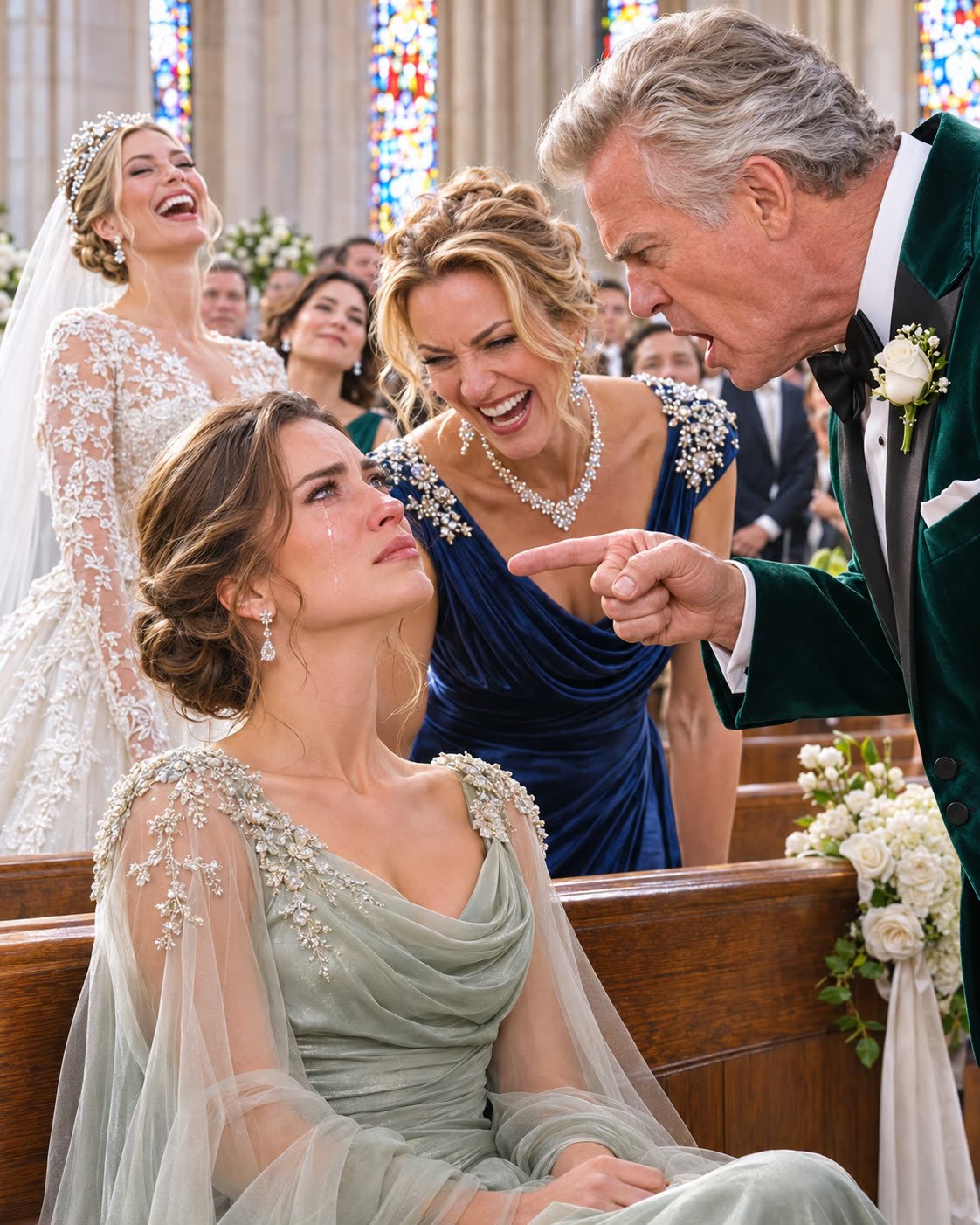
Part 1: The Seat They Thought I Deserved
My parents wanted me hidden in the last pew while my sister married beneath the stained glass they claimed to have saved. I might have endured their familiar cruelty and left quietly. But this time, their version of our family had reached beyond me—and into accounts holding money that belonged to other people.
My mother leaned over the back of the pew, close enough that her pearl necklace brushed the polished wood.
“You were never wanted here, Nora. You don’t belong.”
I kept my wedding program open on my lap. The paper trembled once before I pressed it flat.
Across the aisle, a woman I didn’t know lowered her eyes. My mother noticed and immediately smiled, the expression she used whenever witnesses threatened to become inconvenient.
“We’re only trying to avoid a scene,” she added.
At thirty-six, I knew exactly what that meant: accept the insult quietly, and afterward everyone could call the afternoon pleasant.
We were at St. Agnes Church in Savannah, Georgia, twenty minutes before my younger sister’s wedding. Audrey was marrying Caleb Monroe, whose father owned a respected regional construction company. Three hundred guests had come to celebrate, and my parents had spent months deciding which version of our family those guests would see.
Apparently, that version did not include me.
My father stopped beside my mother and looked down at my forest-green dress.
“You couldn’t have made more of an effort?”
“I’m dressed for church, Dad.”
“You’re dressed like someone who wandered in.”
I glanced toward the entrance, where an usher had checked my name against the guest list. Audrey had mailed the invitation herself. I had answered it, bought a gift, and driven down from Atlanta because some stubborn part of me still believed showing up mattered.
My mother lowered her voice.
“Audrey doesn’t want confusion during the family photographs. Stay out of them. And please don’t go near the head table afterward.”
“Has Audrey said that?”
“Don’t make us repeat ourselves,” my father said.
They walked away before I could answer. He paused twice to shake hands, transforming effortlessly from an irritated parent into a gracious host.
I remained in the last pew.
From there, I could see the restored ceiling and the leaded windows that had once been covered with protective plywood. The stone beneath the sanctuary had been stabilized. The community kitchen, in the building behind the church, was serving meals again.
Five years earlier, inspectors had warned that major structural repairs could not be postponed. The parish had enough money to operate, but not enough to restore the building and preserve its outreach programs. Closing the church temporarily had begun to look unavoidable.
Now white flowers lined the aisle. Guests admired the craftsmanship above them without knowing how close it had come to being lost.
Near the side entrance, Father Thomas Reed caught my eye. He didn’t wave or approach. We had agreed there would be no special attention before the ceremony.
My father had requested a short restoration dedication immediately after the wedding, while the guests were still seated. He had helped coordinate several community fundraising events and seemed certain the dedication would establish him as the afternoon’s second honored man.
For months, he had been calling St. Agnes a Hartwell family achievement.
It was a carefully phrased claim. He hadn’t paid for the restoration, but he had discovered that standing beneath a restored roof made fundraising much easier.
My phone vibrated inside my bag.
The message was from my attorney, Martin Cole.
“Independent directors have received the final report. Counsel confirms the account restrictions are in place. Your statement is cleared.”
I read it twice.
Three weeks earlier, a folder had arrived at my office containing my father’s signature, several transfers between charitable and business accounts, and a discrepancy of approximately $740,000.
I had spent the first hour hoping I had misunderstood it.
Then I had called Martin.
Now the evidence had been checked by people with no interest in my family history. The foundation’s independent directors had their own counsel. The appropriate authorities had been notified. Nothing depended on whether anyone believed the supposedly disappointing daughter.
I typed back.
“Proceed as agreed.”
Then I silenced my phone.
A few rows ahead, my father was telling Caleb’s uncle about his proposed expansion of the Hartwell Community Foundation. He wanted to establish a new scholarship initiative and was seeking substantial pledges at the reception.
Those pledges were why I had refused to wait until Monday.
An organ note rose through the church. Conversations stopped. Audrey appeared at the entrance on our father’s arm, luminous in ivory satin, her bouquet held perfectly still.
For a moment, all I saw was my little sister at nine, standing outside my bedroom with a broken bracelet she trusted me to fix.
I wanted her marriage to begin well. I wanted Caleb’s smile to mean what it seemed to mean. I wanted, even then, to be wrong about how much she understood.
As she passed my pew, Audrey looked directly at me.
Her smile tightened. Then she turned toward the waiting cameras.
I watched our father place her hand in Caleb’s, knowing that when the vows were finished, he expected another ceremony to confirm everything he believed about himself.
The report on my phone would not interrupt the marriage. But the dedication afterward was no longer going to belong to him.
Part 2: What They Never Asked
The ceremony was beautiful, and that made the rest harder.
Caleb’s voice broke during his vows. Audrey squeezed his fingers before answering with her own. Whatever vanity she had inherited, whatever careless things she had learned to say, I could see that she loved him.
When they kissed, I stood with everyone else. I applauded. I meant it.
After the recessional, the couple stepped into a side room to sign the marriage register. The guests remained for the restoration dedication, which had been printed in the wedding program with the couple’s approval.
My mother returned before the organ music ended.
“Your father thinks you should leave now.”
I looked up.
“The invitation includes the reception.”
“There are important people here. Business associates. People who might ask questions.”
“About what?”
Her expression suggested I was deliberately making something obvious difficult.
“About why our older daughter dropped out of college and never did anything with herself.”
“I graduated, Mom.”
“You’ve always had your own interpretation.”
That was the moment I stopped trying to find a gentler explanation for their ignorance.
Twelve years earlier, at twenty-four, I had been one year away from completing my degree in finance. My father had promised to cover the remaining tuition, then withdrawn the money after I refused to sign a loan application for one of his companies.
He called it a test of family loyalty.
An adviser at school called it a personal guarantee and told me not to sign anything without independent advice.
I followed her advice. My father stopped paying.
That same summer, he bought Audrey a condominium near the college she planned to attend.
I took a semester away, increased my hours at a financial consulting firm, and returned with a scholarship and a payment plan. I graduated at twenty-five, one year later than intended.
I sent my parents the commencement announcement. Neither came.
For years afterward, my mother introduced me as someone who had “left school.” Correcting her never lasted beyond the conversation. By the next gathering, the old story had returned.
Eventually, I stopped supplying facts to people who preferred a verdict.
I also stopped using Hartwell professionally. Ellis was my grandmother’s maiden name, and after making the change legally, I put it on every application and business card that followed.
My parents knew about the name. They described it as another performance of ingratitude.
They never asked what I was building under it.
At thirty, after five years in commercial property finance, I founded Ellis Harbor Capital with two former colleagues. We worked on troubled properties with useful futures: half-empty office buildings, neglected apartment complexes, small industrial sites burdened by bad loans.
We made mistakes. We lost one acquisition after months of work. For the first two years, I earned less than I had at my previous job.
Then a regional property portfolio we had painstakingly stabilized attracted a major buyer. My ownership share produced a substantial payment. Later investments increased it. By the time Audrey’s wedding invitation arrived, my net worth exceeded ninety million dollars, although much of it remained invested.
None of that made my parents’ treatment wrong. It had been wrong when I was checking my grocery balance, too.
But financial independence had given me something they could no longer withdraw: choices.
Five years earlier, Father Thomas had approached a community foundation where I quietly supported housing grants. He needed help finding a major donor for St. Agnes.
I visited the kitchen, reviewed the restoration estimates, and met the volunteers who had moved meal preparation into borrowed space. Over the following years, my charitable trust committed five million dollars in staged grants for structural repairs, kitchen improvements, accessibility work, and a maintenance reserve.
The parish finance council knew the source. My parents did not.
I had asked for anonymity because I wanted the work completed without invitations, speeches, or requests for influence.
A month before the wedding, Father Thomas asked whether I would allow acknowledgment at the scheduled dedication. Smaller donors would be thanked as well. I agreed.
Only afterward did I learn what my father had been doing.
A prospective contributor contacted the parish to verify a fundraising brochure from the Hartwell Community Foundation. It featured the restored church and implied that my father’s foundation had financed the major work.
The parish administrator corrected that claim. Concerned, the contributor sent the brochure to a foundation director she knew.
That director was Ruth Bell.
Ruth requested records she was entitled to inspect. When the explanations did not match the accounts, she sought independent counsel and contacted my office to clarify the church funding.
My trust supplied its own grant records. The foundation’s directors supplied theirs to the forensic accountants they retained.
The money had not vanished from St. Agnes. It had been diverted from separate, restricted foundation funds intended for food assistance and education grants.
Several transfers led to my father’s development company.
Others appeared under vague event-service descriptions associated with Audrey’s wedding-planning business.
The accountants were still separating legitimate payments from false entries. They were not uncertain about the larger diversion.
My mother was watching me now, impatient for my answer.
“Have you ever wondered what I actually do?” I asked.
She gave a small, dismissive laugh.
“Successful people don’t make their lives a secret, Nora.”
Then she returned to the front.
Audrey and Caleb emerged from the side room. My father joined them, one hand resting on Caleb’s father’s shoulder.
“We’ve put a great deal into this place,” he announced to the people nearby. “A family has an obligation to leave something lasting.”
Audrey followed his glance toward me.
“Nora mostly leaves early,” she said, smiling.
A few guests laughed uncertainly.
Father Thomas stepped to the lectern. My father straightened his jacket, ready to be thanked—and the priest reached for the card bearing my name.
Part 3: The Name Beneath the Silence
“Before we conclude,” Father Thomas said, “we have a promise to keep.”
My father settled back with the comfortable expression of a man certain the room was arranged in his favor.
The priest thanked the restoration committee, the craftspeople, and the many parishioners who had contributed what they could. He named the volunteers who had kept the meal program operating away from its usual kitchen.
Then he paused.
“Five years ago, the future of this building was uncertain. One donor made a commitment that allowed us to undertake the essential work without sacrificing the services this parish exists to provide.”
I rested both feet against the floor.
“Through her charitable trust, she contributed five million dollars toward the restoration, our community kitchen, accessibility improvements, and the reserve that will help protect this work.”
Applause started near the front.
My father leaned forward, one hand on the pew ahead of him, as though preparing to stand.
“She asked for no position,” Father Thomas continued, “and no control over the parish. Until recently, she asked that her name remain private.”
My mother turned toward my father. Something in his face had changed.
“Today, with her permission, we thank Ms. Nora Ellis, founder of Ellis Harbor Capital.”
For a second, I heard only the ventilation system.
Then someone at the end of my pew stood to let me pass.
Heads turned. A woman near the aisle began clapping, and others joined her. My father remained halfway forward, his hand gripping the wood.
My mother stared at me as though a stranger had risen from the seat she had assigned to her daughter.
Audrey whispered something to Caleb. He looked toward me, then back at her, his expression puzzled rather than accusing.
I walked down the aisle.
There was no sudden pleasure in seeing my parents shocked. My mouth was dry. My knees felt unreliable. I had wanted them to ask one ordinary, interested question years before any of this became necessary.
At the sanctuary steps, Father Thomas offered his hand.
“Thank you for trusting us,” he said quietly.
He gave me the microphone.
I looked first toward the kitchen volunteers seated beside the wall. One of them, Denise, had once spent an entire afternoon showing me how they organized meal deliveries without wasting a single driver’s trip.
“Thank you for keeping this place useful,” I said. “A restored building matters. What happens inside it matters more.”
Denise smiled. That helped me breathe.
I could have stopped there.
My father clearly hoped I would. He was smiling now, too broadly, already preparing to absorb my achievement into his own story.
But the reception pledge cards were printed. His foundation’s name was on them. Some of the guests had been told that evening’s donations would support programs the foundation had already failed to fund.
“There is also a clarification I need to make,” I said.
The room quieted.
“The grants I’ve described came from my charitable trust directly to the parish. They did not come through the Hartwell Community Foundation.”
My father’s smile disappeared.
“St. Agnes has not been accused of financial misconduct. Its restoration accounts have been independently reviewed. However, claims connecting that restoration to a separate fundraising appeal have created confusion.”
A chair shifted somewhere behind my parents.
“The Hartwell Community Foundation’s independent directors have suspended new fundraising while they address documented financial irregularities. If you were planning to make a pledge tonight, please do not submit payment. The directors will provide information directly.”
My father stood.
“That is enough, Nora.”
The familiar command struck harder through a microphone’s silence than it ever had across a dinner table.
I looked at him.
“The directors received the completed report yesterday, Dad.”
“You don’t understand what you’re talking about.”
“Approximately seven hundred forty thousand dollars in restricted donations was transferred out for purposes the donors did not authorize.”
A murmur moved through the church.
“The records have been preserved and referred to counsel and the appropriate authorities. They will determine responsibility. I am not asking anyone here to do that.”
My father started up the aisle.
Father Thomas stepped down from the lectern, not blocking him but making it clear that he was no longer addressing his daughter alone in a private room.
“Grant,” he said, “we will not debate the records during this gathering.”
“She’s using my daughter’s wedding to settle a grudge.”
I tightened my hand around the microphone.
“Your directors stopped the fundraising. I’m telling the people being asked to donate.”
My mother had gone very still. Audrey stood beside Caleb, clutching her bouquet with both hands.
“Dad,” she said, “what transfers?”
He waved toward her without looking.
“Administrative matters. Stay out of it.”
I knew that gesture. So did she.
Caleb’s father, Peter Monroe, rose from the front pew.
“Grant, our company will not move forward with the proposed investment while this is unresolved. I’ll have our counsel contact yours.”
It was not a verdict or an instant cancellation of a binding contract. It was a businessman withdrawing from negotiations he had not yet completed.
My father heard it as a door closing.
“After everything I’ve done for this community?”
No one answered.
Father Thomas took the microphone when I offered it back. He ended the dedication with a brief prayer and asked the ushers to guide guests outside, where transportation waited for the reception.
There was no triumphant exit. People moved awkwardly, avoiding the family at the front. I stood beside a pillar until the aisle cleared.
Audrey reached me before I could leave.
Her face was flushed, but she was no longer looking at the guests.
“Those event payments,” she said quietly. “My bookkeeper asked me about them last month. Dad said they were reimbursements.”
“Let your own accountant review everything,” I told her. “Keep the original records.”
She swallowed.
“He asked me to sign revised invoices this morning.”
Behind her, my father was coming toward us—and she was holding the envelope he had told her not to open.
Part 4: What I Would No Longer Carry
Audrey looked down at the envelope as though she had forgotten it was in her hand.
“He gave it to my coordinator,” she said. “He said to bring it to the reception so I could finish some paperwork.”
My father reached us before I could respond.
“Give me that.”
Audrey moved it against her waist.
“What am I supposed to sign?”
“Nothing that concerns your sister.”
Caleb joined her. He didn’t touch the envelope or speak for her. He simply stood beside her while she opened it.
Inside were several invoices bearing her business name, with descriptions broader than the services she had actually provided. I recognized two amounts from the accountants’ summary.
I did not take the papers.
“Audrey, photograph what you received and give the originals to your lawyer. Don’t change anything.”
My father’s eyes fixed on me.
“You planned this.”
“I planned to stop people donating under false information.”
“You could have come to me.”
“You would have asked me to keep it in the family.”
His silence was an answer I had heard all my life.
Audrey slid the papers back into the envelope.
“I’m not signing these.”
For the first time that afternoon, my father seemed uncertain which daughter to address.
I left them there and walked through the side entrance into the small church garden. I needed air, but more than that, I needed a moment in which nobody expected me to make the family look whole.
My mother followed.
“Nora, please. We’re family.”
I turned toward her.
“You told me I was unwanted.”
Her eyes filled.
“I was upset. This day has been stressful.”
“I hadn’t done anything when you said it.”
She looked toward the church doors, perhaps hoping my father would appear with a new instruction.
“You know how he gets.”
“I know how you get, too.”
She flinched. I had never said that to her before.
For years, I had treated her as the softer parent because she delivered the same message quietly. Standing there, I could finally see how much harm I had excused because she occasionally touched my shoulder afterward.
“We didn’t know you had all this money,” she said.
That hurt more than her first insult.
“Would you have wanted me here if I didn’t?”
She opened her mouth, then closed it.
I waited long enough for an answer. None came.
“I won’t discuss the investigation with either of you,” I said. “Your lawyers can contact the foundation’s counsel. And I’m not paying your business debts.”
“Nobody asked you to.”
“Then we understand each other.”
I walked to my car before she could make me responsible for comforting her.
Martin called while I sat behind the wheel. He asked whether I was safe, then whether anything had happened that needed documenting.
I told him about the invoices.
“Her lawyer should contact foundation counsel,” he said. “She needs independent advice, Nora. Not yours and not your father’s.”
That simple boundary kept me from making my next mistake. I could care about Audrey without taking charge of the consequences for her.
The months afterward were neither swift nor tidy.
The foundation’s directors commissioned a full review, contacted affected donors, and arranged for remaining legitimate grants to be administered elsewhere. Civil proceedings sought recovery of the diverted money. State investigators requested records and interviewed board members, employees, and vendors.
My father called it a misunderstanding until his attorneys began speaking for him.
His development company was already in difficulty. Without fresh financing, it defaulted on its loans. The lenders eventually foreclosed on the unfinished condominium project.
My parents sold their house. Part of the proceeds later went toward a negotiated restitution payment. It did not recover everything donors had lost.
The foundation was wound down under legal supervision. My father was charged with offenses relating to the diversion of charitable funds and, more than a year after the wedding, entered a guilty plea to one financial charge under a negotiated agreement. The court ordered further restitution and imposed a sentence that included incarceration.
There was no pleasure in reading the final order.
There was relief that an official record now existed, one he could not revise by raising his voice.
Audrey hired her own attorney and supplied her original invoices, emails, and bank records. The review established which services her business had genuinely provided and identified the altered paperwork she had refused to sign.
She returned an unearned advance through her lawyer. No criminal charge was brought against her.
She also had to tell Caleb that her family was not what she had presented it to be. Their first year of marriage included difficult conversations, canceled business plans, and counseling. They stayed together, but not by pretending the wedding had merely been awkward.
Her first apology to me came by phone six weeks after the ceremony.
“I knew they were cruel,” she said. “I told myself it wasn’t my responsibility because I wasn’t the one saying most of it.”
I sat at my kitchen table and listened.
“Sometimes you were saying it.”
“I know.”
She didn’t add that she had been young, or influenced, or under pressure. She named the joke she had made in the church. She named other moments I had assumed she had forgotten.
“I’m not ready to be close,” I told her.
“Can I still try to do better?”
“Yes. Just don’t make me promise where that leads.”
We began with occasional messages. Months later, we met for coffee. I did not become her financial adviser, and she did not bring our parents as a surprise.
It was a modest beginning. Modest was something I could trust.
My mother sent apologies mixed with explanations for a long time. I answered only the messages that respected the boundaries I had stated. I stopped treating every expression of regret as an obligation to reopen my door.
Meanwhile, St. Agnes continued its ordinary work.
The kitchen expanded its delivery schedule with separately funded grants. A small scholarship-advice program began using a room upstairs. Father Thomas sent reports about budgets and repairs, just as he had before anyone applauded.
One Sunday, nearly eighteen months after the wedding, I returned without telling him I was coming.
I sat in the last pew.
After the service, he stopped beside me.
“You know there are seats farther forward.”
“I like this one.”
He smiled, then noticed that I was watching the entrance.
Audrey stood there holding two paper cups from the parish coffee table. We had agreed to meet after the service. She waited for me to wave before approaching.
“Is this seat taken?” she asked.
I moved my bag.
She sat beside me without asking about money, introductions, or forgiveness. For a while, we watched people gather their coats and fold the service sheets.
Sunlight crossed the wood where my mother’s necklace had brushed it on the wedding day. The pew had not changed. What I expected from it had.
I had once sat there waiting to learn whether my family would let me belong. Now I shifted a little farther over, making room because I wanted to—not because anyone had decided how small I should be.
Disclaimer: This story is a work of fiction inspired by real-life themes. Names, characters, places and events are fictionalized, and any resemblance to real persons is purely coincidental. Images are for illustration purposes only.


