

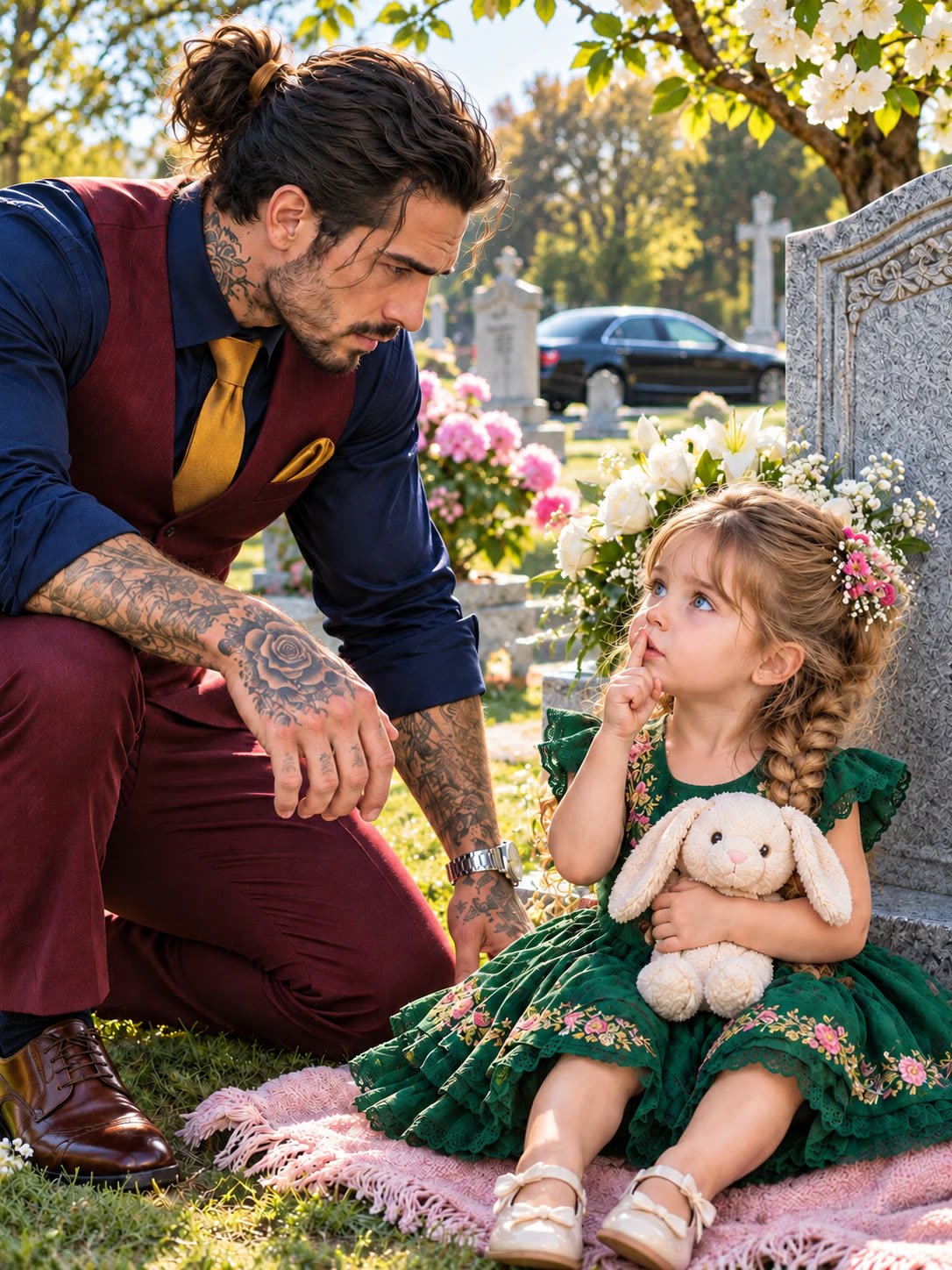
Part 1: The Thirteenth Rose
“Shhh, mister. Grandma is sleeping.”
The little girl pressed one finger to her lips before I had even reached my mother’s headstone. She sat on a pink blanket with a rabbit tucked beneath her arm, her small brown shoes lined up neatly at its edge. Behind me, Marcus stopped walking. In fifteen years of Sunday visits, nobody had ever told Gabriel Santoro to be quiet.
I lowered the bouquet in my hand.
“Where is your mother?”
“Coming back.”
She said it with the patience children reserve for adults who ask obvious questions. Her dress was pink, with a skirt that spread around her like a small overturned flower. Someone had buttoned a mustard cardigan over it and braided one side of her hair. Beside her stood a lavender backpack, open just far enough to show a packet of crackers.
I looked toward the cemetery path. Empty. Beyond the trees, the gates had only just opened for the morning.
“Did she go to get something?”
The girl shook her head.
“She said wait with Grandma. Aunt Beth was here, but she went to find Mommy.”
Marcus took out his phone. I raised a hand, signaling him to wait before approaching. A frightened child did not need three large men closing around her.
“What’s your name?”
“Daisy.”
“I’m Gabriel.”
Her face brightened.
“Uncle Gabe?”
Nobody had called me that in thirteen years.
Not since my sister vanished. Not since our father told me Lucia had stolen five million dollars and run away with a man from the family he said had killed our mother. I had accepted his explanation with the fury of someone relieved to be handed a target.
I crouched, keeping a little distance between us.
“Who told you that name?”
“Mommy. You’re her big brother.”
“What does your mommy call herself?”
“Lucy. But Aunt Beth says Lucia when Mommy forgets her phone.”
The flowers slipped against my fingers. I set them on the grass before I dropped them.
My name carried weight in Boston. I owned freight companies, restaurants, and commercial buildings. I also controlled men and arrangements that no honest balance sheet could explain. People called me a businessman to my face and a mafia boss when they thought I could not hear. None of that gave me the slightest idea what to do with a three-year-old who had just returned my sister to me.
“Daisy, how long ago did your mommy leave?”
She held up four fingers, considered them, then lowered two.
Marcus spoke quietly behind me.
“The groundskeeper saw a woman walk toward the service lane about five minutes ago. Another woman followed a minute later. I’m having someone check.”
“Call the police,” I said.
He looked at me.
“Tell them a young child has been found without her caregiver. Tell them we’re staying at the grave.”
It was not an instruction I often gave. I saw him register that before he moved away.
Daisy watched him go.
“Mommy said you’d have friends.”
“Sometimes they’re useful.”
“She said don’t be scared of your eyebrows.”
For a moment, Lucia was twenty-two again, leaning across our kitchen table, telling me to stop scowling at the toaster. Then the memory passed, leaving the empty years behind it.
“Your mother has always had opinions about my face.”
“She gave me a letter.”
Daisy pulled open the backpack and removed its contents carefully: crackers, a pink sweater, a water bottle, a newer white rabbit, and an envelope folded around something stiff. She handed the envelope to me.
Gabe.
One word, in handwriting I knew better than my own.
I opened it with a finger that would not stay steady.
“Gabe—If Daisy gives you this, something has gone wrong. Beth knows not to leave her, but I need a second way to reach you. I did not steal Father’s money. I ran because I found Mother’s records, and because he made it clear what would happen if I stayed. You told me not to come home. I believed you.”
I stopped reading.
I remembered that call. Lucia crying. Me standing beside Antonio’s desk, listening to him say she would lie, she would plead, she would use our mother’s memory. I remembered saying exactly what my sister had written.
Stay gone, Lucia.
Below it, the writing grew smaller.
Mother knew the feud was manufactured. The proof I carried was incomplete, and the man who helped hide the rest is dead. His lawyer finally found me. I have been working with Elise Warren. Her number is in the rose that isn’t real. Keep both rabbits. Don’t send Daisy anywhere with Father. He is alive. I am sorry to tell you this way.
Marcus returned before I reached the signature.
“Police are coming. One of our men found a woman near the service lane. She’s conscious, says her name is Beth Hale. She says two men took Lucia into a car. She tried to follow and fell when one pushed past her.”
I stood too quickly. Daisy reached for the edge of my jacket.
“Did Aunt Beth get hurt?”
I made myself crouch again.
“Someone is helping her. We’re going to stay right here until they come.”
“Mommy said you’d know what to do.”
I wanted to deserve that sentence. I had done very little to earn it.
There were roses already at the stone: twelve white blooms in a low vase, exactly like those I brought every week. A thirteenth rose stood among them, its stem an unnatural, glossy green. I pulled it free. A paper strip was tucked beneath the removable flower head.
ELISE WARREN. A telephone number. Under it, in Lucia’s handwriting: ANTONIO SANTORO IS ALIVE.
My father had died five years earlier after what I was told was a sudden collapse at his winter home. There had been a sealed coffin, a private service, a physician’s certificate, and enough grief to make questions seem indecent. I had paid for his monument. I had stood beside the open ground.
“Uncle Gabe?”
Daisy was looking beyond my shoulder.
“Grandpa came.”
A black limousine waited outside the cemetery gates. The rear window slid down.
Silver hair. The pale line beside his cheek. The stillness I had mistaken, all my life, for strength.
Antonio Santoro looked directly at me.
My phone rang with a number I did not recognize. I answered without taking my eyes off him.
“Gabriel.”
The voice had aged less than it should have.
“Where is Lucia?”
“Safe, provided we handle this intelligently.”
Marcus saw my face and followed my gaze. His hand went toward his own phone.
“You sent men to take her.”
“I sent men to stop her making another mistake.”
Daisy began putting her crackers back into the bag. I could hear the little plastic wrapper crinkling beside my knee.
“Listen carefully,” I said. “There are police on their way. A child was left without her mother. You are not turning that into a private family meeting.”
For the first time, my father hesitated.
“Your sister has something that belongs to me.”
“Then your attorney can ask her attorney for it.”
“Ask the girl about the old rabbit.”
I looked down. The toy beneath Daisy’s arm had one drooping blue-lined ear and crooked green letters sewn across its chest.
GABRIEL.
My mother had made it when I was six. Lucia stole it from my bed so often that Maria eventually told us it belonged to whichever child needed it most.
“You remember,” Antonio said.
“I remember enough.”
“Bring it to the old house. Come without your men, and Lucia walks away.”
The limousine’s window began to rise. Before it closed, I saw him lift one hand in the small, dismissive gesture he used when a conversation was finished.
Daisy offered me the rabbit.
“Mommy said Bunny is yours, but can I hold him a little longer?”
I covered her small hand with mine.
“As long as you need.”
At the gates, the car rolled away. I gave Marcus the plate number, then looked back at the letter in my hand. My father was alive, my sister was missing again, and this time I knew exactly who had taught me not to ask questions.
Part 2: The Room Under the Roses
The first officer arrived while Daisy was explaining that her rabbit needed breakfast. I gave my name, described the limousine, and handed over my phone so she could note the incoming number. Her expression changed when she recognized me, but she continued writing.
“You understand we need to establish who this child is and who is authorized to care for her?”
“Yes.”
It was a small word. Marcus glanced at me as though I had spoken in another language.
Beth Hale arrived with a paramedic several minutes later. She had a scraped palm and dirt on one sleeve, but Daisy ran straight into her arms. Beth knelt and held her, murmuring an apology that was not meant for us.
She was Lucia’s sister-in-law. Daisy’s father, Daniel Hale, had died in a road accident eighteen months earlier. Beth had helped with Daisy ever since. She showed the officer her identification, photographs, and messages from Lucia arranging that morning’s visit. I listened to an entire family history in which I had never appeared except as a warning and, apparently, a hope.
“Lucy wanted to leave before you arrived,” Beth told me. “She was going to watch from the other path while I gave you the letter. Then she saw your father’s driver.”
“She recognized him?”
“From an old photograph. She went to tell him to keep away from Daisy. I heard them arguing. I followed, but I thought I could still see Daisy through the trees. I lost sight of her for less than a minute.”
Her voice broke on the last sentence.
The officer asked Beth to tell the account again, slowly. Nobody accused her. Nobody pretended a minute could not change a life.
Elise Warren answered on the second ring. When I said Lucia’s name, she asked where Daisy was before asking anything about me.
“With her aunt and the police.”
“Good. Put an officer on, please.”
I obeyed. That morning was becoming an education in how much could be accomplished when I stopped insisting on being the only authority in the room.
Elise had represented Lucia for six weeks, since the death of Harold Voss, our former accountant. A lawyer handling his estate had discovered instructions to send Lucia a packet containing copies of old correspondence. Voss had apparently kept it as insurance against Antonio, then arranged delivery only after he could no longer be threatened.
Among those papers was evidence that Antonio had continued receiving money after his supposed death. Lucia and Elise had been assembling a report. They did not yet know who inside the old organization remained loyal to him.
“Why come to me at a cemetery?” I asked when the officer returned the phone.
“Because she knew you went there without fail. Because she would not take Daisy into one of your businesses. And because she wanted to see your face before deciding whether to trust you.”
There was no answer I could give that would improve that.
Elise arrived before the detectives. She wore flat shoes, carried a battered leather bag, and showed no interest in the men standing behind me. She read Lucia’s letter, photographed it with the officer’s permission, then asked about the rabbit.
Daisy pressed it to her chest.
“Are you taking him?”
Elise sat on the edge of the blanket.
“We think your mommy put something inside him for your uncle. We would like to look. You can watch, and we’ll mend him afterward.”
“Will it hurt?”
“He won’t feel it.”
Daisy considered that, then handed him over with instructions to be careful of his loose ear.
A short seam across the rabbit’s back had been sewn in newer green thread. With the officer documenting what we did, Elise opened only those stitches. Inside a cloth sleeve were a brass key and a narrow note.
Lucia had written: Mother’s dry room. Under the rose arbor. Marcus will remember.
I turned toward him.
Marcus was looking at the key, not at me.
Before I could ask, Antonio called again. The detective beside me motioned for me to answer and activate the speaker.
“You’ve involved strangers,” my father said.
“You abducted my sister.”
“Lucia is sitting in her mother’s library. She is unharmed.”
“Let her speak.”
There was a pause, a muffled exchange, then a breath I recognized.
“Gabe?”
I gripped the phone.
“Daisy is safe. Beth is here. Elise is here.”
“Don’t bring her to the house.”
Antonio took the phone back.
“The old property. One hour. Bring what Maria hid.”
“I don’t have it.”
“Then find it.”
The line ended.
The detective, a patient woman named Elena Ruiz, had already sent officers toward the estate. She did not promise a rescue in ten minutes or let me mistake my anger for a plan. She asked about entrances, employees, weapons, and the man who had driven Antonio for years.
I answered everything I knew.
Daisy left with Beth after the officers had verified the arrangements with Lucia during a second, brief call. Elise accompanied them to Beth’s home before joining us later. I gave Daisy my number on a card, although she could not read it.
“Aunt Beth can call me.”
“Are you getting Mommy?”
“People who know how to help are working on it.”
“You too?”
“Me too.”
I did not promise a result I could not control. It felt less comforting than the lies my father used to tell, and more like something a child could safely stand on.
We reached the old Santoro house after the police. Antonio’s limousine stood in the drive. He had expected my men and threats; instead, uniformed officers were speaking to his driver.
Lucia came through the front door between two detectives.
For a second I could not move. Her hair was shorter. There were fine lines around her eyes. She was thirty-five, not the twenty-two-year-old I had kept frozen inside an accusation.
She saw me and stopped.
“Where’s Daisy?”
“With Beth. Safe.”
Only then did she let herself sit on the front step.
I sat two steps below her, leaving space.
“I should have looked for you.”
“Yes.”
“I should have listened when you called.”
She rubbed one wrist where someone had gripped it. I made myself keep looking at her face.
“Yes.”
There was no reunion embrace. There was my sister, alive, and the knowledge that I had helped make thirteen years of her life more difficult than they needed to be.
Antonio had told the officers Lucia was a willing guest. Her account, Beth’s account, the cemetery camera footage being collected, and the driver’s conflicting statements were already making that claim untenable. He was taken for questioning. I watched him look back at me, waiting for the familiar intervention.
I did not move.
After Lucia had been examined and interviewed, she asked Ruiz whether we could retrieve the records. Officers secured the property while Elise clarified access and ownership. The house belonged to a holding company I controlled, inherited through Antonio’s estate. Even that fact now required examination.
My mother’s rose arbor had collapsed along one side. Beneath it, a stone ledge concealed a narrow door I remembered from childhood. Maria had stored garden tools there before turning the dry basement room into a place for household records.
The rabbit’s key opened the old lock.
Inside were shelves, a table, and a covered portrait. Lucia pulled the cloth away. Our mother smiled out at us, caught mid-laugh, one hand raised toward whoever held the camera.
Behind the frame was an envelope addressed to both her children.
Maria wrote that she had found duplicate invoices linking Antonio and Voss to attacks on commercial property, threats against businesses, and payments made to men claiming allegiance to rival organizations. Vincent Moretti had brought her a second set of records. Together, the documents suggested the feud was being fed deliberately to consolidate control.
The originals were elsewhere. Maria had divided access because she no longer trusted any single person to keep them safe.
At the bottom she had written: Marcus knows the second place. Please remember that frightened people can do wrong without ceasing to know what right is.
I looked up.
Marcus stood in the doorway with his hands empty and his face drawn.
“You told me you barely remembered my mother.”
“I lied.”
“How much else?”
He reached slowly into his coat and placed a second brass key on the table.
“Enough,” he said, “that you should hear it before you decide whether I leave this house with you.”
Part 3: What Silence Had Bought Us
Marcus was nineteen when my mother died. His father had driven for Antonio, and after his father’s death Maria had helped Marcus finish school and find clerical work at the estate. I remembered a quiet young man carrying boxes. I had never bothered to connect him with the security chief I hired three years later.
“You knew who I was,” I said.
“Of course.”
“And you let me think we met through a recruiter.”
“We did meet through a recruiter. I left out what came before.”
Ruiz asked him to sit down. Elise stopped him from continuing until he understood that he might need his own lawyer. Marcus looked at the key on the table.
“I’ll get one. But the records shouldn’t wait.”
He gave enough information for the police to secure the second location, then called an attorney from the garden. It was the first time I had seen him choose a boundary that inconvenienced me. Under other circumstances, I might have considered it disloyal.
Lucia stood beside the portrait, studying our mother’s hands.
“You’re doing it,” she said.
“Doing what?”
“Looking for the next person whose betrayal will make yours easier to bear.”
I opened my mouth, then closed it.
Outside, an officer was photographing the lock. Ordinary work. Necessary work. Nobody in the room needed my anger to make it more important.
Marcus returned after speaking to counsel. He explained that Maria had asked him to help move a trunk to a storage cellar beneath an old waterfront warehouse. She had kept one key and given him the other. Two people she trusted would know where the records were, even if one disappeared.
“Why didn’t you take them to somebody after she died?” Lucia asked.
He looked at her rather than at me.
“Voss knew I’d helped her. He knew where my sister went to school. He showed me a photograph of her outside our apartment.”
“So you left them there.”
“Yes.”
“And when she was grown?”
Marcus swallowed.
“By then I had a career with Gabriel. I told myself the danger was over, that opening it would only start everything again. Then every year made admitting the first year harder.”
He did not say he had been protecting us. I was grateful for that much.
The warehouse above the cellar had been demolished, but the enclosed underground storage survived on a parcel one of my companies still owned. There was no secret expedition. I signed access authorization; officers checked the structure; a property manager found the utility plans. By late afternoon, a small team had reached the door.
Lucia and I waited aboveground while they documented and removed the trunk. Watching people handle my mother’s work with numbered labels and careful photographs should have felt cold. Instead, it was the first assurance I had that nobody could quietly make it disappear.
At the station, we were allowed to identify personal items while investigators began cataloging the rest. There were three ledgers, letters, copied banking records, and a cassette inside a plastic case. Maria’s handwriting covered the label.
For my children. Not for revenge.
I had built fifteen years on the opposite instruction.
Elise arranged for a specialist to preserve the recording before anyone tried playing it. We heard a digital working copy the following day in a small interview room with a machine humming beyond the wall.
My mother cleared her throat.
I bent forward before she said a word. That small, impatient sound had preceded every school telephone call, every instruction shouted upstairs, every serious conversation at our kitchen table. I had forgotten it. Hearing it again made the years feel less like distance than theft.
Maria described the documents she had gathered. She named the companies, the dates, and the people who could verify individual entries. She explained that Vincent Moretti had approached her because payments made in his organization’s name did not match his own records.
Then her voice changed.
“Gabe, you are going to want a simple explanation. You always do when you are frightened. Please don’t turn this into permission to hurt someone. If these records reach you, give them to people who can examine them without needing to protect our name.”
Lucia covered her mouth.
I stared at the speaker.
“And Lucy, sweetheart, you cannot keep everyone safe by yourself. Whatever happens, none of this belongs to you to repair alone.”
When the recording ended, nobody immediately filled the silence.
Later, Lucia told me about the night Maria died. Our mother had argued with Antonio in the study, then developed sudden chest pain and collapsed. Lucia had heard her call for help. Antonio ordered Lucia upstairs and told a household employee to fetch his private physician rather than immediately call emergency services.
“I went back down,” Lucia said. “He was on the phone in the hall. Mother was on the floor. I called for an ambulance from the kitchen.”
“How long?”
“I don’t know. It felt endless. The phone records might tell them.”
Maria died at the hospital. Antonio later told me the attack had been triggered by a threat from the Morettis, then allowed that story to harden into the claim they had caused her death. I had repeated it so often that the distinction disappeared.
“We don’t know whether faster help would have saved her,” Lucia said. “I need you to understand that. Father made a terrible choice. But I won’t replace his lie with something we can’t prove.”
I nodded. It hurt to leave uncertainty where I wanted a verdict. My sister had learned to bear that hurt without using someone else to carry it.
She had not fled until two years later. At twenty-two, sorting boxes from Maria’s study, she found copies of the disputed payments and an unfinished letter. She confronted Antonio. He accused her of stealing money, showed her a falsified transfer in her name, and warned that I would believe him.
“I thought he was bluffing,” she said. “Then I called you.”
There was nothing to add to that.
Vincent arranged temporary shelter through people outside either organization. Lucia eventually moved west, worked in a dental office, married Daniel, and built an ordinary life that required constant care around old names and photographs. She sent two letters through a cousin. Neither reached me. After my telephone call and the cousin’s warning that Antonio was asking questions, she stopped trying.
“Did you ever look?” she asked.
“Not properly.”
“What does that mean?”
“I asked men who worked for Father whether they knew where you were. They said no. I let that be enough.”
She nodded once, receiving the answer without making it easier.
Among the trunk’s papers was a trust agreement established by Maria with independently inherited money. It named me as beneficiary and Vincent as one of the original trustees. The account was modest compared with the empire Antonio built around me, but enough to have funded education, relocation, a different profession.
A note in Maria’s handwriting said: A door, not another chain.
Recent statements showed the trust still existed. One authorization had been signed by Vincent less than four months earlier.
“He died nine years ago,” I said.
Lucia shook her head.
“He was reported missing after a boat fire. I heard they presumed him dead later. I never saw proof.”
Elise examined the statement.
“Then we find out whether this signature is genuine before deciding what it means.”
For years, I had spoken Vincent’s name as if hatred were evidence. Now an old man’s signature suggested he might still be alive somewhere, maintaining the escape my mother had tried to leave me.
Before we left, Elise asked to speak with me alone.
She placed a copy of a much newer document on the table. I recognized the company heading before I saw the signature.
Mine.
Six years earlier, I had authorized a payment through a consulting business after a restaurant owner refused an exclusive supply agreement. Marcus told me a conversation would settle it. The owner signed after his delivery vans were damaged overnight.
I had not asked who did it. I had approved the invoice.
“Your mother’s records explain how this began,” Elise said. “They do not explain away what happened afterward.”
Outside the room, I could hear Lucia speaking to Daisy on the phone.
Elise turned the page toward me.
“Before you offer the investigators everything, Gabriel, you need to understand that everything includes you.”
Part 4: The Price of an Honest Name
I found an independent defense attorney that afternoon. Elise represented Lucia, and she was careful not to let my money blur that fact. My lawyer’s name was David Chen. He listened without offering reassurance I had not earned.
“You can preserve records and stop ongoing conduct now,” he said. “You can cooperate through counsel. None of that guarantees immunity.”
“I’m not asking for it.”
“People say that when the consequences are still theoretical. I want you to think about prison, forfeiture, public testimony, and employees learning things you would rather they didn’t know.”
I thought of Daisy calling me Uncle Gabe. Then I thought of the restaurant owner whose name I had almost forgotten.
“They’re not theoretical for everyone else,” I said.
We started with preservation notices and instructions that no company records were to be destroyed. Outside accountants were engaged to review payroll, ownership, and transfers. Managers of lawful operations were told to keep paying staff and to report pressure from anyone claiming to speak for me. I stepped back from decisions that might affect witnesses or evidence.
It was slow, expensive work. It did not feel like redemption. It felt like finally opening bills I had required other people to pay.
Antonio was charged over Lucia’s abduction and the related threats while investigators examined his false death and financial arrangements. The old medical records and circumstances surrounding Maria’s death required separate review. Nobody promised Lucia a charge that the evidence might not support.
Through his lawyer, Antonio asked to see us. Lucia refused a private meeting. If he wanted to explain, he could do it in a setting where his words were recorded and counsel was present.
I expected him to refuse.
Three days later, we sat across from him in a conference room.
Without his limousine, his house, or a line of men waiting to obey him, my father looked like a seventy-four-year-old man who had slept badly. It did not make him harmless. It did make me wonder how much of his size I had supplied myself.
“I kept this family alive,” he began.
Lucia stood.
“If that is what you came to say, we’re finished.”
His attorney touched his sleeve. Antonio looked from her to me, waiting for me to negotiate my sister back into obedience.
“Sit down, Lucy,” he said.
I heard the old command reach for its place inside me.
“Her name is Lucia,” I said. “And she can leave.”
She remained standing until Antonio lowered his eyes.
“I knew about the duplicate payments,” he said.
The room grew very still.
He admitted that Voss had moved money through shell companies with his approval. Men were paid to threaten businesses, sabotage commercial property, and blame people connected to the Morettis. Fear made owners accept protection, exclusive contracts, and unfavorable sales. The feud was not entirely invented—there were real disputes and real retaliations—but Antonio had deliberately fed it.
“And Mother?” Lucia asked.
“She found things she didn’t understand.”
“Try again,” she said.
He pressed his fingers against the table.
“She understood enough.”
He admitted arguing with Maria and delaying the emergency call while he contacted his physician and tried to persuade her not to expose the records. He insisted he had not expected her to die. Whether earlier treatment would have changed the outcome was a question for the medical evidence, not for his remorse or our anger.
“You told me Vincent killed her,” I said.
“I told you the pressure he put her under—”
“You knew what I believed. You watched me act on it.”
Antonio looked at me for a long time.
“You were easier to guide when you had an enemy.”
Lucia sat down.
Not because he had told her to. Because, finally, there was something true in the room that required her full attention.
His false death had been arranged five years earlier when a financial investigation threatened to reach him. A complicit physician supplied documents; an intermediary handled the funeral arrangements; the sealed coffin prevented questions. Antonio moved between properties held by associates while continuing to receive money through disguised accounts.
“You let us bury you,” I said.
“I thought it would free you.”
“You kept collecting from the businesses.”
He had no answer to that.
Voss’s posthumous papers had exposed the arrangement. An old associate alerted Antonio when Lucia began asking questions about a dormant company. He followed her return to Boston, learned she intended to approach me, and decided to recover whatever evidence she carried before she could.
“Daisy was never supposed to be involved,” he said.
Lucia’s hands flattened on the table.
“You watched her from a car while your men took her mother.”
For once, my father did not try to improve the sentence.
At the end of the meeting, he asked whether he could see his granddaughter.
“No,” Lucia said.
He turned toward me.
I did not help him.
Outside, Lucia stood against the corridor wall and shook so badly she could not fasten her coat. I held it open while she put her arms through. It was the first useful thing I had done for her that required neither money nor a decision made on her behalf.
“I don’t know what I’m supposed to feel,” she said.
“You don’t have to decide today.”
She looked at me, surprised by the words.
We found Vincent through the trust’s current administrator. Elise passed along a request rather than demanding his address. Two days later, a letter arrived authorizing her to give us the location of a marine repair shop on the Maine coast.
Lucia agreed to go. I asked whether she wanted me there.
“Yes,” she said. “But let him finish his sentences.”
The shop smelled of engine oil and coffee. An elderly man in a faded work shirt straightened from a workbench when we entered. His face matched the old photographs only in fragments: the heavy brow, the crooked finger, the eyes that noticed Lucia before they settled on me.
“You look like Maria,” he told her.
Lucia hugged him. I stood by the door with a lifetime of hatred and nowhere honest to put it.
Vincent had survived the boat fire and taken the opportunity to disappear. Associates had wanted him dead; others had wanted him to return and escalate the conflict. He chose neither. He had lived under his mother’s surname, worked at the shop, and maintained contact with a few people who helped Lucia.
“Why not send the records yourself?” I asked.
“I had copies of only part of them. Maria divided the evidence. I knew there was more, but not where.”
“You could have told me what you knew.”
“I tried through a lawyer after she died. Your father sent him away. Later, I decided you had become your father’s son.”
He looked down at his hands.
“That decision was convenient for me. I was tired and afraid. It doesn’t make it right.”
There it was again: no clean rescuer, no single confession that made everyone else innocent.
Vincent agreed to speak to investigators through his own counsel. He had questions to answer about his old organization as well as evidence to provide. Leaving that life had not erased it.
Before we left, he brought out photographs and Maria’s correspondence about the trust. One envelope bore my name.
The letter explained that Antonio was my biological father. Vincent’s role as trustee had nothing to do with a secret parentage, only with her determination that I have an option Antonio could not quietly withdraw.
My mother knew how quickly men in our family could turn a mystery into a new legend. She left no room for one.
You were born Gabriel Santoro, she wrote. You do not have to earn the name by becoming Antonio. You do not have to escape the name by pretending he is not your father.
Below that was one last line.
Be strong enough to speak gently when you could make someone afraid.
On the drive home, Lucia held a photograph of Maria in the garden. I kept my eyes on the road.
“I’m going to cooperate,” I told her. “About my businesses too.”
She did not congratulate me.
“What does your lawyer think will happen?”
“He doesn’t know yet.”
“Could you go to prison?”
“Yes.”
She turned the photograph over.
“Then tell Daisy the truth before she has to hear another story about someone in this family disappearing.”
Part 5: The Sundays We Could Keep
I did not tell a three-year-old about racketeering charges over breakfast. Lucia and I spoke first with a child therapist about language Daisy could understand, then waited until there was something definite to explain. For the moment, we told her Uncle Gabe had done things he needed to answer for and was working with people whose job was to make sure the rules were followed.
Daisy listened while buttering the same corner of her toast.
“Like when I draw on the wall?”
“More serious than that,” Lucia said. “And he has to help put things right.”
Daisy looked at me.
“You have to do the cleaning.”
“Yes,” I said.
She pushed a napkin toward me. There was jam on my sleeve.
For the next year, my life became appointments, interviews, document reviews, and the steady dismantling of arrangements I had once called necessary. My attorneys negotiated no miracle. Investigators checked what I told them against records and other witnesses. Some of my information was useful. Some required correction. Cooperation did not turn my memory into proof.
Several businesses remained open under independent management. Others were sold, closed, or restrained while ownership and proceeds were examined. Employees received notices, explanations, and assistance where legally available. I could not promise every job would survive, but I could stop using their livelihoods as an excuse to preserve every part of my empire.
The restaurant owner whose vans had been damaged declined a personal meeting. Through his attorney, he submitted his losses and a statement describing what the intimidation had cost his family.
I read every page.
Then I signed the acknowledgment my lawyer put before me. There was no request for forgiveness attached.
Marcus left my employment. His own attorney helped him provide a statement about Maria, the threats from Voss, and his later conduct. We did not pretend an apology made him my security chief again. We met twice with counsel present, then once for coffee after the necessary interviews were over.
“I should have told you,” he said.
“Yes.”
“You made it difficult.”
“Yes.”
Neither answer canceled the other. That was the beginning of a more honest relationship, though neither of us yet knew what shape it could have.
Antonio eventually pleaded guilty to offenses connected with Lucia’s abduction, his fraudulent death arrangements, and parts of the financial scheme. Other findings took longer. The review of Maria’s death established a delay in seeking emergency care but could not say with certainty that an earlier call would have saved her. Lucia accepted that limit even when commentators preferred a more dramatic conclusion.
“We know what he chose,” she told me. “We don’t have to claim we know everything.”
She did not bring Daisy to see him. She sent no photographs when he requested them through his lawyer. Her boundary was not a punishment I was entitled to shorten because he was old or because the truth had finally cost him something.
Vincent gave evidence from Maine and resolved his own legal obligations through counsel. He never returned to public life. When Lucia asked for photographs of Maria, he mailed copies with names and dates written on the back. In one, our mother was laughing at a crooked rosebush near the garden wall.
Lucia showed it to me across her kitchen table.
“Mine,” she said.
“I remember.”
“You tripped over it twice.”
“Once.”
She raised an eyebrow.
“Twice,” I admitted.
Daisy demanded to know why anyone would walk into a rosebush. Lucia laughed so hard she had to put down her cup. It was not forgiveness. It was an afternoon we would have lost if either of us had waited to be completely healed before spending time together.
We did not move into one house. Lucia rented a place near Beth while deciding whether she wanted to remain in Massachusetts. She found work, arranged preschool, and chose what parts of her life to share with me. I learned to ask before visiting. I learned that bringing an expensive gift did not excuse arriving late.
Once, a legal meeting ran over and I missed a planned walk with Daisy. I called Lucia rather than sending a driver with a shopping bag.
“Tell her I’m sorry. Can we choose another afternoon?”
“You can tell her yourself,” Lucia said.
Daisy was disappointed. She made me listen to the whole account of the ducks I had failed to see.
I listened.
When my case reached a plea agreement, I admitted my part in extortion-related conduct and the financial offenses supported by the evidence. Restitution and forfeiture took away assets I had once treated as proof of my success. The judge considered my cooperation, my history, and the harm described by people who had never had a reason to call me honorable.
I received a twenty-month federal sentence, followed by supervised release. There was time before I had to report, but not enough to imagine it belonged to someone else.
Lucia sat beside Elise at sentencing. She had told me beforehand that her presence did not mean she endorsed every choice I made or every argument my lawyer offered.
“I’m your sister,” she said. “That doesn’t require me to say you did nothing wrong.”
It was a kind of loyalty our father had never taught us.
The therapist helped Lucia explain my absence to Daisy. I had broken serious rules. A judge had decided where I needed to stay for a while. She had not caused it, could not fix it, and would always be told who was taking care of her.
“Will you come back?” Daisy asked.
“Yes. Your mommy will know when. We can write, and we can talk when the rules allow.”
“Don’t say you’re sleeping,” she said.
I looked at Lucia.
Daisy held her rabbit against her cheek.
“Grandma doesn’t wake up. Mommy told me.”
Lucia had gently corrected that cemetery explanation months earlier, using the plain language the therapist recommended. I had not realized Daisy was still fitting all our disappearances into categories she could understand.
I sat on the floor so she did not have to look up.
“I won’t say that. I’ll tell you where I am.”
She studied my face, then nodded.
We visited Maria’s grave the Sunday before I reported. It had been fourteen months since I found Daisy on the blanket. She was four now, tall enough to insist she could carry the flowers herself, though Lucia supported the stems when they began sliding from her arms.
There were thirteen roses.
All real.
The old rabbit had been repaired by a local seamstress. Daisy had supervised the choice of thread and refused to have the crooked letters replaced. She said that was how he knew his name.
We spread the pink blanket beside the stone. Beth waited near the path with a thermos, giving us space without leaving Daisy’s sight. There were no guards stationed among the trees. The absence felt strange, then peaceful.
Lucia placed a small photograph beneath a weighted glass frame: Maria in her garden, hands muddy, laughing at something outside the picture.
For years, I had brought flowers to a version of my mother defined by what was done to her. My sister had brought back the woman who made bread badly the first time, sang while washing dishes, and once let us eat dinner on the kitchen floor because we had built a fort around the table.
“Do you remember the fort?” I asked.
Lucia smiled.
“Father was furious.”
“She said the ceiling was better down there.”
“She said the company was.”
I bowed my head, laughing once before the grief caught up.
Lucia put her hand beside mine on the blanket. She did not take it. I moved my hand the last inch.
We had established a small fund in Maria’s name using assets independently verified as lawful and available after my obligations were accounted for. It was not the grand foundation I first imagined. A community legal clinic administered it, helping people navigate employment disputes and financial intimidation. Nobody put my photograph on the materials.
That, too, was a relief.
Daisy arranged the roses beneath Maria’s name, counting aloud until the numbers became uncertain. Lucia helped without taking over.
“Can she hear us?” Daisy asked.
“People believe different things,” Lucia said. “I don’t know. But we can still talk about her.”
Daisy thought about that.
“I can tell Bunny.”
“You can.”
She leaned close to the rabbit’s bent ear and whispered something neither of us tried to overhear.
Before we left, I touched my mother’s name. I did not ask her to forgive me or promise that pain had made me better. There were people alive who needed the work more than she needed another vow.
“I’m listening now,” I said.
Lucia squeezed my hand once.
At the path, Daisy asked whether I would still remember the roses while I was away. I told her I would. She assigned herself responsibility for the pink ones and her mother responsibility for the white ones, then looked at me with the seriousness she brought to every important arrangement.
“And you have to come back when you say.”
I could not give her the next Sunday. For once, I did not offer a promise large enough to hide that fact. I gave her the dates I knew, the letters I would write, and my full attention while she explained how to draw a rabbit.
Then she slipped her hand into mine for the walk to the car. It was a little heavier than it had been on the morning we met. I held it carefully, knowing the next time she offered it, I would have to be someone who had kept his word.
Disclaimer: This story is a work of fiction inspired by real-life themes. Names, characters, places and events are fictionalized, and any resemblance to real persons is purely coincidental. Images are for illustration purposes only.


