

Part 1: The Room Where Everything Changed
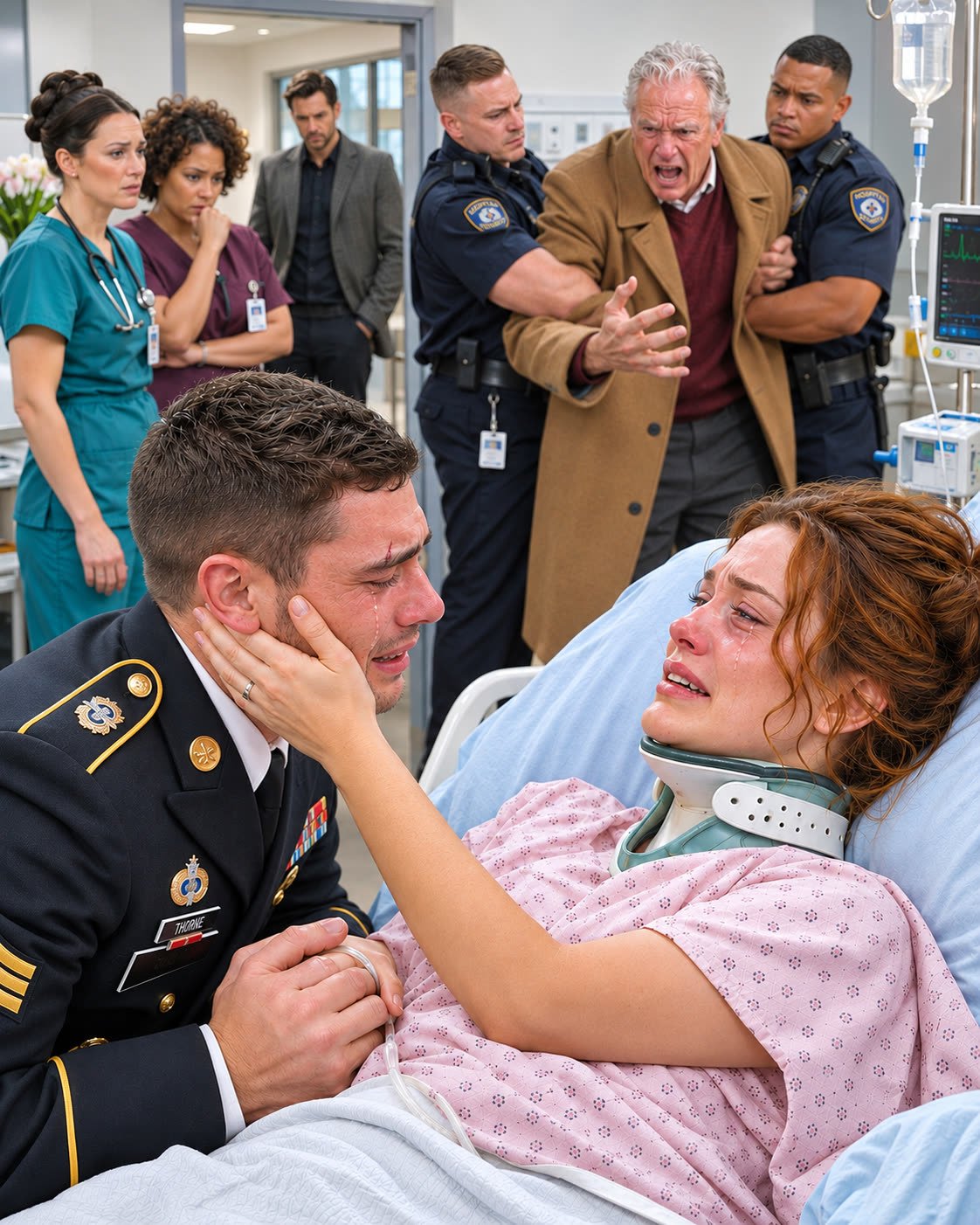
“Your wife is alive,” the doctor said. “I need you to hear that before I tell you anything else.” I stood outside intensive care with an airline luggage tag still looped around my wrist. Behind the glass, Tessa lay beneath a pale blanket, one hand resting where our daughter had moved beneath her ribs. Her father was twenty feet away, explaining to someone on the telephone that the situation had been exaggerated.
Thirty hours earlier, I had been finishing an overseas training rotation. Now I was in Boston, wearing yesterday’s clothes, trying to understand how a person could survive and still have an entire future disappear.
Dr. Patel guided me into a consultation room. Tessa had suffered a fall, a cervical ligament injury, and a placental abruption. She had hemorrhaged. The team had performed an emergency delivery, but our daughter had died before delivery.
Twenty-five weeks. We had argued affectionately over names for eleven of them.
“Her bleeding is controlled,” he said. “She’s breathing on her own. We’re monitoring her closely, and she’ll need further assessment of her neck injury. She has asked for you several times.”
I asked whether she was in pain. I asked what I could touch. I asked questions because the alternative was asking him to say something different.
“She knows about the baby,” he added gently. “Please don’t feel you need to protect her by avoiding it.”
When I entered, Tessa turned her head as far as the collar allowed. There was bruising near her temple. A nurse adjusted the line beside her bed and quietly gave us space.
“Elias,” Tessa whispered.
I put my hand beneath hers. She caught my fingers with surprising determination, as though she had been waiting for something solid enough to hold.
“I’m here.”
Her face folded. “I couldn’t keep her safe.”
I lowered my forehead to her hand. “You didn’t do this.”
I said it before I knew what had happened. I knew only that my wife would blame herself for a broken glass someone else had knocked from her hand, and that whatever had occurred at the Sterling estate, she had already begun carrying everyone’s share of it.
She cried without making much sound. I stayed bent over her hand until my back hurt, grateful for something simple to endure.
We had chosen June. Tessa finally said the name, and I said it back. The nurse returned with tissues and asked whether, when we were ready, we wanted to discuss the photographs and keepsakes the bereavement team had prepared. We said yes. Neither of us was ready to say more.
Tessa drifted to sleep after medication. In the corridor, Silas Sterling rose from a chair as if I had kept him waiting for a business appointment.
His eight sons stood around him: Caleb, Nathan, Owen, Grant, Miles, Reid, Luke, and Daniel. I had spent four years learning which silences belonged to which brother. Caleb’s meant calculation. Daniel’s usually meant fear.
“An appalling accident,” Silas said. “She became upset. She was rushing near the stairs.”
“Why was she upset?”
Caleb stepped forward. “She’d been under strain. You being away didn’t help.”
The accusation landed exactly where he intended. I had missed appointments. I had watched our daughter turn on an ultrasound through a screen. I had promised Tessa I would be home before the difficult part, as though difficulty respected a calendar.
“Did anyone call an ambulance immediately?” I asked.
“Of course,” Silas said.
Daniel looked down.
A nurse approached and told them Tessa’s visitor permissions had changed. Until she could review them herself, only I would be admitted.
Silas’s smile vanished. “I’m her father.”
“And she has asked not to see you.”
He started toward the room. Two hospital security officers moved between him and the doorway. Nobody struck him or raised a weapon. One officer simply said, “Sir, you need to step back.” The fact that he had to obey seemed to offend him more than anything else that morning.
Caleb leaned close enough that I could smell the mint on his breath. “Don’t turn grief into a campaign, Thorne. You’re a soldier. You don’t understand how families like ours work.”
I looked through the glass at Tessa.
“I’m beginning to.”
They left after an administrator warned that further disruption would result in removal. Daniel lingered long enough to meet my eyes, then followed his brothers without speaking.
I had no secret authority to summon. My rank did not give me control over a civilian hospital or the Massachusetts courts. What I had was emergency leave, a terrified wife, and two people I trusted to help me think while grief made thinking difficult.
Jonah Reed answered on the second ring. We had served together years earlier. He now worked in digital forensics with Vivian Park, a licensed investigator.
“Tell me what you need,” he said.
“I don’t know yet.”
“Then start with what you know.”
I told him about the fall, the brothers, Daniel’s face. Jonah didn’t promise revenge. He asked whether police had taken a statement, whether Tessa had a lawyer, and whether anyone had asked the estate to preserve its camera recordings.
That last question brought back something Tessa had mentioned three weeks earlier: a meeting with an attorney about her mother’s trust. She had sounded worried, then changed the subject when I asked whether her father knew.
“Find Mara Bell,” I said. “Tessa spoke to her recently.”
Jonah went quiet for a moment. “I know her office. I’ll call when they open.”
Back in the room, Tessa was awake. I pulled the chair close and told her nobody would come in without her permission.
She watched the door before looking at me.
“They told you I fell.”
“Yes.”
Her fingers tightened around mine. “I did fall. But that isn’t where it started.”
Part 2: What Her Mother Left Behind
Tessa could manage only a few sentences before exhaustion took over. I wrote nothing down until she asked me to. Then I used a notebook from the hospital gift shop, recording her words rather than trying to improve them.
She had gone to the estate because Silas said he had found her mother’s jewelry. He wanted to give it to her before the baby came. For a woman who had lost her mother at eight, it was an invitation designed to be impossible to refuse.
Instead, she found her father and all eight brothers in the upstairs sitting room. A folder waited on the table. Caleb told her it contained routine documents concerning the family trust.
“They wanted me to replace Mara with their lawyer,” she said. “And sign approval for transactions I hadn’t even seen.”
I asked whether they had explained why.
“Dad said a child changes things. That I needed to stop treating independence like a game.”
We stopped when the nurse came to check her blood pressure. Later, a detective named Elena Ruiz asked whether Tessa felt able to speak privately. I offered to leave, but Tessa asked me to remain. Ruiz explained that Tessa could pause or end the interview at any time.
The story emerged slowly. No single brother had done everything, and Tessa insisted on making those distinctions even when speaking hurt.
Nathan had brought the papers. Owen and Grant stood in the doorway when she tried to leave. Miles took her phone after she threatened to call Mara. Reid and Luke told her she was destroying the family. Daniel stood near the window and said almost nothing.
Caleb had followed her into the corridor.
“I said I was going downstairs,” Tessa told Ruiz. “He grabbed my arm. I pulled away. Dad was in front of me, and Caleb shoved me back toward him.”
She closed her eyes. Ruiz waited.
“I don’t remember every step. I remember the railing. Then I was downstairs, and they were arguing about who to call.”
Ruiz asked about the ambulance. Tessa remembered asking for help more than once. She remembered Daniel kneeling beside her. Then the memories broke apart.
“Not remembering everything doesn’t make what you remember unimportant,” Ruiz said.
Afterward, Tessa apologized for not telling me about the trust. I wanted to demand why she had gone there alone. The question rose hot and useless, and I swallowed it.
“Tell me now,” I said.
Her mother, Evelyn, had left a trust for her children. An independent trustee had managed it when they were young, but after that trustee retired, a family-controlled trust company took over. Tessa had received statements she barely understood and distributions Silas described as gifts.
When she turned thirty, she became entitled to request a fuller accounting. Pregnancy had made her think about wills, guardians, and what she could leave June. She asked for records.
Silas sent a bracelet instead.
She asked again. Caleb called her ungrateful. Then she found the same commercial property listed under different ownership percentages in two statements. That was when she contacted Mara Bell.
“I thought it was a bookkeeping problem,” Tessa said. “Then Mara told me not to sign anything.”
I remembered the bracelet. I had admired it during a video call, and Tessa had laughed too brightly before putting it away.
Mara arrived that afternoon after confirming Tessa wanted her there. She carried a slim folder, not the army of paperwork I had imagined a fight against the Sterlings would require.
“Your wife had already taken an important step,” she told me. “She asked questions in writing.”

Three weeks earlier, Mara had requested trust records and instructed the trust company to preserve relevant documents. Some records had arrived. Others had been withheld. The estate meeting had taken place the day after Mara sent a second demand.
“Do you think they hurt her because of money?” I asked.
“I think there was pressure to obtain her signature,” Mara said. “We have to establish what happened, not decide first and search backward.”
I disliked the restraint in her answer. Later I would understand how much protection it offered us.
Jonah and Vivian reached Boston that evening on commercial flights. They came in plain clothes carrying laptops and overnight bags. Jonah hugged me hard enough that I nearly lost the control I had been using like a splint.
Vivian asked to speak with Mara before doing anything. Tessa authorized them to assist her attorney with her own accounts and records. Nobody would enter a Sterling server, impersonate an employee, or retrieve evidence through some clever illegal shortcut.
“Anything we do has to survive being questioned by people who dislike us,” Vivian said.
The next morning she helped Tessa secure her email and banking access. A recovery address on one account belonged to the family office. Tessa stared at it, then asked Vivian to remove it.
It was a small action. She cried afterward.
Meanwhile, Ruiz obtained the emergency dispatch records. She did not give us every detail, but she confirmed that Daniel had placed the call. Investigators were examining the timeline and seeking estate security footage.
Caleb’s attorney issued a statement describing a tragic accident compounded by a distraught husband’s accusations. I read it in the corridor and felt an almost physical need to break something.
Jonah took the phone from my hand.
“Walk with me.”
We went down six flights of stairs. At the bottom, I braced my hands against the wall.
“They get to go home.”
“For now,” he said.
“June doesn’t.”
He stayed beside me. There was nothing useful to say to that.
Upstairs, Tessa was choosing whether to keep a tiny knitted hat from the bereavement box. I sat with her while she folded it twice and unfolded it again. For twenty minutes, the investigation ceased to exist.
Then Mara called. The family office claimed the interior security system had malfunctioned before Tessa’s visit. Recordings from the relevant afternoon were supposedly unavailable.
Tessa listened on speakerphone, her hand resting on the box.
“That’s the main system,” she said. “The upstairs sitting room used to be the nursery. Mom had a separate camera installed when Daniel and I were little. Dad replaced it last year because he liked watching the garden through its window.”
Vivian looked up from her notebook.
“Do you know who installed the replacement?”
Tessa nodded. For the first time since I had arrived, her voice grew steadier.
“Yes. And Caleb doesn’t know it uploads anywhere.”
Part 3: The Brother Who Finally Spoke
We gave the installer’s name to Ruiz rather than calling him ourselves. Mara explained that a provider might hold recordings, but access required the owner’s permission or appropriate legal process. Knowing a file might exist was not the same as having the right to take it.
Waiting became our work.
Tessa moved from intensive care to a quieter room. A specialist cleared her to stop wearing the rigid collar after further imaging and examination, though pain and stiffness remained. A physical therapist helped her walk the corridor in short stages.
On the first attempt, she made it to the nurses’ station. On the second, she saw a father carrying an infant seat toward the elevators and asked to return.
I brought her back without telling her that tomorrow would be easier.
Jonah stayed in a nearby hotel. Vivian worked with Mara on the records Tessa had lawfully obtained. They found transfers described as loans to related businesses, repeated extensions, and property valuations that required independent scrutiny.
“It could be improper management. It could be fraud,” Vivian said. “An accountant needs to follow it through.”
For years, Silas had told Tessa that her brothers were protecting her inheritance because numbers bored her. Now she sat propped against pillows, reviewing statements in twenty-minute stretches and asking precise questions.
She had been an architectural project coordinator before pregnancy. She could read a construction budget better than any of us. Watching her recognize what had been hidden beneath familiar terminology made me angrier than the original insult.
On her sixth hospital day, Daniel sent a message through Mara’s office. He wanted to speak, but not at the hospital and not with his father informed.
Tessa stared at the message for a long time.
“He was there.”
“You don’t owe him a meeting,” I said.
“I know. But I want him to tell the truth somewhere he can’t take it back.”
Mara arranged for Daniel’s own attorney to contact Ruiz. Two days later, he gave a recorded statement. Only afterward, with everyone’s agreement and Tessa’s permission, did he meet us in a conference room at Mara’s office. By then, Tessa had been discharged to a hotel near the hospital for follow-up appointments.
Daniel looked older than the man who had stood in the corridor. He kept rubbing his wedding band.
“I called the ambulance,” he said.
Tessa didn’t answer.
“Dad wanted the private doctor. Caleb said an ambulance would bring police. I waited. I should have called immediately.”
“How long?” she asked.
“I don’t know exactly. Several minutes. Too long.”
His attorney touched the folder before him, reminding him not to speculate. Daniel nodded, but kept looking at his sister.
“Did you see Caleb push me?”
“Yes.”
The answer was so plain that I had to look away.
Daniel said he had preserved messages from the family group chat. Before the meeting, Caleb had told the brothers they needed a united front. Afterward, Silas instructed them to describe Tessa as agitated and the fall as unwitnessed.
Daniel had already provided his phone to investigators through his attorney. He had also turned over an email from the security company announcing a cloud-storage renewal. It had gone to him because he had arranged maintenance at the house.
“Why didn’t you tell them about the camera?” I asked.
“I was afraid.”
“Of what?”
He met my eyes. “Losing my job. My house. My father.”
I wanted to despise the answer, but its honesty made that difficult. Silas employed his sons, guaranteed loans on their homes, and called every advantage a debt. Fear explained Daniel’s silence. It did not excuse it.
Tessa leaned forward carefully.
“I was afraid too. You all watched me be afraid.”
Daniel began crying. She did not comfort him.
Before he left, he said there was something else. Years earlier, Evelyn’s sister had sent a packet of letters to the estate. Silas had refused it and told the children their aunt wanted money. Daniel had found the returned packet while helping clear an old storage room after a leak.
He had kept it without opening it. Now he wanted Mara to contact their aunt and ask whether she would permit Tessa to have it.
“Why keep it?” Tessa asked.
“Because I thought someday I might be brave enough to ask what happened.”
After he left, Tessa asked me whether I thought he deserved forgiveness.
“I don’t think anyone gets to assign that to you.”
She leaned against me then, not collapsing, simply letting some of her weight become mine.
The camera provider responded to legal process that week. Ruiz confirmed that investigators had recovered footage. She warned us that seeing it could be distressing and that we were not obliged to watch.
Tessa chose to view the relevant portion with Mara present. I sat beside her. There was no dramatic soundtrack, only a fixed view of a room where I had once helped decorate a Christmas tree.
The recording showed the folder. It showed Owen and Grant blocking the exit and Miles taking Tessa’s phone. Silas stood so close to her chair that she had to lean away.
The microphone caught his words clearly.
“Your mother signed what she was given. You will too.”
Tessa asked to stop the recording. Mara paused it immediately.
We sat in silence until Tessa nodded for it to continue. The camera did not show the full staircase. It showed Caleb following her out, then part of a struggle at the corridor’s edge. The sound of the fall came from beyond the frame.
What followed mattered too: no immediate call for help, an argument about appearances, Daniel finally reaching for his phone.
I had spent days imagining myself watching proof with cold satisfaction. Instead, I felt ill. Proof could establish responsibility. It could not give us back the afternoon before it happened.
Ruiz told us the recording, witness accounts, medical evidence, and messages would be reviewed together. Charges would not depend on one blurred second.
Outside the interview room, my phone showed a voicemail from Silas.
“Elias, this has gone far enough. There are things about Tessa’s mother you don’t understand. Before you destroy this family, ask your wife whether she’s prepared to lose everything she has left.”
I handed the phone to Mara. She listened once and requested a copy.
Tessa stood beside me, pale but upright.
“Tell him,” she said, “that this time I’m keeping the message.”
Part 4: The Price of Telling the Truth
The arrests did not happen in a hospital corridor. They happened after interviews, warrants, consultation with prosecutors, and weeks during which it sometimes felt as though nothing was moving at all.
Silas and Caleb faced the most serious state charges arising from the confinement, assault, and efforts to influence witnesses. Other charges reflected individual conduct. Blocking a doorway, taking a phone, falsifying records, and helping coordinate an account were not treated as interchangeable acts.
Nathan’s role in the trust transactions drew separate scrutiny. Federal investigators became involved in the financial case after records raised questions about bank submissions and interstate transfers. Mara cautioned us that neither investigation would finish quickly.
The first public hearing brought photographers to the courthouse. Tessa chose not to attend. She had spent too much of her life being expected to appear wherever her father’s reputation needed her.
We watched no footage of the defendants arriving. Instead, we went to a follow-up appointment and bought groceries. In the cereal aisle, Tessa picked up the brand she used to eat at midnight during pregnancy, then put it down.
I asked whether she wanted to leave.
“No,” she said. “I want to be allowed to stand here for a minute.”
So we did.
There were victories that looked nothing like victories. A judge imposed no-contact conditions. The trust company supplied records it had previously withheld. Tessa’s accounts no longer sent recovery notices to her father’s office.
Then came costs.
A cousin wrote that Tessa’s accusations were hurting innocent employees. An old friend suggested grief might have distorted her memory. Online strangers debated whether marrying a soldier had made her resent her family.
I wanted to answer every one of them. Tessa watched me typing and touched my wrist.
“Don’t let them move into this room with us.”
I deleted the response.
Mara arranged a forensic accounting review and a petition concerning the trust’s administration. The preliminary findings supported serious concerns: money had been diverted into Sterling-controlled developments, losses concealed by renewed loans, and beneficiary approvals described in records that Tessa said she had never signed.
The estate meeting had been intended to obtain documents that might help legitimize earlier transactions and replace the lawyer asking inconvenient questions. June had not created a magical inheritance claim. Her approaching birth had prompted Tessa to examine what her mother left her—and that examination threatened an arrangement built on obedience.
Understanding the motive did not make the cruelty easier to understand. It made it smaller and uglier.
Silas’s attorneys proposed a settlement of the civil trust dispute. The offer included a substantial payment and broad confidentiality terms. Criminal charges were the state’s concern, and nobody could legitimately promise to make them disappear.
But one paragraph required Tessa to stop cooperating voluntarily with certain third-party inquiries beyond what law compelled. Mara marked it in red.
“You can negotiate financial claims,” she said. “You should understand exactly what silence they’re trying to buy.”
Tessa asked to take the document home.
For two days, she carried it between the table and the bedroom. The amount could have secured our future. It could have paid for treatment, a house, and years without financial anxiety. I would be lying if I said I never imagined what relief would feel like.
“Would you hate me if I took it?” she asked.
“No.”
“Would you think they won?”
I sat beside her. “I think you’ve had enough men decide what your choices mean.”
She leaned her head against my shoulder. “I don’t want to spend the rest of my life proving I’m brave.”
“Then we won’t make that the job.”

The next morning, she instructed Mara to reject the confidentiality provisions and continue seeking an independent accounting. She did not reject the possibility of a fair financial settlement. She rejected having her voice included in the purchase price.
Around that time, her aunt returned Mara’s call. The estrangement had begun long before Tessa could remember. Her aunt had kept copies of letters Evelyn sent during the final years of her life, and she wanted Tessa to read them only if she wished.
The packet arrived through Mara’s office. There was no envelope impossibly addressed to a future husband. There were letters to a sister, shopping lists on the backs of pages, and one folded note marked, “For Tessa, when she is old enough.”
Tessa read the first letters alone. Later she handed me several pages.
Evelyn described a household where money carried conditions and disagreement became disloyalty. She worried about her sons learning to confuse control with care. She wrote about seeking advice, about being discouraged, about trying again.
There was no evidence in the letters that her death from a cardiac condition had been anything other than what the medical records documented. The truth was painful without inventing another crime: a woman could die naturally after years of being made to feel that her life was not entirely her own.
Tessa left the note addressed to her unopened.
“I can’t have another person tell me what I should become. Not yet.”
I put it in the drawer she chose.
Months passed. Caleb challenged the evidence and denied intentionally pushing her. Silas claimed he had been trying to calm everyone. Daniel’s cooperation did not erase his own decisions; his agreement required truthful testimony and left consequences for the court to determine.
The civil court appointed an independent professional to oversee the disputed trust while litigation continued. It was not a windfall. Some assets were tied up, some losses might never be recovered, and the legal bills were real.
Then Silas sent a final proposal through counsel: a private family meeting, without investigators or the press, supposedly to begin repairing what had broken.
Tessa read it beside the unopened note from her mother.
“He still thinks this is something we did to him,” she said.
She wrote her answer herself, then asked Mara to review it: no private meeting, no direct contact, and no discussion of reconciliation while he continued denying what the evidence showed.
Before sending it, she looked at me.
“If I do this, I may never have a father again.”
I took the chair beside hers rather than standing behind her.
Tessa placed her finger over the send button—and chose which family she would protect.
Part 5: The Door We Could Open
She sent the letter.
Nothing shattered. No one arrived to tell her she had made a terrible mistake. The kettle clicked off in the kitchen, and someone downstairs laughed at something on television. An enormous decision entered an ordinary evening.
For several minutes, Tessa watched her inbox. Then she closed the laptop.
“I’m hungry,” she said.
It was the first uncomplicated request I had heard from her in months.
We did not move west immediately. My leave ended, and I returned to duty while requesting an assignment that would keep me nearer home. Tessa stayed in treatment and began seeing a grief counselor. Some appointments we attended together; some belonged only to her.
I eventually applied to leave active service through the regular process. Approval took time. There was paperwork, planning, and a hard conversation with a commander who reminded me not to confuse leaving the Army with escaping grief.
He was right. I left because our life needed a different arrangement, not because a new address could make us untouched.
Fourteen months after the fall, we moved to a modest house outside a small Washington town. It had a roof inspection we could understand, a mortgage we could afford on civilian income, and a back door Tessa chose herself.
Jonah helped install ordinary security equipment. No hidden command center. No armed men in the trees. Just working locks, cameras we controlled, and an alarm code known only to the people we invited in.
The legal cases continued.
Caleb eventually accepted a plea agreement after the court rejected a major challenge to the recordings and the remaining evidence. Silas went to trial on the principal state charges. Tessa testified with breaks arranged through the court, answering questions she had feared for more than a year.
I sat where she could see me, but not so close that she had to watch my face after every answer.
When defense counsel suggested she had exaggerated because she resented her father’s financial oversight, she folded her hands in her lap.
“I asked for an accounting,” she said. “I did not consent to being held in that room.”
Silas was convicted on several counts. Caleb and Silas received prison sentences; the court considered their conduct, the evidence, and the applicable law. The financial case and remaining claims followed their own slower course.
The brothers’ outcomes differed. Some accepted pleas for their roles in the confinement or concealment. Others faced financial charges or civil liability supported by separate evidence. Cooperation affected sentencing; it did not transform anyone into an innocent bystander.
Daniel testified. Later, he sent Tessa a short letter that contained no request for forgiveness. He described what he had done, what he should have done, and the work he was beginning to change a life built around his father’s approval.
She kept it. She did not answer for several months.
When she eventually did, she offered one supervised conversation with a counselor present. She made no promise of another. He accepted without bargaining, which she said was the first useful thing he had done since telling the truth.
With the trust removed from family control, Tessa recovered part of what had been diverted through a combination of repayment, asset sales, and settlement. The amount was less than the statements had once promised. Mara showed her every fee and every remaining uncertainty.
Tessa signed the final documents after reading them herself.
We used some of the money to replenish savings depleted during the case. She kept the rest separately invested under advice she chose. Having her own resources mattered to her. So did knowing that loving me did not require surrendering them.
Our daughter had a place beneath a young maple in the garden. We chose a small stone with her name and planted flowers suited to the soil rather than the elaborate memorial I first imagined.
On June’s birthday, we sat there with coffee. Tessa told me about a dream in which she could remember our daughter’s weight even though she had held her for so little time.
I told her I was afraid of forgetting the exact sound of her voice when she first said June’s name.
“Then we’ll say it,” she answered.
So we did.
Healing did not arrive as a reward for winning. Tessa still sometimes stopped at the top of unfamiliar stairs. I still woke when my phone rang after midnight. We learned when to ask for help and when a difficult day was simply a difficult day, not proof we had failed.
Tessa returned to architectural project work part-time. The first plan she brought home was for an accessible entrance to a neighborhood library. She spread the drawings across our table and argued cheerfully with herself about the slope.
I stood in the doorway listening to her think aloud. For months, every folder in our home had contained something terrible. This one contained a way for people to get inside a building.
Jonah and Vivian later invited me to join their investigative practice. They needed someone to coordinate records, client safety planning, and work with attorneys. I completed the required training and licensing steps for the work I would perform.
We were not a private army. We could preserve evidence entrusted to us, conduct lawful inquiries, and help people find the right professionals. We could not promise arrests, recover every missing dollar, or rescue someone who had not asked to be rescued.
I learned to find dignity in those limits.
One evening, nearly two years after the hospital, Tessa brought her mother’s unopened note onto the porch.
“Will you sit with me?”
She unfolded it slowly. Most of the page concerned ordinary memories: Tessa refusing to wear matching socks, a cake that collapsed, a morning spent watching birds instead of leaving on time.
Near the bottom, Evelyn had written, “I hope you build a life in which you do not have to earn the right to feel safe. You may love people and still leave the room.”
Tessa read that sentence twice.
Then she folded the note and went inside to put it somewhere other than a drawer. Later, I found it framed beside a photograph of her mother laughing, taken before anyone had taught Tessa to mistake solemnity for respectability.
That night, a message arrived through the practice’s referral system. An attorney in Chicago was seeking assistance for a woman whose politically connected relatives controlled her housing, accounts, and access to important records. She was ready to speak, but only from a safe telephone.
I read the referral and felt the old urgency rise. Then I checked the time, called Vivian, and made a plan instead of a promise I could not keep.
Tessa watched from the kitchen doorway.
“Another family?” she asked.
“Someone trying to get out from under one.”
She nodded. “Find out what she wants first.”
I remembered a hospital room, my wife’s hand gripping mine, and all the people who had spoken for her before anyone thought to listen.
“I will.”
The secure line rang the following morning. Tessa set a cup beside my notebook and opened the back door to let in the garden air.
I answered, introduced myself, and waited.
For a moment there was only breathing. Then a woman whispered, “If I tell you what happened, will you believe me?”
I looked toward Tessa, standing in a doorway nobody could forbid her to leave.
“I’ll listen,” I said. “Start wherever you can.”
Disclaimer: This story is a work of fiction inspired by real-life themes. Names, characters, places and events are fictionalized, and any resemblance to real persons is purely coincidental. Images are for illustration purposes only.


