

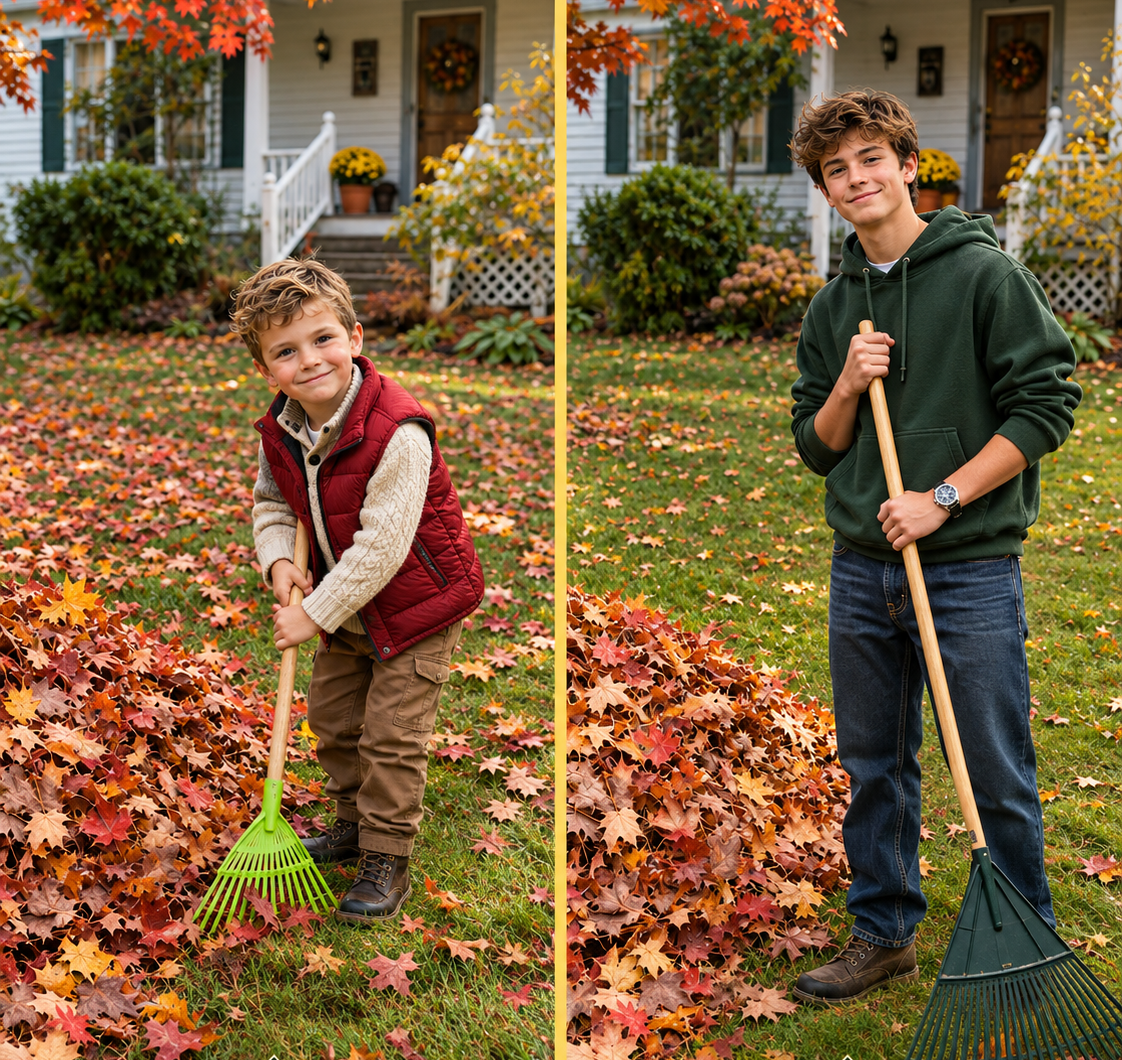
Part 1: The Boy With the Plastic Rake
The first time my son raked Mrs. Adler’s yard, he was six years old, the sun wasn’t up yet, and he did it with a green plastic rake from the dollar store.
I found his bed empty at 6:20 on a Saturday morning in October. My heart dropped straight into my stomach. Then I looked out the front window and saw him.
He was across the property line in his pajama pants and my old rubber rain boots, the ones that came up past his knees. He was dragging that little rake through a carpet of red maple leaves, and he was making a pile about the size of a laundry basket.
I pulled my coat on over my nightgown and went out.
“Caleb. What are you doing, buddy?”
He didn’t stop. “You did it last week and your back hurt. So I’m doing it.”
I opened my mouth and nothing came out.
A week earlier, I had raked Mrs. Adler’s front yard after a double shift at the hospital laundry, because the leaves had piled so high against her steps that I worried she’d slip getting her mail. Caleb had sat on our porch with a juice box and watched me the whole time. I hadn’t thought he was paying attention.
Six-year-olds are always paying attention.
Above us, the lace curtain in Mrs. Adler’s front window moved. I saw her face for a second, pale and still, white hair pinned back. She looked at Caleb. She looked at me.
Then the curtain dropped, and she didn’t come out.
To understand why that hurt so much, you have to know what our life looked like back then.
My name is Jenna Marsh. Two years before that morning, my husband, David, packed a duffel bag, kissed our four-year-old on the forehead while he slept, and drove away from our little rental house on Linden Street in Millbrook, Pennsylvania. He left a note on the kitchen counter that said I’m sorry. I can’t do this. He didn’t say what “this” was.
He didn’t call. He didn’t send money. After a while, I stopped checking the mailbox twice a day.
I worked forty-eight hours a week folding hospital linens and picked up weekend shifts when I could get them. I learned how to make one pound of ground beef last three dinners. I learned which bills could wait ten days and which ones couldn’t.
And I made Caleb one promise I knew I could keep. I told him that whatever we didn’t have, we could still be kind, because kindness doesn’t cost anything.
I didn’t know he’d take it so literally.
Mrs. Adler had lived in the gray two-story next door for over forty years. Her husband, Frank, had passed long before we moved in. She was in her late seventies, walked with a cane, and kept to herself. Twice a week a grocery van dropped bags on her porch. On Sundays, her lamp stayed on until midnight.
That first morning, Caleb worked until the whole front yard was bare grass and four lumpy piles. It took him almost two hours. When he came inside, his cheeks were bright red and his fingers were stiff with cold.
“Did she say thank you?” he asked, pulling off the boots.
“No, baby. She didn’t come out.”
He frowned at that for a long moment.
“Some people have a hard time saying thank you,” I told him. “That doesn’t mean they don’t feel it.”
I believed that when I said it. Mostly.
He nodded, ate two bowls of oatmeal, and fell asleep on the couch before nine.
I stood at the window afterward and watched Mrs. Adler’s curtain. It moved twice more that morning. Both times, she was looking at the yard.
I didn’t know it then, but someone else had been looking at that yard too. And it would take ten years and one dead woman’s patience for me to find out who.
Part 2: Ten Autumns
The next October, I didn’t have to say a word.
On the first Saturday the maple turned red, Caleb was out the door at seven with a new rake, a real one this time, from the hardware store on Main. It was taller than he was. He held it halfway down the handle and hit himself in the shin with it twice before he figured it out.
That was how it became ours. Not a chore. Not a favor. A season.
The Halloween decorations went up. The furnace kicked on. Caleb raked Mrs. Adler’s yard.
At eight, he did it in a Pittsburgh Steelers hoodie that came down to his knees. At nine, he made a map of her yard on notebook paper so he could “plan the piles.” At eleven, he set his alarm for 5:45 so he could finish before his soccer game at nine.
“You’re going to be exhausted by halftime,” I told him from the kitchen doorway.
He was already lacing his sneakers. “Then I’ll eat a bigger lunch.”
He did. He also scored a goal. I’m not saying the two things are related, but I’ve never been able to prove they weren’t.
Mrs. Adler never came outside. Not once in ten years.
But she started leaving things.
The first time, Caleb was nine. He finished the last pile and found a thermos of hot chocolate on her top step with a paper napkin folded under it. The next year, it was hot chocolate and a plate of oatmeal raisin cookies covered in plastic wrap. The year after that, there was a twenty-dollar bill tucked under the plate.
Caleb brought the twenty back and slid it under her door.
“Why’d you do that?” I asked him.
He shrugged. “She didn’t ask me to do it. So she doesn’t have to pay me for it.”
She tried three more times over the years. Twenty dollars. Then forty. Then a fifty in a card with nothing written inside. Every time, he returned it the same way, under the door, with no note.
The cookies, he kept.
I’ll be honest. Some years it bothered me more than it bothered him. I’d watch my kid drag tarps of wet leaves to the curb in freezing drizzle, and I’d watch that curtain move, and I’d think, Would it kill you to open the door?
Once, when he was thirteen, I almost went over there to say it.
Caleb stopped me on our porch. “Mom. Don’t.”
“She could just say it, Caleb. One time.”
“She does say it,” he said. “She leaves the cookies.”
At fourteen, he was busy in a way I hadn’t expected. Algebra homework, junior varsity soccer, a group chat that buzzed until midnight, and a girl named Hailey he swore was “just a friend.” I figured the tradition might finally fade out on its own, the way childhood things do.
Then the first cold Saturday came, gray and windy, and at 7:15 I heard the front door close.
He was out there in a beanie and work gloves, alone, raking.
The year he turned sixteen, Mrs. Adler died.
It was the second week of September. The ambulance came on a Tuesday morning, and the lamp in her front window didn’t come on again. A small notice ran in the Millbrook Courier: Helen R. Adler, 88, beloved wife of the late Frank Adler. The funeral was private. I didn’t know who would have attended.
A month later, the maple turned red right on schedule.
I watched Caleb stand at the living room window for a long time that Saturday morning. Then he went to the garage and came back with the rake.
“Honey,” I said carefully, “you know she’s not—”
“I know.” He pulled on his gloves. “I just want it to look nice. One more time.” He paused at the door. “Maybe she can see it.”
I didn’t stop him. I couldn’t have if I’d tried.
He raked her whole yard. Front and side. He bagged every pile and lined the bags up neatly at the curb, eleven of them, the way she must have watched him do it a hundred times.
When he came in, he didn’t say anything. He just sat on the bottom stair with his gloves in his lap.
Three days later, there was a knock at our door. The man standing on the porch was holding a bundle of dry red leaves tied with brown twine.
Part 3: You Forgot to Rake These
He was about sixty, tall and slightly stooped, in a canvas barn coat with sawdust in the creases. He had kind, tired eyes and a gold wedding band he kept turning with his thumb.
“I’m looking for Caleb,” he said.
Caleb came up behind me in the hallway. The man looked at him for a long moment, the way you look at someone you’ve only ever heard about.
Then he held out the bundle.
“You forgot to rake these.”
Caleb took it like it might break. They were maple leaves, pressed flat and dried to the color of old brick. Ten of them. And tucked behind each leaf, folded into a long narrow envelope, was a note.
“My name’s Robert Adler,” the man said. “Helen was my aunt. I took care of her these last few years.” He cleared his throat. “She made me promise to bring these over after she was gone. She was very particular that it be after.”
I invited him in. I made coffee because I didn’t know what else to do with my hands.
Caleb sat at the kitchen table and untied the twine. Each envelope had a year written on the front in slanted, careful handwriting. He opened the oldest one first.
The paper was soft, the way paper gets after it’s been read more than once. He read it out loud, slowly.
“A little boy raked my yard before sunrise today. He wore his mother’s boots. I don’t know what I did to deserve it.”
Caleb stopped. He looked up at me, then back at the paper.
“She remembered,” he said quietly. “I didn’t think she even knew my name.”
The second envelope was shorter. He came back again. I didn’t think he would.
They went on like that. One for every autumn. She wrote about the year he hit himself in the shin with the new rake and kept going anyway. The year he returned her money under the door and she laughed out loud in an empty house for the first time since Frank died. The year he worked in the freezing rain and she sat at the window with a blanket around her shoulders because it felt wrong to be warm while he wasn’t.
I had to get up and stand at the sink for a while.
The tenth envelope was thicker than the rest. It wasn’t a letter.
“She said there was something special inside that one,” Robert said. “She wouldn’t tell me what.”
Caleb tipped it, and a small stack of photographs slid onto the table.
They were all of him.
Six years old in my rubber boots with the green plastic rake. Eight in the Steelers hoodie, mid-swing. Eleven with his soccer cleats laced around his neck. Fourteen in the beanie, alone in the gray drizzle. Every one taken from the same angle, from inside her front window, the lace curtain blurred at the edge of the frame.
She hadn’t just been watching. She’d been keeping him.
Caleb turned over the first photograph. On the back, in that same slanted hand, she had written:
The first autumn you came, I stopped feeling alone.
My son is sixteen and six-foot-one, and he put his face in his hands at our kitchen table and cried like he was six again.
I came around the table and held on to him. Robert looked down at his coffee and let us have the moment.
It was only when Caleb set the photo back down that I really looked at it.
Six-year-old Caleb in the middle of the yard. The maple tree on the left, its trunk wide and dark. And half hidden behind that trunk, a man in a brown work jacket, one hand on the bark, watching my son.
I knew the shape of his shoulders before I knew anything else.
I knew the jacket. I had bought it at a Sears outlet for $39.99 the winter before Caleb was born.
“Mom?” Caleb said. “What’s wrong?”
I couldn’t answer him. I picked up the photo and held it closer to the window light, as if that would change what I was seeing.
It was David.
Two years after he left us, my husband had been standing in the yard next door, close enough to touch my son, and he had said nothing.
I turned to Robert. My voice came out flat. “Do you know who this is?”
Robert leaned in and studied it. Then he let out a long breath.
“Aunt Helen told me about him once,” he said slowly. “She caught a man standing behind her tree one morning, watching a little boy rake. She went right out on the porch in her housecoat and asked what he thought he was doing.” He almost smiled. “Then she invited him in for tea.”
“Did she tell you his name?”
He nodded.
“David. And Mrs. Marsh, he didn’t come just the one time.”
Part 4: The Man Behind the Maple
I didn’t sleep that night. I sat at the kitchen table after Caleb went to bed and spread all ten photographs out in a row, oldest to newest.
Now that I knew what to look for, I couldn’t stop seeing it.
In the photo from when Caleb was about nine, there was a blue Ford Ranger parked at the curb two houses down. Same model David drove the whole time we were married. Same dent over the back tire, if I squinted.
In the one from when Caleb was fourteen, there was a gray SUV pulled up near Mrs. Adler’s driveway. I couldn’t see a driver. I couldn’t prove anything.
But I was done telling myself it was nothing.
At 7:30 the next morning I called Robert.
“Did your aunt keep an address book?”
“Oh, she didn’t trust phones,” he said. “Wouldn’t put a single number in one. She had a little green notebook by the kitchen phone. I’ve got it in a box somewhere.”
He brought it over that afternoon. It was spiral-bound and swollen with forty years of crossed-out names. I found it on the second-to-last page, written in blue ink:
David — handyman.
Below it was an address on Ridge Road, out past the grain elevator on the far edge of town.
I didn’t tell Caleb where I was going. I told him I had an errand.
The building was a converted dairy barn with a hand-painted sign over the double doors: Hollow Creek Woodworks. Inside, it smelled like cedar and varnish. A radio was playing classic rock somewhere in the back. A young guy in safety glasses, maybe twenty-two, looked up from a table saw.
“Help you?”
“I’m looking for David.”
“He’s out on a job. Should be back in twenty minutes or so. You can wait if you want.”
I waited. I didn’t sit.
One whole wall was covered with photos of finished projects. Kitchen cabinets. A church pew. A cedar chest. And near the top, pinned with a yellow thumbtack, a photo of a front porch I would have recognized anywhere. New railings, new steps, fresh gray paint. Mrs. Adler’s porch.
Someone had written underneath it in marker: Adler restoration. No charge.
“That one’s the boss’s favorite,” the young guy said, following my eyes. “That old lady over on Linden. He took care of her place for years. One time he turned down a $12,000 cabinet job because her back steps cracked and he didn’t want her using them.”
The barn door scraped open behind me.
David looked older than I had let myself imagine. There was gray running through his hair now, and deep lines at the corners of his eyes. He had a toolbox in one hand. When he saw me, he set it down on the floor very slowly, like it had gotten heavy all at once.
“Jenna.”
“Don’t.”
I walked to the workbench and laid the photograph flat on it. Six-year-old Caleb in my boots. The man behind the maple.
“Explain this.”
The young guy found something urgent to do in the back.
David stared at the picture for a long time. When he finally spoke, his voice was rough.
“I came back that morning,” he said. “Two years after. I’d been sober eight months. I was going to knock. I had it all planned, what I’d say.” He touched the edge of the photo. “Then I saw him out there with that little rake, and he was so much bigger. And I realized I’d already missed two years of him. I couldn’t move.”
“So you hid behind a tree.”
“So I hid behind a tree.” He didn’t argue. “And Mrs. Adler came out on her porch and asked me what in the world I thought I was doing. I told her that was my son.” He let out a breath that was almost a laugh. “She said, ‘Then you’d better come in for tea, because you look like you’re about to fall down.’”
“You never told her the truth?”
“Not all of it. I told her I wanted to come back. I told her I was afraid you’d never forgive me.” He looked at me. “She asked if her porch steps needed fixing. I think it was the only way she knew to keep me coming around.”
“And it did.”
“Every fall. I’d come fix something, and I’d see him through her window.” He swallowed. “I watched him grow up from her kitchen, Jenna.”
That was the part that broke something open in me.
“You were next door,” I said. “Ten years. Ten Octobers. You could walk up her steps over and over again, but you couldn’t walk thirty feet to ours?”
He didn’t look away. I’ll give him that.
“Every year,” he said quietly, “I had one less excuse. And somehow that made it harder, not easier.”
I didn’t say anything. I didn’t tell him I understood. I didn’t.
“She wouldn’t keep my secret,” he said after a while. “I asked her to, more than once. She always said the same thing. That it wasn’t her job to fix what I broke.” He rubbed his thumb hard across his knuckles. “When she got sick this spring, she told me she was done protecting me. She said she’d started putting something together for the boy.”
“The envelopes.”
He nodded. “The last time I saw her, she was in the hospital bed in her living room. She grabbed my wrist. Strong grip for eighty-eight.” He tried to smile and couldn’t. “She said, ‘I watched that boy grow up for ten years, and so did you. The difference is I was never afraid to let him know I cared.’”
The radio in the back had gone quiet. Somebody had turned it off.
“And then she told me to stop feeling sorry for myself,” David said, “and go talk to my son.”
I picked up the photograph.
I looked at it one more time in the gray light coming through that barn door. Caleb, six, in boots that swallowed his legs. Leaves up to his ankles. And at the edge of the frame, a man who should have been in the middle of it, half-hidden, one hand on the bark.
Helen Adler took that picture from her front window with a steady hand. She kept it for ten years. She could have cropped it, or chosen a different morning, or left it out of the envelope altogether.
She didn’t.
I put the photo in my coat pocket and turned toward the door. Then I stopped with my hand on the frame.
“Saturday,” I said, without looking back. “Ten o’clock. There are still leaves in our yard.”
I heard him take a breath behind me.
“Jenna, does he—”
“You’ll knock,” I said. “Or you won’t. That part’s yours.”
I drove home down Ridge Road with the photo against my chest, past the grain elevator, past the Main Street hardware store where I’d bought a rake that was taller than my son. The maples on Linden Street were bare by then. Caleb had seen to that.
When I pulled into the driveway, Mrs. Adler’s front window was dark, the lace curtain perfectly still.
For ten years, I had believed she never said thank you.
I had it wrong. She’d said it ten times, in ten envelopes. And at the very end, she had said one more thing, in the only way she could, to a woman she’d never spoken to and a man who’d run out of excuses.
Mrs. Adler hadn’t left David in that picture by accident.
Would you have opened the door to someone who hid for ten years—or would you have let the leaves stay where they fell?
Disclaimer: This story is a work of fiction inspired by real events. Names, characters, and details have been altered. Any resemblance is coincidental. The author and publisher disclaim accuracy, liability, and responsibility for interpretations or reliance. All images are for illustration purposes only.


