

Part 1 — Three Little Boys in Black Tuxedos
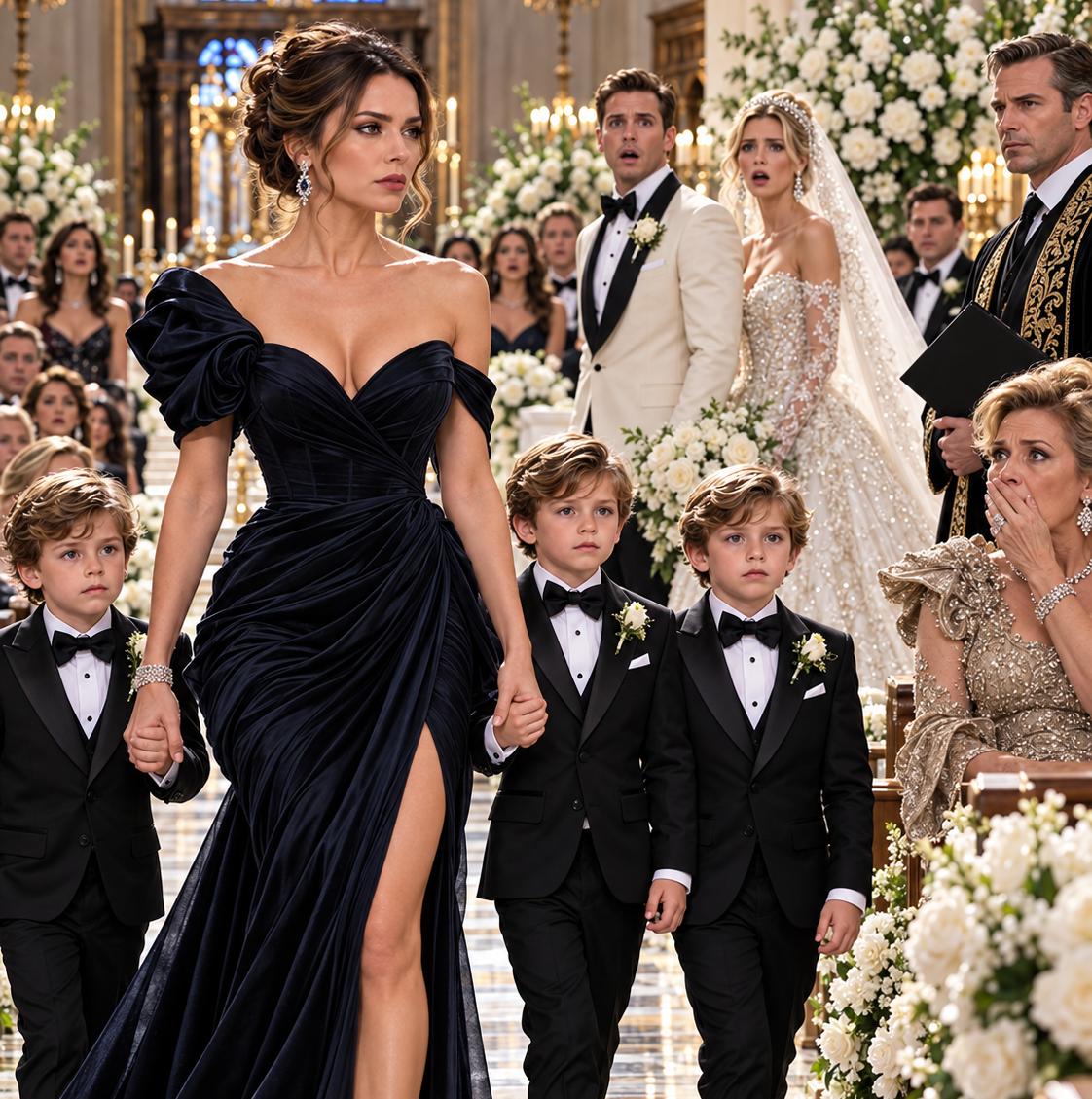
The moment Christopher Ashford saw the three little boys walking beside me, his face went completely white.
For several seconds, he couldn’t move.
His bride was standing only a few feet away, surrounded by white roses and hundreds of beautifully dressed guests. She had been smiling moments earlier. Now she was staring at my children with a confused expression.
My former mother-in-law, Patricia Ashford, stood near the entrance to the ballroom, looking as though she had just seen a ghost.
I almost understood why.
Six years earlier, Patricia had helped her son throw me out of our marriage while I was pregnant with those very same boys.
She had called me a burden.
She had accused me of trying to trap her wealthy son.
And she had made it perfectly clear that neither she nor Christopher wanted anything to do with my unborn children.
Now, after years of silence, she had invited me to Christopher’s extravagant wedding in downtown Chicago.
Not because she wanted reconciliation.
Not because she regretted what had happened.
She wanted me to witness the wonderful life Christopher had supposedly built without me.
The invitation had arrived in an expensive cream-colored envelope, with gold lettering and the Ashford family crest embossed across the top.
Beneath the formal wedding details, Patricia had written a personal message.
Come and see what you lost.
I knew exactly what she meant.
She expected me to appear alone, miserable, and overwhelmed by jealousy.
Instead, I arrived holding the hands of three six-year-old boys dressed in matching black tuxedos.
Oliver, my oldest by four minutes, walked on my right.
Benjamin, who could turn almost any serious occasion into an opportunity to ask about dessert, held my left hand.
And Theodore, my quietest son, stayed close beside his brothers.
All three had Christopher’s dark hair.
His distinctive gray-blue eyes.
Even the same little crease between their eyebrows when they were concentrating.
There was no mistaking the resemblance.
Christopher’s bride looked from the boys to her fiancé.
Then back again.
“Christopher?” she whispered. “Who are those children?”
He opened his mouth.
But no words came.
And as I stood in that luxurious ballroom, looking at the man who had once made me feel utterly worthless, I realized something unexpected.
I wasn’t afraid of him anymore.
For the first time in nearly seven years, Christopher Ashford was the one who had no idea what would happen next.
But to understand why I had come, you need to know what happened the morning he told me to disappear.
Part 2 — The Day My Marriage Ended
My name is Hannah Brooks.
Before my divorce, I was Hannah Ashford.
At twenty-seven, I believed I had married the love of my life.
Christopher was charming, confident, and successful. He worked in the family investment business, drove expensive cars, and belonged to a world where people discussed vacation homes as casually as other families discussed grocery bills.
I came from an entirely different background.
My father had been a high school teacher, and my mother worked as a nurse.
We were never wealthy, but we had always been comfortable. My parents taught me that kindness mattered more than money and that a person’s character could never be measured by the size of their bank account.
Christopher seemed to admire those values when we first met.
“I love that you’re so different from everyone I know,” he used to tell me.
For a while, I believed him.
We married after two years of dating.
The wedding was beautiful, although his mother controlled nearly every detail.
Patricia never openly said that I wasn’t good enough for her son.
She was much too polished for that.
Instead, she made small remarks that seemed harmless until they accumulated.
“Your family must find all this rather impressive.”
Or, “Hannah, darling, you really should learn how things work in our circles.”
Christopher always dismissed my concerns.
“That’s just Mom,” he would say. “She doesn’t mean anything by it.”
I wanted to believe him.
Then I became pregnant.
At first, Christopher seemed delighted.
He brought flowers home after our first appointment. He talked about decorating a nursery and buying a house with a bigger backyard.
But everything changed when the doctor discovered that I was carrying triplets.
I remember the ultrasound room vividly.
The technician moved the probe slowly across my stomach, studying the screen.
Then she smiled.
“Well, there isn’t just one baby.”
Christopher laughed nervously.
“Twins?”
“Actually, there are three.”
I started crying immediately.
Not because I was unhappy.
Because I was overwhelmed.
Three babies.
Three little lives.
I turned toward my husband, expecting to see the same astonished joy on his face.
Instead, he looked frightened.
On our way home, Christopher barely spoke.
Over the following weeks, that silence became something worse.
He stopped discussing baby names.
He avoided medical appointments.
Whenever I mentioned the nursery, he changed the subject.
Then Patricia started visiting more frequently.
One afternoon, I overheard her speaking to Christopher in his study.
“Three children at once? Have you considered what this will do to your life?”
“Mom, they’re my children.”
“Are you even certain of that?”
I froze outside the door.
Christopher didn’t immediately defend me.
That silence hurt more than the accusation.
A few weeks later, when I was several months pregnant, he finally told me he wanted a divorce.
It happened on a freezing February morning.
I was standing in our condominium, struggling with a pair of boots because my feet had become so swollen.
Christopher came into the living room carrying a suitcase.
My suitcase.
Patricia followed him.
“What’s going on?” I asked.
Christopher wouldn’t look at me.
“I’ve spoken to an attorney.”
I stared at him.
“About what?”
“Our marriage.”
At first, I thought he was talking about counseling.
Then Patricia stepped forward.
“Let’s not make this unpleasant, Hannah. Christopher has made his decision.”
My heart began pounding.
“What decision?”
Christopher finally met my eyes.
“I can’t do this anymore.”
I instinctively placed both hands over my stomach.
“Do what? Be a husband? Become a father?”
He looked away.
Patricia crossed her arms.
“You knew exactly what you were doing. You thought three children would guarantee your place in this family.”
For a moment, I couldn’t even speak.
“Are you seriously accusing me of planning this?”
She gave me a cold smile.
“Women have done worse things for money.”
I turned to Christopher.
“Tell her to stop.”
He said nothing.
“Christopher, please. These are your babies.”
His expression hardened.
“I think it’s better if we separate before things become even more complicated.”
I remember looking around our beautiful living room.
The framed wedding photographs.
The flowers on the dining table.
The little pair of baby shoes I’d bought after our ultrasound.
Everything looked exactly the same.
Yet my entire life had just collapsed.
“Where am I supposed to go?” I whispered.
Patricia pointed toward the suitcase.
“You have family. I’m sure you’ll manage.”
Christopher added, “My attorney will contact you about the divorce papers.”
That was it.
No embrace.
No apology.
No concern for the three children I was carrying.
By that afternoon, I had left the condominium with one suitcase, a small amount of savings, and three unborn babies whose father had already decided they were an inconvenience.
I cried almost the entire drive to my friend’s house.
But something changed that night.
As I lay awake feeling my babies moving inside me, I made a promise.
Whatever happened next, my sons would never have to beg someone to love them.
Part 3 — Six Years of Building a Life From Nothing
Starting over was harder than I could ever have imagined.
My closest friend, Rachel Turner, welcomed me into her small home without hesitation.
She gave me the spare bedroom, helped me arrange prenatal appointments, and never once made me feel like a burden.
But kindness couldn’t eliminate the reality of my situation.
I was pregnant with triplets.
My marriage was falling apart.
My savings were disappearing.
And Christopher, who had initially promised to provide financial assistance while everything was being settled, began withdrawing those promises one by one.
One transfer he had arranged for maternity expenses was canceled.
Emails went unanswered.
His attorneys insisted that questions about the children’s paternity needed to be resolved before any support could be discussed.
I tried contacting him directly.
He refused to speak to me.
Patricia sent one final message.
Stop contacting this family. Christopher has moved on. You should do the same.
I saved it.
At the time, I didn’t know how important those words would eventually become.
The boys arrived several weeks early.
Oliver was born first.
Benjamin followed four minutes later.
And Theodore arrived last, protesting loudly as though he resented being kept waiting.
They were tiny.
Beautiful.
And completely dependent on me.
When a nurse placed Oliver against my chest, I began to cry.
Rachel stood beside the hospital bed, holding my hand.
“You did it,” she whispered.
I shook my head.
“No. We’ve only just started.”
The first year was exhausting.
There were endless feedings, diapers, pediatric appointments, and nights when I survived on two or three hours of broken sleep.
Sometimes all three babies cried at once.
Sometimes one finally fell asleep just as another woke up.
More than once, I sat on the kitchen floor with tears streaming down my cheeks because I couldn’t remember the last time I had eaten a proper meal.
But there were beautiful moments too.
Oliver’s first smile.
Benjamin’s infectious laugh.
Theodore falling asleep with his tiny fingers wrapped around mine.
Little by little, those moments gave me the strength to keep going.
Before marrying Christopher, I had worked as a paralegal.
I understood enough about the legal system to recognize that my situation wasn’t simply unfair.
There were responsibilities Christopher couldn’t erase just because he had expensive attorneys and a powerful family.
At first, however, I could barely afford to support my children, let alone engage in a prolonged legal battle.
So I made a plan.
I returned to work, taking evening and remote assignments whenever possible.
With Rachel’s help and a patchwork of childcare arrangements, I eventually enrolled in a flexible law program.
It took years.
There were nights when I studied with a sleeping baby against my shoulder.
I reviewed legal cases while waiting outside pediatric clinics.
I prepared for examinations after putting three energetic toddlers to bed.
I missed social gatherings.
I gave up vacations.
I wore the same winter coat for years.
But I kept going.
And eventually, I graduated.
When I passed the bar examination, I sat at my kitchen table staring at the results until my vision blurred.
Oliver climbed onto my lap.
“Why are you crying, Mommy?”
I pulled him close.
“Because I worked really hard for something, sweetheart.”
“Did you win?”
I laughed through my tears.
“Yes, baby. I think I did.”
That evening, we celebrated with homemade pizza and a grocery-store chocolate cake.
The boys thought the celebration was wonderful.
They had no idea how much it meant to me.
Over time, I began working with families facing difficult separations, financial pressure, and disputes over child support.
I knew how frightening those situations could be.
I also knew the importance of evidence.
And throughout those years, I kept everything connected to Christopher.
Every unanswered email.
Every canceled payment.
Every message from Patricia.
Every legal document.
Every statement in which Christopher denied responsibility for his sons.
I wasn’t collecting those records because I wanted revenge.
I was collecting them because someday my children deserved answers.
And eventually, I would have enough resources to demand those answers properly.
Part 4 — The Invitation That Changed Everything
The wedding invitation arrived on an ordinary Wednesday afternoon.
By then, the boys were six years old.
We had moved into a comfortable little house outside Rockford, within driving distance of Chicago.
Our kitchen was usually full of noise.
Oliver liked building complicated structures from plastic blocks.
Benjamin believed every meal could be improved with ketchup.
And Theodore loved drawing pictures of our family.
Most of his drawings showed four people.
Three little boys.
And me.
For years, I had worked hard to make sure they never felt that our family was incomplete simply because their father wasn’t involved.
When they asked about him, I answered honestly in ways they could understand.
I told them that their father had made choices I couldn’t explain.
But I also reminded them that those choices had nothing to do with their worth.
Then came the envelope.
I recognized the Ashford family crest immediately.
Inside was an invitation to Christopher’s wedding.
His bride was a woman named Natalie Sterling.
I knew the name.
The Sterling family controlled a major investment company in Chicago. Their business interests extended into hotels, commercial developments, and financial services.
It was exactly the kind of marriage Patricia had always wanted for her son.
Wealth marrying wealth.
Influence joining influence.
A perfect arrangement.
At the bottom of the invitation, Patricia had added her handwritten message.
Come and see what you lost.
I read those words several times.
Then I placed the invitation on the kitchen counter.
For a long moment, I simply stood there.
A few years earlier, that message would have devastated me.
I might have wondered why Christopher could so easily offer someone else the future he’d once promised me.
I might have questioned whether I had ever been good enough.
But I wasn’t that woman anymore.
I had three healthy children.
A career I was proud of.
A home filled with laughter.
And something else Patricia didn’t know about.
For more than a year, my colleague Julian Mercer and I had been pursuing Christopher’s financial and parental responsibilities through the appropriate legal channels.
Julian was an experienced family-law attorney.
He had helped me reopen the paternity proceedings after Christopher’s representatives repeatedly delayed cooperation.
Our investigation had uncovered suspicious financial transfers and inconsistencies in disclosures submitted during earlier proceedings.
Eventually, the court ordered Christopher to participate in genetic testing.
He resisted.
His attorneys requested delays.
But the testing finally went ahead.
And two weeks before his wedding, the results arrived.
The probability that Christopher was the biological father of all three boys exceeded 99.99 percent.
There was no longer any meaningful doubt.
Julian was also reviewing documents suggesting that Christopher and Patricia had deliberately moved assets between related business entities to make his personal finances appear smaller than they were.
The case was far from over.
But our evidence was finally strong enough to move forward.
And now Patricia had given me an unexpected opportunity.
She wanted me at the wedding.
She had practically challenged me to attend.
That evening, after the boys went to bed, I called Julian.
“I received an invitation,” I said.
“To what?”
“Christopher Ashford’s wedding.”
There was a short silence.
Then Julian asked, “Did his family actually invite you?”
“His mother did.”
“Why?”
I looked at the handwritten message.
“Because she wants to embarrass me.”
Julian sighed.
“Hannah, you don’t need to prove anything to those people.”
“I know.”
“Then why are you calling?”
I took a slow breath.
“Because I’ve spent six years letting them control the story. Christopher told everyone I was dishonest. His mother made sure people believed I was trying to exploit their family.”
Julian listened.
“I don’t want another six years of that,” I continued. “And I don’t want Natalie Sterling to marry him without knowing he has three children.”
He was quiet for a moment.
Then he said, “If you decide to go, make sure you know exactly what you’re prepared to say. The legal case belongs in court.”
“I agree.”
“And Hannah?”
“Yes?”
“Remember that your boys come first. Not Christopher. Not his mother. Not the wedding.”
I looked toward the staircase, where my sons were sleeping.
“They always have.”
That night, I made my decision.
I would attend the wedding.
But Patricia was about to discover that the woman she had once dismissed was no longer afraid of being seen.
Part 5 — The Wedding No One Would Forget
The wedding took place at one of Chicago’s most luxurious lakeside hotels.
The ballroom had been transformed into an elegant ceremonial space.
White roses climbed tall columns.
Crystal chandeliers glittered overhead.
A long ivory aisle stretched between rows of guests toward a raised platform decorated with flowers and candles.
Outside, expensive cars arrived one after another.
Photographers captured smiling guests.
Everything looked like a magazine spread.
I wore a simple emerald-green dress.
Nothing extravagant.
Nothing designed to compete with the bride.
I wanted to look confident, not desperate for attention.
The boys wore matching black tuxedos with tiny bow ties.
Oliver kept straightening his jacket.
Benjamin was already asking about the wedding cake.
Theodore held my hand tightly.
“Mommy,” he whispered, “are we really going to see our dad?”
I knelt in front of him.
“We might, sweetheart.”
“Does he know we’re coming?”
“No.”
Theodore considered that.
“Will he be happy?”
For a moment, I struggled to answer.
“I don’t know, honey. But whatever he feels, I want you to remember something.”
“What?”
“You haven’t done anything wrong.”
He nodded slowly.
Before we entered, I had arranged for Rachel to remain nearby.
If the conversation became upsetting, she would take the boys somewhere quiet.
I wasn’t going to allow them to stand through an ugly confrontation simply because adults had failed them.
We stepped into the hotel’s entrance hall.
Patricia noticed me almost immediately.
Her expression brightened.
For one brief second, she looked triumphant.
She probably imagined that I had come alone to watch Christopher marry a wealthy, beautiful woman.
Then Oliver stepped out from behind me.
Benjamin followed.
Theodore moved closer to my side.
Patricia stopped smiling.
Her eyes moved from one child to the next.
And then to their faces.
Her hand trembled.
The champagne glass she had been holding slipped from her fingers and shattered across the marble floor.
“Hannah?”
Her voice sounded thin.
I smiled politely.
“Hello, Patricia.”
She stared at the boys.
“What is this?”
I held up the invitation.
“You invited me.”
“Not with them.”
“These are my sons.”
Her expression hardened.
“You can’t bring them inside.”
I looked at her calmly.
“Why not?”
“Because this is Christopher’s wedding.”
“I know.”
“You’re trying to create a scene.”
“Actually, I came because you asked me to.”
Patricia stepped closer and lowered her voice.
“Listen carefully. You will turn around and leave before anyone notices what you’re doing.”
Oliver looked up at her.
“Mommy, why is that lady angry?”
I gently squeezed his hand.
“She’s surprised, sweetheart.”
Patricia glanced around nervously.
Several guests had already begun watching us.
“You have no right to do this,” she hissed.
I met her eyes.
“Patricia, I spent years listening to you tell me what rights my children did and didn’t have. I think we’re finished with that conversation.”
Then I walked toward the ballroom.
The ceremony had not yet reached the vows.
Christopher stood near the front beside his bride.
Natalie Sterling was beautiful.
She wore an elegant ivory gown with a delicate lace veil. Her father stood proudly in the first row.
I almost felt sorry for her.
Because from the look on her face, she had absolutely no idea what kind of man she was about to marry.
As I walked down the aisle, conversations faded.
People turned.
Someone whispered my name.
Then another person recognized me.
“Isn’t that Christopher’s first wife?”
“Why is she here?”
“Wait… look at those boys.”
The whispers grew louder.
Christopher glanced toward the aisle.
At first, he looked irritated.
Then he recognized me.
His expression froze.
And when he saw the three boys walking beside me, the color drained from his face.
Natalie noticed immediately.
“Christopher?”
He said nothing.
She followed his gaze.
Then she looked at the children.
“Who are they?”
Christopher swallowed.
“Hannah, what are you doing here?”
I stopped several feet away.
“Your mother invited me.”
He looked toward Patricia.
She had followed us into the ballroom, her face pale with anger.
“This is completely inappropriate,” she announced.
Natalie turned toward Christopher.
“Do you know these children?”
He hesitated.
It was a small hesitation.
But everyone close enough to see him noticed it.
Finally, he said, “Hannah is my ex-wife.”
Natalie’s eyes narrowed.
“I know who she is. I’m asking about the boys.”
Christopher looked at me.
There was fear in his expression now.
Real fear.
“Hannah, please. Not here.”
I held his gaze.
“Then perhaps you should have told Natalie the truth before bringing her here.”
Part 6 — The Truth Behind the Perfect Groom
Natalie slowly turned toward Christopher.
“What truth?”
He reached for her hand.
“Natalie, this isn’t what it looks like.”
She pulled away.
“Then explain it.”
Christopher looked around the ballroom.
Hundreds of people were watching.
His wealthy business associates.
Family friends.
Investors.
Members of Natalie’s family.
The audience that had come to celebrate his success was now waiting for an explanation.
He forced a weak laugh.
“Hannah has a history of making accusations. We had a difficult divorce.”
I felt the familiar sting of hearing him dismiss me.
Years earlier, those words would have made me doubt myself.
Now I simply opened my handbag.
Inside was a blue folder containing copies of the documents Julian and I had prepared.
Patricia immediately recognized what I was doing.
“Don’t you dare,” she whispered.
I looked at her.
“There’s nothing in this folder that isn’t already part of the legal record or supported by documented evidence.”
Christopher took a step toward me.
“Hannah, stop.”
Natalie moved between us.
“Christopher, leave her alone.”
Then she looked at me.
“Please tell me what’s going on.”
I glanced toward the boys.
Rachel was waiting near the back of the room.
I crouched and kissed each of my sons on the forehead.
“Go with Aunt Rachel for a little while, okay? I’ll be right there.”
Benjamin looked disappointed.
“But the cake?”
I smiled despite everything.
“We’ll find you something even better.”
Rachel approached and took their hands.
Oliver looked back at Christopher once.
Theodore did too.
Then they disappeared through the ballroom doors.
Only when they were safely away did I turn back to Natalie.
“Those three boys are Christopher’s biological sons.”
Natalie stared at me.
Then she turned toward her fiancé.
“That’s not possible.”
Christopher immediately said, “She’s lying.”
I took a document from the folder.
“Then perhaps you should explain these.”
I handed Natalie the genetic testing results.
She began reading.
At first, her expression remained confused.
Then her eyes widened.
She looked at the names.
The dates.
The laboratory’s findings.
And the probability of paternity.
“Christopher…”
He reached toward her.
“Listen to me.”
She stepped back.
“You told me there were no children.”
The words were barely audible.
Then she repeated them, louder.
“You told me you didn’t have any children.”
Christopher rubbed his forehead.
“It’s complicated.”
Natalie looked horrified.
“What’s complicated? You have three sons?”
He said nothing.
“Three children who are six years old?”
Still nothing.
I spoke quietly.
“I was pregnant when Christopher ended our marriage. He denied being their father and spent years avoiding his responsibilities.”
Patricia stepped forward.
“That is a complete distortion of what happened.”
I turned toward her.
“Would you prefer we discuss the messages you sent me?”
She stopped.
“Or the financial records?”
Her eyes widened.
Natalie looked between us.
“What financial records?”
Before I could answer, Julian Mercer approached from the back of the ballroom.
He had been waiting nearby as my legal adviser.
He nodded politely toward Christopher.
“Mr. Ashford.”
Christopher’s jaw tightened.
“What are you doing here?”
Julian remained calm.
“Making sure Ms. Brooks has support while she addresses a matter that concerns her children.”
He turned toward Natalie.
“Several proceedings are already underway. We have documented concerns about financial disclosures and assets transferred among related entities.”
Patricia snapped, “You have no proof of wrongdoing.”
Julian didn’t argue.
“That’s what the court will determine.”
Natalie looked at Christopher.
“You told me your divorce was finished years ago. You said she had been unfaithful.”
My stomach tightened.
I had suspected Christopher had lied about our marriage.
But hearing it confirmed still hurt.
Natalie continued.
“You told me she was trying to get money from you for children who weren’t yours.”
Christopher stared at the floor.
“That was what I believed at the time.”
“Then why didn’t you tell me about the DNA test?”
He had no answer.
I reached into the folder again.
“There’s something else you should hear.”
Two years earlier, Patricia had left an angry voicemail after I contacted her seeking a way to discuss the boys’ medical and financial needs.
I had saved it.
And after consulting Julian, I had preserved an authenticated copy for the legal proceedings.
Natalie looked at me.
“May I hear it?”
I nodded.
I played the recording on my phone.
Patricia’s voice was unmistakable.
“Stop trying to drag Christopher back into this. Those boys are not going to get his name, his money, or a place in our family. I will make certain of that.”
The recording ended.
For several seconds, no one spoke.
Natalie looked toward Patricia.
“You said that about three little children?”
Patricia’s mouth opened.
Nothing came out.
Then Natalie slowly removed her veil.
And I knew the wedding was over.
Part 7 — The Bride Who Walked Away
Natalie held the veil in both hands.
She looked at Christopher as though she were seeing him for the first time.
“I asked you about your past,” she said quietly.
Christopher’s voice shook.
“Natalie, please.”
“I asked whether there was anything I needed to know before we got married.”
He reached for her again.
She stepped back.
“And you told me there was nothing.”
“Natalie, I love you.”
She stared at him.
“Then why did you lie to me?”
Christopher looked desperate.
“I was afraid you’d misunderstand.”
She gave a short, disbelieving laugh.
“Misunderstand what? That you abandoned your pregnant wife? That you refused to acknowledge your own children?”
His expression tightened.
“It wasn’t that simple.”
Natalie looked toward the doors where the boys had disappeared.
“Those children didn’t ask to be born into your family’s problems.”
Her voice trembled.
“They didn’t ask to be ignored.”
Then she said something that made Christopher visibly flinch.
“I would rather walk away from this wedding than spend my life wondering what else you’re capable of hiding.”
Her father, Edward Sterling, rose from his seat.
He approached his daughter and gently placed a hand on her shoulder.
“Natalie, come with me.”
She nodded.
Then she turned toward me.
For a moment, neither of us spoke.
I could see how humiliated she felt.
How suddenly her future had changed.
And I understood that, in her own way, she had become another woman caught in Christopher’s dishonesty.
“I’m sorry,” she whispered.
I shook my head.
“You didn’t know.”
Tears filled her eyes.
“I wish I had.”
Then she walked away with her father.
Christopher tried to follow.
“Natalie! Please!”
Edward stopped and turned toward him.
“Don’t make this worse.”
Christopher froze.
The ballroom had become painfully quiet.
The wedding coordinator stood near the floral arrangements, looking unsure what to do.
Guests whispered among themselves.
A few people began leaving.
Within minutes, what should have been Christopher’s perfect wedding had fallen apart.
Patricia turned on me.
“Are you satisfied now?”
I looked at her.
“No.”
Her face twisted.
“Of course not. You won’t be satisfied until you’ve destroyed everything we’ve built.”
I took a breath.
“Patricia, I didn’t force Christopher to deny his children.”
She glared at me.
“I didn’t tell him to lie to Natalie. I didn’t make him avoid financial disclosures. And I certainly didn’t write that voicemail for you.”
She looked away.
I continued.
“You invited me here because you thought seeing Christopher marry someone wealthy would remind me of everything I’d lost.”
My voice remained steady.
“But you were wrong about what mattered to me.”
Christopher suddenly stepped forward.
“Hannah.”
I turned.
He looked exhausted.
The confidence that had once seemed such a permanent part of him had disappeared.
“Please,” he said. “Can we talk privately?”
I hesitated.
“What do you want to discuss?”
“The boys.”
I studied him.
For six years, I had wanted him to ask about our children.
Now, standing in the ruins of his wedding, he finally had.
“They’re beautiful,” he whispered.
I felt something tighten in my chest.
“Yes. They are.”
He swallowed.
“Oliver, Benjamin, and Theodore?”
I was surprised he knew their names.
Then I remembered they appeared on the genetic testing documents.
He took another step.
“I don’t know what to say.”
I looked at him for a long moment.
“Then don’t say anything you don’t mean.”
His eyes filled.
“Hannah, I made mistakes.”
I nodded.
“You did.”
“I can make it right.”
“Not with a check. And not with one apology.”
He looked down.
“I’ll pay whatever you want.”
Those words told me how little he still understood.
“This was never about buying my forgiveness, Christopher.”
I paused.
“It’s about three children who have lived their entire lives without a father because you decided your comfort mattered more than their needs.”
A tear slid down his cheek.
“Can I see them?”
I thought of Theodore asking whether his father would be happy to meet him.
I thought of Oliver’s curious expression.
Benjamin’s innocent questions.
And all the bedtime conversations in which I had tried to explain why someone could be related to you and still choose not to be present.
“If you truly want to become part of their lives,” I said, “you’ll have to demonstrate that through your actions.”
Christopher nodded rapidly.
“Anything.”
“Then cooperate with the legal process. Be honest. Stop fighting your responsibilities.”
He whispered, “Okay.”
“And understand something else.”
He looked up.
“I will not let you walk into their lives for a week and disappear again because things become inconvenient.”
His expression changed.
I continued.
“They deserve consistency. They deserve safety. And they deserve time to decide what kind of relationship, if any, they want with you.”
For the first time, Christopher didn’t argue.
He simply nodded.
I closed the blue folder.
Then I turned and walked toward the exit.
Behind me, Patricia called my name.
I didn’t stop.
There was nothing left to discuss.
Part 8 — What Justice Really Looked Like
The consequences didn’t arrive all at once.
Real life rarely works that way.
Christopher didn’t lose everything overnight.
Patricia wasn’t immediately stripped of her social standing.
And the court didn’t issue a final judgment just because hundreds of wedding guests had witnessed an uncomfortable confrontation.
Instead, what followed was months of hearings, financial reviews, legal arguments, and decisions that had to be supported by evidence.
But the truth was finally impossible to ignore.
Christopher’s genetic test results established the biological relationship.
The financial investigation uncovered transfers that required further explanation.
Previously disputed disclosures were reviewed.
And Christopher’s attorneys could no longer rely on the claim that my children’s paternity was uncertain.
Natalie ended the engagement.
Her family’s company eventually withdrew from a proposed business arrangement with Christopher’s firm.
Without that partnership, several financial plans he had been counting on collapsed.
As more people learned about the wedding and the underlying dispute, Christopher’s reputation suffered.
Patricia stepped down from several public charitable positions amid the controversy.
She blamed me, of course.
For a while, she continued sending bitter messages.
I forwarded them to Julian and stopped responding.
I had spent enough years allowing her words to disturb my peace.
Eventually, Christopher’s company removed him from an executive leadership role while its board reviewed the financial allegations.
The legal proceedings continued.
Six months after the wedding, the court finalized a significant portion of the paternity and support matters.
Christopher was required to contribute toward the boys’ ongoing support and medical needs.
He also agreed, as part of the resolution, to establish education funds for each child.
There were financial obligations for the years he had failed to contribute, subject to the court’s determination.
The outcome mattered.
Not because I needed his wealth to prove that I had succeeded.
But because my children had rights that should have been respected from the beginning.
Christopher also asked about visitation.
That was more complicated.
The boys knew who he was.
They had asked questions after the wedding.
Oliver wanted to understand why their father had never come to see them.
Benjamin wondered whether Christopher liked baseball.
Theodore asked whether he had done something wrong.
That last question nearly broke my heart.
I held him close.
“No, sweetheart. Never.”
He rested his head against my shoulder.
“Then why didn’t he want us?”
I kissed his hair.
“Sometimes grown-ups make choices that hurt people. That doesn’t mean the people they hurt deserved it.”
He was quiet for a moment.
“Do you think he’ll come now?”
I didn’t make a promise I couldn’t keep.
“I don’t know yet. But whatever happens, you’re loved.”
With professional guidance, we agreed that any introduction to Christopher would happen gradually.
There would be no sudden weekend visits.
No expensive gifts used to replace genuine effort.
No promises made without the intention of keeping them.
If he wanted to know his sons, he would have to learn who they really were.
Not just their names.
Their personalities.
Their fears.
Their favorite stories.
Their little routines.
He would have to understand that Oliver hated being rushed in the morning.
That Benjamin was allergic to strawberries but adored anything chocolate.
And that Theodore sometimes needed extra reassurance when he entered an unfamiliar place.
Being their father meant more than sharing their DNA.
It meant showing up.
Consistently.
Patiently.
Without expecting praise for doing what should have been done years earlier.
Whether Christopher would become capable of that remained to be seen.
But I no longer felt responsible for making him into a better man.
That responsibility belonged to him.
On the afternoon the final paperwork was completed, I took my sons to our favorite little diner.
It was nothing fancy.
There were red vinyl booths, slightly scratched tables, and a waitress named Linda who had known the boys since they were toddlers.
The moment we sat down, Benjamin announced that he wanted chocolate-chip pancakes.
Oliver ordered waffles.
Theodore asked whether he could have extra blueberries.
I looked at their happy faces and felt a peace I hadn’t experienced in years.
“Mommy?” Oliver asked.
“Yes, sweetheart?”
“Are we celebrating something?”
I smiled.
“A little.”
“What did you win?”
I considered the question.
For years, I had believed that winning meant finally making Christopher acknowledge what he had done.
I had imagined that justice would feel like watching him lose the things he valued.
His money.
His reputation.
His perfect life.
And I won’t pretend there wasn’t some satisfaction in seeing the truth exposed.
But sitting there with my children, I understood something deeper.
The most important part of my life had never been taken from me.
It was sitting across the table, debating whether waffles were better than pancakes.
I reached across the table and squeezed Oliver’s hand.
“I didn’t exactly win something,” I told him.
“Then what are we celebrating?”
I looked at all three of my boys.
“We’re celebrating how far we’ve come.”
Benjamin grinned.
“Does that mean dessert?”
I laughed.
“Yes, Ben. It means dessert.”
He threw both hands into the air.
“Best day ever!”
The others burst out laughing.
And I laughed with them.
Not the nervous laughter of a woman trying to hide her pain.
Not the bitter laughter of someone remembering an old betrayal.
Just genuine happiness.
The kind that comes when you realize you no longer have to prove your worth to people who refused to see it.
That evening, after the boys were asleep, I sat alone on our back porch.
The sky was turning pink above the trees.
A cool breeze moved through the garden.
I thought about the young pregnant woman who had stood outside a Chicago condominium almost seven years earlier, holding a suitcase and wondering how she would survive.
I wished I could go back and speak to her.
I would tell her that the coming years wouldn’t be easy.
That there would be nights of exhaustion.
Bills she wouldn’t know how to pay.
Moments when she’d feel lonely.
And days when even the smallest responsibility would seem overwhelming.
But I would also tell her about three beautiful little boys.
About bedtime stories and birthday cakes.
About scraped knees, sticky kisses, and laughter echoing through a small house.
I would tell her that she’d return to school.
That she’d build a career.
That she’d discover a strength she never knew she possessed.
And that one day, the very people who had tried to make her feel ashamed would be forced to confront the truth.
Most importantly, I would tell her this:
Losing a husband who refuses to stand beside you does not mean you’ve lost your future.
Sometimes, it means you’ve finally been given the chance to build one that truly belongs to you.
Patricia invited me to that wedding believing I would be reminded of everything Christopher had taken from me.
But as I stood in the sunshine outside that little diner, holding the hands of my three sons, I understood what she had never been able to see.
Christopher had lost six years of birthdays, first words, bedtime stories, and childhood memories that could never be recreated.
He had lost the opportunity to watch three wonderful boys grow from tiny newborns into curious, loving children.
And he had thrown those years away for a life that looked perfect only from the outside.
I, on the other hand, hadn’t lost the things that mattered most.
I had raised my sons.
I had rebuilt my life.
I had found my own voice.
And I had learned that dignity doesn’t come from being accepted by a wealthy family.
It comes from knowing your worth even when others refuse to recognize it.
For years, the Ashfords believed they had left me with nothing.
They were wrong.
Because the day I walked away from Christopher’s wedding, I didn’t look back.
Everything I needed was already waiting for me on the other side of those doors.
And all three of them called me Mom.
The End.
Disclaimer: This story is a work of fiction created for entertainment purposes. Any resemblance to actual people or events is coincidental.


