

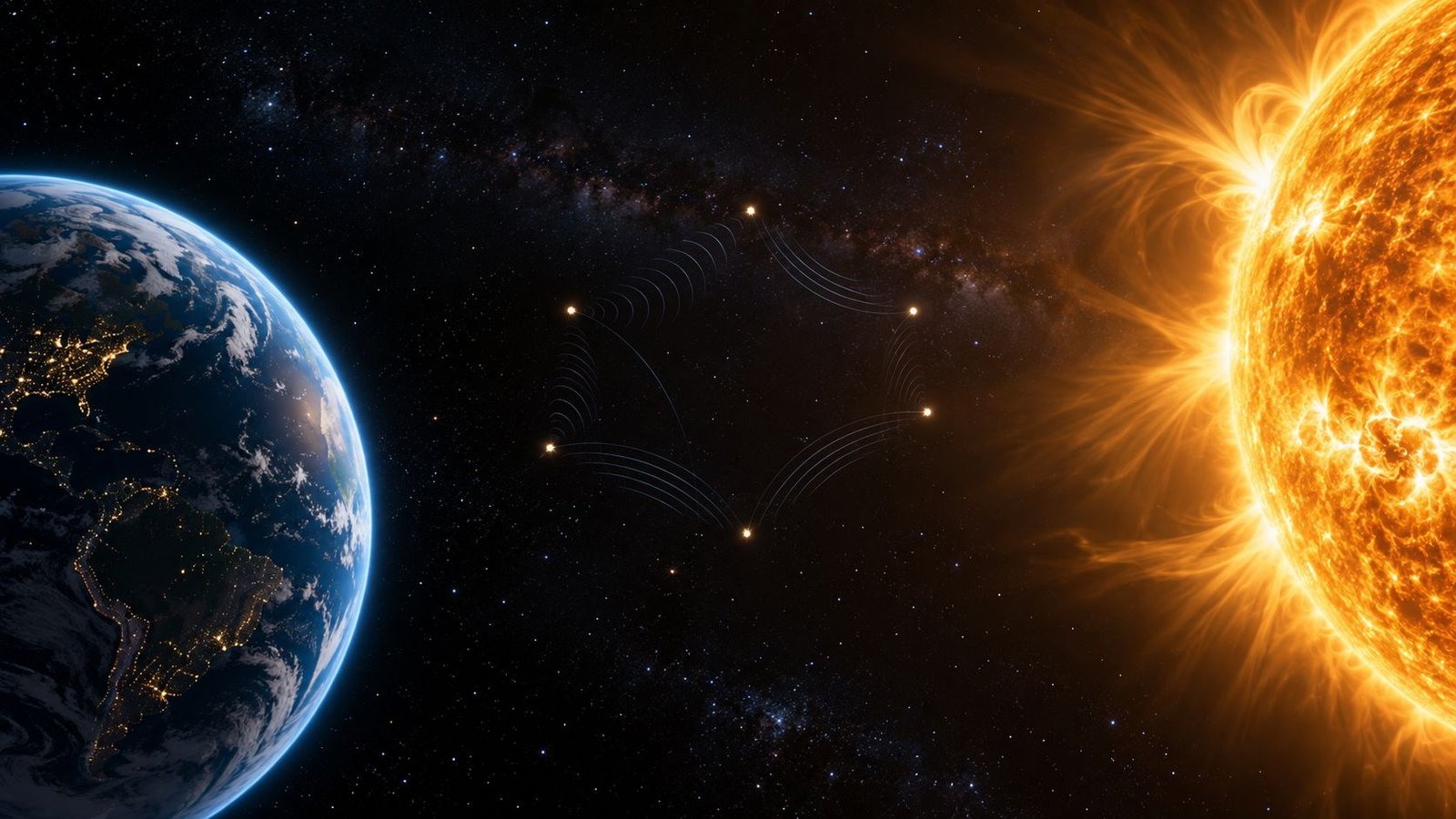
NASA has set a new window for SunRISE: the mission will not take off before mid-2027. Its principle is more of a network than a traditional telescope. Six small satellites, each the size of a toaster oven, will fly in formation and combine their measurements to behave like a single giant radio antenna. Its objective will be to locate the radio bursts produced in the solar corona, where events capable of accelerating dangerous particles for astronauts and satellites are also formed.
SunRISE will travel as a secondary passenger on a SpaceX Falcon Heavy rocket, which will launch from the Kennedy Space Center in Florida. The primary flight is sponsored by the US Space Force Space Systems Command. This timing precision constitutes the new element announced by the Jet Propulsion Laboratory.

Six separate devices to build a virtual antenna
The full name, Solar Radio Interferometer Space Experiment, describes the method. In interferometry, several receivers observe the same signal and their data are recombined. The instrument then obtains a resolution comparable to that of an antenna whose diameter corresponds to the maximum distance between the receivers. The six SunRISEs must fly approximately ten kilometers apart: this deployment will therefore form a virtual radio telescope that is impossible to launch in a single unit.
Each small satellite will deploy four antennas of approximately 2.5 meters. The formation will evolve slightly over time, giving scientists different perspectives on the source of an emission. The signals will then be transmitted to NASA’s long-range communications network and combined on the ground. The mission will not create a classic photograph of the Sun; will reconstruct the position and progression of the radio emissions from their differences in arrival at each receiver.
The constellation should be located a little above the geosynchronous orbit, at about 35,000 kilometers altitude. This position is essential. Part of the long wavelengths sought are blocked by the Earth’s ionosphere, which limits radio telescopes installed on Earth. By observing from space, SunRISE will access a band of the spectrum that our atmosphere makes very difficult to study from the surface.
Better understand space weather alerts
Solar flares and coronal mass ejections can accelerate particles to very high energies. They are likely to damage spacecraft electronics, degrade communications, and increase the radiation dose received by crews beyond the protection offered by Earth’s atmosphere. The associated radio bursts may appear before the particles arrive at Earth.
SunRISE should help researchers understand where and how this acceleration occurs. The mission will be able to compare its radio maps with observations from other machines, in particular the Parker solar probe, when it passes through regions close to the Sun. However, the constellation should not be presented as a new operational warning system ready to immediately protect power grids. Its main objective is scientific: to improve physical models that can, in the long term, strengthen forecasts.
What is at stake is very real. We have already explained how a solar storm can alter GPS. A recent study also recalled that the Sun can produce superflares, although their frequency and exact effects remain difficult to quantify.
A compact but technically demanding mission
Using six small satellites reduces the mass of a monolithic telescope, but shifts the difficulty to formation flying, clock synchronization, and data processing. Measurements are only valuable if the relative position of each device and the time of acquisition are precisely known. The mission must also operate far from the usual low orbits of many CubeSats, in a more severe radiation environment.


