

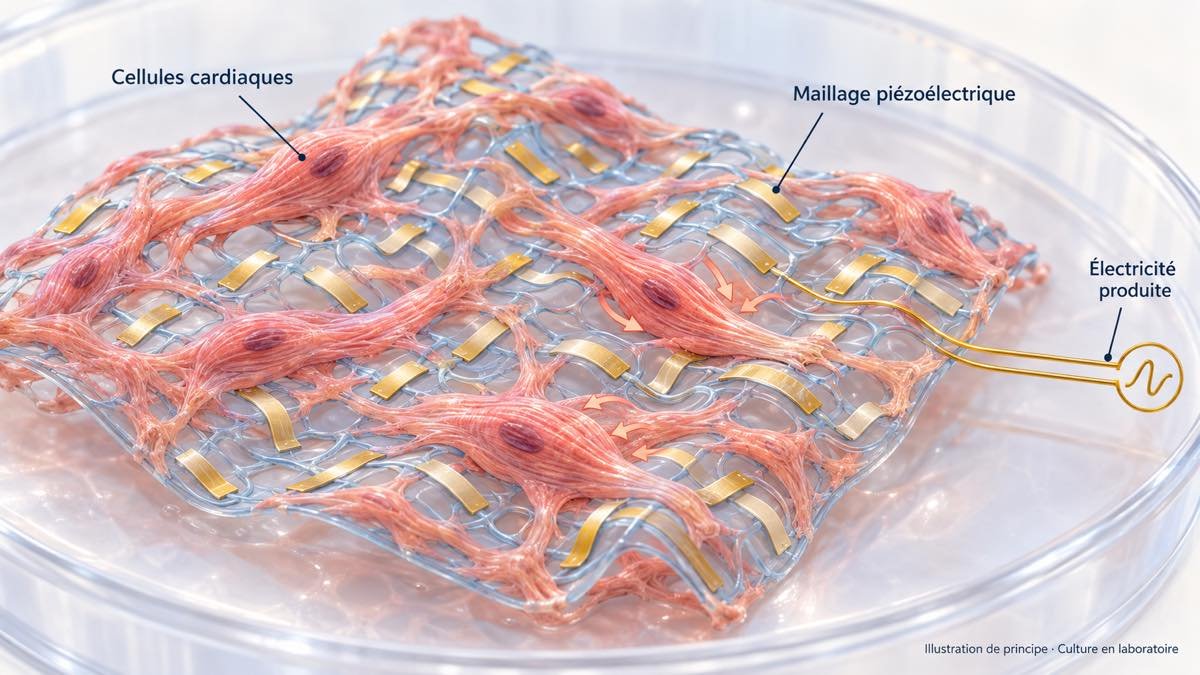
Engineers at the University of Massachusetts Amherst have integrated human heart cells into a flexible electronic mesh capable of converting their contractions into electricity. This biohybrid device, tested only in a laboratory, produces continuous, distributed energy that could one day reduce the dependence on batteries in some sensors or body implants.

A generator that grows with cells
The heart of the system is a flexible, ultra-thin polymer platform carrying small ribbons of PZT, a piezoelectric material based on lead zirconate titanate. A piezoelectric material produces a voltage when it is deformed. The researchers then grew human heart cells in this framework; As they developed, they were inserted around the mesh and its active elements.
When the cells contract, their movement distorts the ribbons. The mechanical energy is then converted into electrical current. The novelty, therefore, does not reside in the existence of cells that pulse in culture or in that of a flexible sensor, but in its integration in a material that mechanically resembles a tissue while guaranteeing the generating function.
The team presents this architecture as distributed energy. A battery provides power from a central block, while the new mesh collects it at numerous points, as close to the cells as possible. In the peer-reviewed study published October 7 in Scientific advancesthe device reaches a power density ten times greater to that of the centralized systems used as reference by the authors.
Stackable diapers, but not an implant yet
The support is thin enough to be able to overlap several films. This stacking increases the available power without immediately creating the rigid volume of a conventional battery. In the long term, this principle could power sensors that track tissue activity, highly flexible wearable devices, or small implantable electronic functions.
This perspective addresses a real problem. Pacemakers, implantable defibrillators, cochlear implants, and brain stimulators require a power source. Batteries take up space, eventually run out, and may need to be replaced. A generator that takes advantage of the natural movements of a tissue would be especially interesting for devices whose consumption is low and intermittent.
But the prototype was not implanted in any animal or human. It combines human cells grown in vitro with an experimental mesh. The team still needs to demonstrate stability over time, the amount of energy actually usable by a complete circuit, resistance to repeated cycling, and compatibility with a complex biological environment.
The choice of PZT also raises a question of materials. Its piezoelectric operation is well known, but it contains lead. A future medical application will need to prevent tissue exposure, validate encapsulation, and meet much stricter safety requirements than a laboratory experiment.
Harvest energy without altering the tissue.
The project is part of a series of research at UMass Amherst on the interfaces between cells and electronics. The same team has already developed a mesh capable of growing with the heart tissue and simultaneously measuring its electrical signals and movements. The new version adds energy harvesting to this soft integration logic.
This proximity could limit the mechanical limitations imposed on the cells. A thick or rigid device does not deform like living tissue and can trigger a rejection response. A flexible film that follows contractions distributes the stresses over a larger surface area, although this hypothesis will have to be evaluated in long biological studies.
KultureGeek recently introduced a robotic heart designed to replicate heart failure. The UMass mesh follows a different path: it does not simulate the organ, but rather directly transforms the activity of cardiac cells into an electrical source. To move from the demonstrator to the medical component, it will still be necessary to integrate the storage, regulation and control electronics and then measure the net energy available once all of these functions have been added.


