

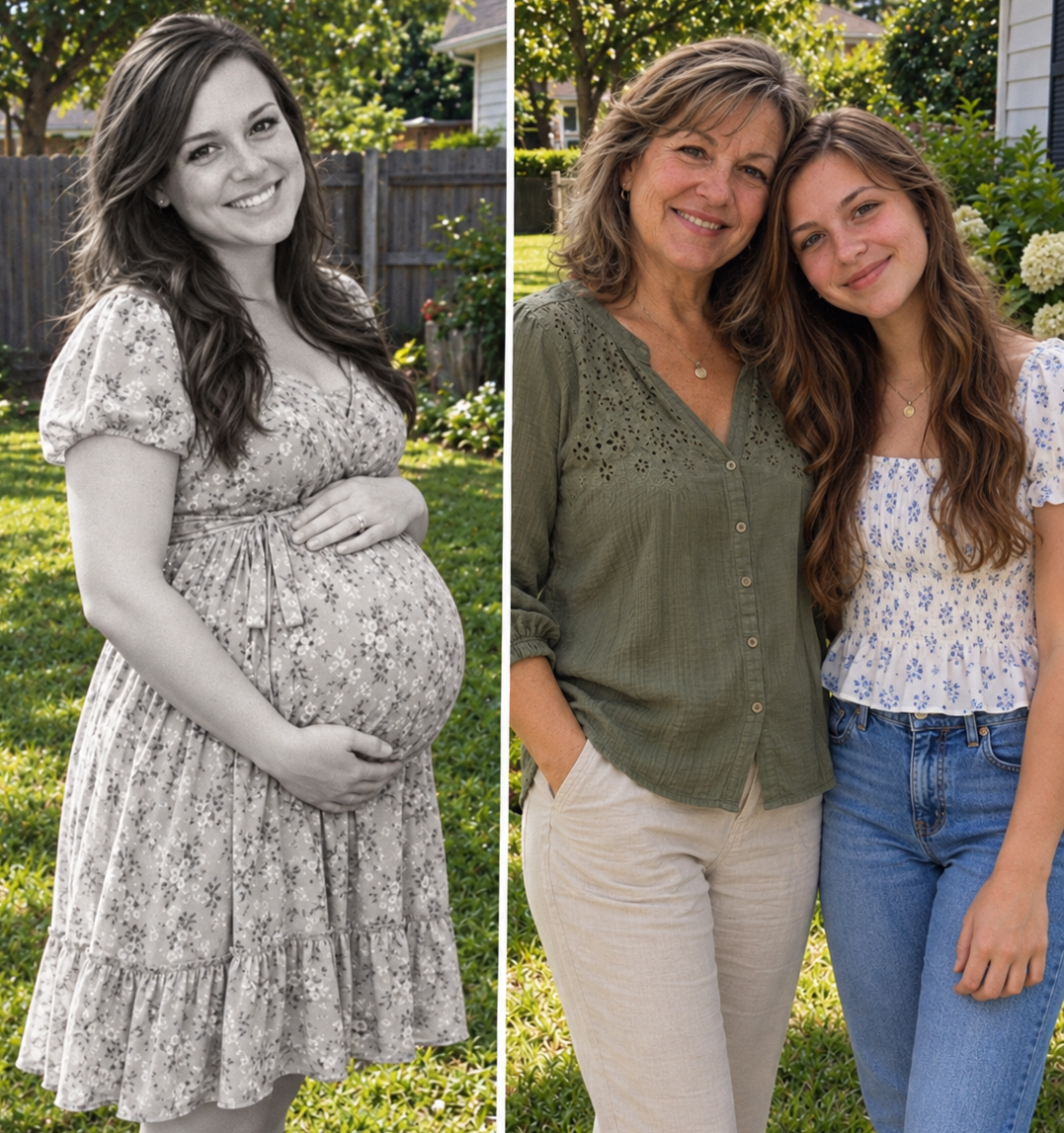
For fifteen years, a single white candle has stood beside my granddaughter’s birthday cake — one small flame for the mother she never met. Then, hours before Audrey’s fifteenth birthday party, I found a dusty box hidden behind a closet shelf, labeled in my late daughter’s handwriting. What Hannah left inside was meant for Audrey. But one line in it changed everything I thought that candle meant.
The White Candle
The candle was already out on the counter the afternoon I found the box.
Fifteen slender candles, pink and purple, filled a little glass bowl beside the cake stand. A short distance from them lay a single plain white one. It always lay a little apart. That was the point of it.
Audrey had been lighting it for her mother for as long as she could hold a match. At six, she needed my hand wrapped around hers to keep the flame steady. At nine, she shook me off and announced she was perfectly capable, thank you very much.
Last year, I forgot to buy matches. I didn’t realize it until the cake was already on the table, and before I could even apologize, Audrey was elbow-deep in the junk drawer. She came up with a crumpled matchbook from a restaurant that had closed years ago and held it up like a trophy.
“You can’t forget Mom’s candle, Gee Gee.”
I pulled her into a hug so tight she squirmed and complained I was ruining her hair. I remember thinking, She loves this as much as I do. I remember feeling almost proud — as if I’d managed to hand her a piece of Hannah that time couldn’t take away.
That morning, I had no reason to believe anything different.
Audrey was at school, where her friends had apparently decided that turning fifteen called for enough streamers on her locker to alarm the fire marshal. I’d taken the afternoon off with exactly one job left before the party: find the silver cake server.
I hadn’t seen it since her fourteenth birthday. After tearing through every drawer and cabinet in the kitchen, I climbed the stairs to Hannah’s old room.
I still called it that. Fifteen years, and I still called it that.
The room had slowly been claimed by the living. Audrey did homework at the desk sometimes. Winter coats crowded half the closet. Rolls of wrapping paper were shoved under the bed. But on the top shelf, Hannah’s things stayed exactly where she’d left them — her yearbooks, a threadbare stuffed rabbit, a little ceramic bowl still holding one mismatched earring. I dusted around them. I never moved them.
The Box Behind the Shelf
I knelt in front of the closet and checked the bottom shelf. No cake server. I shifted a stack of old magazines. Still nothing.
That was when I noticed the gap — a thin sliver of space between the back of the shelf and the wall. Something brown was wedged in there. I worked my fingers behind it and pulled out a small cardboard box, soft with age and furred with dust.
I assumed it was more photographs. There were boxes of them all over the house, ones I’d never been brave enough to sort through.
Then I turned it over and saw the lid, and my legs simply stopped holding me. I sat down hard on the carpet.
For Audrey.
It was Hannah’s handwriting. I would have known it anywhere — the tail of the y swooping too far beneath the rest of the word, the way it had on every birthday card and grocery list she ever wrote. Which could mean only one thing. She had tucked this box here herself, sometime before I drove her to the hospital. Before either of us knew.
I traced the letters with my thumb. The ink had faded to the color of weak tea. I couldn’t make myself lift the lid. For a long moment I just held it, the way you hold something that might still be warm.

The Promise in the Car
Fifteen years ago, I drove my twenty-four-year-old daughter to the hospital while she gripped the door handle and complained that every pothole in town had a personal grudge against pregnant women. She joked the whole way. That was Hannah — the more scared she was, the funnier she got.
Then, about ten minutes out, she went quiet.
“Mom?”
“Yeah, honey?”
“What if I’m terrible at this?”
I glanced over. One of her hands rested on the great round curve of her belly. The other was twisting the strap of her purse into a knot.
“You’re going to be a wonderful mother.”
“You have to say that.”
“No, I don’t.”
She turned to look at me, and at the next red light I reached across and squeezed her hand.
“And I’ll be right there. Whenever you need me. Always.”
I walked out of that hospital carrying that promise, and carrying her daughter. I did not walk out with Hannah.
Audrey’s father lasted barely a week. He stood in my kitchen with his car keys already in his hand.
“I can’t do this, Giselle. Every time I look at her, I see Hannah.”
“She’s your daughter,” I said. “She needs you.”
“I know,” he said. And then he left anyway.
So it was me. Me, and a newborn with her mother’s chin, and a silence in the house so big that some nights I talked to it.
“If I Don’t Get to Say This Myself”
I opened the box.
Inside lay a thick blue folder, a small white envelope, and a folded yellow handout from the childbirth class Hannah had taken in her last weeks. My name was written on it again and again.
Emergency contact.
Person authorized to make decisions if I am temporarily unable to.
Person I trust to care for my baby if something unexpected happens.
She had planned. She had sat in some fluorescent-lit classroom, one hand on her belly, and quietly written me into the worst-case scenario. That alone made my throat close.
But it wasn’t the forms that made my hands start to shake. It was the sheet of paper tucked behind them. Across the top, in Hannah’s hand:
If I don’t get to say this myself.
The air went out of me. “No,” I whispered. “No, Hannah. No, no, no…”
I knew how foolish it was. She wasn’t anywhere, waiting for my answer. There was nothing left to refuse. And still some wild part of me wanted to shove the page back into the box, jam it behind the shelf, and pretend this afternoon had never happened — because as long as I didn’t read it, there were still words from my daughter I hadn’t heard yet.
I unfolded it anyway.
The first line was darker than the rest, as if she’d gone back and traced over it, making sure.
If Audrey ever asks whether I died because of her, the answer is no.
The paper began to tremble. I read the sentence once. Then again. Then a third time, as if it might change. Below it, Hannah had kept writing:
Mom, if you’re reading this, something went really wrong, and I’m so sorry you’re the one left holding everything together. I know you. You’re going to turn yourself inside out making sure Audrey knows how much I loved her. But please — don’t ever tell her I gave my life for her. I’m not giving my life for anybody. I’m having my daughter because I want her here. If something happens to me, that is not a debt she owes me. Not ever.
I pressed my hand over my mouth.
For fifteen years, I had told Audrey that her mother loved her before she was born. That was true. I’d told her Hannah was brave. That was true, too. I’d told her Hannah would be proud of her, and I prayed that was true.
But there was one sentence I’d said more often than all the others. I’d said it so many times it had worn smooth in my mouth.
Your mom gave you life.
I said it the first time Audrey asked why her mother died. I said it when she came home from second grade in tears because every other girl had a mom at the Mother’s Day breakfast. I said it the night she asked, in a very small voice, whether Hannah had been scared.
I had always meant it as a gift — a way of saying you were worth everything. I had never once imagined how it might sound to the child on the receiving end. Like a bill. Like something she’d been handed at birth and could never pay back.
I looked toward the bedroom door. Downstairs, the white candle was lying beside the cake, waiting. My eyes dropped back to the page. There was more.
Also, Mom — because I know exactly what you’re like — one more thing. Do NOT turn that poor kid’s birthday into an annual memorial service for me.
Despite everything, a sound escaped me that was almost a laugh. That was Hannah. That was so completely Hannah that for one second she was in the room with me.
If you want to tell her about me, tell her I got kicked out of choir rehearsal for laughing. Tell her I hated tomatoes but would put ketchup on anything. Tell her I dated a guy for three whole months because I couldn’t figure out how to dump him without hurting his feelings — which was ridiculous, and yes, you were right. Tell her the fun stuff. And please, please let her birthday belong to her.
I didn’t go on to the next line. I stared at let her birthday belong to her until the letters stopped looking like words.

Strawberry Cake
Every year since Audrey turned one, we’d followed the same ritual. Before the birthday candles, I lit a single white one for Hannah. When Audrey was tiny, I’d say, “This one’s for Mommy,” and then tell a story. Sometimes two.
By ten, she was choosing them herself.
“Tell the one where Mom backed into Grandpa’s mailbox.”
“Tell the one where she turned all your towels pink.”
“Tell the one where she tried to make spaghetti and forgot the water.”
I had believed I was giving her something precious. A mother she could know through stories. A thread running from the day Hannah left to the little girl she left behind.
My phone buzzed against the carpet. Audrey.
Gee Gee can Mia and Zoe come at 5 instead of 6??
Then another.
And do NOT let them see my baby pictures. Mia has zero mercy.
I looked at the box. At Hannah’s page. Then I typed: 5 is fine. Baby pictures are negotiable.
Three dots appeared.
TRAITOR 😈
I smiled — and then, without any warning at all, I was crying so hard I had to set the phone face-down on the carpet.
Because Audrey was fifteen. Not a symbol. Not a tribute. Not the reason Hannah died. Not the bundle I’d carried out of that hospital while my own child stayed behind.
She was a girl who wanted loud friends and chocolate frosting and veto power over which embarrassing photos her grandmother dragged out at the party.
I wiped my face with the heel of my hand and thought about the cake waiting downstairs.
Strawberry. Hannah’s favorite. It had been strawberry every single year.
I went very still.
Audrey had never asked for strawberry cake. Not once. And I couldn’t remember a single time I had asked her what she wanted.
What Audrey Wished For
The front door banged downstairs.
“Gee Gee?”
I glanced at the clock. Early dismissal — teacher conferences. I’d completely forgotten.
“Up here!”
She thundered up the stairs, still wearing a lopsided silver paper crown someone had given her at school, and stopped short in the doorway.
“Why are you sitting on the floor?”
Then she saw the box, and all the teasing drained out of her voice.
“Is that Mom’s?”
I nodded.
She let her backpack slide off her shoulder. “What’s in it?”
I looked down at Hannah’s page. Nothing you need to worry about rose up in my throat — the same words I’d reached for every time something hurt too much to say out loud.
I swallowed them. I held out the page instead.
“Something your mom wrote for you, sweetheart.”
Audrey didn’t take it right away. “For me?”
“And for me,” I said.
She sat down beside me on the carpet, close enough that our knees touched, and I placed the page in her hands.
She read slowly. I watched her eyes stop on the line about the debt and stay there for a long time. Then she kept going. When she reached the part about her birthday, she looked up at me, just for a second.
Neither of us said anything. At last she folded the page back along its old crease and handed it to me.
“Gee Gee?”
“Yeah, Audie?”
She looked out toward the hallway. “Did you already buy the white candle?”
Somewhere downstairs, the refrigerator hummed.
“Yes.”
She nodded once and began picking at a bent silver point on her crown.
I waited. And then I asked the question I suddenly understood I should have asked years ago.
“Why didn’t you ever tell me?”
She looked up. “Tell you what?”
I didn’t answer. I didn’t need to.
Her fingers went still on the crown. “Oh.”
That one tiny word frightened me more than anything else she could have said.
“Audie…”
She pulled one knee up to her chest. “It’s not like I hate it.”
“The candle?”
She nodded. “I know why we do it.”
“But?”
She looked down at her mother’s handwriting lying between us.
“You cry before breakfast every year, Gee Gee. You try to hide it, but you do. And you always look at the clock.”
“I what?”
“On my birthday. Around lunchtime.”
I knew exactly which hour she meant. The hour Hannah died. I had never said it out loud — not once, not to anyone. And Audrey had noticed anyway. Of course she had. She’d spent her whole life watching me watch that clock.
“And then right before I blow out my candles, everybody goes quiet for Mom.”
“Audie, I never wanted you to think—”
“I know.” She looked at me quickly. “I know I didn’t do anything. I know it wasn’t my fault.”
She pressed the silver point of her crown flat with her thumb.
“But knowing that doesn’t make it feel any less weird.”
I had nothing. No answer, no story, nothing that could fix it. She looked toward the door again, and when she spoke, her voice had shrunk to almost nothing.
“How am I supposed to make a birthday wish on the day you lost your daughter?”
I stared at her.
All those birthdays. All those candles. All those years of watching her squeeze her eyes shut and thinking, There she goes — wishing for a puppy, or a phone, or some boy from math class.
“What did you wish for?” I asked.
She was quiet for a moment. “Mostly?”
Then she looked straight at me.
“I wished Mom hadn’t died.”
And in that moment, I understood. Hannah’s box had been hidden behind a shelf for fifteen years. But Audrey’s secret had never been hidden at all. It had been sitting right in front of me every single birthday, beside one plain white candle — and I had been too busy grieving to see it.

A Birthday That Belongs to Her
I reached for her hand.
“What do you want tonight, Audie? What do you really want?”
She glanced toward the stairs. “I don’t want to throw Mom’s candle away.”
“We don’t have to.”
“Could we light it on her birthday instead?”
I waited, sensing there was more.
“And maybe you could tell me stories then. Not hospital stories. Just… Mom.”
I squeezed her fingers. “Oh, honey. I have so many.”
She smiled — really smiled — for the first time since she’d walked in.
“And, Gee Gee?”
“Yeah?”
“I hate strawberry cake.”
I stared at her. “You’ve eaten strawberry cake every year of your life.”
“I thought it was important!”
I laughed so hard I had to wipe my eyes all over again.
“So what cake do you actually like?”
“Chocolate.”
“Your mother hated chocolate cake.”
Audrey just looked at me. For a split second I felt the old reflex — to soften it, to meet her halfway, to suggest vanilla.
Instead, I got to my feet.
“Well. Good thing it isn’t her birthday.”
That evening, fifteen bright candles crowded the top of a chocolate cake that Mia had helped me rush out to pick up. Everyone pressed in around the table.
Out of pure habit, my hand drifted toward the counter for the white candle. My fingers touched it. I stopped.
“Audie?”
She looked at the candle for a long moment.
“Not tonight.”
I nodded. She picked it up herself and set it gently beside Hannah’s box, which I’d carried downstairs and placed on the sideboard.
“We’ll need it for Mom’s birthday.”
Then her friends launched into a loud, gloriously off-key “Happy Birthday.” Nobody paused for a story. Nobody glanced at the clock. Audrey closed her eyes, fifteen little flames flickering gold across her face, and she blew.
Every one of them went out.
The white candle lay unlit beside Hannah’s box, waiting for its own day. And for the first time in fifteen years, I didn’t ask my granddaughter what she had wished for.
I didn’t need to. Whatever it was, it finally belonged to her.
Note: This story is a work of fiction inspired by real events. Names, characters, and details have been altered. Any resemblance is coincidental. The author and publisher disclaim accuracy, liability, and responsibility for interpretations or reliance. All images are for illustration purposes only.


