

Part 1: The Engine Was Still Ticking
“My dad didn’t choose you by accident. And it wasn’t for my sake.”
Georgia said it with her hand still on the door handle of my uncle’s Buick. The passenger door was cracked open just wide enough to let in the thump of bass from the gym.
I had the keys halfway out of the ignition. I left them there.
“What does that mean?”
She looked across the parking lot at the doors of Kettering Ridge High, where a line of girls in sequins waited to get their tickets scanned. Then she looked back at me, and for the first time all night, she didn’t look bored.
“Brent, my dad’s been watching you for months.”
My stomach did the thing it does when a customer calls the warehouse before seven in the morning.
“Watching me do what?”
“How you handle problems. How you treat people. Whether you lose your temper.”
I felt sweat start under the collar of the only dress shirt I owned. “Wait. Did I do something wrong? You’d tell me if I messed something up, right? Is this about the Dumont order?”
“No,” she said. “That’s the problem. You didn’t do anything wrong.”
Before I could figure out how that counted as a problem, her phone buzzed inside her beaded clutch. She glanced at the screen and groaned like someone had handed her a pop quiz. “It’s Dad.”
She turned the phone so I could read it.
“Remember our agreement. Don’t make things too easy for him.”
I read it twice. Then a third time, because the words didn’t get any less strange.
To understand why I was sitting in a borrowed car staring at that message, you have to know how I ended up working for her father in the first place.
I was nineteen when I started at Pruitt Supply, a squat brick warehouse off Wilmington Pike in Dayton. It sells to-go containers, deli paper, degreaser and floor cleaner to about two hundred restaurants and grocery stores across southwest Ohio. Sheldon Pruitt hired me on a Tuesday after a twelve-minute interview, and I started the next morning at fifteen dollars an hour.
I needed that job more than he could have known. My mom, Denise, works the front desk at a dental office and has raised my little sister, Janelle, by herself since Janelle was four. Janelle is fourteen now and goes through sneakers the way other people go through paper towels.
So every other Friday I cashed my check and handed Mom an envelope. It covered groceries, the gas bill, and whatever Janelle’s school was asking for that month, whether a calculator, a field trip or a band T-shirt. I kept a little for gas and a little for nothing in particular.
I was never late. I didn’t call out unless I had a fever I could prove. When Sheldon asked if I could stay an extra hour, I usually stayed two.
By the end of my first year, I was the one running deliveries when a driver quit, counting pallets during inventory and locking the building at night. He’d bumped me to $17.50 an hour. I honestly thought that was the whole reward.
Sheldon was a good boss with one strange habit. He asked questions, and not small talk. He tossed out hypotheticals while signing invoices or eating a turkey sandwich over his keyboard.
“What would you do if a customer refused to pay an invoice?”
“What if two people wanted the same Saturday off and both had a good reason?”
“What if a supplier dropped off the wrong order at four-thirty on a Friday?”
I’d answer, and he’d nod slowly, the way my old chemistry teacher nodded when you got partial credit. I figured he just loved the business. Some guys talk about fantasy football; Sheldon talked about late invoices.
I never once asked him why. I think about that now. I was too busy being grateful to be curious.
Then, one Friday afternoon in May, he leaned out of his office and said my name in a voice I’d never heard him use. It was careful, almost polite.
“Brent. Got a minute? I need a favor.”
He shut the door behind me, which he never did. He sat down, stood back up, and moved his stapler three inches to the left.
“My daughter’s prom is tomorrow,” he said.
I knew who Georgia was. She was eighteen, a senior, and she’d come by the warehouse maybe four times, once to drop off a birthday cake for Linda in accounting. We’d said hi. That was the whole relationship.
“The boy she was supposed to go with backed out,” Sheldon said. “I want you to take her.”
I laughed, because I thought he was joking. He didn’t laugh.
“Me?”
“You’re responsible. I trust you.” He tapped the desk once. “Do this for me, and I’ll make it worth your while.”
I should have asked what that meant. Instead, I thought about our washing machine, which had died three weeks earlier with a sound like a bowling ball falling down the stairs. I thought about Mom hauling our laundry to the laundromat on Far Hills every Sunday with $11.75 in quarters, and about Janelle’s left sneaker, split along the side and patched with duct tape she’d tried to color black with a Sharpie.
“Okay,” I said.
Sheldon let out a breath like he’d been holding it since lunch. He shook my hand with both of his.
He looked relieved. Almost too relieved.
Twenty-six hours later, I was in a parking lot with his text glowing on his daughter’s phone. Georgia was looking at me like she felt a little sorry for me.
“Georgia,” I said slowly, “what exactly did I agree to?”
She sighed and finally let go of the door handle. “Something my father thinks is brilliant.”
Part 2: A Buick With Personality
The evening had started badly long before that parking lot.
At five-thirty, I’d picked up my uncle Frank’s 2009 Buick LaCrosse, along with a pair of his black dress shoes that were half a size too big. Frank walked me around the car like a flight instructor.
“Don’t touch the radio,” he said. “It changes stations by itself.”
“Why?”
“Because it has personality.”
He didn’t mention that it also squeaked every time I turned left, like a shopping cart with a bad wheel. I discovered that on my own, eleven times, on the way to Ridgeway Court.
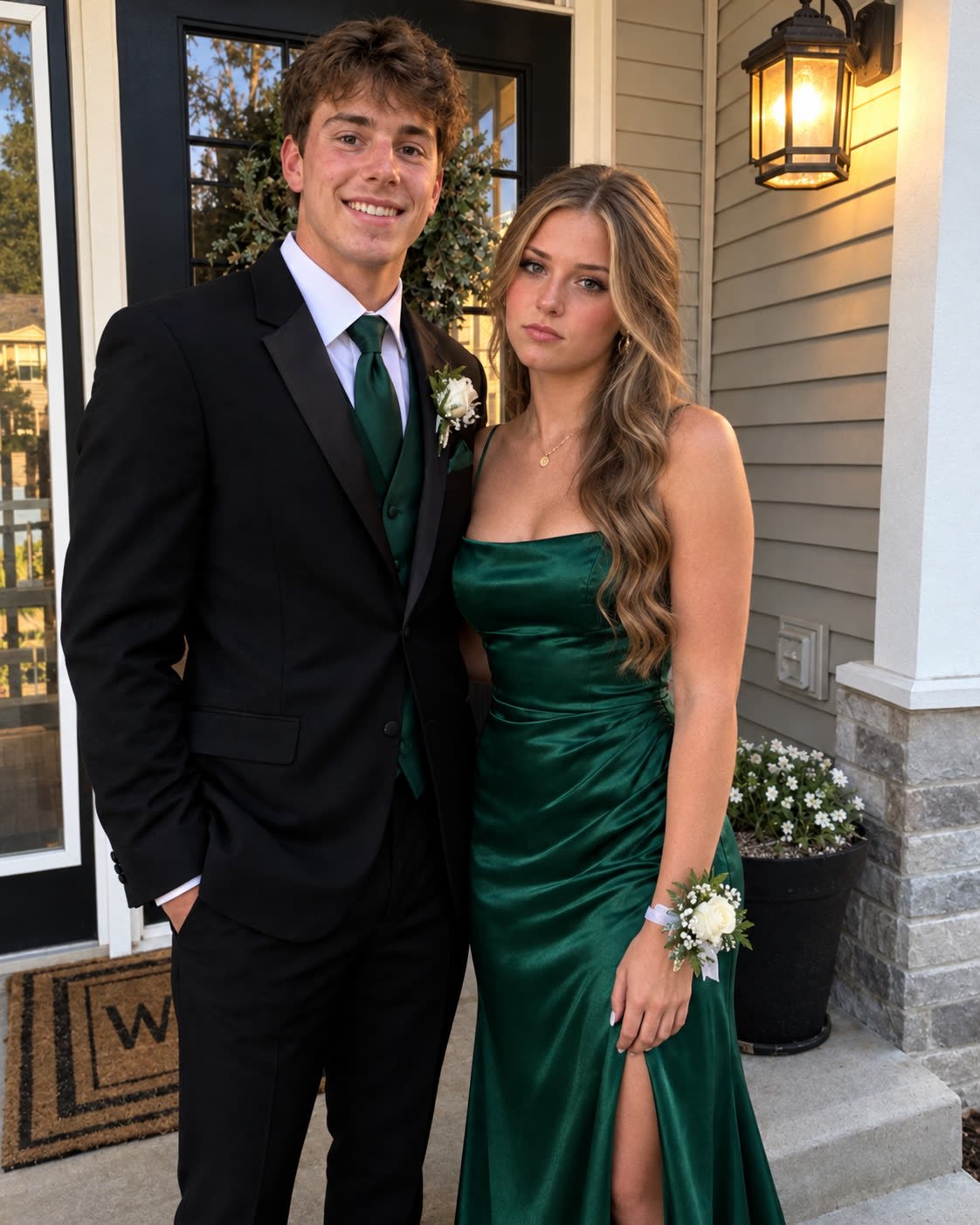
I pulled up to the Pruitts’ house at 6:25. It was a gray two-story with a black front door, a wreath, and a brass lantern already glowing beside the porch. I sat in the driveway for a full minute, practicing how to say hello like a normal person.
Sheldon opened the door before I could knock.
“Brent! You’re early!”
“Only by five minutes, sir.”
“Excellent.” He reached out and straightened my tie without asking, then straightened it again in the other direction. He was wearing khakis and a quarter-zip, and somehow he seemed more nervous than his daughter.
“Just make sure Georgia has a good night.”
“I will.”
He lowered his voice. “And if anything unexpected happens, stay calm.”
I frowned. “What kind of unexpected thing?”
“Oh, nothing.” He waved his hand like he was clearing smoke. “Nothing at all.”
Right then, Georgia came down the stairs. She wore a long emerald dress, her hair loose over one shoulder, and she looked like she belonged in a magazine. She also looked at me for exactly one second, and her smile disappeared like someone had flipped a switch.
Sheldon already had his phone up. “Out on the porch! Stand closer!”
We moved closer.
“Smile!”
I smiled. Georgia did something with her mouth that wasn’t technically a frown. She stood next to me under that lantern looking like she’d been sentenced to three hours of accounting.
The drive to Kettering Ridge took fourteen minutes and felt like forty. I asked about her friends, and she said they were fine. I asked what music she liked, and she said, “Stuff.”
Somewhere around Stroop Road, the radio switched by itself from a classic rock station to a man explaining crop insurance. Georgia stared out the window like the crop insurance man was better company.
Eventually, I stopped trying.
So when we parked and I said, “Well, I hope tonight won’t be too terrible,” I meant it as a polite way of surrendering. Instead, she grabbed the door handle, said “Wait,” and told me her father hadn’t chosen me by accident.
Now I stared at her phone again, at that message about not making things too easy.
“Don’t make things too easy for him?” I read out loud.
Georgia nodded. “My dad wants me to make tonight difficult.”
“Why?”
“To see how you react.”
I blinked. “What?”
“He suggested I complain about everything. Make unreasonable requests. See whether you lose your patience.”
I looked at the gym doors, then down at Frank’s shoes. “So I’m wearing borrowed shoes and driving a car that sounds like a grocery cart because your father wants to test my patience?”
Georgia burst out laughing. It was the first real sound she’d made all night. “Pretty much.”
“Does he know there are easier ways to annoy me? He could just ask me to reorganize the warehouse again.”
“Brent!”
“I’m serious. Aisle four took me a whole weekend.”
She laughed harder, and then the laugh faded. She turned the phone face-down on the dashboard.
“I told him I wouldn’t do it. It wasn’t fair to you.”
“Then why the silent treatment on the way here?”
Her cheeks went pink. “Because I didn’t know how to tell you. And because my dad was watching from the front window, and I’m a coward.”
“Then why are we here at all?”
“Because I still wanted to go to my prom,” she said. “And I figured you deserved to know what he was planning.”
“Planning for what?”
She hesitated. “That’s the part I can’t explain yet.”
“Why not?”
“Because I want you to hear it from him.”
I groaned and leaned my head back against the seat. “Georgia, you’re making this sound like I’m about to inherit a castle.”
She smiled and pushed the door open. “No castle. But you might be surprised.”
Inside, the gym was buried in silver balloons and string lights, and the basketball hoops were wrapped in white tulle. Georgia steered me toward a girl in a gold dress who was already halfway through a cupcake.
“This is Madison,” Georgia said. “My best friend.”
Madison looked me up and down and grinned like she’d been waiting all week. “So you’re Brent.”
I looked at Georgia. Georgia rolled her eyes.
“Madison knows about Dad’s little experiment.”
“Wonderful,” I said. “Does the DJ know too?”
“Not yet!” Madison said brightly.
We found our table, number nine, near the bleachers. For thirty minutes things were almost normal. Then Georgia stood up, turned to me, and held out her purse.
“Hold this.”
I took it. She handed me her phone. “And this.”
Then she handed me her cup of punch and looked straight at me without a hint of a smile.
“Is this the test?”

Part 3: North or West
“No,” Georgia said. “I’m tying my shoe.”
She bent down, fixed the strap on her heel, and stood back up laughing so hard she had to grab the back of a chair.
“You’re going to question everything I do tonight, aren’t you?”
“Your father has destroyed my ability to recognize normal behavior.”
That turned into a game. For the next hour, Georgia pretended to be the nightmare date her father had ordered, and she was clearly enjoying herself.
She asked if I could get the DJ to play a song that didn’t exist. She tasted the punch and announced it was two degrees too warm. Then, with a perfectly straight face, she requested a chair facing exactly northwest.
I looked at the gym, the bleachers and the emergency exit sign. “Georgia, I can offer north or west. The budget doesn’t cover both.”
Madison laughed so hard she dropped half her cupcake on the tablecloth.
Somewhere in there, my shoulders came down from around my ears. For the first time all evening, I relaxed.
That was when a woman in a navy cardigan with a chaperone lanyard stopped at our table.
“Brent?”
I stood up fast enough to bump the table. “Yes, ma’am?”
“I’m Evelyn, Georgia’s aunt. I’m chaperoning tonight.” She shook my hand firmly. “So you’re the young man Sheldon keeps talking about.”
I glanced at Georgia. “Hopefully nothing terrible.”
Evelyn smiled. “He says you’re excellent under pressure.”
I frowned. “Does everyone in your family discuss my job performance?”
Georgia covered her face with both hands. “Aunt Evelyn!”
Evelyn just laughed and moved on to scold a boy standing on a folding chair. I sat back down, but her words stuck with me like a splinter. Keeps talking about. Excellent under pressure.
Around nine, Georgia and I stepped out the side door for some air. The parking lot smelled like cut grass and somebody’s cologne. I’d been patient all night, and I was done being patient.
“Okay,” I said. “Enough games.”
She leaned against the brick wall. “What?”
“Your dad asks me strange questions at work. He asks you to torture me at prom. Your aunt apparently knows my entire employment history. What is going on?”
It came out sharper than I meant. Georgia didn’t flinch, but she didn’t joke either.
“He’s been thinking about something important,” she said quietly.
“Yes, and?”
“Something involving the company.”
My stomach dropped. “Is he selling it?”
“No.”
“Am I getting fired?”
“No. Calm down. It’s definitely not that.”
“Then what, Georgia?”
She bit her lip. “You’ll know soon. I promise.”
I shook my head. “Your family is exhausting.”
“Imagine growing up with them,” she said, and she sounded like she meant it more than she was letting on.
Before I could ask what that meant, Madison stuck her head out the door. “Georgia! Group pictures! Now!”
Georgia grabbed my arm. “Come on.”
On the way back in, I noticed she hadn’t let go. Whatever her father was planning, she had chosen her side, and it was mine. That made me feel better, but only a little.
The photographer had us line up beneath a balloon arch. “Couples together!”
Georgia stepped beside me. “Put your arm around me,” she whispered.
I hesitated. “Another test?”
“Brent. It’s a picture.”
“Right. Sorry.”
The flash went off. Three seconds later, my phone buzzed in my jacket pocket.
It was Sheldon: “Everything going smoothly?”
I showed Georgia. She grinned. “Tell him I’m being difficult.”
So I typed, “Georgia has requested a chair facing northwest. Negotiations are ongoing.”
He replied immediately. “Interesting. How are you handling it?”
“I’ve offered her a north-facing chair and a complimentary napkin.”
Three dots appeared, disappeared, and appeared again. Then: “Good thinking.”
I stared at the screen. “Your father needs a vacation.”
Georgia plucked the phone out of my hand. “I’ve got an idea.” She typed fast, biting her tongue in concentration, and handed it back.
“Georgia has also requested that I obtain the moon. Please advise.”
I laughed out loud. Behind us, the photographer said, “Sir, I need you to stop moving.”
My boss didn’t answer for two full minutes. I watched the screen the whole time. Then, finally: “Um. Well. Use your judgment.”
I laughed so hard the photographer had to take the picture three more times.
After that, the night just became a night. We danced badly, ate too many cupcakes, and watched Madison talk the DJ into playing an old disco song nobody under fifty should have known. Georgia taught me a dance move that made me look like I was fighting off invisible bees, and she laughed every time I tried it.
At eleven-thirty, we walked back to the Buick. She was still laughing, carrying her shoes in one hand.
“Okay,” I said, unlocking her door. “I’ve survived prom. Now can you tell me what’s happening?”
Georgia stopped smiling. She looked at the shoes in her hand, then up at me.
“There’s something Dad hasn’t announced at work.”
Part 4: The Moon Is Still Pending
I leaned against the car because I suddenly didn’t trust my legs. “Please don’t keep me in suspense, Georgia.”
“He’s opening another location.”
I blinked. “Another warehouse?”
“Up in Springfield. He signed the lease in March.” She took a breath. “And he needs someone to manage it.”
“Okay,” I said slowly.
“He’s been watching a few people. But you’re the one he keeps coming back to.”
For a second, the only sound was a car alarm chirping across the lot.
“Me?” I finally squeaked.
“Yes, you.”
“I’ve been there one year! I still call my mom when I don’t know how long to cook chicken!”
Georgia laughed. “That doesn’t mean you’re bad at your job.”
“Why didn’t he just tell me?”
“Because he’s convinced you’re too young to see what he sees.”
I thought about every question Sheldon had ever asked me over a turkey sandwich: the customer who wouldn’t pay, the two people who wanted the same Saturday, the wrong order at four-thirty on a Friday.
“Those questions,” I said. “Those were tests?”
“Some of them. He wanted to know how you think.”
“And tonight?”
She sighed. “He thought an awkward night with somebody making unreasonable demands would show whether you could stay calm.”
“Your father turned prom into a management interview?”
“That was the plan.”
“That’s ridiculous!”
“I told him!” she said, throwing up her free hand. “I told him at dinner, at breakfast and in the car to get my nails done!”
Then something clicked. “Wait. What happened to your actual date?”
Georgia smiled a little guiltily. “Oliver’s my friend. We were going together as friends. Then Dad came up with this, so he asked if Oliver would mind going with his friends instead. Oliver said yes, because Oliver says yes to everything.”
“So he didn’t back out.”
“No. Dad just liked that explanation better.”
I rubbed my face with both hands. “Everybody knew except me.”
“Pretty much.” She pulled out her phone. “For the record, I already told him what I think.”
She showed me the message, sent at 10:52.
“Brent failed your test. He let me eat three cupcakes, couldn’t obtain the moon, and danced like a washing machine with a loose wheel. We had a great time. Stop treating people like experiments.”
I laughed so hard I had to sit down on the Buick’s bumper. Then the phone buzzed in her hand, and we both looked at Sheldon’s reply.
“Understood. We need to talk.”
I stopped laughing. I drove her home with both hands on the wheel, and the car squeaked on every left turn.
On Monday morning, Sheldon called me into his office at 8:05 and shut the door. He didn’t move the stapler this time. He just looked tired.
“How was prom? We never really got to talk when you dropped Georgia off.”
“Educational.”
He winced. “She told you, didn’t she?”
“Yep. Everything.”
He covered his face with one hand. “I should’ve known she wouldn’t keep it to herself.”
I sat down across from him. “Sir, why didn’t you just ask me whether I wanted to apply?”
“Because I wasn’t sure you’d believe you were ready.”
“Honestly? I’m still not sure.”
“That’s what training’s for.”
He laid it out. The Springfield location would open in six months. I’d train with Marcus, our operations manager, on scheduling, inventory and supplier accounts. If I did well, I’d sit for a real interview, with no balloons and no punch.
Then he slid a sheet of paper across the desk with the salary range: $58,000 to $64,000.
I nearly fell out of my chair. I was making about thirty-six thousand. That number meant a washing machine, new sneakers that didn’t need tape, and an envelope for Mom that didn’t make her pretend she wasn’t counting it. It even meant a savings account with something in it.
But I didn’t say yes right away. For once, I didn’t just nod and say thank you.
“Sir, I appreciate this. I really do. But using Georgia’s prom to test me wasn’t fair. It wasn’t fair to me, and it definitely wasn’t fair to her.”
He was quiet for a long moment. “You’re right. I’m sorry. I’ve already apologized to Georgia. Twice.”
I didn’t tell him it was fine. I just nodded.
He rubbed the back of his neck. “There’s something I didn’t tell her. It wasn’t only about pressure. I wanted to see how you’d treat my most precious person. If you could handle her with kindness on a bad night, I figured you could handle anything.”
My throat went tight, and I had to look at the calendar on his wall for a second.
“It was an honor to take her, sir,” I said. “But if you want to know how I handle pressure, watch me at work.”
Sheldon smiled.
“I already have.”
He held out his hand. “No more surprise tests.”
I shook it. “Good. Because I still haven’t figured out how to get Georgia the moon.”
He laughed, a real laugh, the first one I’d heard from him in weeks.
Six months later, I finished training with Marcus, sat for the interview, and got the job.
Mom cried at the kitchen table when I told her. She cried with a dish towel pressed to her mouth, the way she does when she doesn’t want Janelle to see. Janelle saw anyway and immediately asked if we could finally replace the washing machine.
“Yes,” I said.
She threw both arms in the air. “BEST PROM EVER!”
Georgia and I stayed friends. She’s at Wright State now and texts me pictures of ugly campus statues. The day the Springfield warehouse opened, she showed up with a wrapped box under her arm.
Inside was a framed photo from prom. It’s me, mid-bee-fight, and Georgia doubled over laughing beside me under the balloon arch. Across the bottom, in silver marker, she’d written: “Employee of the Month: Survived One Prom, Three Cupcakes, and a Very Strange Boss.”
I hung it behind my desk, right where everyone who comes in for an interview can see it.
Here’s what that night taught me. Sometimes people see your potential before you do. But if you’re going to tell someone they deserve a promotion, a normal conversation works just fine.
You don’t need a school dance, a borrowed suit or a car with personality.
And you definitely don’t need the moon. Though Georgia reminds me every few months that technically, that request is still pending.
Have you ever had a boss who believed in you before you believed in yourself, and how did you find out?
Disclaimer: This story is a work of fiction inspired by real-life themes. Names, characters, places and events are fictionalized, and any resemblance to real persons is purely coincidental. Images are for illustration purposes only.


