

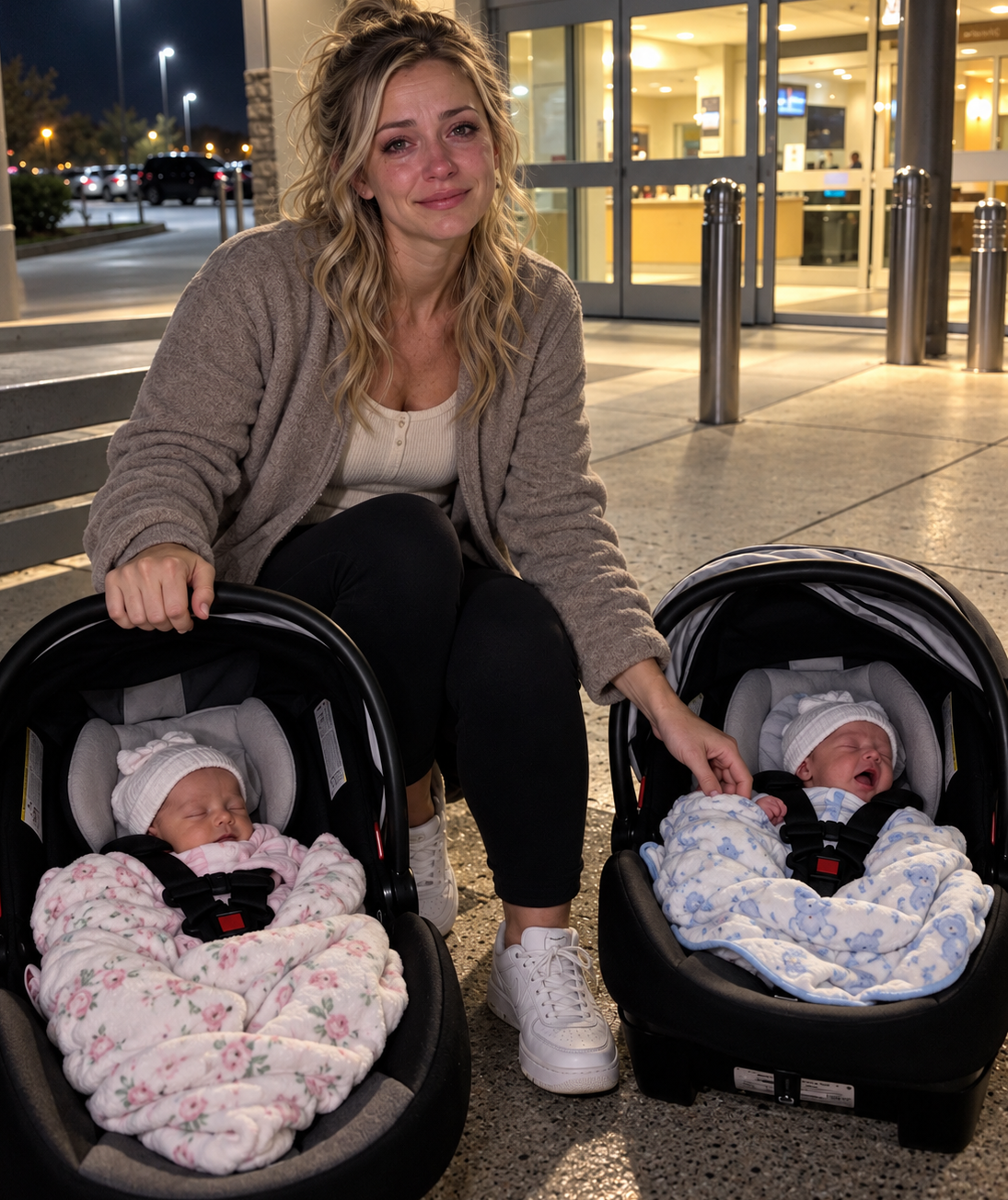
Part 1: Two Car Seats on the Curb
It was 2:07 in the morning, and I had just finished a twelve-hour shift in the emergency room when I saw her.
She was sitting on the bench outside the main entrance of St. Anne’s, under the one streetlight that actually worked. Two infant car seats sat at her feet. One baby was asleep. The other was screaming with the kind of fury only a very small person can produce.
The mother looked like she was about thirty seconds from joining him.
I should have kept walking. My feet hurt, my scrubs smelled like hand sanitizer and somebody else’s coffee, and my car was all the way at the far end of the employee lot.
Instead, I stopped.
“Are you waiting on a ride?”
She wiped her face with the back of her wrist. “No. I just don’t know how to get home.”
“I’m Daniel. I’m a nurse here.”
“Emily.”
I looked down at the car seats. “How old are they?”
“Six days.”
“Six days? They’ve barely finished unpacking.”
She gave me a small, tired smile. It was the kind of smile people give when they’ve forgotten they’re allowed to.
“We brought Oliver in because he wasn’t feeding right,” she said. “The doctor says he’s fine. But when we came out, my husband and I got into it.”
“Got into it how?”
“He left.” She said it flatly, like she was reading a weather report. “He drove off. My purse was in the car. My phone. The diaper bag.”
Something cold settled in my stomach.
“He left you here? With both of them?”
She nodded.
I’ve seen a lot of things in eleven years of emergency nursing. Overdoses, car wrecks, a man who glued his own hand to a fence post. But there was something about that bench—the two car seats, the empty space where a diaper bag should have been—that hit me harder than it should have.
I didn’t know it yet, but the man who had driven away that night was not a stranger to me at all.
Part 2: The Man Who Kept Extra Inhalers
I should explain a little about myself.
I’m thirty-eight. I live alone in a one-bedroom apartment in Rockford, Illinois, that has exactly one good window and a radiator that clanks like it’s trying to escape. I work nights because I like the quiet hours, and because nobody at 3 a.m. expects you to make small talk.
I keep two inhalers in my locker, one in my car, and one in my jacket. I’ve had asthma since I was nine, and it has a terrible sense of timing. It likes to show up whenever I’m angry, which is one reason I’ve spent most of my adult life trying very hard not to be.
My father was a shouter. Not a hitter—a shouter. He could fill a house with his voice until there was no air left for anyone else. My mother, Barbara, spent twenty-six years explaining him to people. “He’s just tired.” “Work’s been hard.” “He doesn’t mean it.”
He did mean it. He just never had to pay for it.
When he died, my younger brother and I had one last fight in Mom’s kitchen. He wanted to sell the house and split the money. I wanted Mom to have somewhere to live. We worked it out in the end without selling, but my brother never forgave me. He decided I had cheated him out of his future, and he stopped speaking to me.
That was ten years ago.
So, if you’d asked me what I wanted out of life back then, I would have said something simple. Quiet. A steady job. No yelling.
What I didn’t say—what I didn’t even admit to myself—was that every time I’d tried to stand up to my brother, I’d heard my father’s voice coming out of my own mouth. So I’d stopped trying.
Standing on that sidewalk at 2 a.m., I had no idea I was about to be asked to try again.
Part 3: A Phone, a Badge, and a Bad Haircut
“Is there someone I can call for you?” I asked.
“My sister, Sophie. She lives about twenty minutes from here.”
I handed her my phone. She dialed from memory. Her sister picked up on the second ring.
“Hello? Who is this?”
“Soph, it’s me.”
“Emily? It’s two in the morning. What’s wrong?”
“Nathan left me at the hospital. Can you come get us?”
There was a sharp breath on the other end. “He what? Are the babies okay?”
“They’re fine. Please, Sophie.”
“Honey, my car’s still in the shop. The transmission. They said Monday. Can you get a cab?”
Emily looked at the twins, then at her empty lap.
“I don’t have any money.”
She said goodbye and handed the phone back, pressing her lips together hard.
“I can drive you,” I said.
She hesitated, which I respected.
“I don’t even know you.”
“That’s fair.” I unclipped my hospital badge and held it out. “Daniel Mercer, RN. Also, there are about nine security cameras out here with excellent footage of my terrible haircut.”
For the first time, she actually laughed.
“Are you sure?”
“Completely.”
We buckled both car seats into my back seat. I checked each base twice—an occupational habit—and Emily squeezed in between them.
I pulled out of the lot thinking the hard part of the night was over.
I was wrong about that. But I wouldn’t find out for two more days.
Part 4: “He Says I Complain Too Much”
For the first few minutes, the car was quiet except for Oliver’s hiccupping cries, which slowly faded into sleep.
“I’m sorry,” Emily said.
“For what?”
“Making you do this.”
“You have two newborns. You’re allowed to be inconvenient for a while.”
She watched the dark storefronts go by.
“Nathan says I complain too much. About being tired. About needing help.”
“Does he help?”
“I asked him to take one night feeding. Just one. He said he’d already worked all day.”
“And keeping two humans alive doesn’t count as work?”
“Apparently not.” She paused. “He says money’s tight, too. His mom thinks we should manage on our own. That’s what he told me, anyway. So I’ve been trying to stretch the diapers.”
I didn’t think much of that at the time. Lots of families are stretched thin. I filed it away and kept driving.
“What happened tonight?”
“I told him I couldn’t do everything by myself anymore. He said if I needed so much help, I should go find somebody who appreciated my problems.” Her voice wobbled. “Then he drove off.”
“Emily, that’s not normal.”
“He’s just exhausted.”
I tightened my grip on the wheel. “My mom used to say that about my dad.”
She looked at me in the rearview mirror. “Was he like Nathan?”
“He yelled. She made excuses for him.”
“Did he ever change?”
“No.”
That was when my chest started to tighten. Not from the cold. From the old, familiar anger.
I pulled into a well-lit gas station and fumbled for the inhaler in my jacket.
“Are you okay?”
“Asthma,” I said between puffs. “My lungs like dramatic entrances.”
When I could breathe again, I drove two more blocks to a 24-hour Walgreens.
“Diapers?” I asked.
She hesitated. Then nodded. “And wipes. And formula, if they have the sensitive kind. That’s what Oliver takes.”
“Anything else?”
“Please don’t spend too much.”
“These two haven’t learned about budgets yet.”
The total came to $87.43. I folded the receipt and tucked it into my glovebox without thinking about it.
That small piece of paper would end up mattering more than anything I said that week.
Part 5: The Name on the Complaint
Sophie opened her front door in fuzzy slippers and a Bears sweatshirt.
“Oh, thank God.”
She wrapped Emily in a hug, then noticed the shopping bags in my hands.
“You bought all this?”
“Just the basics.”
“Let me pay you back.”
“Please don’t.”
Emily touched my sleeve before I left. “I’ll find a way to thank you properly.”
“Get some sleep. That’s thanks enough.”
Sophie and I traded numbers. I wrote mine on the back of a gas receipt. Then I drove home and slept until noon, sure I’d never see any of them again.
Two days later, my department chief called me into his office.
Richard Alvarez does not look worried. Ever. I once watched him calmly direct a three-car pileup intake while eating a granola bar.
That morning, he looked miserable.
“Close the door, Daniel.”
“Am I dying?”
“No.”
“Great. That narrows it down.”
He didn’t smile. He slid a sheet of paper across his desk.
“This came in through patient relations. It’s all because you helped that woman.”
“What woman?”
“The one with the twins.”
“Please tell me she didn’t complain about my driving.”
“She didn’t complain about anything. Her husband did.”
I started reading. Interference in a private marriage. Psychological pressure on a vulnerable postpartum patient. Encouraging a wife to leave her husband. At the bottom was a request that I be suspended pending investigation.
“You’re kidding me.”
“I wish I were. It still has to be reviewed.”
Then I saw the signature.
Nathan Mercer.
Same last name as mine. Same middle initial as our father.
I sat very still in that chair. Suddenly every piece of that night rearranged itself in my head. Nathan. The mother who supposedly wanted them to “manage on their own.” The husband who drove away and called it being tired.
The twins in my back seat were my nephews.
And my little brother had just tried to end my career for driving them somewhere safe.
Part 6: What My Mother Didn’t Know
“Am I suspended?” I asked Richard.
“Not based on anything I’ve seen. But you need to submit a written response by Friday.”
I walked out before my temper did something my lungs would regret. In the hallway, I leaned against the wall and used my inhaler. Then I got in my car and drove twenty minutes to my mother’s house.
Mom answered the door in her gardening gloves.
“Daniel! What a nice surprise!” She hugged me, then pulled back and looked at my face. “Something’s wrong.”
“Someone filed a formal complaint against me at work.”
“Oh, honey. Who?”
“Nathan.”
Her smile vanished. “Your brother? What on earth happened?”
So I told her. The bench. The two car seats. The missing diaper bag. The $87.43 at Walgreens.
Mom put her hand over her mouth.
“Nathan told me Emily refused to go home with him that night. He said he drove her to Sophie’s himself. He said he’d bought supplies and given her cash.”
“He drove away with her phone, Mom.”
I set the complaint on her kitchen table. She stared at the signature for a long time.
“I thought becoming a husband and a father would change him.”
“So did I. Though I only found out he was either one two nights ago.”
She pulled off her gloves slowly, one finger at a time.
“Your father used to do this, too. Hurt people, then make himself the victim.”
“I remember.”
“Daniel, please. Don’t let this tear the family apart again.”
“It’s already apart, Mom. I’m just the only one who’s noticed.”
She was quiet for a moment. Then she said something I didn’t expect.
“I invited Nathan and Emily for dinner on Saturday. With the babies. I wanted everybody at one table for once.”
“Does Nathan know you still see me?”
“He knows. He just won’t talk about you.”
Then she hesitated, twisting her wedding ring—a habit she’s had since I was a boy.
“There’s something else. I think you should know.”
What she told me next made me set my coffee cup down very carefully.
Since Emily found out she was pregnant, Mom had been sending Nathan $600 every month. Seven months now. More than four thousand dollars. It was meant for doctor’s visits, a crib, the double stroller, diapers. Nathan had thanked her every time.
“Mom,” I said. “Emily told me in the car that you think they should manage on their own.”
My mother went pale.
“I never said that. Not once.”
“Don’t tell Nathan we talked,” I said. “Not yet.”
“Why not?”
“Because if he knows it’s coming, he’ll have a new story ready by Saturday.”
“Daniel, what are you planning?”
“Nothing illegal. My nursing license has had enough excitement this week.”
Part 7: Saturday Dinner
The next morning, I called Sophie. We talked for almost an hour. That afternoon, she texted me:
Everything’s set. Spare room’s ready. See you Saturday.
I got to Mom’s early. She had made a roast chicken and enough mashed potatoes for a church picnic.
“Nathan’s going to push your buttons,” she warned.
“I know.”
“Please don’t fight with him.”
“Part of me wants to.”
“Daniel.”
“But Dad yelled until everybody gave up. I’m not doing that.”
She studied my face. “You’re nervous.”
“It’s the asthma.”
“Daniel.”
“Okay. Maybe a little nervous, too.”
The doorbell rang at 5:30. Nathan walked in carrying a bouquet of grocery-store tulips.
“Mom, you didn’t have to cook all this—”
Then he saw me, and the room changed temperature.
“What the hell is he doing here?”
“Visiting my mother,” I said. “I believe that’s still legal.”
“Absolutely not. I’m not eating with him.”
“Then you can go hungry,” Mom said. “It’s my house, Nathan.”
He stayed.
Twenty minutes later, Emily and Sophie arrived with the twins. Emily stopped short in the doorway when she saw me.
“Daniel?”
“Hi, Emily.”
Nathan looked back and forth between us, his jaw working.
“Well,” he muttered. “Isn’t this a lovely little reunion.”
Halfway through dinner, he leaned back in his chair. “Nobody understands how exhausting twins are. I barely sleep.”
Sophie raised an eyebrow. “You barely sleep?”
“I work hard, Sophie.”
“So does Emily.”
Mom set her fork down. “Nathan, you told me you drove Emily to Sophie’s after the hospital.”
“I did.”
“Then why did Daniel find her sitting outside at two in the morning?”
He shifted. “We had an argument. She refused to get in the car.”
“Without her phone or the diaper bag?” I asked.
“She was being dramatic.”
“You drove away with both,” Emily said quietly.
“I knew your sister would come get you.”
“My car was in the shop,” Sophie said. “You knew that, too.”
“Then why,” Mom asked, “did you tell me you’d taken care of everything?”
“Because I did! I bought supplies afterward.”
I reached into my jacket and set a small, folded piece of paper on the table.
“Funny. Because I’ve got the receipt for everything they needed that night. Walgreens on State Street. 2:46 a.m. $87.43.”
Nobody spoke.
“You’re twisting things,” Nathan said. “You’ve hated me for ten years.”
“I haven’t seen you for ten years. That’s not the same thing.”
Then I laid the complaint next to the receipt.
Mom pushed it toward him. “Explain this.”
“He interfered in my marriage.”
“I drove your sons somewhere safe.”
“You told Emily to leave me!”
“I told her to get some sleep.”
Emily stared at the paper. “You tried to get him fired? After he helped us?”
“I was protecting our marriage!”
“From diapers?” Sophie asked.
Nathan had no answer. He thought that was the worst of it. He actually picked his fork back up.
“Mom,” I said, “tell Emily what you told me. About the money.”
Part 8: Six Hundred Dollars a Month
Nathan’s fork stopped halfway to his mouth. “What money?”
Mom folded her hands on the table. “I’ve been sending Nathan six hundred dollars every month since you found out you were pregnant, Emily. For the appointments. For the crib. For the boys.”
Emily turned slowly toward her husband.
“You told me your mother refused to help us.”
“That’s not exactly what I said.”
“You said she thought we should figure it out ourselves! I’ve been cutting diapers in half at night, Nathan, because you said we couldn’t afford the big box.”
“Where did it go?” I asked.
“Some of it went to expenses.”
“Which expenses?”
“My expenses!”
Emily’s voice went very quiet. “The new golf clubs. The weekend in Lake Geneva with your friends.”
“I work hard! I deserve something, too!”
“And Emily doesn’t deserve diapers?” I asked.
Nathan slammed his palm on the table. One of the twins startled, and Sophie rocked his car seat with her foot without looking away.
“I don’t have to explain every dollar I spend!”
“You do,” Mom said, “when it’s my money. And when you’ve been lying to your wife about it.”
“From now on,” Mom went on, “I’ll help Emily and the boys directly.”
“You can’t cut me off.”
“I already have.”
Nathan turned to his wife, his face red. “Fine. Let’s see how you manage without me.”
Emily took a breath. “I’m not coming home, Nathan.”
“What?”
“She and the boys are staying with me,” Sophie said. “As long as they need.”
“Mom and I will help with expenses,” I added. “And with night feedings, if Emily wants. I’m used to being awake at three.”
Nathan glared at me. “You planned this behind my back.”
“Somebody had to think about your kids.”
“You turned everyone against me!”
“No, Nathan. You managed that all by yourself.”
He shoved his chair back. At the door, he turned around one last time.
“You know what? You sound exactly like Dad. Always telling everybody what to do.”
For ten years, that sentence would have stopped me cold. But I’d been thinking about it all week. And I finally understood the difference.
“No,” I said. “You’re the one who’s like Dad. You walk away from people when they need you, and then you blame them for noticing.”
He left. Nobody followed him.
Three days later, Richard called.
“Complaint’s been dismissed. No disciplinary action.”
“Does that mean we’re finally getting a new coffee machine?”
“Goodbye, Daniel.”
Emily and the boys are still at Sophie’s. Emily found a part-time job doing medical billing from home, and she’s meeting with a family lawyer next month. Mom drives over every Tuesday with groceries. I take the Thursday overnight shift—not at the hospital, but in Sophie’s spare room, with a bottle in each hand and Theo spitting up on my shoulder.
Nathan sent me fourteen angry texts the first week. I blocked his number. If he ever wants to be a father to those boys, the door will be there. But it won’t be my door he knocks on first. It’ll be Emily’s, and she’ll decide.
Last Thursday, around 3 a.m., Oliver finally fell asleep on my chest. Emily stood in the doorway with a cup of tea.
“I still owe you $87.43,” she whispered.
“You don’t owe me anything.”
“I know,” she said. “That’s why I want to pay it.”
For years, I was afraid that if I ever stood up to my brother, I’d turn into our father.
But standing up for someone isn’t the same as controlling them. Shouting until people give up isn’t the same as speaking up so they don’t have to.
It took two car seats on a hospital curb at 2 a.m. for me to learn the difference.
I keep the receipt in my glovebox now. Not because I need it.
Just so I don’t forget.
Would you have stopped for a stranger at 2 a.m.—even if it meant risking your job?


