

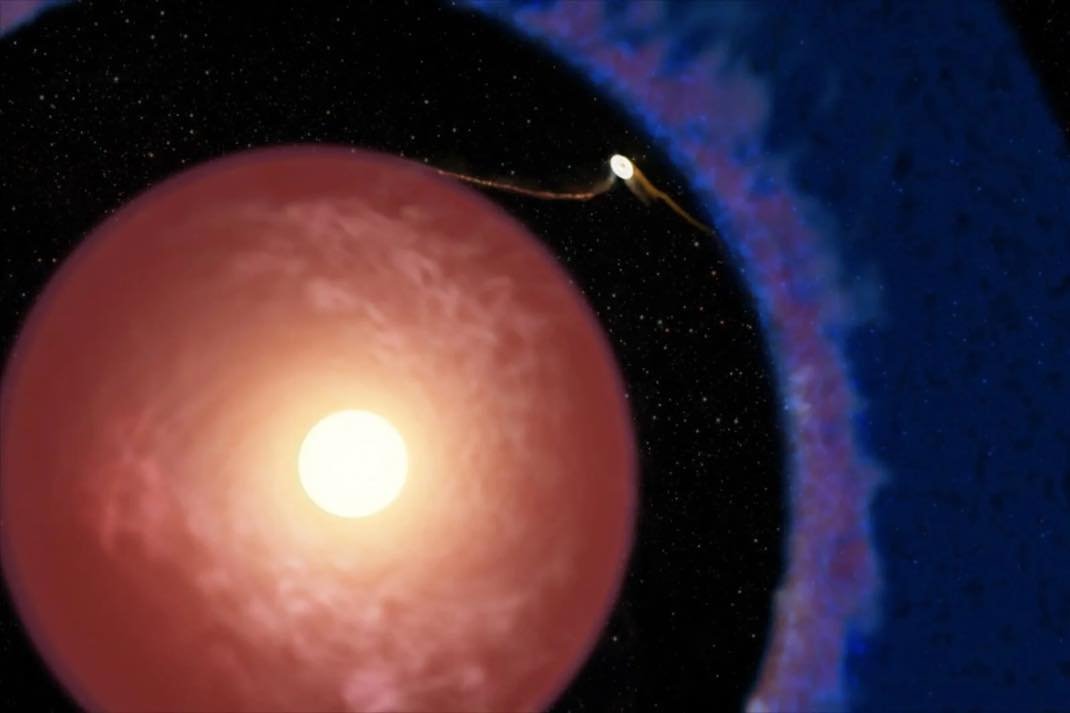
Astronomers have just identified a world that could revolutionize our understanding of the birth of giant planets. Baptized Elijah 2-24bThis exoplanet less than a million years old evolves around a star located 450 light years from Earth. Their discovery, detailed in The Astrophysical Journal Letters, sets a new juvenile record.
A giant planet appeared much faster than expected
Elias 2-24 b is about 55 astronomical units from its star, or eleven times the distance that separates Jupiter from the Sun. It already has a mass comparable to that of Jupiter, while it continues to accumulate gas and dust.

Elias 2-24 b is the youngest exoplanet detected to date. The latter is still growing within the disk of gas and dust surrounding its young host star.
This precocity poses a problem: current models estimate that a gas giant takes about five million years to form at the distance of Jupiter. Farther from its star, the process should be even longer. “Elias 2-24 b shows us that even our best models of planetary formation still ignore some important processes.” explains astrophysicist Lucas Cieza.
Ten years of observations to confirm its existence
The first traces date back to observations by the ALMA radio telescope, which detected an area apparently empty of material in the disk surrounding Elias 2-24. Then the Very Large Telescope detected a mysterious bright spot. The team led by Andrea Bernardi finally exploited files from the Keck Observatory dating from 2018 and 2020. Analysis of the movement of this light source made it possible to confirm its planetary nature.
This discovery is reminiscent of James Webb’s recent observations of moon formation around a giant exoplanet: planetary systems under construction are gradually becoming accessible to telescopes.
The Roman telescope, launched on August 30, could accelerate these discoveries thanks to its experimental coronagraph, capable of masking the brightness of stars to reveal much fainter objects.
While Roman must also search for thousands of exoplanets using gravitational microlensing, Elias 2-24 b offers a rare opportunity to directly observe a growing planet and reexamine the mechanisms that shape planetary systems.


